Agiou Pavlou Monastery: An Orthodox Monastery on Mount Athos
Site at a Glance
- Popularity
- High
- Country
- Greece
- Primary era
- Modern
- Eras represented
- Medieval, Early Modern, Modern
- Civilizations
- Ottoman
- Site type
- Religious
- Remains
- Fortified Monastery
On this page15 sections
History
Agiou Pavlou Monastery is an active Orthodox men’s monastery on Mount Athos in Greece, traditionally founded before 1035 by Paul of Xeropotamou. It is affiliated with the Ecumenical Patriarchate of Constantinople, the senior patriarchate of Eastern Orthodox Christianity, and holds fourteenth place among the peninsula’s twenty monasteries. It is also recognized as a UNESCO monument.
Origins and changing status
Tradition says Paul established the monastery at its present location shortly before his death. It was first known as Xeropotamou and was renamed Agiou Pavlou in 1108. A separate tradition tells of an earlier monastery dedicated to the Presentation of Mary, the mother of Jesus, founded by a man named Stephen during the reign of Constantine the Great, a Roman emperor who ruled from 306 to 337.
By the ninth century, the monastery stood on land belonging to Xeropotamou and probably depended on that house; it later became one of its cells. A document from 972 mentions it. In 1259, an imperial charter issued by Michael VIII Palaiologos described it as a monastery of Christ the Savior and confirmed its rights to several properties.
The monastery was destroyed in the early fourteenth century and again became a cell of Xeropotamou. Its revival began between 1355 and 1365 under the Serbian lords Antony Bagash and his brother Nikola Radonja. Radonja gave Agiou Pavlou the monastery of Mavriotissa, villages, and other property as a dependent estate. In 1365, Agiou Pavlou regained its independence and was repopulated by Serbian monks.
Serbian patronage and later fortunes
A patriarchal decree issued by Matthew I of Constantinople in 1404 settled boundary disputes with Dionysiou and called Agiou Pavlou an ancient monastery. John VII Palaiologos provided financial support in 1406. Lazar Brankovic also aided the monastery, and on 14 October 1410 George Brankovic gave it a village in fulfilment of the will of the late Lazar Hrebeljanovic.
After the fall of Constantinople, the Serbian princess Mara Brankovic became an important patron and gave the monastery relics attributed to the Magi. Tradition says that Athonite rules prevented her from carrying the relics into the monastery herself, so they were handed over outside its walls. The monastery flourished until the seventeenth century. Its monks were predominantly Slavic after Byzantium’s fall, while by the middle of the eighteenth century the community was Greek.
Heavy Ottoman taxes and debts to moneylenders brought a period of decline in the eighteenth century. The monastery recovered in the late eighteenth and early nineteenth centuries with help from the priest Grigorios and Archimandrite Anthimos Komninos, and it repaid its debts. Its principal dedication had varied over time, including Saint George, Christ the Savior, and Mary. The present patronal feast, the Presentation of the Lord, commemorates Jesus being presented at the Temple and is observed on 15 February; Paul of Xeropotamou is commemorated on 9 August.
Rebuilding and the modern period
The main church was rebuilt between 1839 and 1844 and received further repairs and additions during the nineteenth and twentieth centuries. In 1837, the English traveler Robert Curzon received the London and Vidin Gospels as gifts from the monastery. He also noted about 200 Serbian and Bulgarian manuscripts in its library. A major fire damaged the monastery in 1902, and floods struck in 1911. The complex had also suffered repeated damage or destruction in earlier periods.
Remains
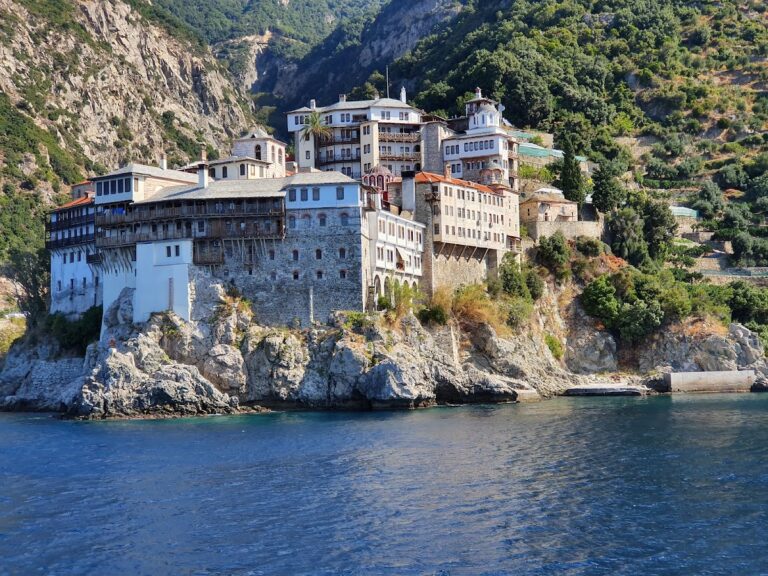
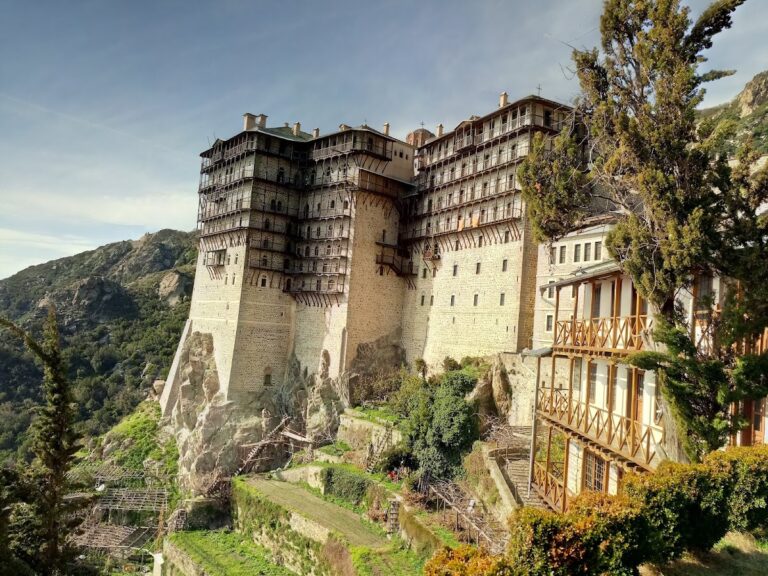
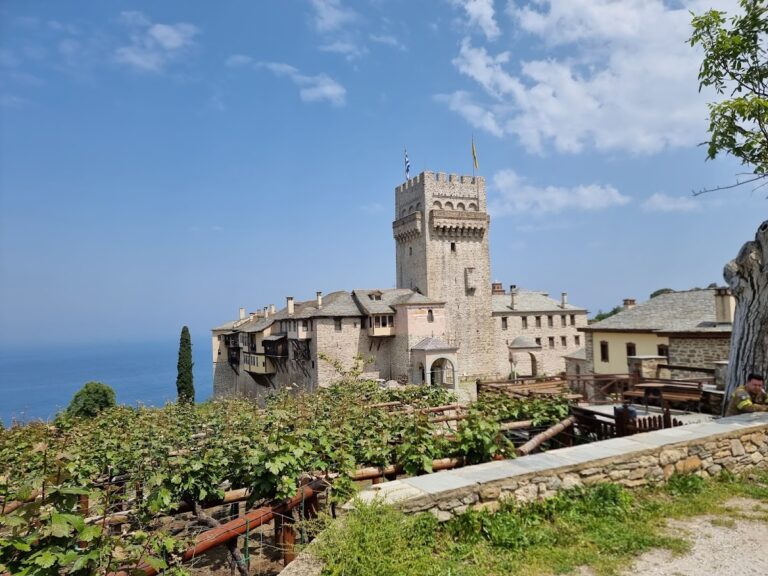
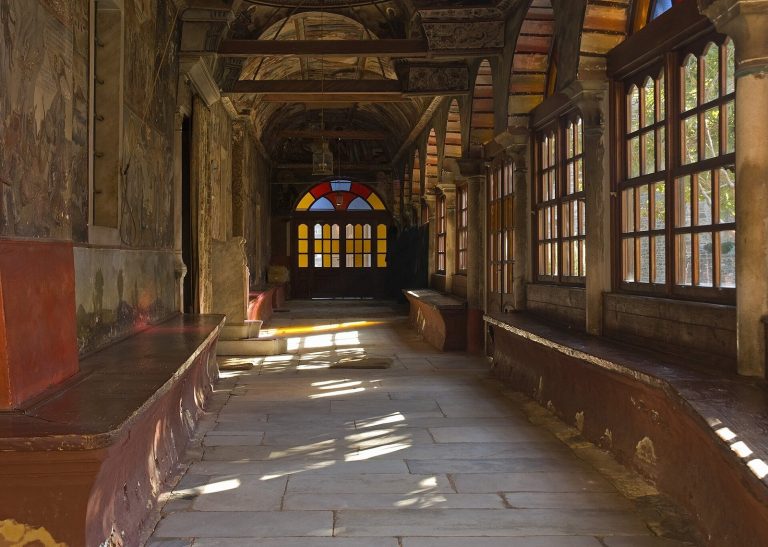
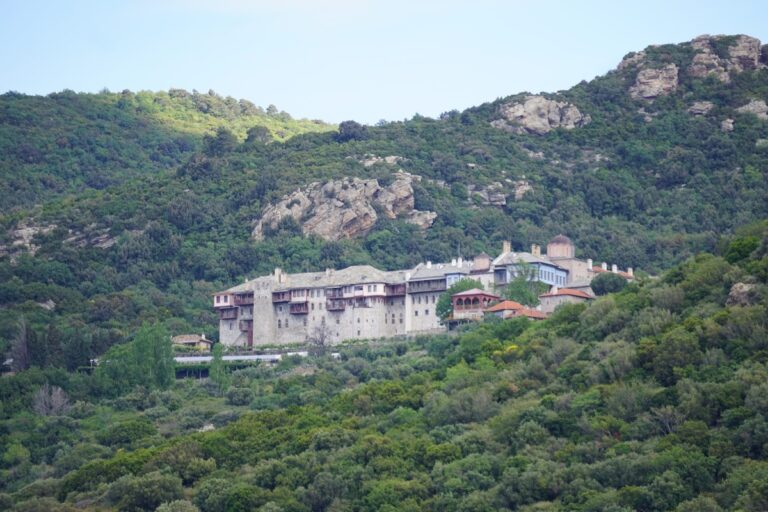
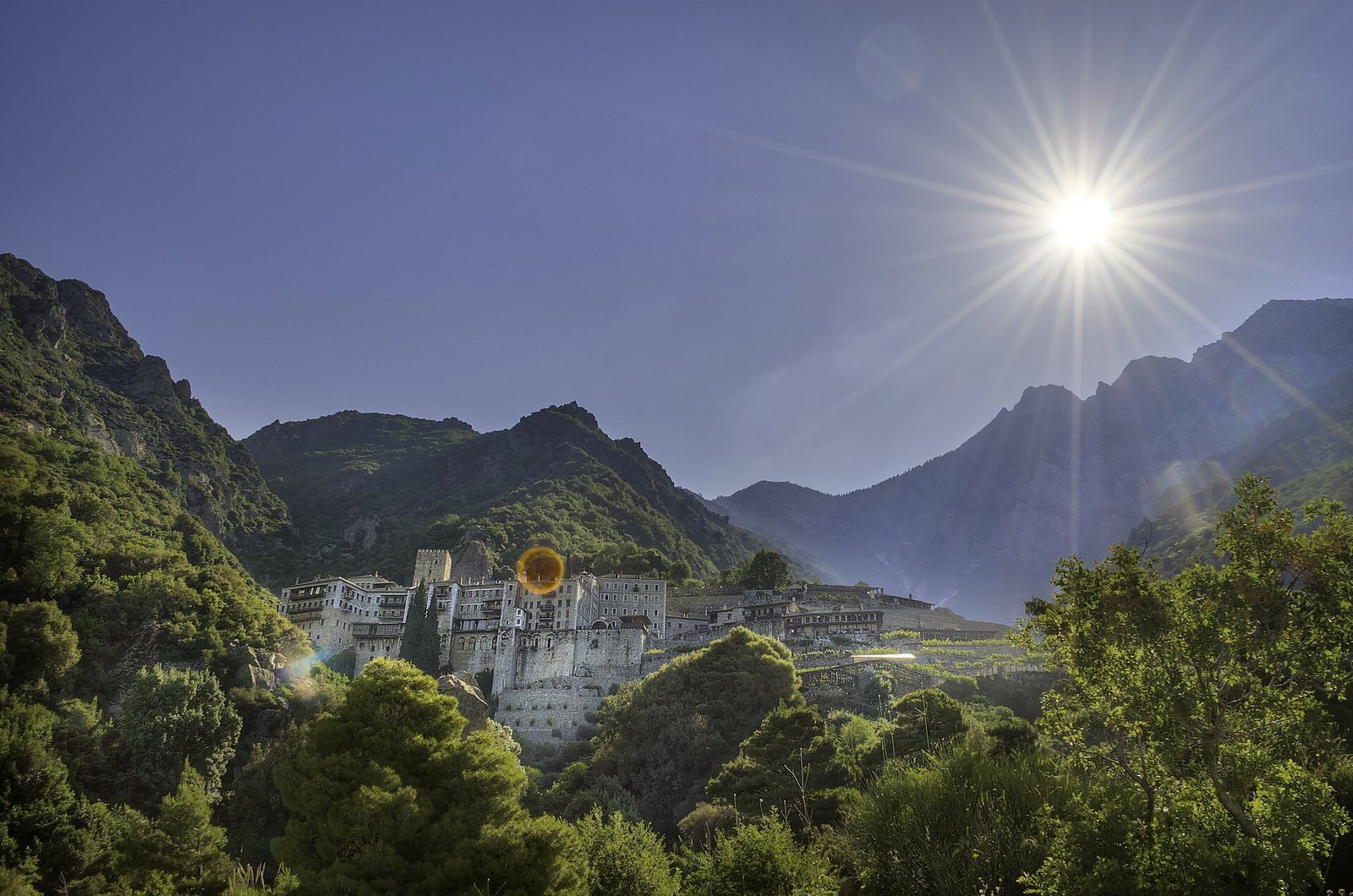
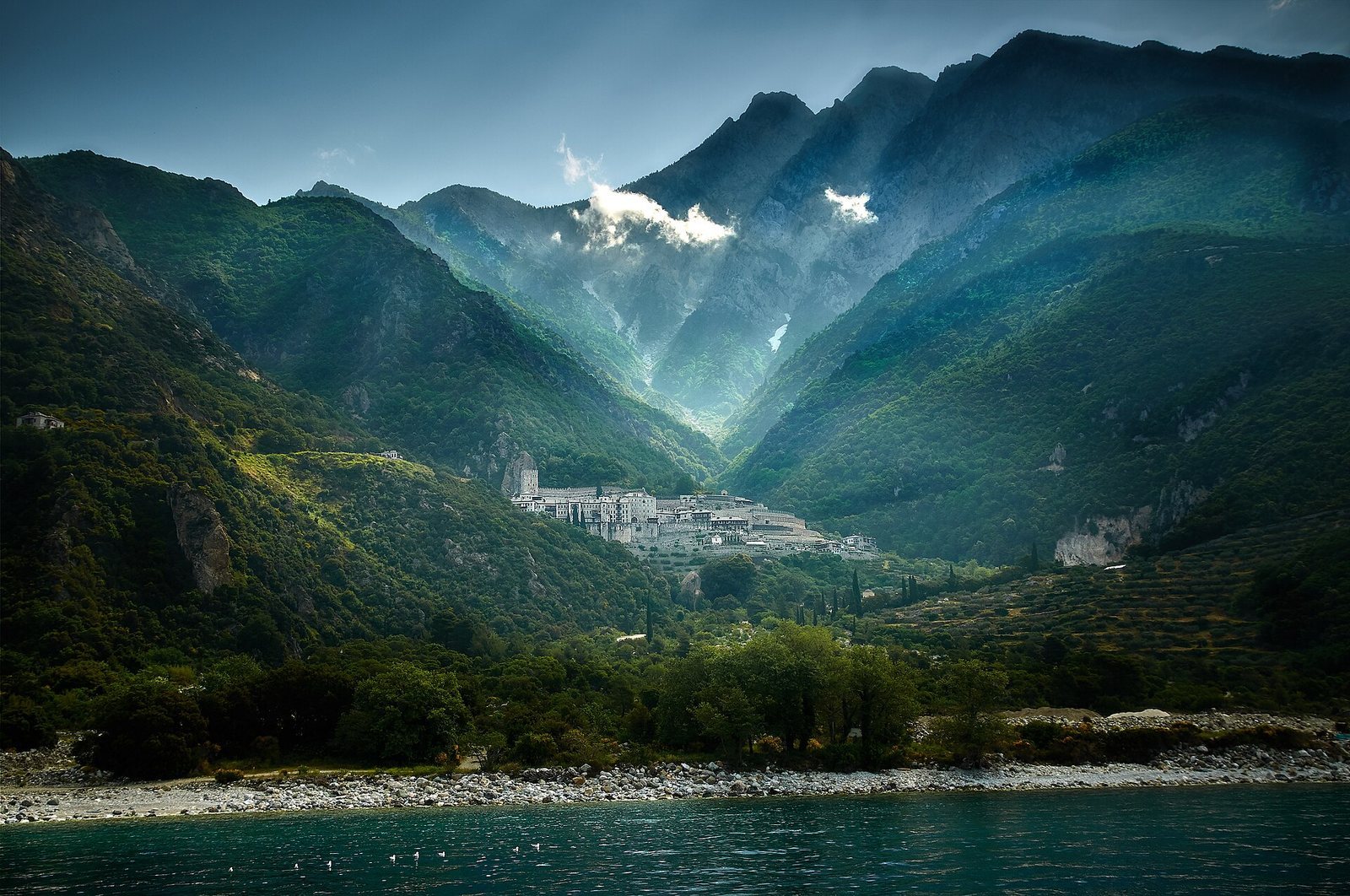
The monastery stands on the western slope of Mount Athos, about 1.5 kilometres from the coast and roughly 150 metres above sea level. It occupies the southernmost position among the monasteries on the peninsula’s western coast, a little north of its southwestern tip. Its quadrangular compound is enclosed by high stone defensive walls. The north wing dates to the fifteenth century, and the defensive tower to the sixteenth.
The monastic compound
Main church
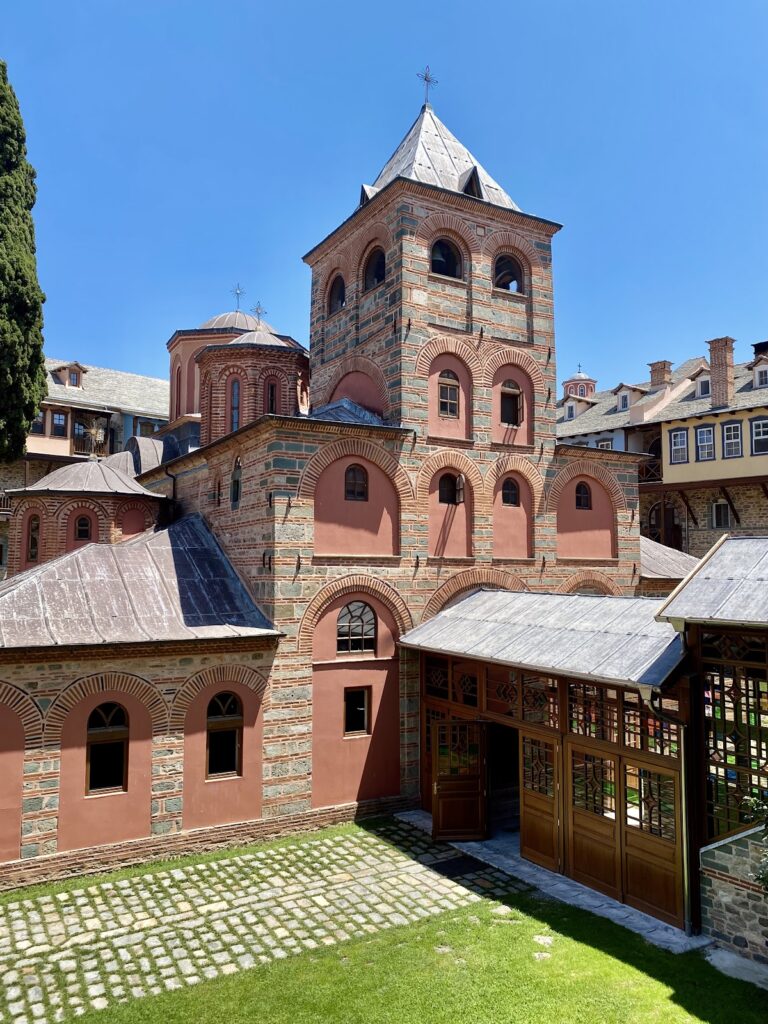
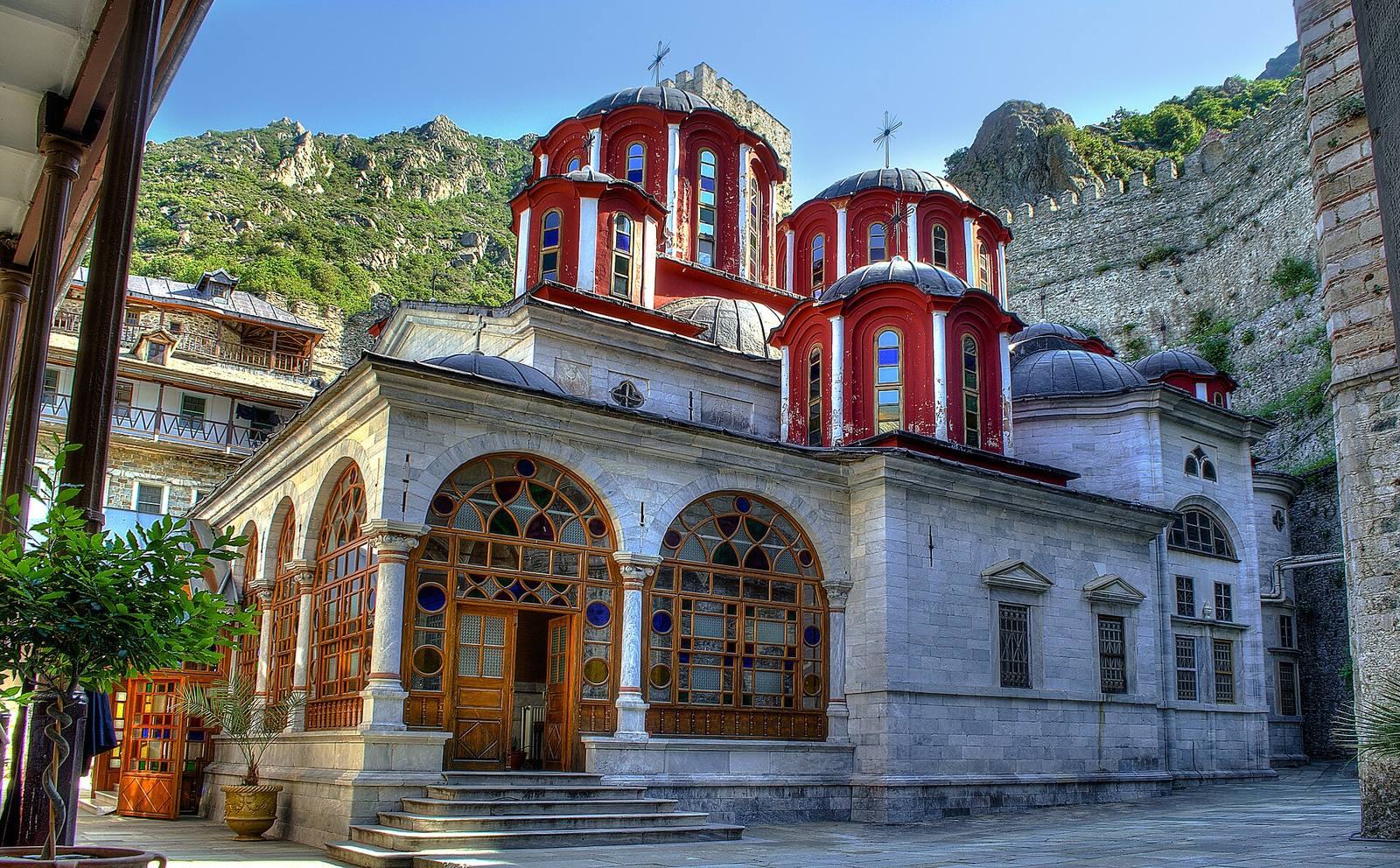
The main church has eleven domes and marble lining throughout. Its carved wooden screen of icons belongs to the wood-carving tradition associated with Mount Athos. Side chapels are dedicated to Saint Paul and Saint Gerasimos of Cephalonia on the right, and to Saint George on the left.
Saint George Chapel
On the north side of the complex, the fifteenth-century Chapel of Saint George is among its oldest surviving buildings. Its frescoes follow the Cretan School, a post-Byzantine tradition of icon painting. Their subjects include the embrace of the apostles Peter and Paul and scenes from major Christian feasts. An inscription names the painter Antonios and gives the date 1554. In the mid-nineteenth century, the forger Simonides altered the inscription to make it read 1431.
Chapels and collections
Other chapels
Nine chapels stand within the compound and seven outside it. The internal chapels include one in the monastery tower dedicated to the Five Martyrs, as well as chapels dedicated to Saints Anthimos of Nicomedia, Gerasimos, Nicholas, Gregory the Theologian, and Constantine and Helen. Outside the enclosure are the Chapel of Saint Tryphon in the gardens, the Chapel of Saint Demetrius at the harbor, and the Chapel of the Transfiguration at the mountain forestry office.
Memorial and sacred objects
A small chapel-like monument marks the place associated with the handover of Mara Brankovic’s gift. The monastery preserves two revered icons of Mary, known as the Myrrh-streaming icon and the Mirror. Its relics include portions of the gifts attributed to the Magi, a fragment of the True Cross, relics of Gregory the Theologian, Maximus the Confessor, Kalinik, and Basil the Great, and a head relic associated with a saint of Alexandria. The gifts of the Magi are kept in silver containers in the main church.
Library
The library holds 494 manuscripts and about 12,000 printed books. Some manuscript books date to the ninth and tenth centuries.
Dependent monastic settlements
Sketes
The monastery has two dependent sketes, smaller monastic settlements associated with a larger house. The Skete of the Entry of Mary, also called New Skete, has a Greek community. The Skete of Saint Demetrius, known as Ravine Skete, has a Romanian community.
Cells, small establishments, and hermitages
At Karyes, the monastery’s dependencies include the Cell of Saint Andrew, now used as its representative office, the Cell of Saint Theodore about 100 metres northwest of the office, and a cell dedicated to the Presentation. Northwest of the monastery is the Kathisma of Mary, a small monastic establishment about a twenty-minute walk away. The Kathisma of Saint John the Forerunner lies nearer in the same direction and is in ruins. Six hermitages, secluded places for solitary or small-community religious life, lie between the monastery and New Skete. They are named the Holy Trinity, Daniel, Damaskinos, Joseph, Zarkadi, and Chairi.