Fortress of Arquata del Tronto: A Medieval Stronghold in Italy
Site at a Glance
- Rating
- 5
- Popularity
- Very Low
- Country
- Italy
- Primary era
- Medieval
- Eras represented
- Medieval, Early Modern, Modern
- Civilizations
- French, Italian, Papal States
- Site type
- Military
- Remains
- Fort
On this page19 sections
History
Origins and a fortified frontier
The Fortress of Arquata del Tronto in Italy is a medieval stronghold whose hilltop defenses began in the eleventh or twelfth century. Built to control the surrounding territory, it later became a key position in struggles between Ascoli and Norcia for influence over the upper Tronto Valley. An earlier defensive installation may have occupied the same hill, possibly in Roman times, but this has not been confirmed.
Between 1099 and 1119, Berardo III, abbot of Farfa, acquired Arquata and other settlements for the abbey. An imperial diploma subsequently confirmed Farfa’s possession of the fortress and its territory. In the early thirteenth century, a settlement grew around the stronghold and declared itself a free commune. After the death of Emperor Frederick II, Ascoli reinforced its frontier in response to the ambitions of Manfred of Sicily, Frederick’s son and a ruler of southern Italy, and to the danger of incursions from Norcia. Arquata, Amatrice, and Castel Trione contributed to thirteenth-century works that included enclosure walls and a stronghold guarding the mountainous valley.
Arquata’s allegiance shifted as neighboring powers competed for control. In 1251, it joined a confederation with Norcia and promised an annual ceremonial banner for the Feast of the Assumption. Norcia transferred Arquata and nearby possessions to Ascoli in 1255; that year Pope Alexander IV also ordered funds for strengthening Ascoli’s territorial castles, including Arquata. In 1263, the town was required to provide six crossbowmen, six workers who could carry out siege operations, and eight soldiers. Arquata renewed its allegiance to Ascoli in 1293, offering a banner and participating in the city’s Quintana, a tournament-style event.
Repeated conflict in the fourteenth century
Arquata renewed its allegiance to Ascoli in 1317, but the relationship broke down after Ascoli rejected Church authority and declared itself an independent republic in 1334. Arquata tried to escape its control. Ascoli besieged and retook the stronghold in 1337, restoring the alliance, and Arquata surrendered again in 1348 after Ascoli declared war. In 1350, the military leader Galeotto I Malatesta attacked to suppress a revolt but was defeated.
During Cardinal Egidio Albornoz’s restoration of papal authority in central Italy, Arquata became one of the fortified places of the Papal States, the territories governed by the pope. It served as an advanced post on the southwestern frontier, and the papal Apostolic Chamber paid for the garrison’s administration. In 1357, Arquata was classified among the region’s larger and intermediate towns. Its obligations to Ascoli continued alongside these papal ties: in 1377 it owed the city a ceremonial banner for the feast of Saint Emidius.
Control remained unsettled. In December 1378, the Duke of Acquaviva defeated Norcian forces occupying Arquata. The papacy then declared that it would not grant the town to anyone and exempted it from all but an ancient tribute. Ascoli retook it from Norcia in 1384. Arquata allied with Fermo in 1386, accepting a chief magistrate appointed by that city and promising another banner for the Assumption. The mercenary commander Boldrino da Panicale was repelled in 1387, captured the fortress in a second assault in 1390, and was later expelled by the inhabitants. Arquata and Norcia made peace on 5 December 1390, but troops led by Matteo d’Acquaviva captured the town and fortress in 1395.
From 1397, Ascoli and Norcia fought repeatedly over Arquata. Norcia used the fortress as a stronghold, including for political exiles from Ascoli, before Ascoli besieged and recovered it. In 1389, while serving as Ascoli’s chief magistrate, Sinibaldo Cancellieri da Pistoia had commissioned strengthening work at the fortress.
Shifting rule in the fifteenth century
Norcia sought to recover Arquata and Cerreto in 1418. A bishop and papal governor, Astorgio Agnesi, negotiated peace between Arquata and Norcia in 1426. On 19 July 1429, Pope Martin V granted Norcia Arquata, its fortress, and its territory in return for 7,000 florins, a gold coin used in medieval and early modern Italy. The inhabitants swore obedience to Norcia on 20 November. Norcian jurisdiction generally continued until 1816, though control changed during intervening conflicts.
In the 1430s and 1440s, agreements involving the military commander Francesco Sforza repeatedly altered who controlled the town and who received its payments. Sforza’s 1438 agreement with Norcia placed Arquata in his charge as security; Norcian officials arrived and a new chief magistrate was appointed that October. Norcia paid Arquata’s levies to the commander Nicolò Piccinino in 1441. Arquata returned to Norcian rule in 1447, when Sforza’s occupation of the March of Ancona ended. In 1454, Pope Nicholas V directed that Norcia’s payments for itself and Arquata go to the Roman Curia rather than the duchy’s treasury.
In 1466, Ascoli, supported by Accumoli and Amatrice, captured the town but not its fortress. After negotiations failed to secure Norcia’s surrender, Pope Paul II sent the military leader Braccio Baglioni against Arquata. Norcia yielded on 31 January 1467, and the fortress and town passed to the pope’s captain, Chierichino Chiericato. The pope exempted Arquata from levies in July, and the neighboring communities made peace in August. The Papal States promoted further fortification in 1468; the following year, Norcia paid two Lombard builders, Francia and Beltramo, for work at the fortress.
Possession shifted again in the later fifteenth century. The papacy rejected Norcia’s claims in 1472 and 1474, but a Norcian delegation regained control in 1477. In 1479, the papacy sent 400 Ascoli infantry to end Norcian occupation. Norcia regained the defensive post in 1491, and an inventory was prepared at the fortress on 4 April 1492 for its transfer to new Norcian officers.
Early modern administration and repairs
Arquata received permission to collect tolls on traffic through its territory in 1514. Work on the fortress’s upper section was assigned to builder Vincenzo Marinucci in 1525. Arquata returned to Norcian possession in 1527 in exchange for an annual payment of 280 florins. Norcia arranged further maintenance in 1544, and the town authorized the first recorded restoration in 1564. From 1554, papal appointments of local chief magistrates and fortress officers reduced Arquata’s autonomy.
The fortress belonged to a wider warning and customs network of watchtowers and tower-houses. The network remained active at least to the end of the sixteenth century. Signals included reflected light, smoke by day, fire at night, bells, and, after 1300, gunshots; pigeons carried written messages. Some outposts also watched roads and collected tolls. The watchtower and customs station at Santa Gemma were still performing those roles in September 1809. Norcia’s influence over Arquata’s postal services was noted in 1616.
An ex-voto painting, an image offered in thanks or fulfillment of a vow, at the Sanctuary of the Icona Passatora near Amatrice provides the oldest known depiction of the fortress. It portrays a prisoner appealing to the Virgin Mary and Saint Leonard, who was traditionally associated with prisoners. An inscription commemorates his release in June 1485.
French rule, Italian annexation, and conservation
The earthquake of 1703 damaged the fortress and led to repairs. During French rule, it was partly renovated, equipped with protected artillery chambers and gun positions, and occupied by a permanent garrison. Arquata became the center of an administrative district, and its fortress was ranked third in the Department of Trasimeno after those at Spoleto and Perugia. Following the restoration of papal government, Arquata became part of the Delegation of Ascoli in 1816. Repairs included maintenance on the fortress’s southern side in 1826.
Arquata and its fortress were annexed to the Kingdom of Italy in 1860. The stronghold then fell into neglect and was also used as a source of building stone. Inspections in 1882 noted damage to the facing of the outer walls, other demolished sections, and two large breaches in a tower. The state sold the fortress to the municipality on 16 January 1890 because of its poor condition; a decree confirmed the transfer on 2 May. Late-nineteenth-century restoration repaired the tallest tower, the hexagonal tower, and the wall between them. The fortress became an Italian National Monument in 1902.
A restoration campaign planned by architect Giuseppe Sacconi continued after his death in 1905 under Dante Viviani. Work paused during the First World War and resumed in 1922–1923 under Luigi Serra, including construction of a square room atop the principal tower. Further conservation took place in 1966, and a campaign in the 1990s repaired walls and towers and created a multipurpose room within the enclosure. The 2016 earthquake left the fortress requiring structural consolidation.
Local tradition associates the fortress with Queen Joanna of Anjou, said to have lived there between 1420 and 1435. Some writers have suggested that she rebuilt it as a defense for the frontier of the Kingdom of Naples, but no archival evidence supports these claims, and the legend does not establish which Queen Joanna it means. It may refer to Joanna II. In the tale, the queen summoned young shepherds to her room in the tallest tower and had those who displeased her hanged from the towers; her ghost is also said to haunt the fortress.
Remains
The fortress and its principal structures
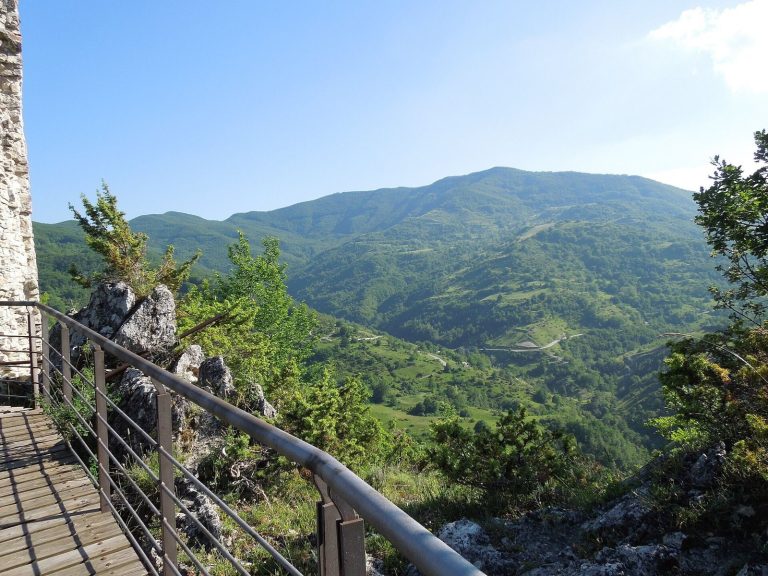
The compact stronghold stands at 777 metres above sea level on a rocky rise north of Arquata’s built-up area, between the Tronto River and the Camartina stream and south of Monte Vettore. It overlooks the town and upper Tronto Valley, near the meeting area of the Marche, Umbria, Lazio, and Abruzzo. Its position commands the Salaria, an ancient Roman road linking Rome with the Adriatic region, as well as routes toward L’Aquila, Umbria, inland Marche, the Galluccio and San Pellegrino passes, Norcia, and the Tronto riverbed. The complex is surrounded by a green park crossed by paths.
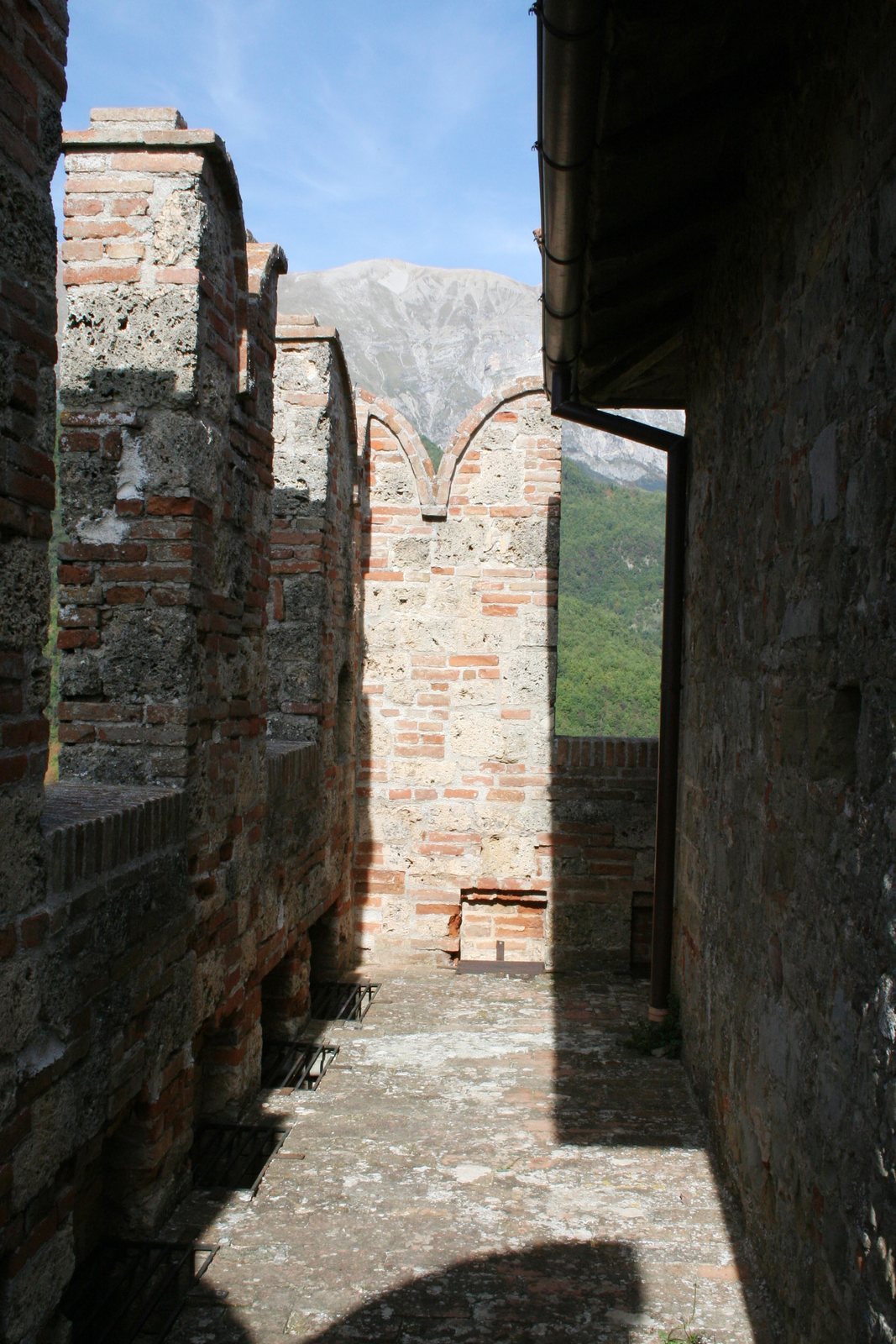
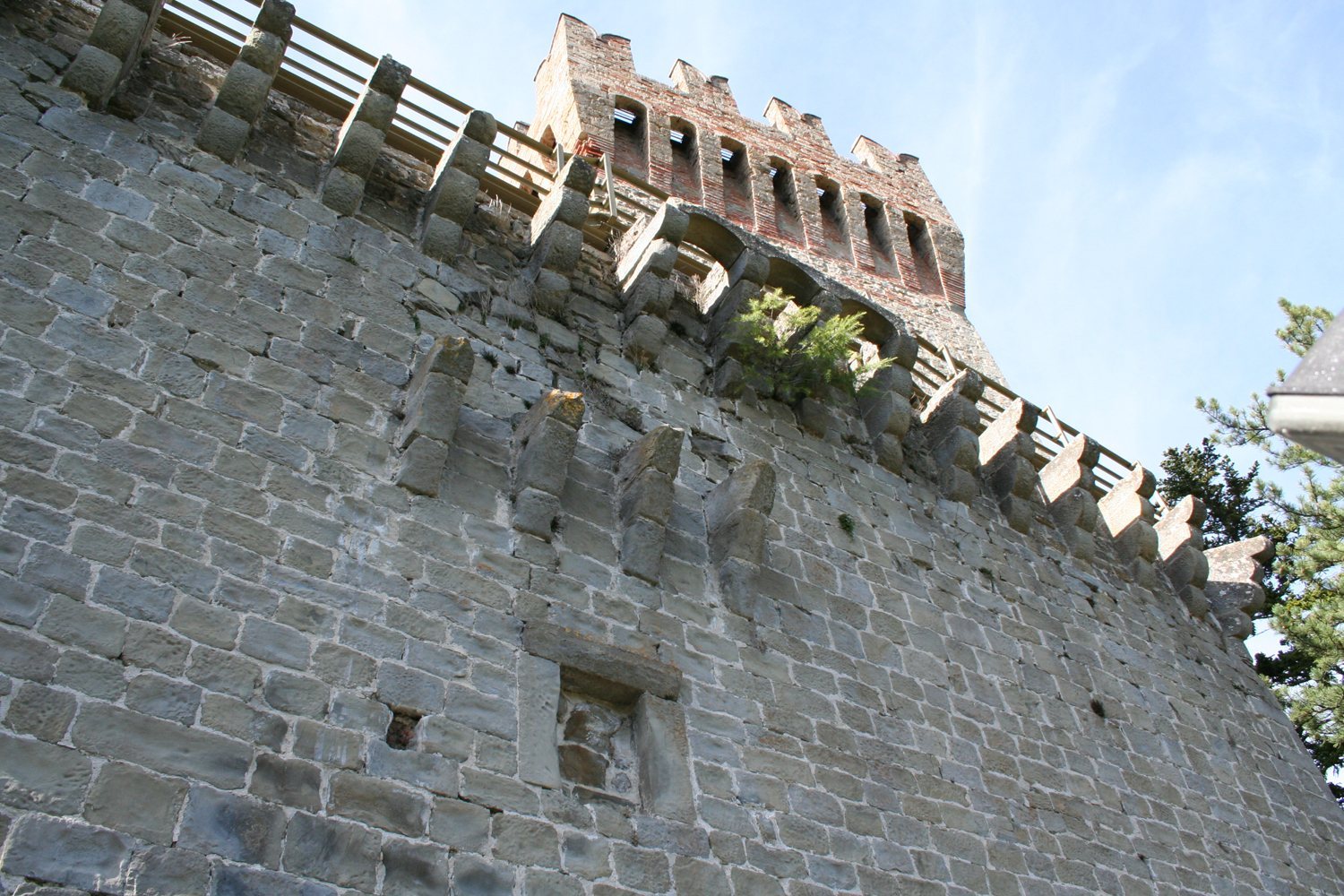
The fortress is a thirteenth-century example of military architecture in the Umbrian-Marche Apennines, although its fabric reflects successive phases of construction and alteration. Its main components are a keep (the principal fortified tower), a hexagonal tower, the remains of a circular tower, and a partly preserved defensive perimeter wall. The buildings use sandstone from the Sibillini Mountains. At the tower tops, projecting defenses made of brick and travertine are finished with raised battlement blocks that have forked, swallowtail tops.
Keep
The north-facing keep rises 24 metres from a base about eight metres square. Its construction date is uncertain, with proposed dates ranging from the thirteenth to the fourteenth or fifteenth century. A double line of walls connects it to the hexagonal tower. The keep served for observation and command: its main bell, or a cannon shot after artillery was introduced, signaled a general alarm. It has six levels, including a fighting platform, and was originally topped by battlements with square-ended raised sections. An inventory describes a small summit shelter with a bed and bench for a sentry. A square room added during early twentieth-century restoration now occupies the summit, where a masonry screen once sheltered the alarm bell.
A metal staircase leads to the battlement walk. The tower also contains a summit gallery and internal stairs, with openings at ground level, at the level of the enclosure wall-walk, and at the upper platform. Cross-shaped narrow openings accommodated firearms and bow-fired weapons. Machicolations, projecting openings for dropping objects on attackers, extend from the tower.
Hexagonal tower and enclosure wall
The southeastern hexagonal tower is 12 metres high and contains an irregular pentagonal chamber, now sheltered by a roof added during later restoration. Openings at the base of its inner walls mark old escape passages, which are blocked. The tower has projecting defensive openings, fork-topped battlements, and a small secondary entrance. It joins a partly surviving wall that ran about 70 metres north to close the exposed side of the hill; a route connected the tower to the town on the eastern side.
The perimeter wall followed the exposed sides of the hill. In 1578, the steep bank facing the Tronto was described as natural protection, while the other stretches were considered old and in need of repair. Five gated openings corresponded to access routes. Each entrance had a flanking guard tower, intended to hold at least two guards during the day and night.
Southwestern tower
A third tower stood on the southwestern side. Built in the sixteenth century to protect the village and withstand artillery strikes, it was a truncated cone about 10 metres across and no more than 12 metres high, with two sloping sections at its base. Earth filled its interior, and an artillery platform occupied the top. The ex-voto painting shows horizontal weapon openings and a gun embrasure in its roof. Its foundation outline was exposed during modern restoration.
Interior spaces and equipment
Inventories describe a drawbridge raised by a chain winch, an open-sided gallery, an armory, a kitchen, a cistern, a granary, a storeroom, and several chambers. A 1467 inventory also lists a room used for tools, household goods, weapons, gunpowder, food, and restraints for prisoners. A chamber in the inner courtyard stored snow for later use.
Recorded weapons include several types of bombards, early gunpowder cannon, and smaller guns. Other supplies included thousands of wooden shafts and crossbow-bolt heads, painted shields bearing Pope Pius IV’s arms, a banner of Pope Paul II, armor, helmets, grain chests, wine casks, and stone cannonballs. A heavy iron chain operated the drawbridge. Norcia’s rules required departing fortress officers to leave 500 beechwood crossbow bolts without iron points and 12 dressed stone cannonballs.
Inscribed stones
A stone block dated 1356 is set into the principal facade. A separate travertine slab was found during excavation of the central courtyard in 1992. It measures 54.5 by 52.5 centimetres and bears an emblem associated with Sinibaldo Cancellieri. Its shield is divided horizontally, and the inscription below is in large Gothic capitals. The lettering’s alignment is uncertain; the slab’s trimmed edge may indicate that the text once continued with a reference to the office of chief magistrate of Ascoli. Such emblems were placed on fortress walls in the fourteenth century to identify officers governing on behalf of the papacy or a dominant city.
Outlying towers and fortified sites
Towers at Arquata
A square civic tower within Arquata’s town walls stood closest to the fortress. Its date is unknown, although its form has been taken to suggest a relationship in date to the keep. Another tower near the cemetery watched a branch of the Salaria leading toward Piedilama, Pretare, and the Galluccio and Forca di Presta passes.
Borgo watchtowers
Borgo had two watchtowers. A quadrangular tower downstream from the settlement had a direct view of the fortress and controlled the Salaria beside the Tronto. Seismic events severely damaged it. Faint red Renaissance paintings survive on its north-facing, white-plastered facade, including a bird, lion, vase with a grape cluster, jug, and human figure. A separate tower-house beside the present bridge has been altered from its original form; faint Renaissance painting and a dovecote remain inside.
Trisungo customs tower
The tower at Trisungo retains reinforcing features and narrow openings for watching the Salaria and the road toward Faete and Spelonga. It served the network’s road-monitoring role.
Santa Gemma tower and buildings
Above Pretare, the Santa Gemma area contains medieval military remains probably dating to the fifteenth century. A square tower, about four metres on each side, has walls more than a metre thick. It was built from large squared local stones laid in lean mortar and contained several levels for a garrison and stores. Adjacent buildings enclosed rooms for lodging and reception, as well as an inn where pilgrims, merchants, and other travelers could stay and change horses. The tower also housed a customs station. Since it could not communicate directly with the fortress by line of sight, messages passed through intermediate towers.
Valle Romana and Il Castelluccio
Another watchtower stood in Valle Romana between Arquata and Vezzano. At Il Castelluccio, between Colle and Spelonga, the remains of a small towered settlement overlook the Salaria and the former border with the Kingdom of Naples. The settlement may have included several dwellings and may predate the fifteenth century, perhaps belonging to the period when the fortress was first raised.