Church of San Salvatore, Campi: A Medieval Romanesque Parish Church
Site at a Glance
- Rating
- 4.8
- Popularity
- Very Low
- Country
- Italy
- Primary era
- Medieval
- Eras represented
- Medieval, Early Modern
- Civilizations
- Papal States
- Site type
- Religious
- Remains
- Church
On this page18 sections
History
The Church of San Salvatore was a Roman Catholic church in Campi, a hamlet of Norcia, Italy, built and developed during the medieval period in the Romanesque tradition. Formerly known as the Pieve of Santa Maria, it stood beside the medieval Via Nursina, the route connecting Spoleto and Norcia and continuing toward Visso and the Adriatic coast. Its long history began with the adaptation of an earlier Roman pagan temple for Christian worship. The church was dedicated to Saint Mary until the fifteenth century and then to the Holy Saviour, preserving evidence of approximately a millennium of religious and local history.
From Roman sanctuary to Benedictine church
The Christian building occupied a clearing along the ancient route and replaced a Roman religious structure. By 1115, the church belonged to the Benedictine Abbey of Sant’Eutizio at Preci. Benedictines, monks of the Order of Saint Benedict, administered it until 1493. As a pieve, or rural parish church with authority over dependent churches and their communities, San Salvatore exercised jurisdiction over Santa Lucia, San Leonardo, and Sant’Andrea of Campi.
The monks supported extensive decoration through offerings and tithes from the faithful. An earthquake in 1328 brought a major rebuilding campaign. The nave was lengthened beneath a gabled roof, a raised presbytery was added, and the façade received a new pointed-arch portal. Its carved cross-bearing lamb referred to the Benedictine order.
Fifteenth-century enlargement and transfer
Population growth led to another major change late in the fifteenth century, when a second nave was constructed on the right side. During this phase the church was rededicated to the Holy Saviour. The date 1491, carved on the right portal, probably marked the completion of the enlargement. In 1493 the Benedictines transferred the church to the community of Campi. It then came under the parish of Sant’Andrea del Castello and served as a church outside the castle.
The new and renewed spaces received an ambitious cycle of religious art. An iconostasis, a decorated screen separating the main body of a church from its sanctuary, was built in 1463 and painted the following year by Giovanni and Antonio Sparapane. Other works were contributed by Nicola da Siena and Domenico di Jacopo da Leonessa, with further painting completed in 1466 and 1493.
Earthquakes, repairs, and early investigations
Later earthquakes repeatedly damaged the church, leading to repairs and partial rebuilding. During a visitation in 1712, Carlo Giacinto Lascaris, Bishop of Spoleto, recorded the church’s ancient origins and the disputes that had developed between the Benedictines and the community of Campi. In 1908, the scholar and art historian Giuseppe Sordini inspected the building and recorded its paintings and other works of art.
Restoration in 1969 brought Roman remains to light, including architectural fragments, sarcophagi, small pediments, and inscriptions. The church’s movable heritage was also gradually moved to safer locations. An immersion baptismal font, possibly fashioned from a Roman altar, was transferred to the parish house in the early 1970s because of theft risks. The large polyptych from the left altar was moved first to the parish house and later to the Diocesan Museum of Spoleto. A wooden sculpture of Saint Andrew followed a similar path and remains in that museum.
Collapse in 2016
The earthquake of 24 August 2016 caused the church to be declared unsafe. It partially collapsed on 26 October and completely collapsed on 30 October during the Central Italy earthquake sequence. Planned safety measures had not been completed before the collapse. The event destroyed or reduced to fragments most of the church’s pictorial decoration, including the iconostasis and many frescoes.
Afterward, part of the right perimeter wall was secured and the ruins were covered to protect ancient fresco fragments from the weather. In early November 2016, workers recovered the wooden crucifix and one fresco and placed them in a depot in Spoleto. Further efforts sought to recover fresco fragments and surviving parts of the iconostasis. The remaining wall, the base of the bell tower, fragments within the rubble, and artworks removed before the collapse preserve portions of the church’s long history.
Remains
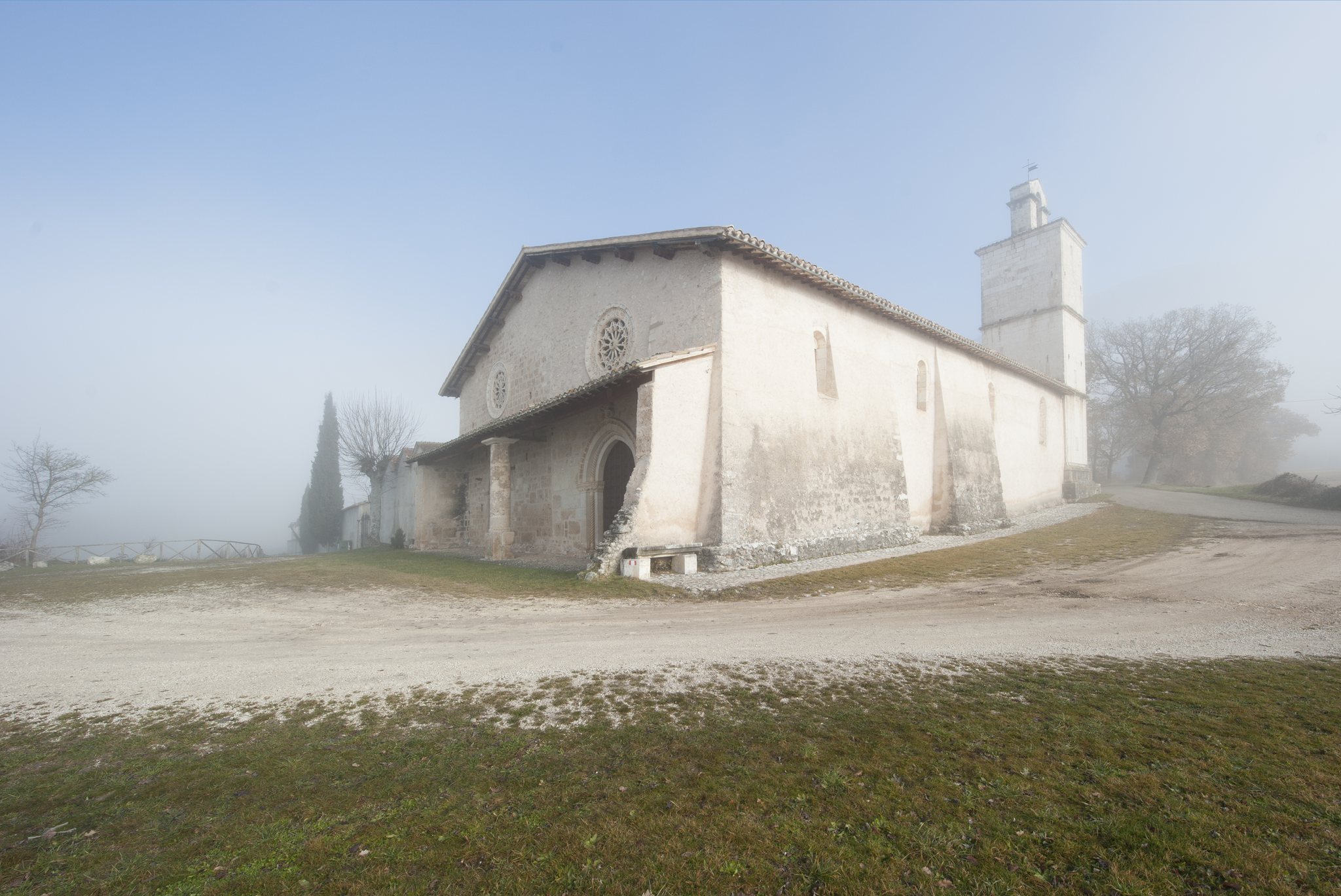
The church was a Romanesque stone building formed by two parallel naves beneath a single roof with two long slopes. The naves shared a symmetrical façade, while five substantial square pillars divided the interior. These pillars were formed from the earlier right perimeter wall, linking the later two-nave arrangement with the building’s preceding structure.
Façade and exterior
Portals and rose windows
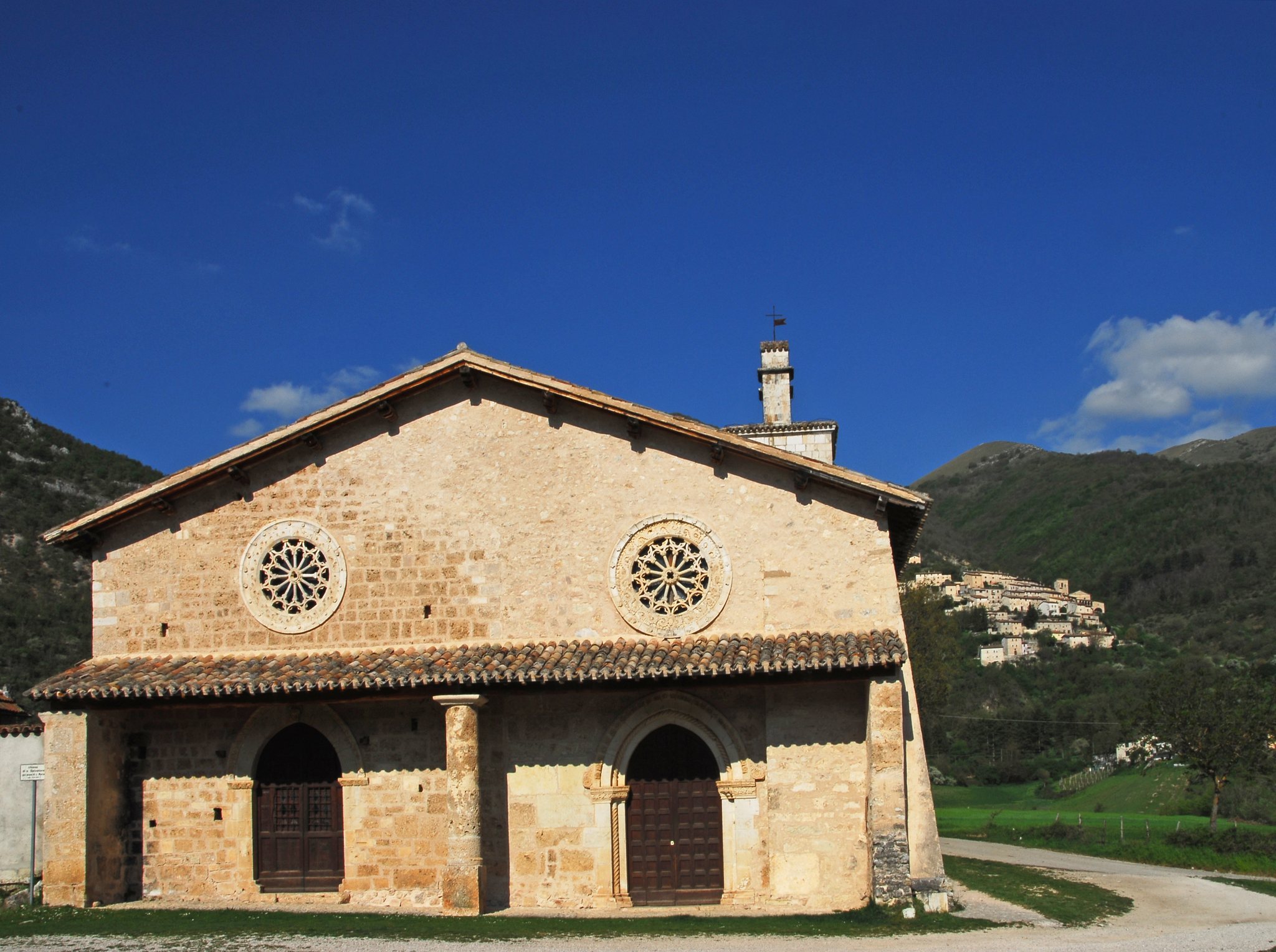
The façade was built from squared stone and contained two rose windows with pierced tracery. Two richly carved pointed-arch portals were connected by a narrow medieval porch carried on one short central column. The left portal included the cross-bearing lamb associated with the Order of Saint Benedict. The more elaborate right portal had two recessed orders and a spiral small column, or colonette. Its inscription reads “1491,” and its paired rose window was also more richly worked than the one on the left.
Right wall and cemetery
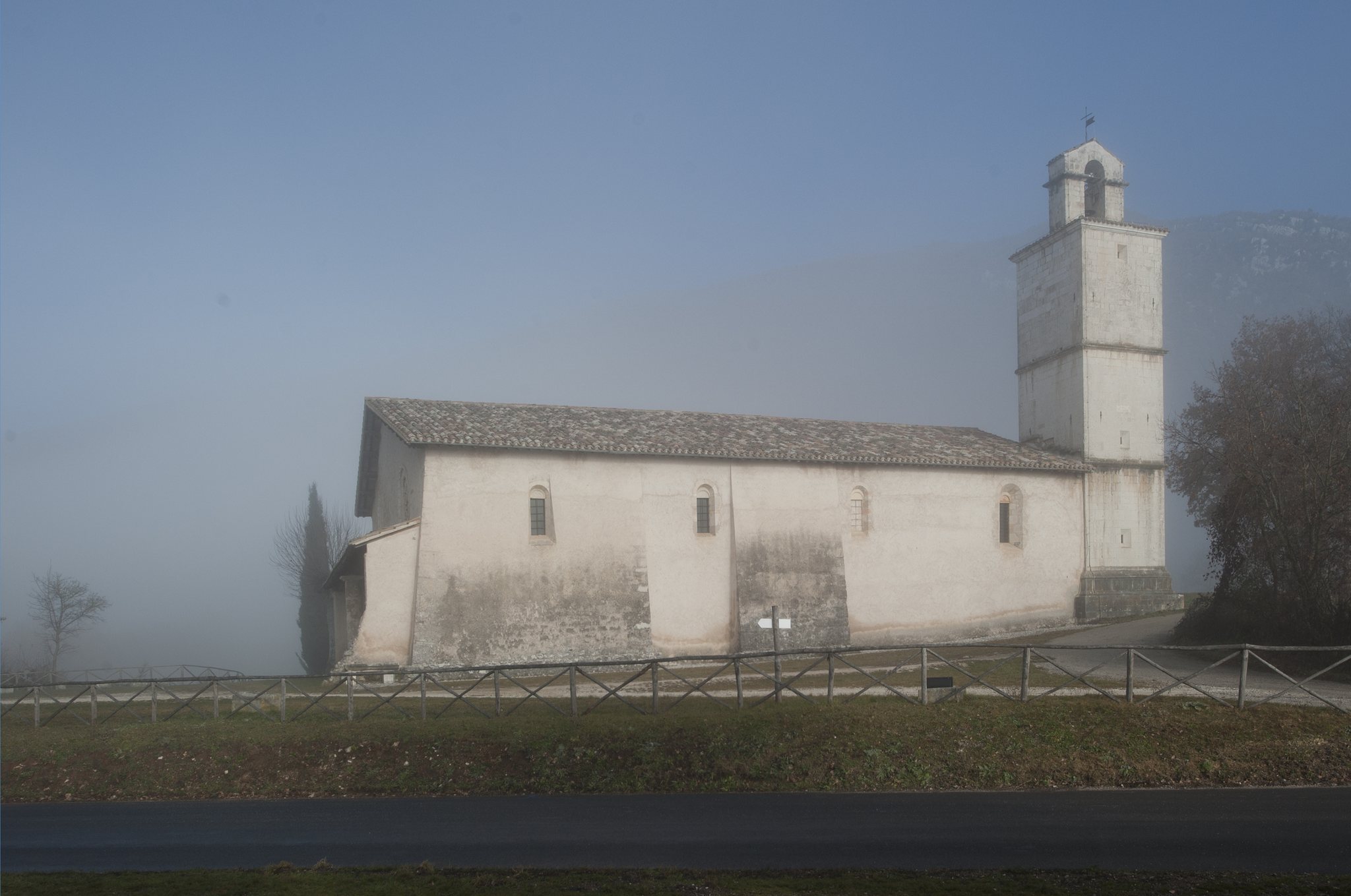
The right exterior wall contained four splayed single-light windows and followed a battered, or slightly sloping, profile toward the bell tower. The adjoining cemetery suffered severe damage in the 2016 earthquakes. After the collapse, a section of this perimeter wall remained standing and was secured to protect the surviving remains.
Bell tower
The bell tower was constructed from carefully finished squared stone. Local builders began it in the fifteenth century, and Lombard masters completed it around 1538. Three levels rose above a moulded base, with five small splayed windows. Its spire was destroyed by the earthquake of 1859. After the 2016 collapse, the base of the tower remained.
Interior structure and medieval decoration
Naves and flooring
The five pillars separated the two naves. The right half had paving dated 1528, made from rectangular local stones of varying sizes and shades in a technique known as schiazze, an arranged stone paving method. Its floor also carried an engraved plan for a proposed section of the bell tower. The left side had a tiled roof, while the right side was covered by cross vaults with ribs.
Iconostasis and crucifix
The left nave was painted as far as the altar and was crossed roughly halfway by the iconostasis erected in 1463. Its triumphal arch had three openings and rested on two twisted octagonal columns with capitals carved as acanthus leaves. The front carried eighteen blind arches with trefoil-shaped heads. A small stone stair led to an upper loft containing a large wooden crucifix regarded as miraculous.
Giovanni and Antonio Sparapane painted the screen in 1464 with the Annunciation, the Pietà, the women at the tomb, and the Resurrection. The blind arches held the Apostles and the Madonna and Child. Nicola da Siena and Domenico di Jacopo da Leonessa contributed to the lower decoration, including works dated 1466. The screen was supported by a wooden framework, but its structure was destroyed in the 2016 collapse.
Frescoes around the sanctuary
Behind the crucifix was a large fresco dated 1446. Rediscovered after the 1979 earthquake, it showed the Madonna and Saint John the Evangelist beside Christ, with angels collecting his blood in chalices and tearing their garments in mourning. A small vault to the right displayed angels bearing the instruments of the Passion and a Mass of Saint Gregory by Domenico di Jacopo da Leonessa. The latter painting was detached from the wall and stolen. On the short side, Saint Jerome, Pope Gregory, and Saint Augustine were painted in 1493 after the second nave was added.
The rear wall of the left presbytery carried a late-fourteenth-century Crucifixion in a Giottesque manner, influenced by the naturalistic and spatially expressive style associated with Giotto. An Umbrian painter of the Spoletan school included donors, trumpeters, grieving women, soldiers, the mounted Longinus, and Mary Magdalene embracing the cross. The scene also contrasted the souls of the two lateral crucified figures. Saints Benedict and Scholastica appeared at the sides, while the arch frame contained the four Evangelists and four major Prophets with inscriptions describing episodes from the Passion.
Other painted works
Giovanni Sparapane painted a Last Supper in an opening in the wall of the third bay, above a scene of Christ’s Descent into Limbo. The table held flatbreads, soups, and bread, and was covered by a Perugian tablecloth. A standing servant wore medieval dress. A large niche contained sixteenth-century frescoes by an anonymous Umbrian painter, including the Madonna and Child in glory between Saint John the Evangelist, Saint Peter, and angels carrying a crown, together with an Adoration of the Child, an Annunciation, and the Coronation of the Virgin.
An early-fifteenth-century Madonna and Child enthroned was painted on the building’s fourteenth-century perimeter wall and rediscovered after the 1979 earthquake. The Child held a small bird and wore a coral necklace. The painting, like a fragmentary Descent into Limbo, is attributed to Nicola d’Ulisse. Antonio Sparapane painted the four Doctors of the Church, Jerome, Ambrose, Augustine, and Gregory, on the cross vaults. A fifteenth-century Nativity fragment occupied the right apsidal wall, where a doorway to the bell tower had later been opened.
Fonts, altarpiece, and recovered works
Baptismal font
The church contained an immersion baptismal font possibly made from a Roman altar. A carved and inlaid roundel closed its opening. To protect it from theft, the font was moved to the parish house in the early 1970s.
Polyptych and sculpture
A large polyptych, or multi-panel altarpiece, once stood above the left altar. Made entirely by Antonio Sparapane, it showed the enthroned Virgin and naked Child between Saint Andrew and Saint John the Baptist, with Saint Catherine of Alexandria and Mary Magdalene. An inscription identified its painter as Antonio, son of Giovanni Sparapane of Norcia. The work was transferred to the parish house and later to the Diocesan Museum of Spoleto, where it was preserved with the wooden Saint Andrew sculpture.
The 2016 collapse left the surviving physical remains concentrated in the secured section of the right wall, the bell-tower base, and rubble containing fragments. Earlier removals also preserved the baptismal font, the polyptych, the Saint Andrew sculpture, the wooden crucifix, and other recovered works outside the ruins.