Fort Christina: Sweden’s First Colonial Fort in North America
Site at a Glance
- Country
- United States
- Primary era
- Modern
- Eras represented
- Modern
- Civilizations
- Unclassified
- Site type
- Military
- Remains
- Fort
On this page13 sections
History
Fort Christina was a Swedish colonial fort and settlement at the meeting of the Brandywine and Christina rivers in Wilmington, Delaware, United States. Construction began in 1638, establishing the first Swedish base in North America. New Sweden was Sweden’s colonial venture in the Delaware Valley, planned under King Gustavus Adolphus. The fort was named for his daughter, Queen Christina, who ruled Sweden from 1632 to 1654.
Founding of New Sweden
On March 29, 1638, the ships Kalmar Nyckel and Fågel Grip reached Delaware Bay with 25 passengers, trade goods, and expedition leader Peter Minuit, a former director of New Netherland, the Dutch colonial territory in the region. The settlers landed at The Rocks beside the Christina River. The next day, Lenape leaders came aboard the Kalmar Nyckel to negotiate a land purchase. The Lenape are an Indigenous people whose historic homelands included parts of the Delaware Valley.
With Andreas Lucasson interpreting, Minuit and three other Swedish representatives prepared two deeds for the Swedish government. The Lenape representatives marked the documents and received gold and silver items, copper pots, axes, and jewelry. The land was described as extending along the Delaware’s western bank from present-day Wilmington to Philadelphia. Minuit chose the site for its prospects for trade, particularly in beaver pelts, and for its defensive position. He declined command of the fort, and lieutenant Måns Nilsson Kling became governor. Twenty-four settlers spent the first winter there.
Expansion under Swedish governors
Plans to send more settlers in 1639 faltered when Dutch shareholders withheld funding after the first voyage cost more than expected, while few Swedish families volunteered. Recruiters turned to Finland. The Kalmar Nyckel brought fewer than 30 people on its autumn voyage, about a third of them officers. In 1640, Governor Peter Hollander Ridder strengthened the fort against possible attacks by Dutch or Indigenous forces. As more colonists arrived, homes and farms spread beyond the defenses. During the early 1640s, settlements extended along the Christina River and toward the Schuylkill River and Philadelphia, with many new communities inhabited mainly by Finns.
Johan Printz became governor in 1643 and worked to strengthen New Sweden against competing colonies. He built additional defenses, including Fort Elfsborg to the south, and established his residence, Printzhof, on Tinicum Island. Printz also redirected the fur trade. As demand from Dutch, English, and Swedish settlers depleted beaver in Lenape hunting grounds, he sought furs from the Susquehannock, whose lands still held healthy beaver populations. New Sweden paid more for furs than its competitors. Fort Christina consequently became important in controlling traffic on the Christina River, and Dutch and English merchant ships were turned back.
Dutch conquest
Interrupted Swedish immigration weakened New Sweden’s position in the Delaware Valley. In 1651, Peter Stuyvesant’s government in New Netherland built Fort Casimir at present-day New Castle, threatening the Swedish settlement. In 1654, Governor Johan Risingh led the Swedes in capturing the Dutch fort. Its 22 Dutch residents were made to swear allegiance to Sweden. Risingh arrived that year with about 250 settlers and supplies for building and trade. After Printz returned to Sweden, his son-in-law Johan Papegojan had governed New Sweden until Risingh took over.
The following year, Stuyvesant led a Dutch expedition to end Swedish control of the Delaware. A ship called Waag brought 200 soldiers to New Amsterdam; later that month, Stuyvesant sailed with 317 soldiers aboard two warships and five armed merchant vessels. Settlers from Upland, Finland, and Tinicum gathered to defend Fort Christina. After the Dutch fleet arrived, Risingh and Stuyvesant negotiated, and the fort surrendered following a ten-day siege without a firefight. The struggle involved hundreds of mercenaries and privateers, privately operated vessels authorized to attack enemy shipping. At the time, it was understood as a contest between the Dutch and Swedish West India Companies, both chartered companies engaged in colonial trade and settlement, rather than a war between the two countries.
The takeover ended official Swedish colonial rule in North America, although most colonists stayed and were allowed to retain their language and religious practices. Within a year, Swedish and Finnish settlers could choose whether to remain under Dutch rule or return to their homelands. Stuyvesant renamed the fort Fort Altena. The area remained part of New Netherland until an English fleet took control in 1664. Under English rule, the Swedish fortifications fell into disrepair and disappeared.
Later use and commemoration
American fortifications were built on the site during the Revolutionary period, and Fort Union was established there during the War of 1812. Caesar Augustus Rodney and James A. Bayard Sr. were among those involved in its defense. During the nineteenth century, factories including those of the Jackson and Sharp Company and Mingus Iron Works industrialized the peninsula. Washington Irving’s 1819 story “Rip Van Winkle” refers to Fort Christina in describing the fictional protagonist’s Dutch ancestry, including an ancestor said to have accompanied the siege.
In 1938, Delaware created a park encompassing The Rocks and the former fort site for the 300th anniversary of Swedish colonization. U.S. President Franklin D. Roosevelt attended its dedication with Crown Prince Gustav Adolf, later King Gustaf VI Adolf of Sweden, Crown Princess Louise, and Prince Bertil. The commemoration presented the site as the first permanent settlement in the Delaware Valley and as the beginning of relations between Sweden and the United States. Fort Christina became a National Historic Landmark in 1961 and was added to the National Register of Historic Places in 1966. First State National Historical Park was authorized in 2014, and Fort Christina is now part of it.
Remains
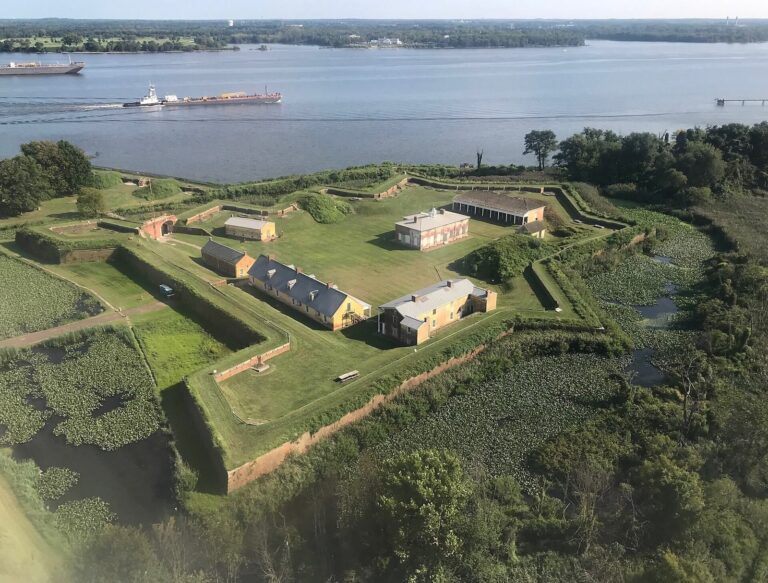
Fort Christina occupied a point at the meeting of the Brandywine and Christina rivers, about 1.6 kilometres east of present-day downtown Wilmington and roughly 3 kilometres upstream from the Christina’s mouth at the Delaware. The river formed one side of the defensive position, while earthworks and timber defenses enclosed the landward sides. The site’s physical features include the rocky outcrop at The Rocks and a later memorial to the Swedish settlement.
The Swedish fort
Defensive layout
Peter Minuit designed the fort for the New Sweden trading company. Its earthwork, a defense built chiefly from packed soil, was strengthened in 1640 and completely rebuilt in 1647. Tall upright logs, reinforced with stone and earth and set with clay, formed the outer defenses. Ditches ran along the three sides away from the river; two bordered boggy ground. In 1654, a wooden palisade, a fence or wall made from upright logs, was added around the earthworks.
Garrison buildings and gardens
Within the defenses were a room for the garrison, storage spaces, and a defensive tower with gunports for cannons brought from the ships. Six small houses were built inside the fort in 1639: five served as homes and one as a church. Two more buildings stood outside the defenses, with small cultivated plots around them, used mainly for growing tobacco.
Riverfront and later features
The Rocks
The Rocks is a rocky outcrop beside the Christina River that served as a natural wharf. It became part of the park created in 1938.
American fortifications
Later American defensive works occupied the same site. These included Fort Union, established during the War of 1812.
Commemorative monument
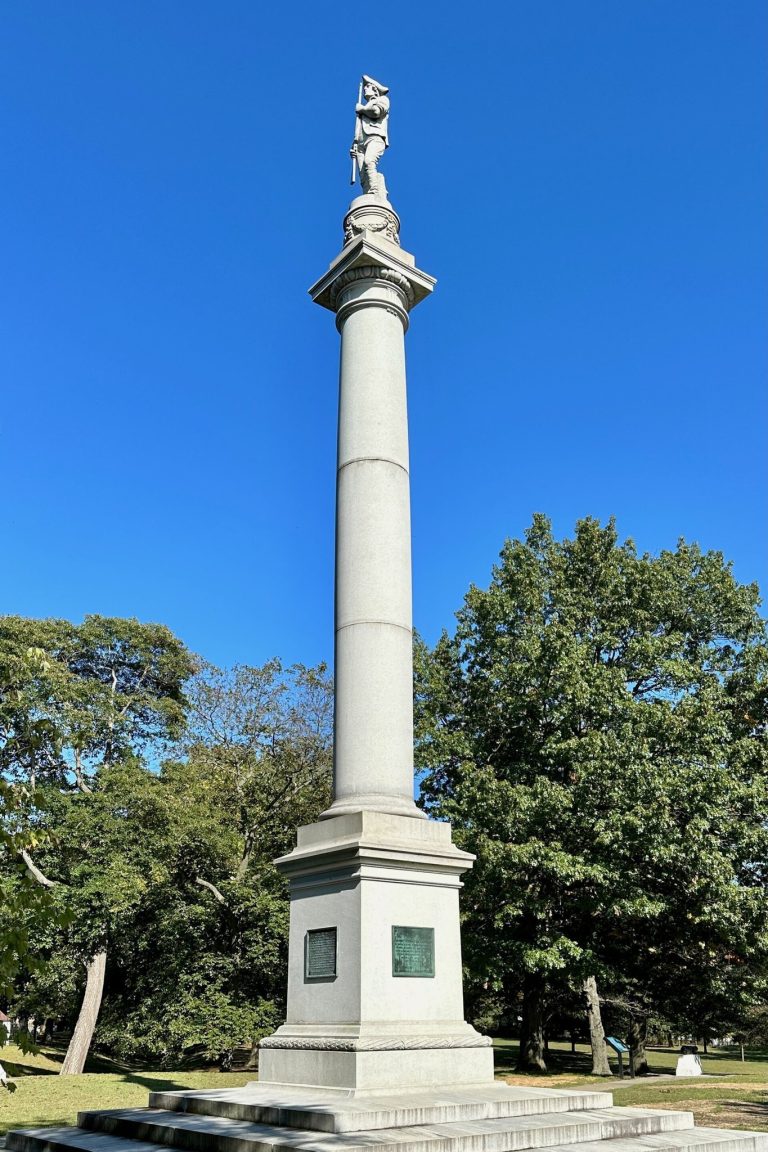
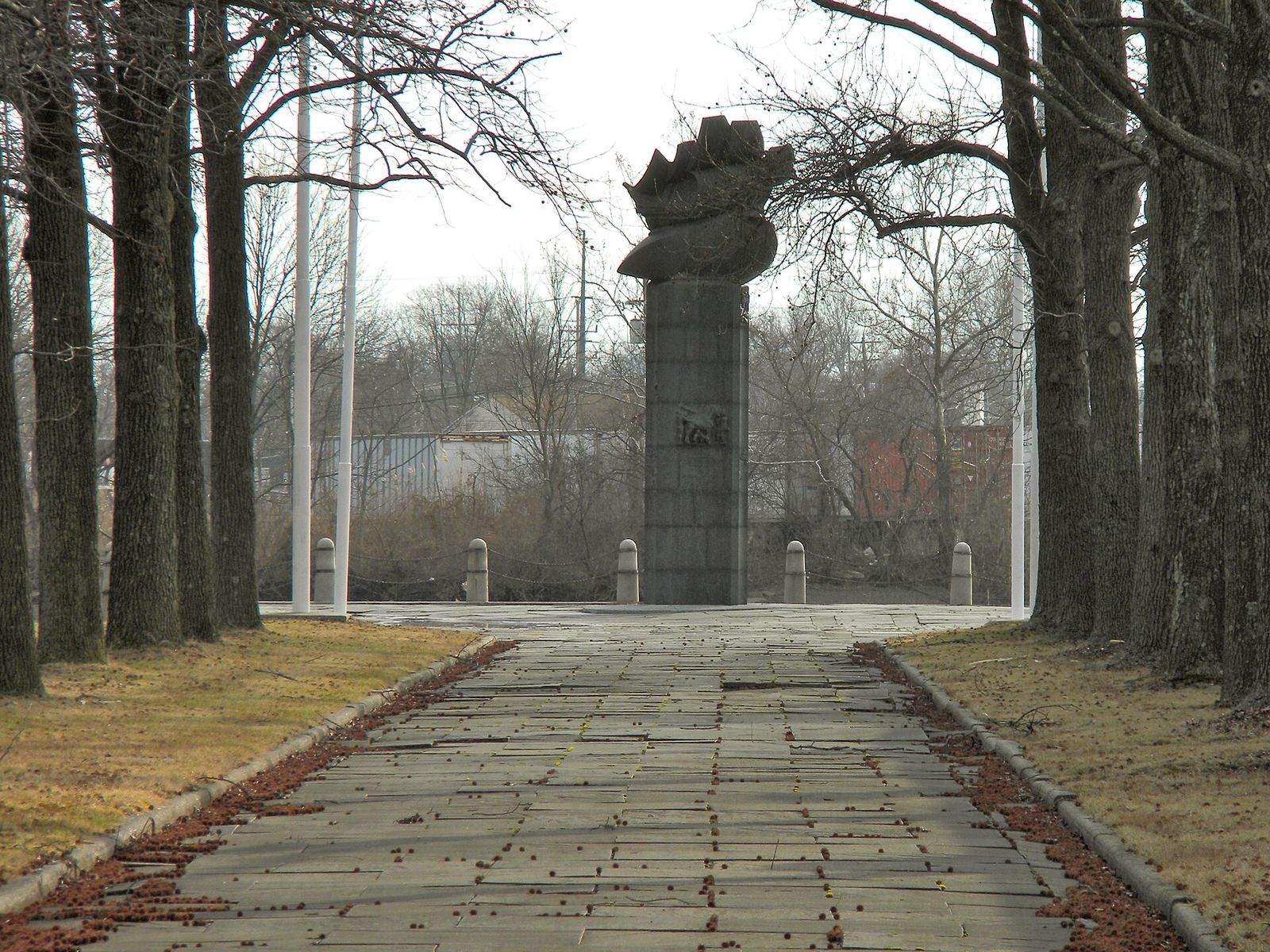
The 1938 park monument was designed by Swedish sculptor Carl Milles. Carved from Swedish black granite, it is topped by a replica of the Kalmar Nyckel.