Gualöv Church: A Medieval Parish Church in Sweden
Site at a Glance
- Country
- Sweden
- Primary era
- Medieval
- Eras represented
- Medieval, Early Modern, Modern
- Civilizations
- Danish, Swedish
- Site type
- Religious
- Remains
- Church
On this page13 sections
History
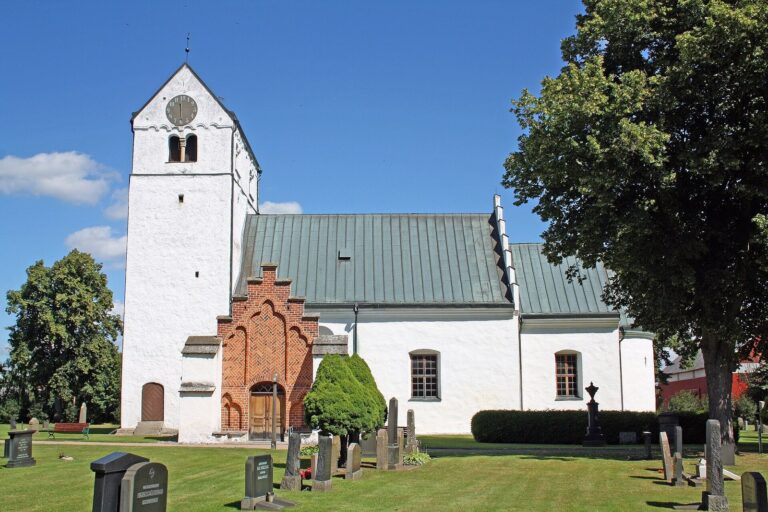
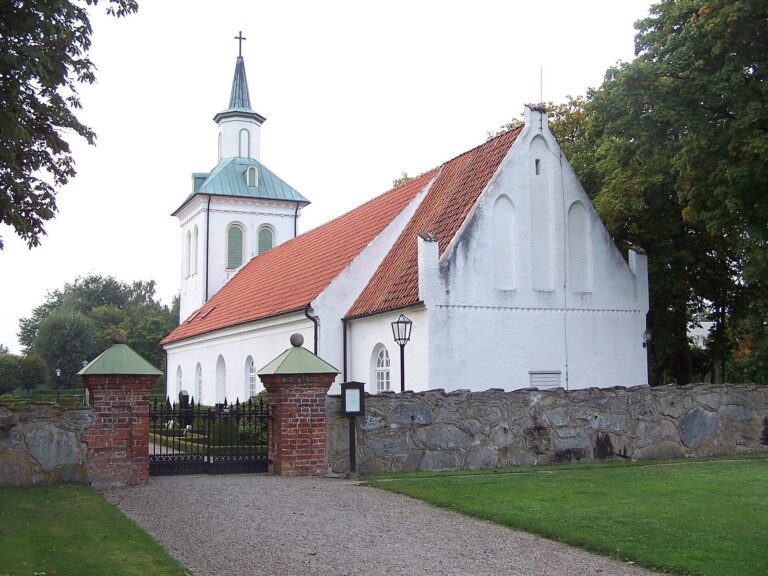
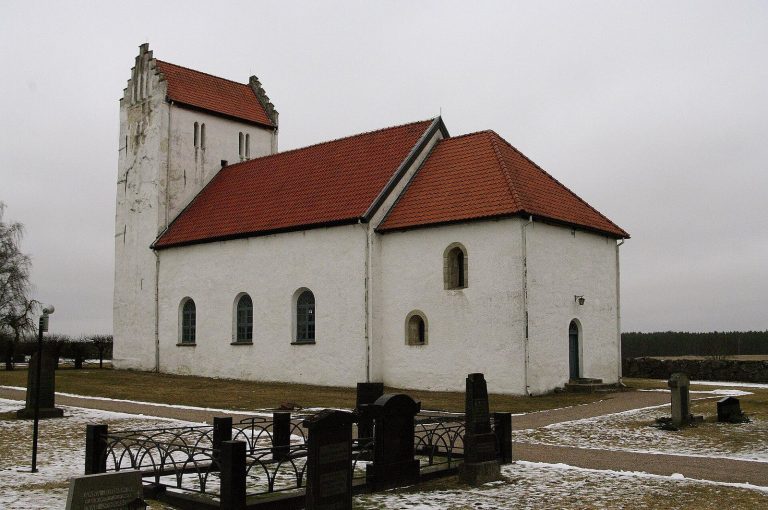
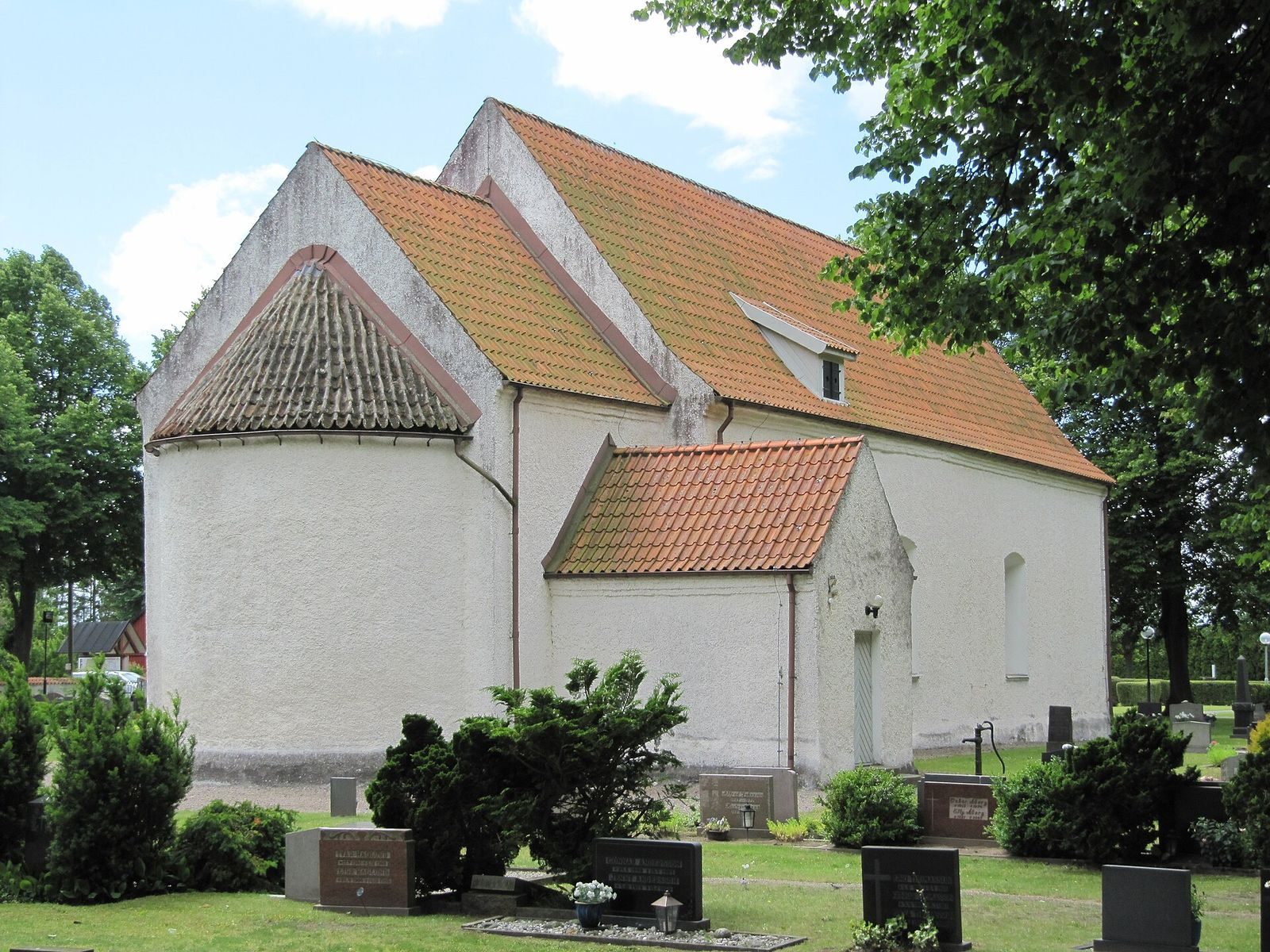
Gualöv Church is a 12th-century Romanesque parish church west of Gualöv in Skåne, Sweden. It was consecrated during that century, and its oldest parts date to the latter half. A Latin inscription links the church’s painted decoration to Hugitus, a nobleman, and his wife Hialmsvith. It says Hugitus commissioned the paintings in their memory; the couple probably also commissioned and financed the church’s construction.
Medieval changes and the Reformation
During the late medieval period, builders added a porch on the south side and replaced the church’s earlier ceiling with vaults. In the Catholic period, a wooden Calvary group stood in the arch between the nave and choir. It was taken down at the Reformation, the 16th-century religious movement that reshaped Christianity in Europe.
Later alterations and present role
The nave was extended westward in 1833, and a separate bell tower was built in the 18th century. Gualöv Church serves Ivetofta-Gualövs parish in the Diocese of Lund, a regional church administrative area, and belongs to the Lutheran Church of Sweden.
Remains
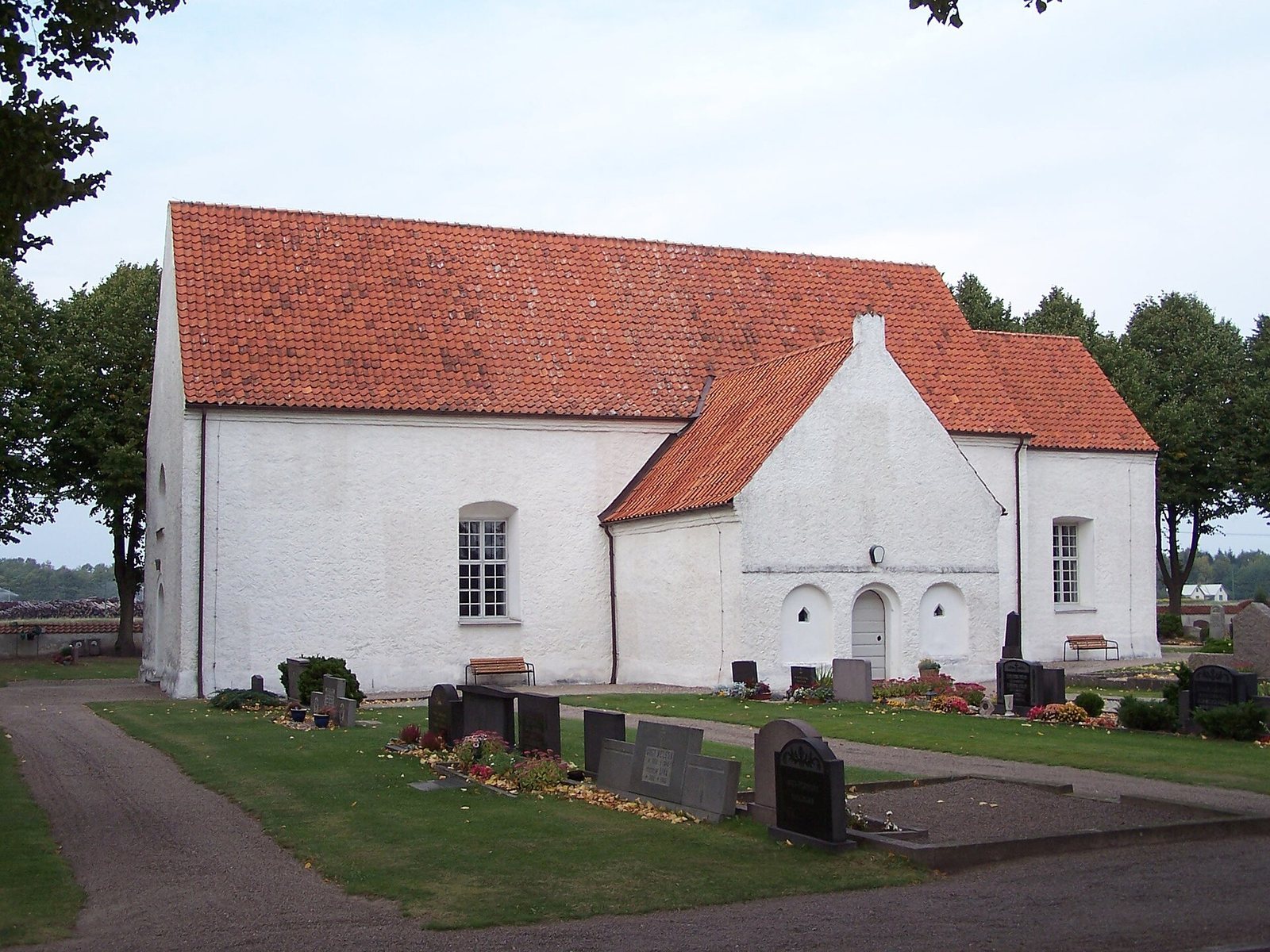
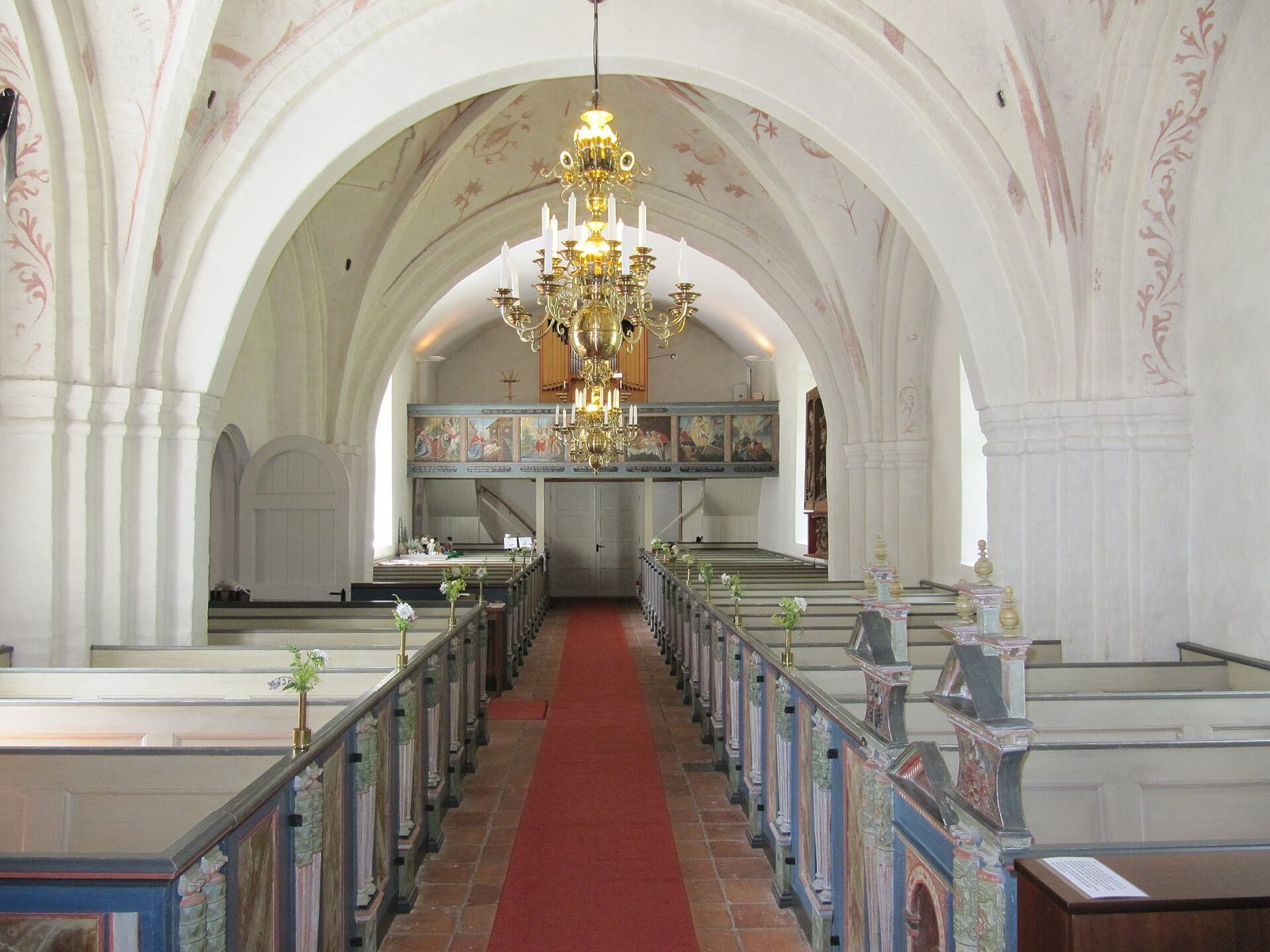
The church is built of fieldstone and has a Romanesque plan, with a nave (the main body), a choir (the area around the altar) and an apse (a rounded projection at the end). It has a south-side porch, vaulted interiors and a westward extension to the nave. The church itself has no tower; its bells are housed in a separate wooden tower.
Medieval wall paintings
The Romanesque mural
A painting in the vault of the triumphal arch, the arch separating the nave from the choir, probably dates to between 1150 and 1200. It depicts Hugitus and Hialmsvith, whose portraits are identified by a Latin inscription.
Paintings in the vaults
Late-medieval paintings, attributed to the unidentified artist known as the Master of Fjälkinge, decorate the vaults and date to around 1475. The western vault shows the royal saints Olaf of Norway, Canute of Denmark and Eric of Sweden, medieval rulers venerated as saints, alongside St Lawrence, an early Christian deacon and martyr. In the middle vault, Christ judges the world amid images of the heavenly Jerusalem, Hell and the Wheel of Fortune, an allegory of how quickly life’s fortunes can change. The eastern vault, above the choir, portrays the archangels Gabriel, Uriel, Michael and Raphael, high-ranking angels in Christian tradition. Fragments of decorative painting also survive in the porch.
Furnishings and objects
Main altarpiece
The main altarpiece was carved by Swedish sculptor and woodcarver Gustav Kihlman and dates to 1704. Its central scene depicts the Crucifixion. Jesus is flanked by Moses holding the tablets and John the Baptist pointing to the Lamb of God.
Older altarpiece
An altarpiece made in northern Germany around 1510 hangs on the north wall. It was once richly painted; fragments of a gold background and red marks remain.
Pulpit and baptismal font
The pulpit and baptismal font are in late Renaissance style and date to the late 17th century. A baptismal font is a basin used in baptism. A tree-shaped furnishing associated with baptism was added in 2010.
Calvary group and relic cache
The wooden Calvary group, a sculpture depicting the Crucifixion, was probably carved in the mid-13th century and is now held at Lund University Historical Museum. A relic cache, a container or cavity for sacred relics, was found in the altar in 1952. It is believed to have been placed there at the church’s consecration.
Organ
The mechanical organ was built in 1952 by Grönlunds Orgelbyggeri AB of Gammelstad, replacing an earlier harmonium. During renovation in 1985, its pedal stop marked Sordun 16′ was replaced by a Subbas 16′ stop; the 16′ designation indicates pitch.