Sölvesborg Castle: A Medieval Fortress in Sweden
Site at a Glance
- Rating
- 4.1
- Popularity
- Low
- Country
- Sweden
- Primary era
- Medieval
- Eras represented
- Medieval, Early Modern
- Civilizations
- Danish, Swedish
- Site type
- Military
- Remains
- Castle
On this page9 sections
History
Sölvesborg Castle is the ruin of a medieval Danish fortress in Sweden, erected in the thirteenth century near Sölvesborg. Its exact beginnings are uncertain, but Valdemar of Braunschweig, a nobleman who held Blekinge as a fief, was recorded in 1263 as lord of Blekinge and Sölvesborg and probably occupied an earlier fortress on the site. During the Middle Ages, Sölvesborg was regarded as the largest and most important fortress in eastern Denmark.
A royal fortress in eastern Denmark
The fortress stood beside the route connecting the Danish provinces of Skåne and Blekinge. Its position between Ryssberg and Hanö Bay allowed it to control a strategic area, while its fief included the districts of Villands, Gärds, and Lister. The nearby inlet was probably an important landing place for border trade between the Danish coast of Blekinge and the Swedish Värend region of Småland.
The great tower was probably built during the reign of King Erik Menved, whose rule lasted from 1286 to 1319. This period saw major Danish brick-building projects and the expansion of royal fortifications. The tower formed part of that wider development and gave the eastern part of the Danish kingdom a royal stronghold.
Changing control in the late Middle Ages
Sölvesborg and Blekinge belonged to Sweden from 1332 until King Valdemar III captured them in 1359. Queen Margaret I, who created the Kalmar Union, and her successor Erik of Pomerania visited the fortress repeatedly in the early fifteenth century. In 1402, they held a meeting there with Danish and Swedish councillors.
The fortress was captured during Engelbrekt Engelbrektsson’s rebellion in 1436. Ivar Axelsson Thott later received Sölvesborg and the districts of Gärds and Villands as a pledge from King Christian I. After Thott openly declared himself in feud against the king, the fortress was recaptured following a siege on 10 September 1467. The fief was pledged again in 1470.
War, administration, and transfer to Sweden
Berend von Melen captured Sölvesborg in 1523 after entering the service of Gustav Vasa. In 1525, after entering the service of King Frederik I, Søren Norby received the fortress and came to control all of Blekinge.
During the Nordic Seven Years’ War, fought between Denmark-Norway and Sweden from 1563 to 1570, Swedish troops advanced through Blekinge. On 6 September 1564, the Danish castellan Verner Parsberg fled Sölvesborg after setting fire to the fortress. Swedish troops then plundered and burned what remained. The fortress lost its military importance during the latter half of the sixteenth century and became an administrative centre, where the castellan governed the Sölvesborg fief and collected taxes for the Danish-Norwegian king.
In May 1645, G. Horn occupied Sölvesborg and strengthened the fortress and the town harbour with earthworks and palisades. Niels Krabbe of Skillinge, the last Danish castellan, held Sölvesborg and Kristianopel together from 1646. He transferred Sölvesborg to the Swedes in 1658.
The county and the later ruin
The County of Sölvesborg was established immediately afterward and granted first to Corfitz Ulfeldt, then to Lars Kagg and K. G. Wrangel. The county was later confiscated during the reduction, the Swedish Crown’s recovery of lands and revenues previously granted to nobles. The fief was abolished on 14 January 1661.
During the eighteenth century, the fortress and its tower were used as a stone quarry. Although the ruins received legal protection in 1816, stone removal continued. Excavations of the castle mound in 1940–1942, led by excavator and curator Lars Göran Kindström, identified three earlier building phases beneath the final castle complex.
Remains
Setting and castle mound
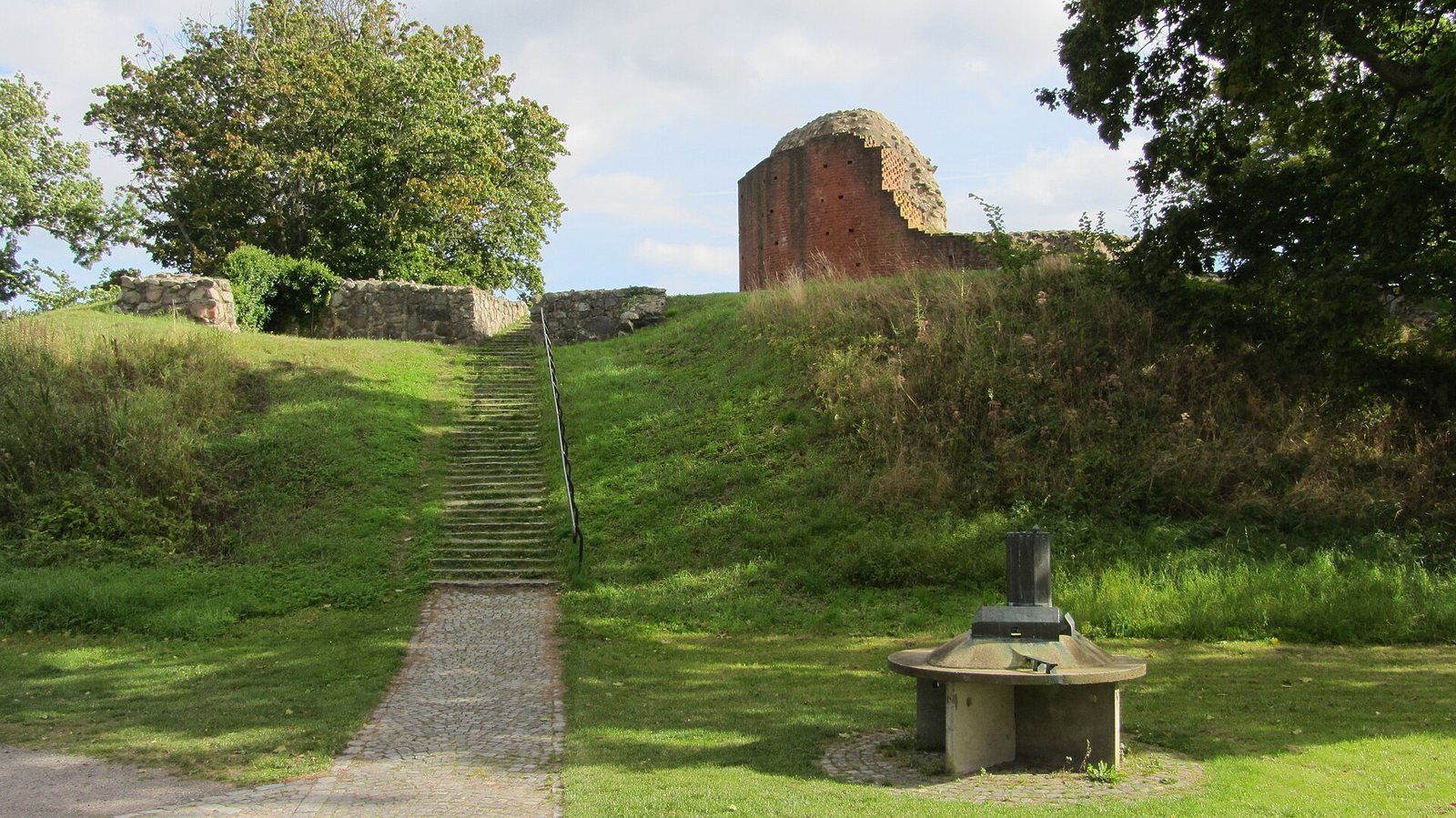
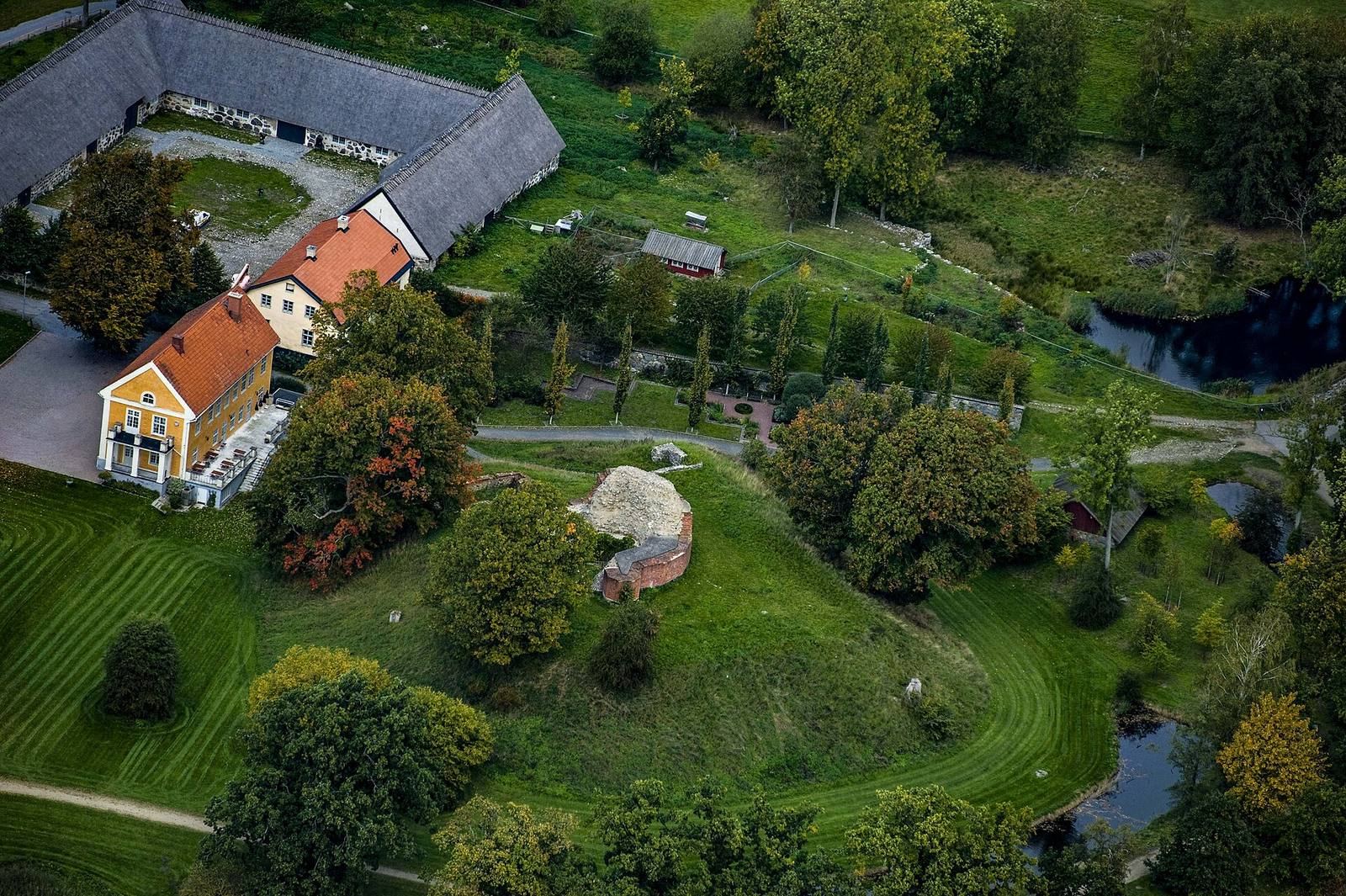
The ruin lies approximately 500 metres northeast of Sölvesborg’s medieval town centre, between the sea and Ryssberg. The castle occupied a position overlooking the inlet and was built on a high mound surrounded by a moat approximately 15 metres wide. Before the final fortress took shape, the mound was raised by about three metres.
The defensive tower
The surviving tower has a diameter of 17 metres and walls approximately 5.5 metres thick. Its circular base probably supported a lower section with sixteen sides, while the upper part was probably octagonal. A projecting stair tower connected the different levels. The tower was built with shell-wall construction, a technique in which two brick faces enclose a core of stones and mortar.
Approximately 11 metres of the tower remain. Nearly all of its brick was removed while the ruin served as a quarry, but a deep cellar room survives. A tradition holds that Admiral Søren Norby buried a large treasure beneath copper trapdoors in this cellar during the sixteenth century.
Courtyard buildings and outer bailey
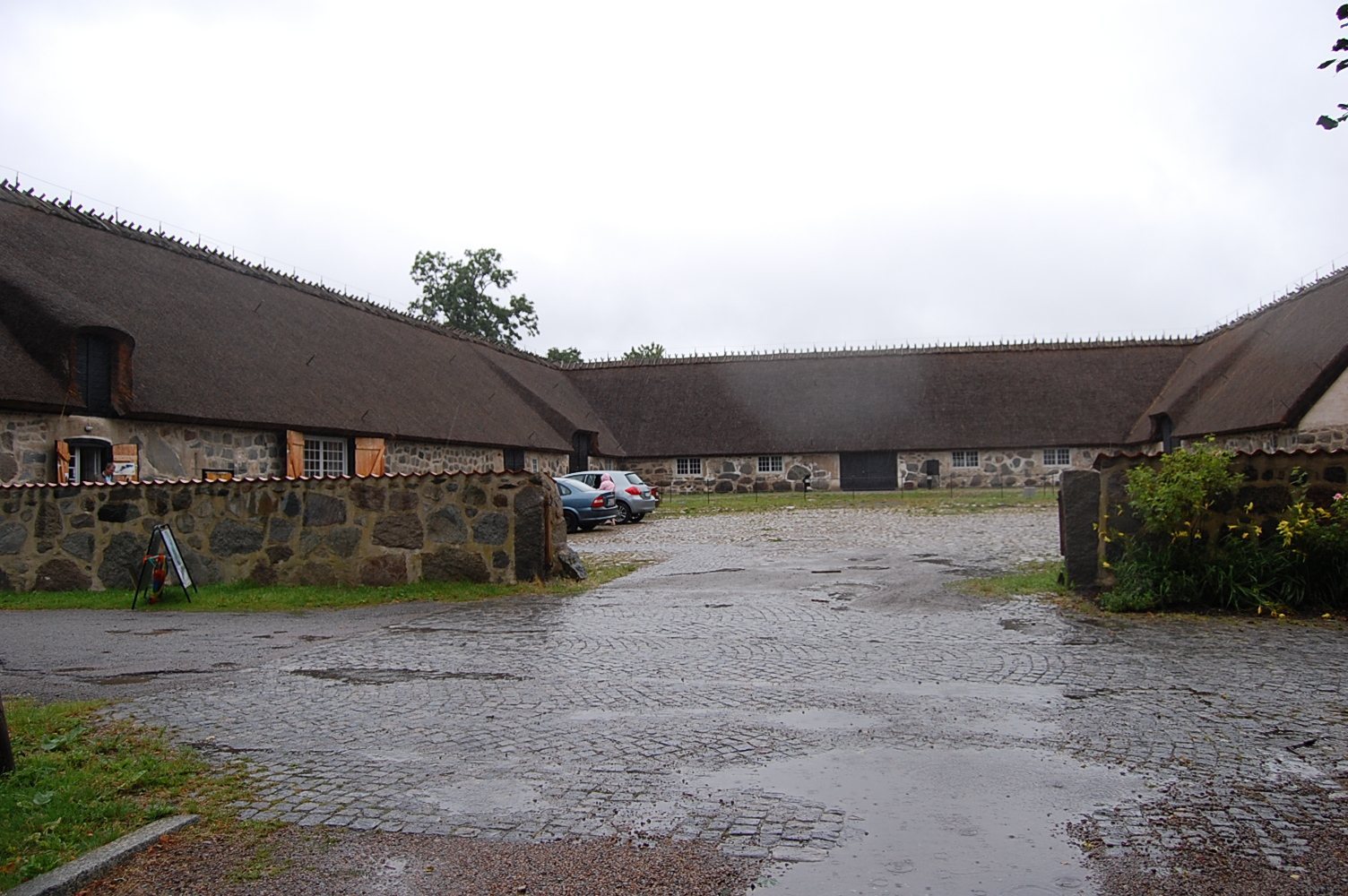
The castle courtyard was enclosed by ranges whose cellars survive among the remains. These buildings are depicted with thatched roofs. West of the moat lay a medieval outer bailey, an enclosed area adjoining the principal stronghold, containing farm buildings and stables.
The castle park contains a red beech with a circumference of 430 centimetres.