Châteaux de Lastours: A Medieval Castle Complex in France
Site at a Glance
- Rating
- 5
- Popularity
- Very Low
- Country
- France
- Primary era
- Medieval
- Eras represented
- Medieval, Early Modern
- Civilizations
- French
- Site type
- Military
- Remains
- Castle
On this page12 sections
History
The Châteaux de Lastours are four ruined castles in France that guarded the Orbiel valley and the route toward the Montagne Noire. Probably three castles stood here by the eleventh century, when local lords used the site to defend this narrow passage. The names Cabardès and Cabaret are linked to Cabardensis, a Latin term used in a charter of Charles the Bald in 870, when territory bearing that name was granted to Oliba, lord of Carcassonne.
The lords of Cabaret and Cathar activity
The lords of Cabaret are first named in 1067. Some of their wealth came from mines in the surrounding mineral-rich area, where mining and prospecting had taken place since Roman times. The succession included at least 22 lords. The castles changed location through successive destruction and rebuilding, while their position helped protect the valley and the route toward the Montagne Noire.
In the thirteenth century, the castles and nearby villages became a centre of Cathar religious activity. Catharism was a Christian movement condemned as heretical by the Roman Catholic Church, and its religious elite were known as Perfects. The castle village housed Cathar Perfects. Bishops Arnaud Hot, Pierre Isarn, and Guiraud Abith also stayed at Cabaret. In 1223, Cabaret became the seat of the Carcassès bishopric, an ecclesiastical district governed by a bishop, who faced pressure from Dominican activity.
The Albigensian Crusade
The Châteaux belonged to Pierre Roger de Cabaret, an ally of Raymond-Roger Trencavel who fought beside him in the defence of Carcassonne. From 1209, Simon de Montfort’s forces attacked the area during the Albigensian Crusade, a military campaign against Catharism in southern France that lasted from 1209 to 1229. The castles held out for about two years. Simon’s forces mutilated captives as a warning to the defenders.
A legend relates that defenders fled on 15 August 1209 through an underground passage said to extend for three leagues, after seeing a prisoner sent toward the castles. The story remains uncertain given the prolonged resistance. Pierre Roger later captured the crusader Bouchard de Marly in an ambush. In 1211, Bouchard’s release was negotiated, and he was sent to seek terms for Cabaret’s surrender. Pierre Roger kept his agreement with Simon de Montfort at least until Simon’s death in 1218. The lords recovered their lands in 1223, but the castles came under siege again in 1226. Cabaret capitulated in 1229.
Royal fortresses and later conflict
After the capitulation, the villages and castles were plundered and rebuilt as royal fortresses. The king ordered Tour Régine to be built to assert royal authority. The former inhabitants probably had to leave in haste. Their castle villages eventually gave way to a crown-established settlement called Rivière, renamed Lastours during the French Revolution. The former lords did not recover the castles. In 1262, Louis IX granted Jourdain de Cabaret, a member of the family, other lands as partial compensation.
The royal complex became the administrative and military centre for six communities in the Cabardès castellany, a territory administered from a castle. A royal viguerie, or administrative district, was established at Cabaret in 1300 and later joined with the one at Carcassonne. The castles underwent repeated rebuilding and alteration, with work continuing into the seventeenth century.
During the French Wars of Religion, a series of sixteenth-century conflicts between Catholic and Protestant factions in France, Huguenots occupied the castles. An assault by Anne de Montmorency failed. Marshal Guillaume de Joyeuse captured them on 8 May 1591. The site lay between Catholic Carcassonne and the Protestant towns of Mazamet and Castres.
Decline and modern recognition
By the middle of the eighteenth century the castles remained in good condition but had been neglected. In 1768, royal engineer Jacques-Philippe Mareschal argued that they should be maintained because of their strategic value in defending the valley. After 1786, during the French Revolution, the castles were burned and destroyed.
The four ruins were classified as historic monuments in 1905. The wider remains, including the castle complex and Cabaret’s castle village, were listed in 2023, with a partial classification replacing that status in 2024. A nomination process for a group of Cathar castles began in 2013 and received approval from the French World Heritage committee in 2021. On 26 July 2026, Lastours became part of the UNESCO serial World Heritage property Royal Capetian Fortresses of Languedoc, alongside Carcassonne’s walls and castle, the castles of Aguilar, Peyrepertuse, Puilaurens, Termes, and Quéribus, and Montségur. Archaeological excavations continue.
Remains
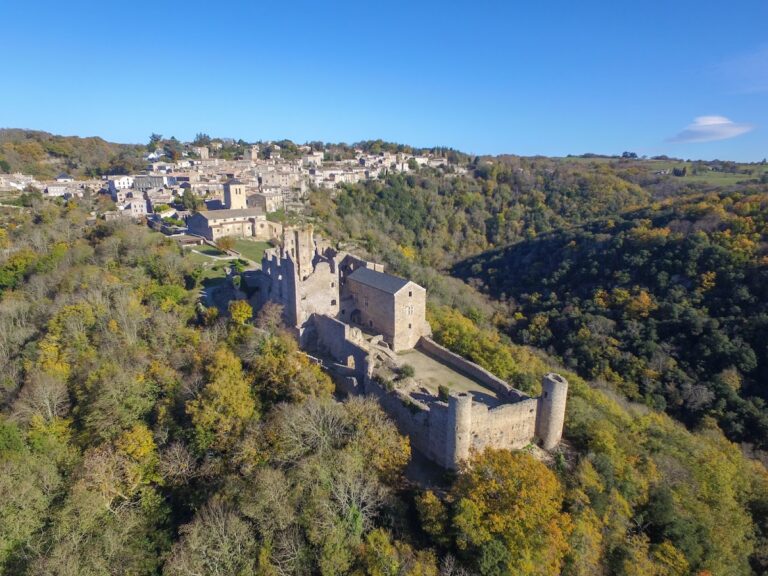
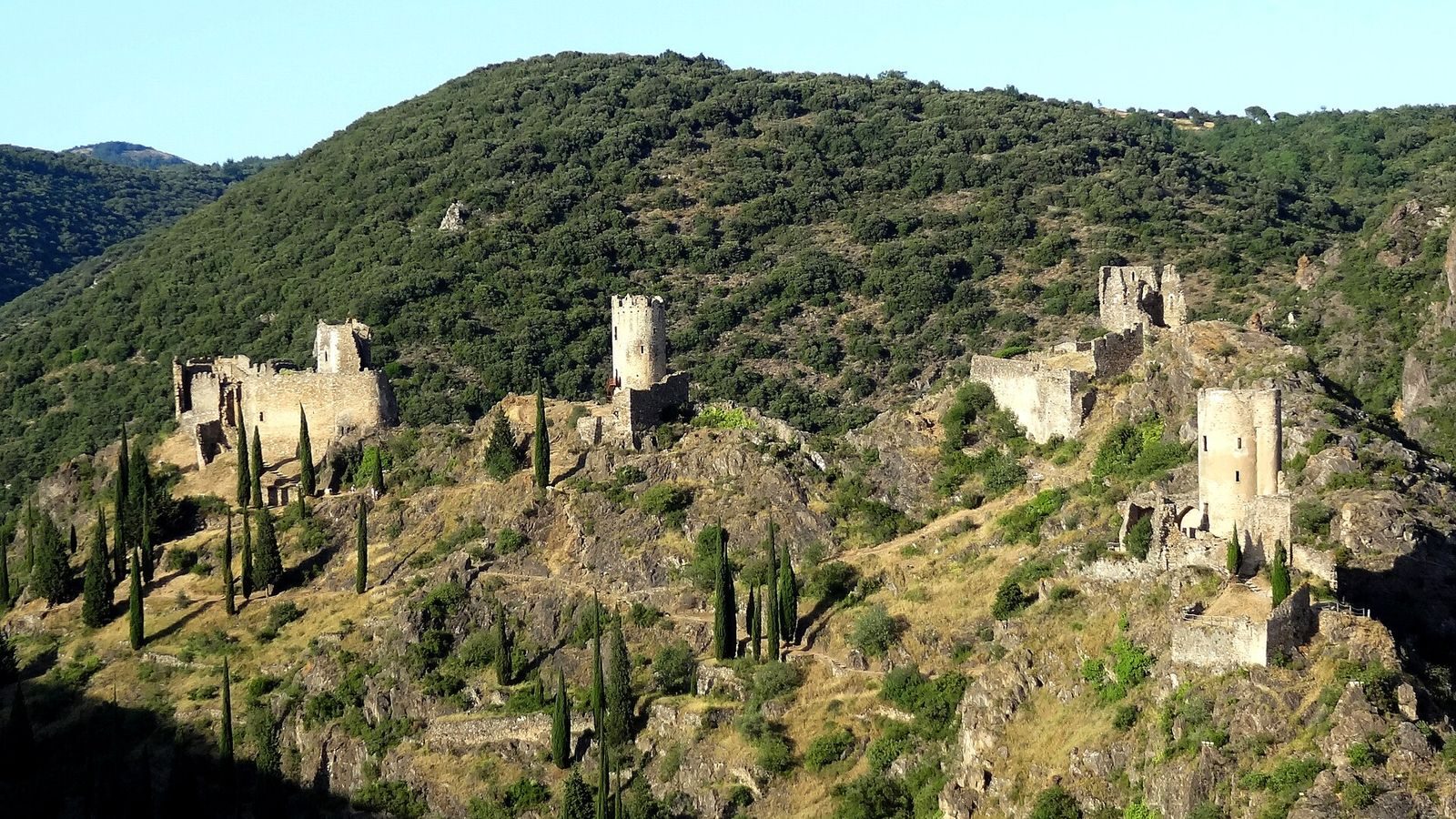
The four castles occupy a rocky spur about 300 metres above the village, measuring roughly 400 metres long and 50 metres wide. The deep valleys of the Orbiel and Grésillou streams isolate the ridge, near the streams’ meeting with the Orbiel River. Arranged broadly from north to south are Cabaret, Tour Régine, and Surdespine; Quertinheux stands slightly apart on a separate rocky pinnacle. Cypress groves surround the complex.
Earlier village remains
Traces of the earlier castle village survive on the western slope. Its buildings followed the contours in a semicircle around the lord’s residence. Before the Crusade, houses, refuge caves, forges, and water tanks stood around a tall, narrow tower. In the thirteenth century, the king ordered the destruction of three towers and their dwellings to remove Cathar refuges. The castles were then rebuilt along the ridges, where they were less exposed to enemy fire.
The four castles
The four castles form one complex but have no shared masonry. Their plans follow the natural rock formations, whose defensive advantages made a single larger fortress unnecessary. Their construction also reflects repeated changes over time.
Cabaret
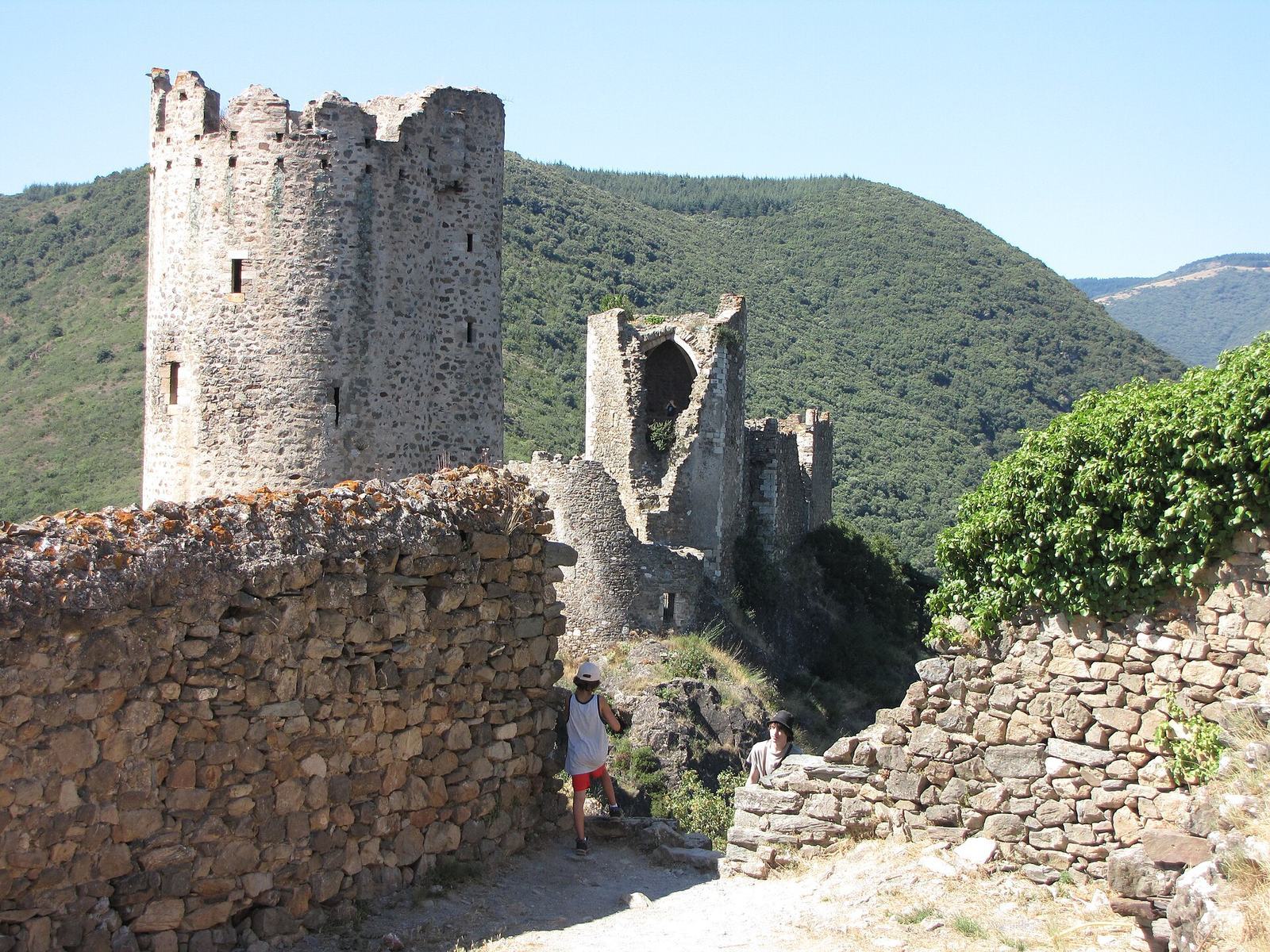
Cabaret is the original and principal stronghold, with an outer defensive work protecting its entrance. A northern tower, an octagonal keep, or principal fortified tower, to the south, and a central residential building stand within enclosing walls. Along the walls, a passage runs above recesses shaped like pointed arches but closed at the back. The masonry is irregular, with carefully cut stones at corners and openings. The keep has a pointed dome and a spiral staircase leading to its summit. Two underground tanks stored drinking water.
Tour Régine
Tour Régine is the smallest castle and probably the most recent. Its circular tower is built of white limestone, the same stone used at Cabaret. It was probably constructed after the Albigensian Crusade, and its first written mention dates to 1260. A small defensive wall once enclosed the isolated tower, but the wall has collapsed. A spiral staircase connects its three storeys. Two lines of sockets near the top indicate where wooden beams once rested, and the complex’s largest water tank lies beneath the tower.
Surdespine
Surdespine, also called Fleur d’Espine, was once the largest castle, before Cabaret was rebuilt. It is now the least well preserved. Its remains include a square tower, a residential building, a water tank, and a rectangular defensive wall. Four round-arched windows and a small number of narrow openings for archers survive. The central tank has a pointed barrel-shaped vaulted roof and a waterproof lining of tile and mortar. It retains pink plaster and part of a terracotta pipe that brought water from the roofs.
Quertinheux
At the southern end of the ridge, Quertinheux occupies an isolated rocky pinnacle. Its remains include a circular tower and a polygonal defensive wall. A bent approach protects the entrance, and the passage through the main gate also curves. The castle overlooks the remains of a destroyed medieval church.