Cathedral Tower of Teramo: Bell Tower of the Cathedral Basilica
Site at a Glance
- Country
- Italy
- Primary era
- Medieval
- Eras represented
- Medieval, Modern
- Civilizations
- Italian, Kingdom of Naples, Kingdom of Sicily
- Site type
- Religious
On this page16 sections
History
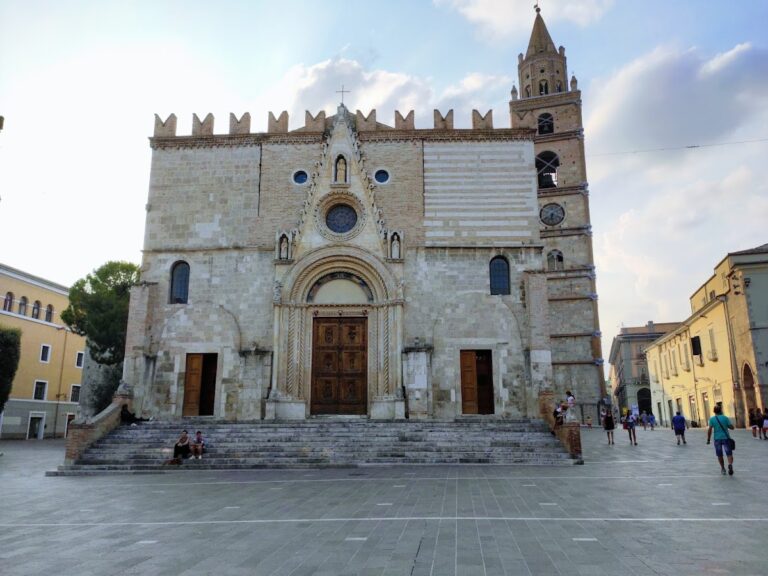
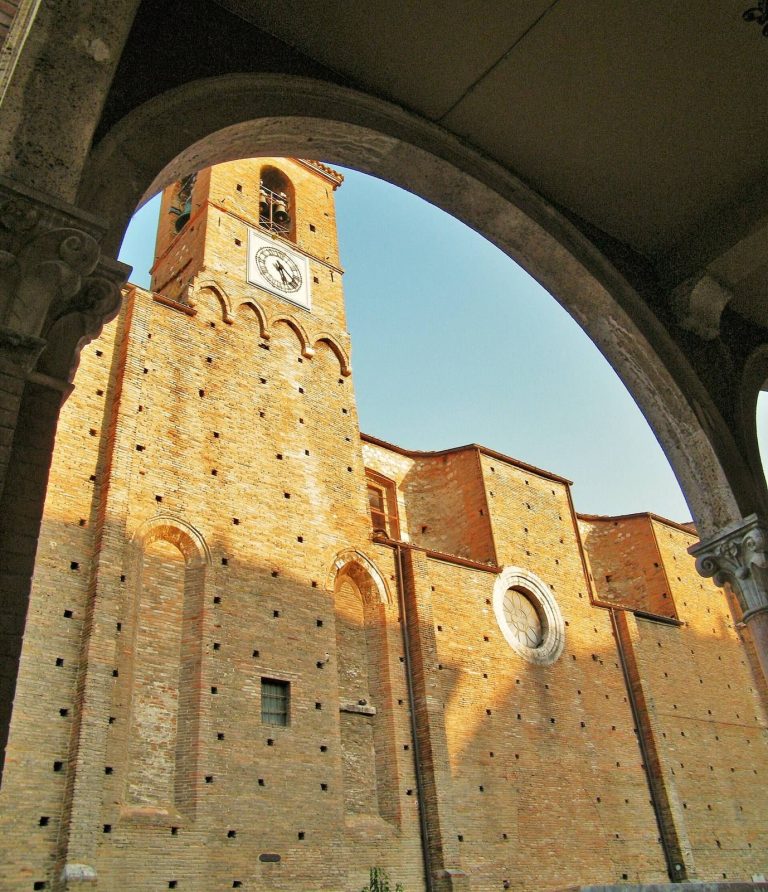
The Cathedral Tower of Teramo, in Italy, serves as the bell tower of the Cathedral Basilica of Saint Mary of the Assumption. The cathedral is the principal church of the Diocese of Teramo-Atri, the church territory overseen by a bishop, and the tower is a symbol of Teramo. Built in successive phases between 1150 and 1493, it combines Romanesque forms, associated with rounded arches and substantial masonry, with Gothic pointed forms and vertical emphasis.
Construction and cathedral use
Bishop Guido II oversaw construction of the lower part during the twelfth and thirteenth centuries. The fourteenth-century middle section was associated with Bishop Niccolò degli Arcioni. Antonio da Lodi, a Lombard architect, completed the upper octagonal crown in 1493. These successive campaigns gave the tower its blend of medieval architectural forms.
The entrance vestibule also served the cathedral’s needs. It functioned as the Old Sacristy until the cathedral’s monumental sacristy was completed in 1632. The cathedral’s former organ was kept in the vestibule until 1956, when Bishop Stanislao Amilcare Battistelli commissioned a new organ in honor of Saint Gabriel of Our Lady of Sorrows, a nineteenth-century Italian religious brother venerated as a Catholic saint.
The Aprutina bell and civic clocks
The large Aprutina bell has a partly uncertain early history, though it is attributed with reasonable confidence to the Teramo craftsman Attone di Ruggiero. After it probably broke, the French bell founder Nicola di Langres recast it in 1483. Further breaks led to recastings in 1704 and 1760.
In December 1798, French troops occupying Teramo tried to drop the Aprutina from its former place in the east window and then attempted to smash it. They did not break the bell, but damaged the axle connecting it to its yoke, leaving it unable to swing. Residents bored its crown and fitted pins so it could be rung by tolling instead. It continued to sound in this way for about 130 years.
During Bishop Antonio Micozzi’s episcopate, the Colbachini foundry of Padua recast the bell in 1930. A committee of cathedral canons and local parish priests, chaired by vicar general Muzj, chose the foundry after seeking estimates from firms in Fermo, Agnone, and Padua. The bell was cast on 26 March, returned to Teramo on 19 April, and blessed by Micozzi on 27 April. It was placed centrally in the lower bell chamber to lessen the strain caused by swinging.
After later seismic events, the Aprutina was again kept from swinging for about a decade and sounded only by a pull mechanism. Once structural consolidation was completed, all the tower’s bells returned to swinging operation on 4 June 2022. Work that year also found problems with the Aprutina’s support frame, wooden yoke, and motor. An apparently old crack affects its sound.
The tower’s first public clock was probably installed in the early nineteenth century and likely had one white-marble dial. In 1891–92, Mayor Berardo Costantini promoted a replacement with two transparent-glass faces, intended to show the time on both sides of the city. The old marble dial remained. The new clock suffered repeated mechanical and weather-related damage. In May 1901, the municipal council ordered a west-facing dial after a violent storm brought down the old one and damaged the Bishop’s Palace roof.
Twentieth-century changes
A third clock, made by the Miroglio brothers’ Turin factory, was installed in 1924. Repairs in 1932 replaced the mechanism’s supports, protected it from dust, and renewed the cords carrying its weights. The tower was restored in 1935, and the clock mechanism was removed on 7 October 2011. An electronic unit now operates the east- and west-facing displays and the hourly and quarter-hour signals.
During the Second World War, part of the cathedral’s treasure was concealed in underground spaces in the tower, where it escaped theft and confiscation by enemy forces. An air-raid siren installed on the tower in 1937 sounded for the first time on 19 June 1938 and last sounded on 14 July 1944. A 1945 Interior Ministry order called for sirens to be removed throughout Italy. Teramo’s siren was taken down on 7 October 2011, restored, and sounded publicly again at the University of Teramo on 27 January 2016.
Further restoration took place in 2019. A major intervention in 2022 consolidated the tower and restored decorative features and contents as well as addressing the structure.
Remains
The tower rises in stacked sections separated by projecting horizontal cornices. Its upper part contains two bell chambers beneath a terrace, an octagonal structure, and a pyramidal crown. The arrangement brings together the tower’s exterior ornament, internal stair and clock spaces, and seven bells.
Exterior and crown
Shaft and upper levels
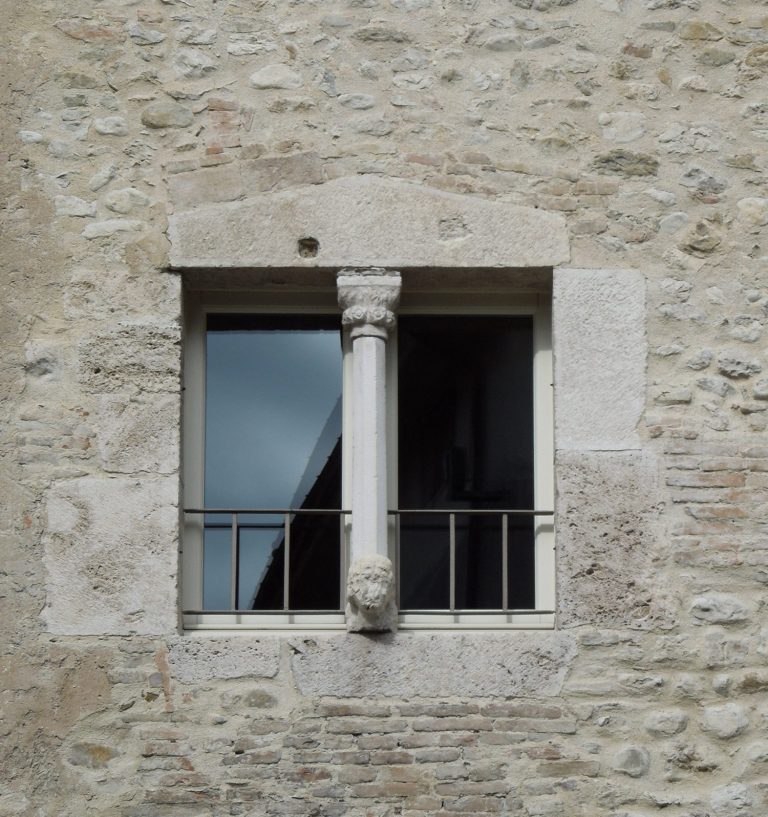
The tower meets the cathedral where its Romanesque section gives way to the Gothic section. Paired windows open in the tower’s third and fourth levels; the fifth and sixth levels hold the bell chambers. The tower stands 48 metres high, according to a 1955 measurement by the Italian Military Geographic Institute. The sphere, weather vane, and cross at the summit bring the total height to nearly 50 metres.
Octagonal crown and terrace
A terrace with small turrets at its corners sits above the upper bell chamber. At its centre, an octagonal prism supports a pyramid topped by a metal sphere, weather vane, and cross. Each face of the prism has paired windows below and circular openings above, the latter surrounded by polychrome decoration. The sphere measures 0.64 metres across and was originally gilded; traces of gilding also remain on the cross. Some capitals and terrace turrets carry the date 1935.
The terrace is reached from the prism. A narrow walkway runs around the pyramid’s base, bounded by eight turrets rising from the prism’s corners. An exterior metal ladder leads towards the sphere and cross, while another ladder inside the tower runs from the pyramid’s base towards the sphere. A small door at the pyramid’s base sits several metres above the prism floor and has no fixed staircase leading to it. A lantern holder is also located on the viewing terrace.
Interior arrangement
Vestibule and stair
The entrance vestibule is small and receives light through an opening made during work in the 1930s to isolate the cathedral. A metal internal staircase, rebuilt during that decade, replaced a deteriorated wooden stair. Metal supports carry the new stair and floors at the tower’s levels, with exceptions at the entrance floor, clock-weight platform, and clock room. The steps between the entrance and the prism follow a linear route.
Clock room and weights
A masonry platform below the clock room supported the clock’s descending weights. Their cords passed through the clock-room floor and down between the stair flights. A floor immediately above the platform was removed to make way for the cords; traces of its former vaulted construction remain. The small clock room is bounded by the tower’s east, north, and west walls. Its floor is the vault over the room below, a door beside the staircase opens into it, and another stair rises to the first bell chamber.
Clock displays and mechanism
The municipal clock is situated about halfway up the tower, with faces on its east and west sides. The glass faces installed in 1891–92 measured 2.55 metres across and were 13 millimetres thick. The 1924 faces were also transparent glass, set in cast-iron frames so they could be lit from behind at night. The clock’s original mechanism used a pendulum and weights, with cords passing through the clock-room floor.
In 1932, two double-T iron beams anchored between the walls supported the mechanism. A wooden casing shielded it from dust, and 200 metres of six-millimetre galvanized steel cable replaced worn weight cords. The hour and minute hands were progressively replaced in 1989 and 2005, except for one hand. In 1989, a minute hand fell into Piazza Martiri della Libertà.
Bells
Aprutina
The lower chamber holds the large Aprutina, now centred on a metal support frame. It is 1.90 metres high and nearly as wide, weighs 44.85 metric quintals, and sounds A-flat. A metric quintal is 100 kilograms. The clapper weighs 2.38 quintals, the oak yoke, the beam to which a swinging bell is attached, weighs 6, and the metal support frame weighs 18.25. Together, the bell and its installation weigh 71.48 quintals. The yoke is oak, like the beams supporting the tower’s internal structure.
The bell’s exterior carries the coats of arms of Bishop Antonio Micozzi, the Pope, the Municipality of Teramo, and the Kingdom of Italy. One side depicts Saint Berardo, the city’s bishop and patron saint, and bears a plea for his protection of the city and its people. Another shows Our Lady of Grace, a devotional title for Mary, and has an inscription naming those involved in the bell’s last recasting. A further inscription recalls its repeated breakages and renewals and connects its sound with the city’s faith, hopes, and fortunes.
The Italian Association of Campanology includes the Aprutina among Italy’s largest bells. It is the second-heaviest bell in Abruzzo, after the Sanctuary of Saint Gabriel of Our Lady of Sorrows’ centenary bell, which weighs about 50 quintals and sounds G2. In pitch, the Aprutina ranks third behind that bell and the principal bell of Avezzano Cathedral, which sounds G-sharp2 but is smaller and lighter. In these note labels, the numeral indicates the octave.
Clock bells
Two bells dated 1830 share the lower chamber with the Aprutina. One sounds C4 and the other E-flat4.
Upper-chamber bells
Four bells occupy the upper chamber. On the east side, a small bell made by Luigi Pasqualini at Montedinove in 1800 hangs from an iron yoke. Inscriptions inside identify its maker and date; its decoration includes angels, flowers, and a bishop holding a crozier, probably Saint Berardo. It sounds B-flat3. The south-side bell, made by Giuseppe della Noce of Penna Sant’Andrea in 1887, sounds D-flat4. The north-side bell is the smallest and oldest of the four. Its maker is unidentified; it was made in 1834, has an iron yoke by OES Brevetti Scarselli, and sounds D4. The west-side bell is the largest in this chamber. Made in 1839 by M. Antonius de Nuci, attributed to the Della Noce family of Penna Sant’Andrea, it has an iron yoke and can be rung by swinging or tolling. It sounds F3.
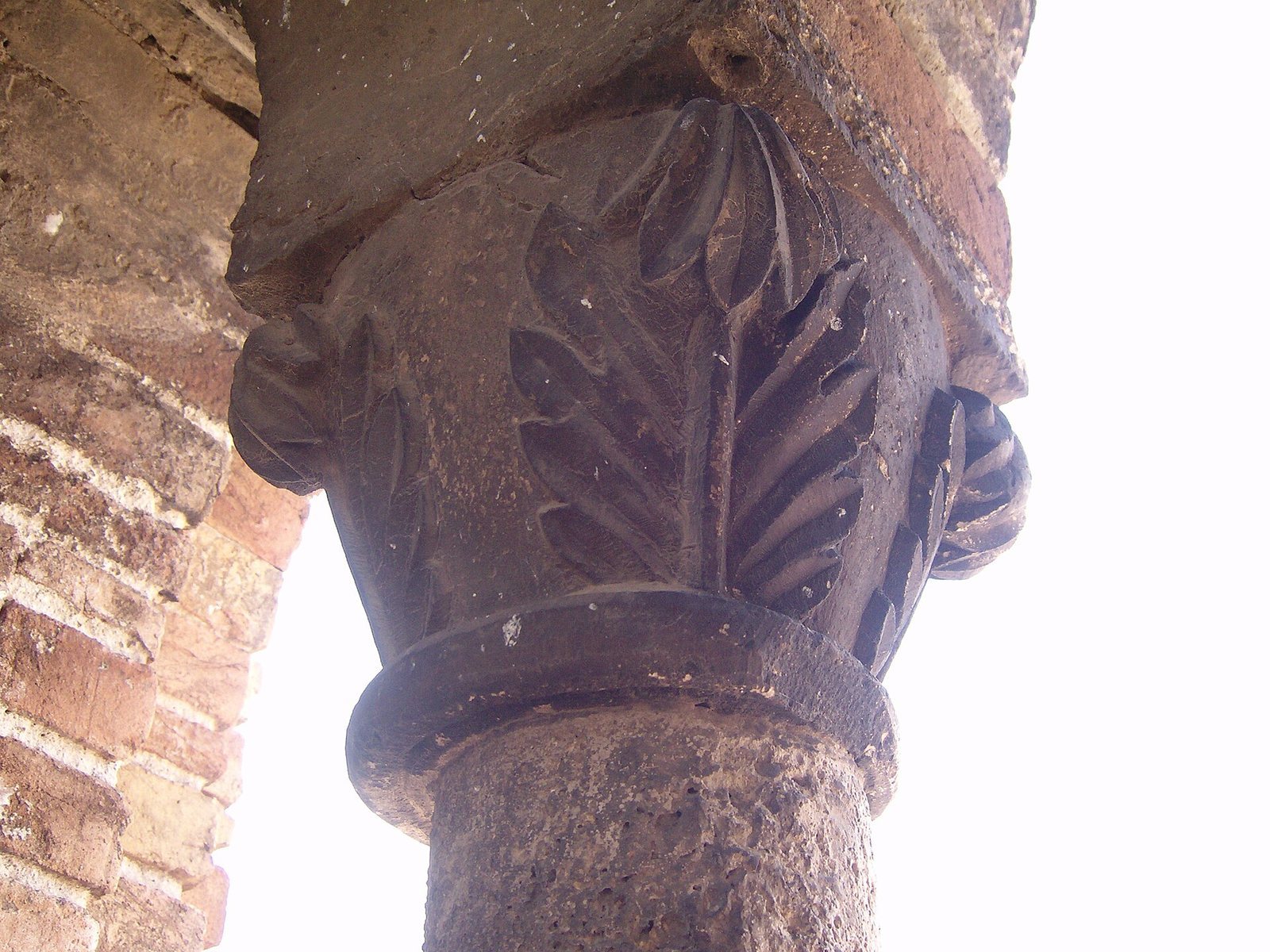
The octagonal prism and pyramid now form one interior space. They were once divided by a wooden floor, and two beams at their junction remain. The capitals and bases of the prism’s paired-window columns are partly original, partly Roman in origin, and partly reconstructed during the 1930s work.