Sant’Antonio: A Franciscan Monastery Church in Teramo


Site at a Glance
- Rating
- 4.5
- Popularity
- Very Low
- Country
- Italy
- Primary era
- Medieval
- External website
- Open
- Eras represented
- Classical, Medieval, Early Modern, Modern
- Civilizations
- Italian, Kingdom of Naples, Kingdom of Sicily, Roman
- Site type
- Religious
- Remains
- Church
On this page14 sections
History
Sant’Antonio is a Roman Catholic church in Teramo, Italy, whose Franciscan complex was established in 1227 and whose building combines early Gothic and Baroque elements. It originally served as the monastery church of San Francesco for the Order of Friars Minor, the Franciscan religious order founded by Saint Francis of Assisi.
Foundation and Medieval Development
Teramo received autonomous communal status in 1207, when Bishop Sasso granted the city the right to govern itself as a commune. The resulting period of peace encouraged economic activity and building, including the construction of the bishop’s palace and the Dominican and Franciscan monasteries.
The first Franciscan complex was established in 1227. It comprised the church, a cloister, a covered passage around an internal courtyard, together with a refectory, the friars’ communal dining hall, and cells. The church was completed and enlarged in 1327. A bell tower was built in 1309 by the master builder Antonio di Florio, although the original form and position of the surviving tower remain uncertain. It may have replaced an earlier bell structure attached to the church wall.
Archaeological Discovery and Later Changes
In 1584, work to embellish the cloister led to the discovery of bronze idols or statues, medals, fragments of columns, marble, and a pavement made from porphyry slabs. The pavement was identified as Roman, adding evidence of earlier activity at the site.
The church was first dedicated to Saint Francis of Assisi. During the first half of the nineteenth century, responsibility passed to the Brotherhood of Saint Anthony of Padua, and the building took the name Sant’Antonio. A Baroque refurbishment altered the medieval appearance and removed much of the original exterior decorative arcade. Since 1902, the church has been included on Italy’s list of national monuments.
Remains
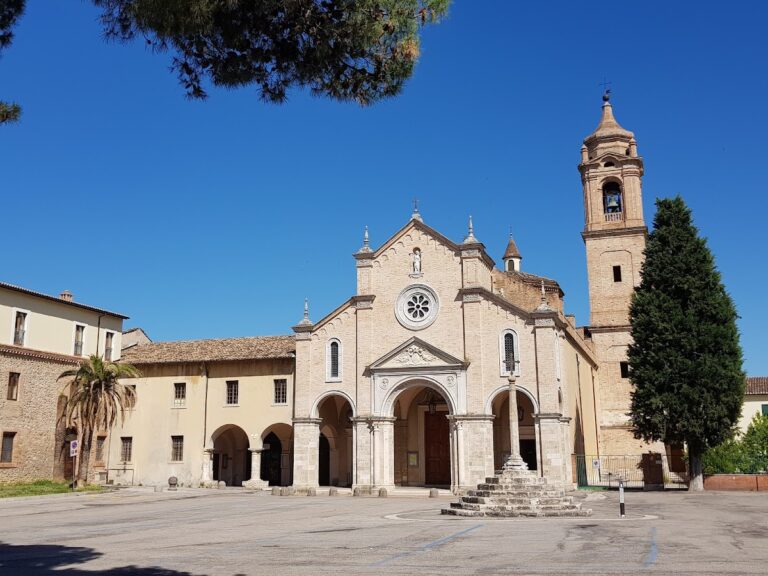
The complex stands at the corner of Corso De Michetti and Largo Melatino. Its physical arrangement preserves the larger Church of Saint Francis and the smaller Chapel of Saint Anthony, which occupies the former monastic refectory. Medieval elements remain in the church’s exterior, while the interiors of both worship spaces are largely shaped by later Baroque work.
Medieval Exterior
Side Elevation and Former Arcade
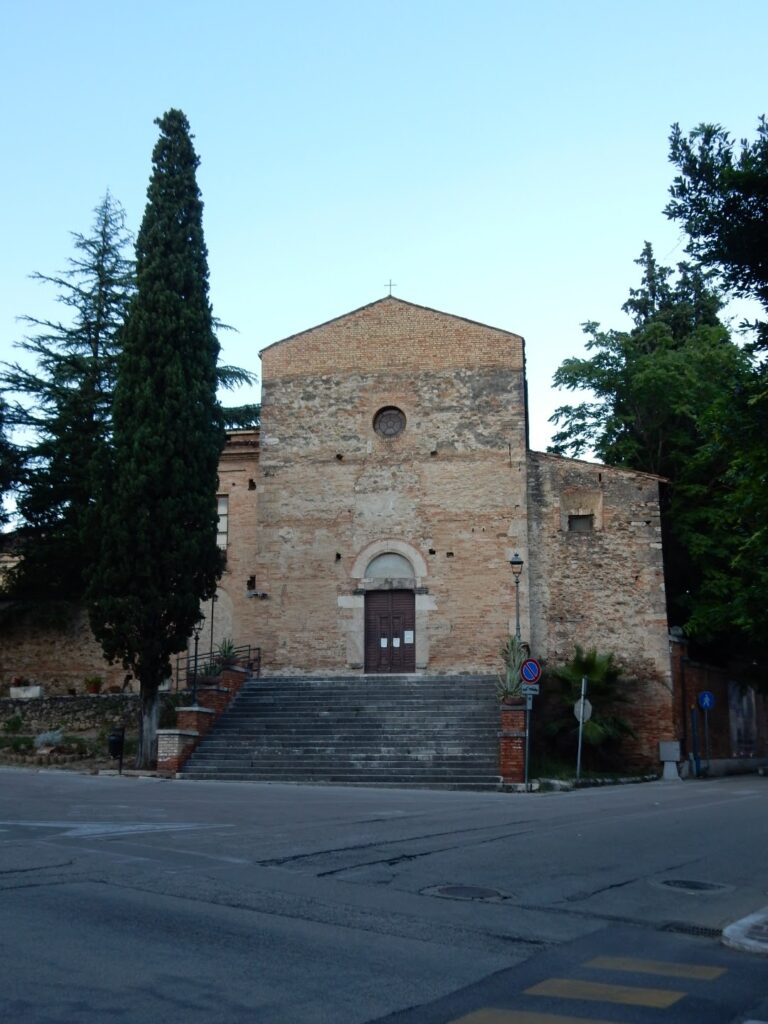
The original Franciscan church had a single nave and a rectangular apse. Its side elevation is divided by buttresses and includes two windows, a rose window, and a blocked entrance. Near the bell tower, parts of the former crowning arcade remain. This arcade consisted of pointed brick arches resting on stone corbels, with rows of brick tiles bordering the arches.
Principal Facade and Portal
A fragmentary fresco on the principal facade is traditionally identified as Saint Christopher. A horizontal cornice separates the portal from the upper part of the facade, where two windows have been blocked and a larger window illuminates the nave.
The portal is set within a deeply splayed opening. Its decoration includes inlaid work, twisted columns, and elaborate foliage that follows the curve of the arch. A bird is carved among the leaves of the left capital, while two further birds appear around and above the lunette, the curved space above the doorway, including one beneath the keystone. The portal has been compared with those of the cathedral of Atri, Santa Maria di Propezzano at Morro d’Oro, San Francesco at Campli, and Sant’Antonio at Morro d’Oro because of related arrangements of columns, foliage, and other decorative details.
Bell Tower
The brick bell tower rises two levels above the church roof and is integrated into the building. Its lower level contains a clock. The upper chamber appears to have been rebuilt and holds four bells, while the tower’s earlier position and form are not securely established.
Church of Saint Francis
Baroque Chapels and Apse
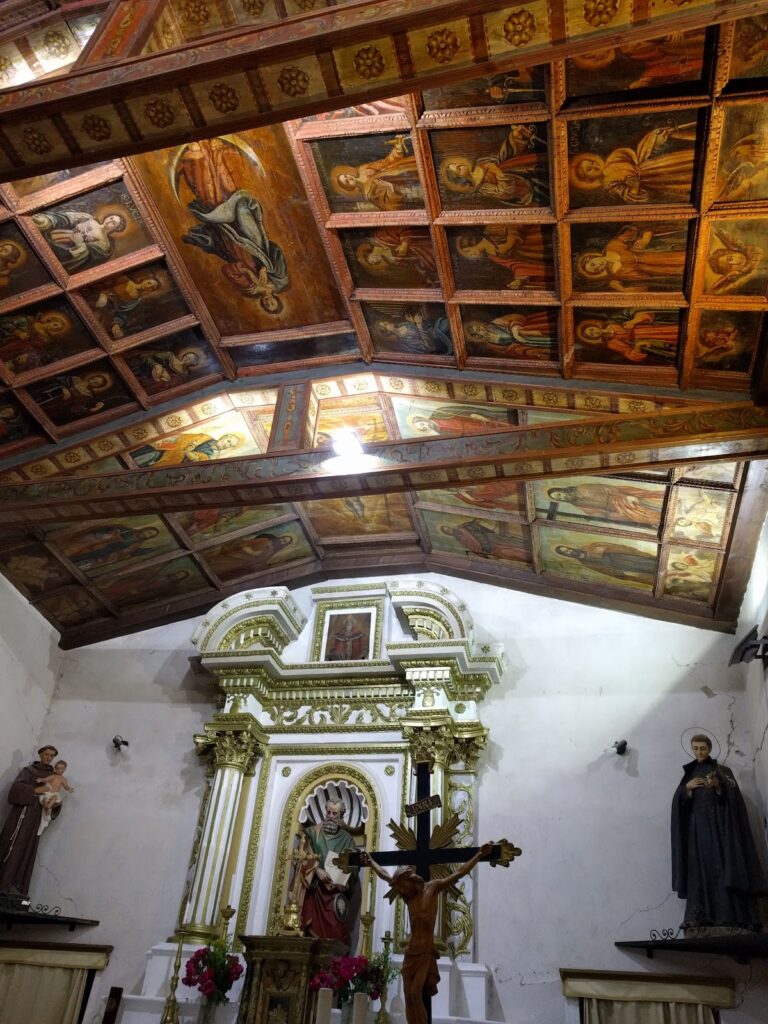
The larger Church of Saint Francis has a Baroque interior with side chapels dedicated to Our Lady of Sorrows, Our Lady of the Rosary, Saint Anthony, and Saint Lucy. The Chapel of Saint Lucy contains an image of the Sacred Heart of Jesus. The complex also includes the Muzi Chapel, with a statue of the Assumption of the Virgin Mary, and the Chapel of Saint Francis.
The semicircular apse contains two tempera paintings inspired by the Old Testament, a statue of the Madonna, and a higher tempera painting of the Coronation of the Virgin Mary. The original church also had a high, pointed, trefoil-headed biforate window, a Gothic opening with three lobes divided into two sections.
Chapel of Saint Anthony
Interior Decoration
The Chapel of Saint Anthony occupies the former refectory and has a Baroque single-nave layout. Its apse is covered with frescoes and paintings, while a large dome rises above the space. The dome has eight windows and a central representation of Saint Anthony in glory.
Ten Corinthian columns are attached to the chapel walls. The altar carries a statue of the Immaculate Madonna. In the four triangular spaces between the dome and the nave are representations of justice, prudence, fortitude, and temperance, the four cardinal virtues of Christian ethics.
Paintings and Canopy
Among the chapel’s paintings is a work by Vincenzo Baldati dated 1792. It shows Saint Anthony kneeling and looking toward Saint Bonaventure of Bagnoregio. Bonaventure, a Franciscan theologian and major leader of the order, is shown looking heavenward and offering the Franciscan Rule, which he had revised, to the Immaculate Madonna.
The chapel atrium contains a neo-Gothic baldachin, a canopy placed over a focal feature such as an altar or statue. Raffaele De Fabritiis made the gilded wooden canopy in 1903.
Organs
The principal choir loft contains a large three-manual organ. A second, older organ stands on the chapel gallery. Vitale De Luca made it in 1862, and it was restored and reconstructed in 1997.