Fort Zeelandia: The Dutch East India Company’s Fort in Anping
Site at a Glance
- Country
- Taiwan
- Primary era
- Early Modern
- Eras represented
- Early Modern, Modern
- Civilizations
- Dutch, Japanese, Qing
- Site type
- Military
- Remains
- Fort
On this page21 sections
History
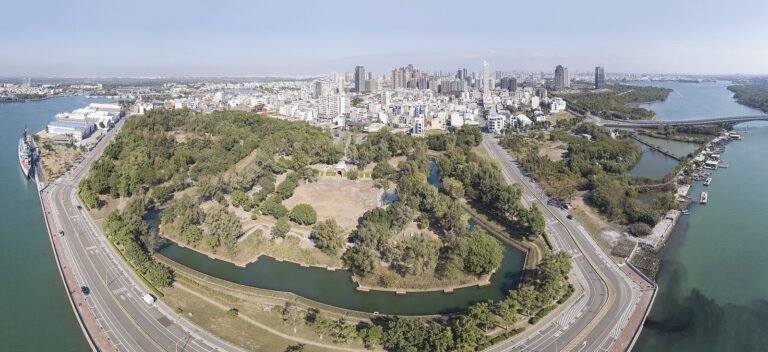
Fort Zeelandia is a Dutch fort in Anping, Taiwan, built by the Dutch East India Company (VOC) from 1624. It became the company’s administrative center on the island and a base for its regional trade. The fort’s position at Tayouan Harbor, the Dutch-era name for the harbor and settlement area of present-day Anping, helped the VOC control access to the inland sea.
First fort and Dutch rule
The VOC began a temporary fort on the sandy shore at the harbor entrance in October 1623. Sixteen soldiers and 34 enslaved laborers from Banda started the work after arriving on 27 October, while local Indigenous communities helped collect bamboo. Tensions over the Dutch use of bamboo and the distribution of gifts led to violence. After several hundred armed people attacked, Indigenous forces set the fort on fire in an assault at night in early 1624.
The VOC dismantled the temporary fort in April 1624 while facing pressure from Ming forces at Penghu and lacking the strength to hold both places. An agreement permitted the Dutch to withdraw from Penghu and trade at Tayouan. Under Martinus Sonck, the first Dutch governor of Formosa, the company began rebuilding at the earlier site in August, using materials from the abandoned fort at Penghu. The new fort was first named Fort Oranje. In 1626, the VOC’s directors ordered the name changed to Fort Zeelandia, after the Dutch province of Zeeland. Work proceeded in stages: the upper main fort was finished by the end of 1632 and opened in January 1633, the lower main fort was completed in 1634, and the outer fort was finished between 1637 and 1639.
Governor Petrus Nuyts judged the original design and its earthen or sandy walls inadequate against a major assault, and strengthened the fort with stone. His successor, Hans Putmans, continued the work. Dutch defenses in the area also included Zeeburg, across the waterway to the north, Fort Utrecht on nearby Spoon Hill from 1639, and Fort Provintia, built in 1653. Zeelandia and Provintia occupied elevated positions from which they could exchange signals. The VOC could also seek supplies and reinforcements from Batavia, its Asian headquarters, during a siege.
A confrontation in 1628 involving Japanese merchant Hamada Yahei exposed tensions within Dutch rule. After VOC officials detained Hamada and representatives of an Indigenous community, Hamada’s armed companions entered the fort and seized Governor Nuyts and his six-year-old son. They took hostages when they left Taiwan on 7 July. The Dutch removed Nuyts from office in 1629, but the dispute disrupted Dutch-Japanese trade until the hostages were released in 1632.
The siege and Zheng rule
Concern over an attack by Zheng Chenggong, a Ming-loyalist military leader who later established Zheng rule in Taiwan, prompted further defenses. In 1660, Zeelandia’s last Dutch governor, Frederick Coyett, added a projecting fortification at the northeast corner of the lower fort. Zheng’s forces began their attack in late April 1661, bringing 25,000 men and 400 warships against a Dutch garrison of about 2,000. In a naval battle on 1 May, one Dutch ship exploded and the others withdrew; Zheng’s forces lost about 1,000 men. At North Line Tail, more than 4,000 Zheng soldiers killed the senior Dutch military officer in Taiwan and over 100 Dutch soldiers after the Dutch force ignored an order to retreat.
Zheng’s troops captured Fort Provintia and advanced on Zeelandia from the peninsula, the water, and North Line Tail. An assault on 25 May failed, with more than 1,000 Zheng casualties and 700 to 800 wounded. Zheng’s forces then blockaded the fort. Dutch reinforcements arrived in August aboard nine ships carrying 725 men, while Indigenous attacks on Zheng garrisons elsewhere killed an estimated 2,000 to 3,000 of his troops. A September engagement left more than 100 dead on each side. In December, the commander of the Dutch relief force fled to Batavia with troops, weapons, and provisions, leaving Zeelandia’s defenders badly weakened.
On 25 January 1662, Zheng’s forces bombarded Zeelandia and Fort Utrecht from the north, east, and south, and attacked Utrecht under the cover of 16 warships. With fresh water running short and no further relief expected, the Dutch council agreed to negotiate on 27 January. The sides signed a surrender agreement on 1 February. Dutch officials, soldiers, and civilians could leave with their personal belongings and supplies, while the forts and VOC property passed to Zheng. Coyett handed over the keys on 9 February, and about 2,000 Dutch people departed on eight ships. The surrender ended VOC rule in Taiwan.
Zheng’s family made the captured fort the residence of the royal house, and three successive Zheng rulers lived there. The site became known as the Royal City. During the siege, Zheng had begun establishing a new administration in Taiwan, with one prefecture and two counties, and renamed the territory Anping.
Qing rule and decline
After Qing forces took Taiwan in 1683, the political center shifted to Tainan and Zeelandia deteriorated. In 1718, a county magistrate established the Taiwan Naval Brigade’s office inside the fort, along with an armory for weapons and gunpowder. Residents and officials also took bricks from the walls for other building work. Repairs followed: in 1733 a military deputy commander repaired the short northern shore wall, whose foundations were being eroded by the tide. Another deputy commander built two guardhouses inside the outer fort’s southern gate in 1748. After the northwest coast eroded in 1749, a local degree-holder paid for a sand embankment, which the deputy commander completed.
During the 1868 conflict known as the Camphor War, British naval gunfire hit the fort’s gunpowder store. The resulting explosion destroyed walls and left the site in ruins. In 1874, Imperial Commissioner Shen Baozhen had bricks from the outer fort taken to build the Eternal Golden Castle at Erkunshen.
Later changes and archaeological work
Japanese authorities leveled the remaining inner-fort walls in 1897 and created a red-brick platform at the site. The area was altered again for a 1930 commemoration of Taiwan’s 300th anniversary, when nearby residences were removed and a customs building was rebuilt for exhibitions and receptions. During the Second World War, a brick air-raid observation tower was added. After the war, the authorities adopted the name Anping Old Fort. A municipal restoration between 1975 and 1977 altered the tower, adding a pointed red roof and white paint. A Zheng Chenggong commemorative park was established beside the southern wall in 1979.
Ground surveys and archaeological investigations began in 1993. In 1983, the Taiwan City Remains received national monument status; the outer walls and building remains were given a separate municipal designation in 2004. In October 2022, a heritage review committee decided to combine the protected areas as one site under the name Fort Zeelandia Remains, recognizing that both belonged to the same Dutch fort. The formal announcement was still pending.
Remains
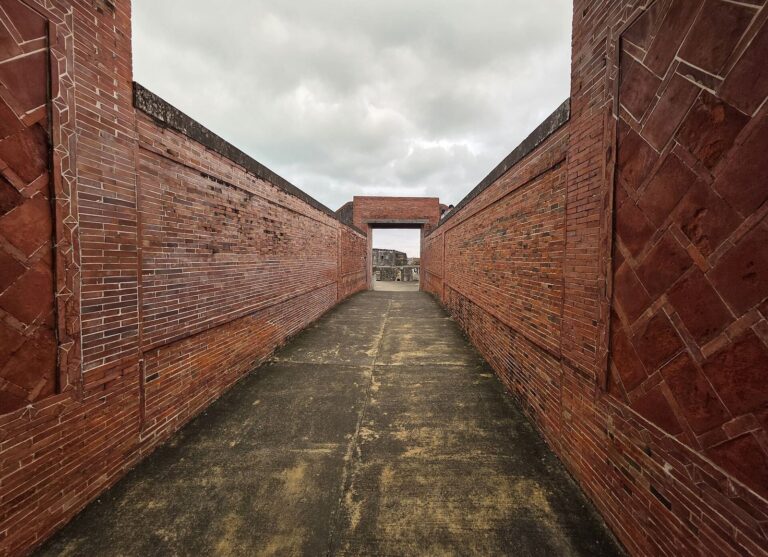
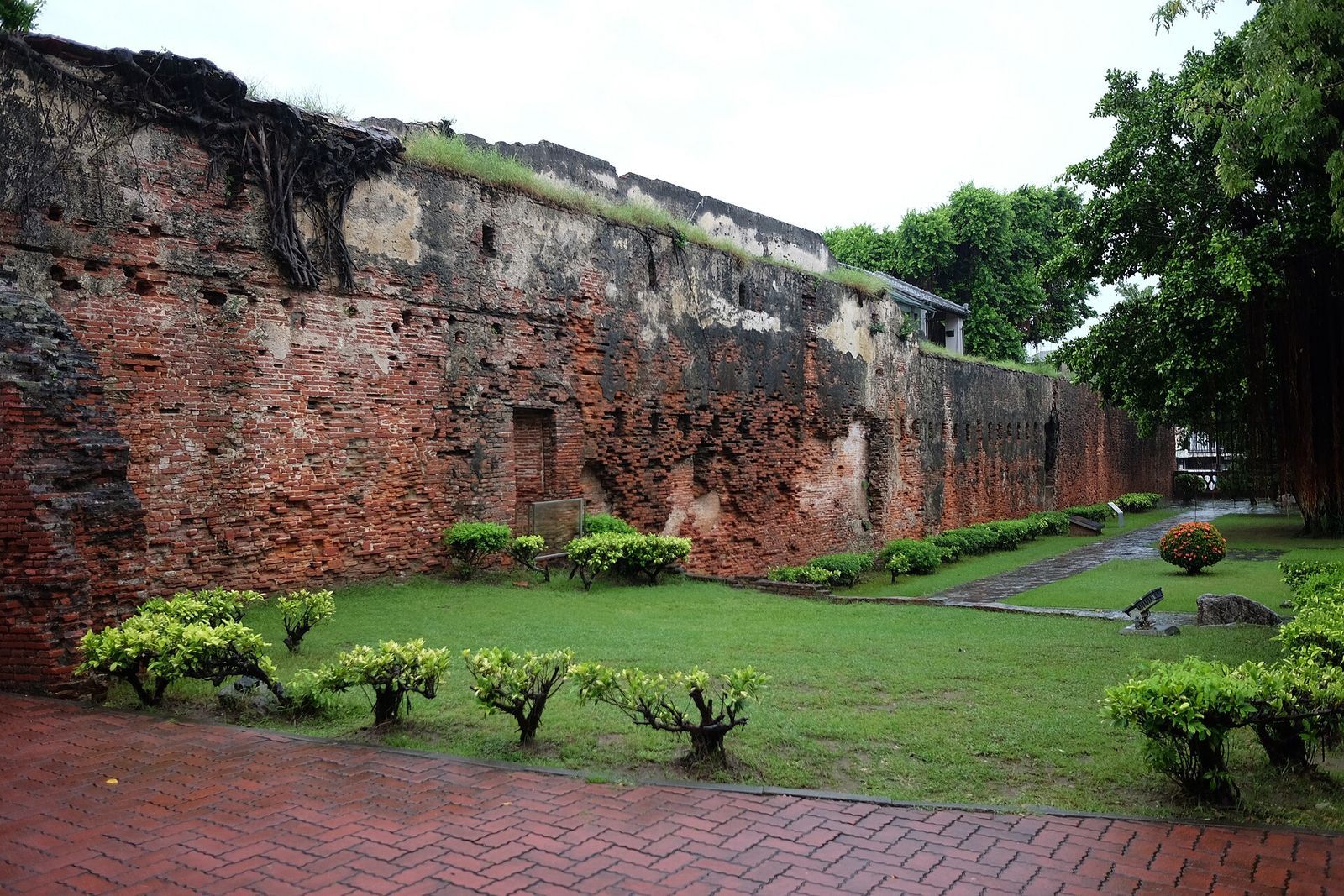
The fort occupied about 2.5 hectares and followed a late-sixteenth-century Dutch defensive plan, with three successive lines of walls. Its square inner fort and rectangular outer fort formed the main parts of the complex. Red bricks brought from Batavia, on the island of Java, were laid with mortar made from glutinous rice, syrup, sand, and oyster-shell lime. The bricks were kiln-fired for ten days. Dutch bond, a brick pattern alternating short ends and long sides with staggered joints, was used in the masonry. Metal ties set into gables connected outer walls to interior timber beams.
Fort layout and masonry
Inner fort
The square inner fort had three levels. Its lowest level stored ammunition and food. On the second level, each side had a wall with a projecting semicircular defensive work at its midpoint. The upper level held separate administrative offices, barracks, and a church. Four bastions, projecting fortifications used for defense, stood at the corners: Vlissingen in the northeast, Amsterdam in the northwest, Middelburch in the southwest, and Camperveer in the southeast. Each had three cannons, and a watch post occupied the southwest bastion. Gates on the north, east, and west sides provided entry between the corners.
Outer fort
The rectangular outer fort joined the inner fort on its northwest side. Its northwest bastion was called Hollandia and its southwest bastion Gelderland; both carried several cannons. Residences, a hospital, and other houses stood within the outer walls, along with a plaza used for trade. A small defensive work was added at the northeast corner in 1660. Outside the fort, the area between it and the town contained a market, slaughterhouse, gallows, execution ground, and public weighing station.
Governor’s residence and construction
The governor’s residence in the inner fort was built around 1635–36 and had a basement and two storeys. Goods were kept in the basement; the first floor contained reception rooms, offices, and living quarters for the governor, senior officials, and their families. The second floor stored textiles and other valuable goods. The entrance displayed the VOC emblem. Its roof was first flat to preserve firing lines, then changed to a pitched roof, and four cannons were mounted for defense. An indoor passage linked the inner and outer forts.
Surviving walls
Southern wall
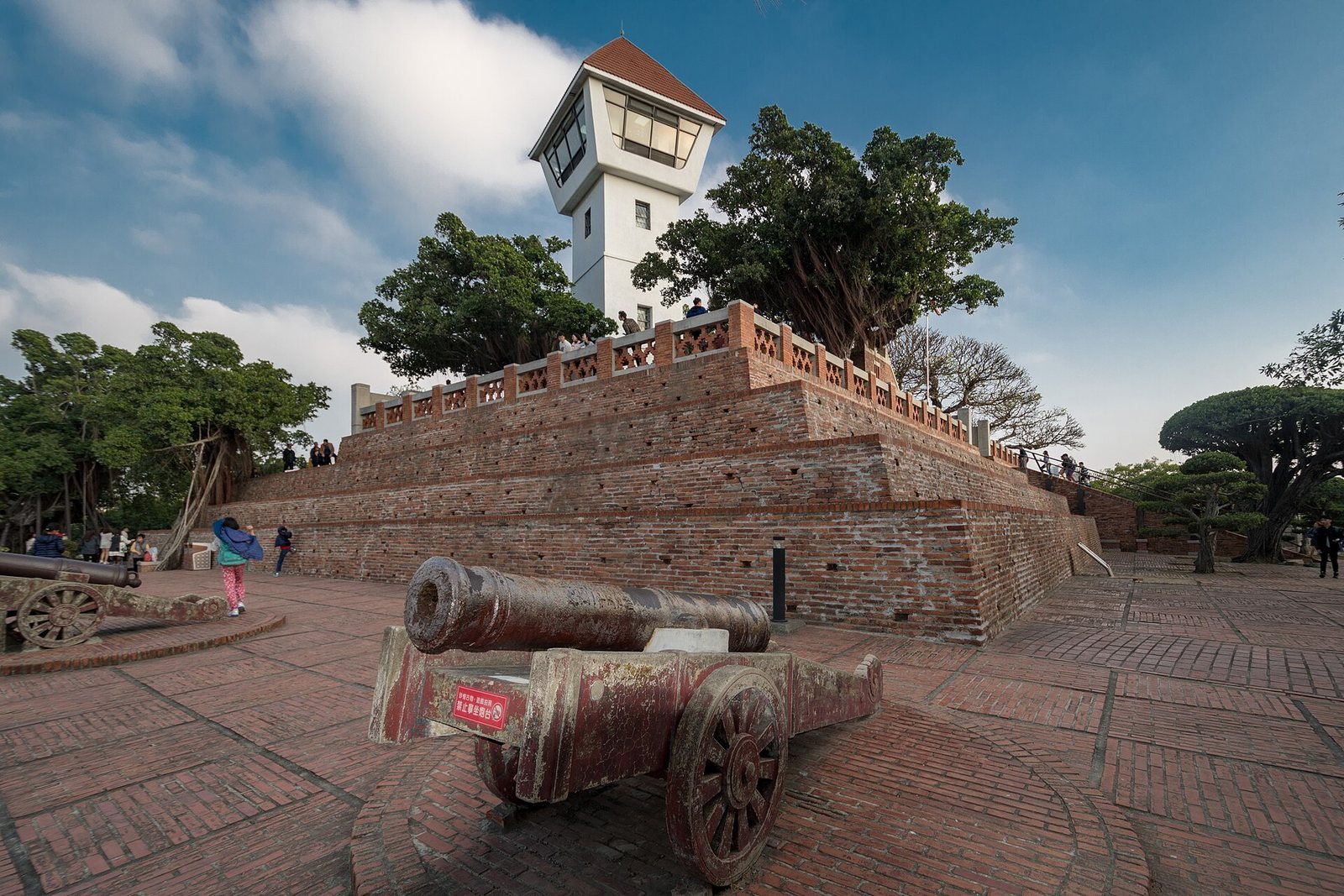
The best-preserved wall remnant is a 65.8-metre stretch of the outer fort’s southern wall, inside the present park. Three metal wall ties survive in it. A southern gate was opened in this wall after Zheng Chenggong took Taiwan.
Northern and southwest sections
A section of the outer fort’s northern wall survives at a residence. It is about 2 metres high and 38.7 metres long, and once faced the harbor channel to control the passage of trading vessels. Its northwest gate remains sealed with cement. Behind a temple in Anping, a section of the southwest bastion wall rises about 5.4 metres and has a side elevation 15.15 metres long.
Inner-fort remnant
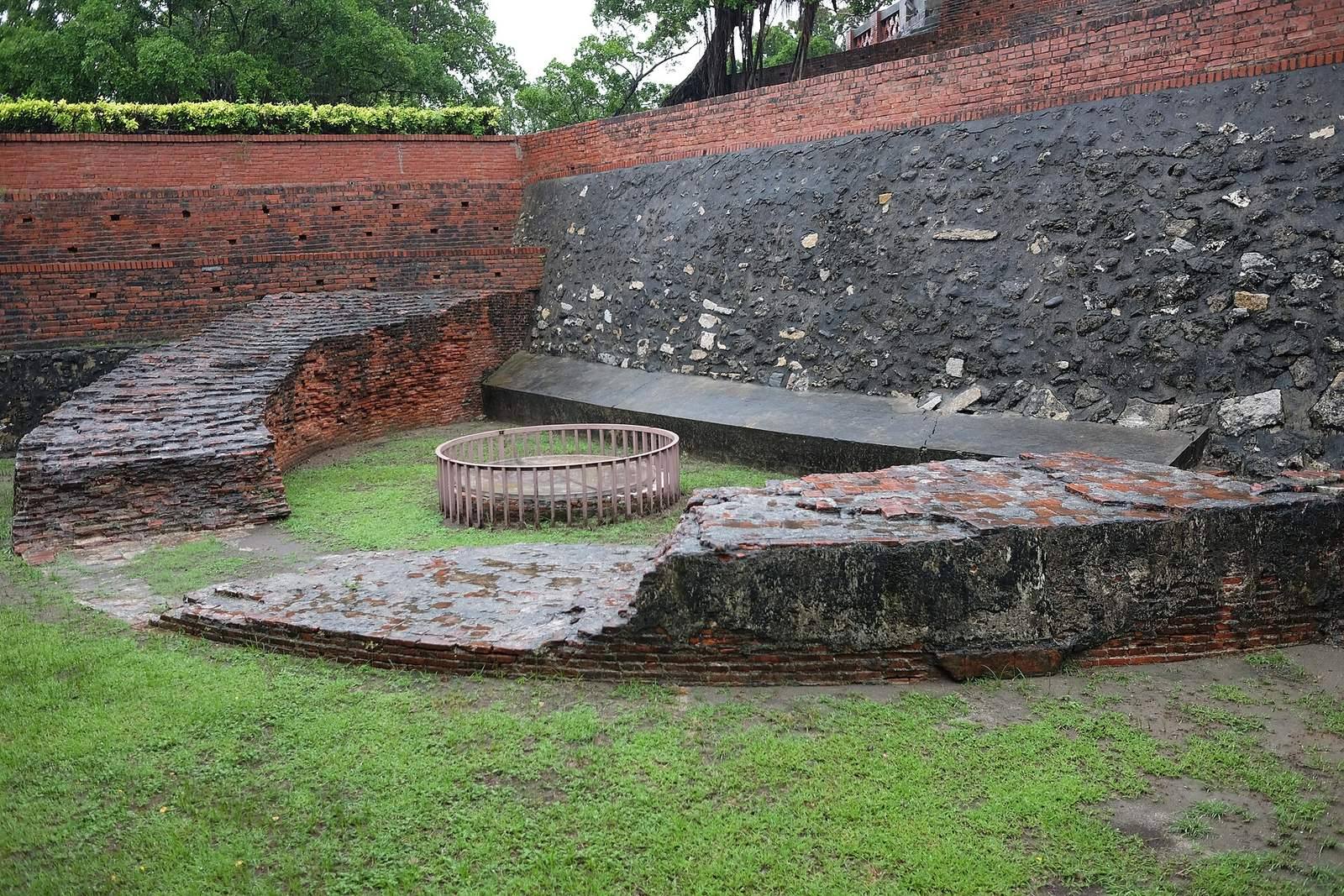
A remnant of a semicircular defensive work survives on the north side of the inner fort. It contains a circular structure traditionally called an old well. Researchers have proposed that it may instead have been a passage between the inner and outer forts.
Excavated remains and water supply
Archaeological features
Ground-penetrating radar work in 2001 detected buried foundations of several inner walls. Test excavations from 2003 to 2005 exposed wall foundations, a widened footing beneath the southern wall, a brick-wall structure, an L-shaped wall meeting at an obtuse angle, and a Japanese-period drainage channel. The excavations recovered seventeenth-century ceramics from the Netherlands, China, Japan, Southeast Asia, and Europe. Later work uncovered the outer fort’s west wall and an exterior waterway. An investigation in 2021 revealed the western outer wall and its drainage system; preparations on nearby land also brought to light remains that may belong to the northeast bastion.
Wells
Records identify north, south, and west wells, as well as two northern wells that were filled or covered with iron plates. The west well is retained beside the entrance to the Fort Zeelandia Museum. Soil now blocks its bottom, and it is dry.
Later structures and objects
Observation tower and lighthouse
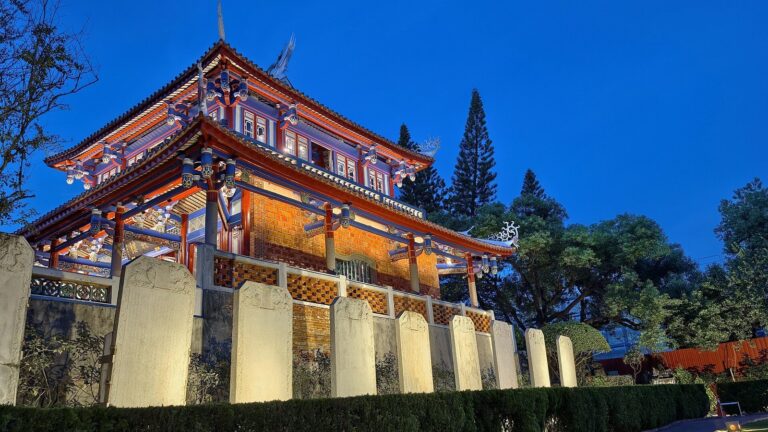
A wooden lookout tower once stood on the fort platform, followed by a brick air-raid observation tower built around 1944. The altered tower in the park has white-painted walls and a pointed red roof. The Anping Lighthouse, a brick structure, was moved from the harbor pier to the platform in 1908. It stopped operating in 1960 and was relocated in 1965 to an iron tower near Anping’s seaside viewing platform.
Memorial buildings
The history memorial hall stands on the fort platform and displays historical material and models, including a model of Zeelandia. The site previously held an Anping customs residence built in 1896; it was adapted in 1929 as a club-like rest facility and rebuilt for exhibitions and receptions in 1930. Near the park entrance, the Fort Zeelandia Museum occupies a customs superintendent’s residence built in 1882. The building later served as a customs club, exhibition venue, district office, and folk-art museum, before opening as the Fort Zeelandia Museum in 2009 after restoration.
Monuments and cannons
A monument commemorating Hamada Yahei stood by the customs residence. Its original inscription was removed in 1946, leaving the words “Anping Old Fort.” Another monument, moved beside the history memorial hall in 1930, commemorates the Taiwan Naval Brigade’s armory and its military deputy commander. It was erected in 1873 after the armory burned. Cannons moved into the park for the 1930 exhibition include a 1,500-jin muzzle-loading cast-iron cannon, inscribed as cast in the nineteenth year of the Jiaqing reign for the Taiwan Naval Brigade’s right battalion. Jiaqing was a Qing reign title, and jin is a traditional Chinese unit of weight. The collection also includes two 500-jin muzzle-loading cast-iron cannons, two further muzzle-loading cast-iron cannons, and a British-made short cannon. A statue of Zheng Chenggong stands opposite the history memorial hall.