Maruoka Castle: A Japanese Hilltop Castle and Its Surviving Keep
Site at a Glance
- Country
- Japan
- Primary era
- Early Modern
- Eras represented
- Early Modern, Modern
- Civilizations
- Japanese, Oda regime, Tokugawa
- Site type
- Military
- Remains
- Castle
On this page11 sections
History
Maruoka Castle is a hilltop Japanese castle in Maruoka, Japan, founded in 1576 by Shibata Katsutoyo during the Sengoku period, an era of civil war and political division. In 1575, after Oda Nobunaga suppressed an uprising by the Ikkō-ikki, leagues of Jōdo Shinshū Buddhist followers who sometimes joined local warriors in armed resistance, Katsutoyo received Toyohara Castle. The following year, he moved his base to Maruoka and built a castle on the hill.
Foundation and changing rule
A local legend connects the castle’s construction to a human sacrifice. After the stone base repeatedly collapsed, the story says, a vassal proposed sacrificing a person to appease the gods. O-shizu, a poor, one-eyed woman with two children, agreed to be sacrificed on condition that one child become a samurai, a member of Japan’s warrior class. The legend says stones were piled around her and that her death allowed construction to succeed. Katsutoyo then left without keeping his promise. People later said O-shizu’s resentful spirit caused the moat to overflow with April rain, called the rain of her sorrow. A small tomb was raised to calm her spirit, and a poem about the rain and her tears was passed down.
After Nobunaga’s death in 1582, the Kiyosu Conference, a meeting of his leading retainers to settle succession and territorial arrangements, transferred Katsutoyo to Nagahama, and Maruoka passed to another lord. In 1583, after Shibata Katsuie was defeated by Toyotomi Hideyoshi, Echizen came under Niwa Nagahide, who appointed Aoyama as castle lord. Following Nagahide’s death in 1585, his successor lost his lands, while Hideyoshi kept Aoyama in charge of Maruoka with a holding assessed at 20,000 koku, a measure of rice yield used to express economic scale.
Under the Tokugawa shogunate
In 1600, Aoyama backed Ishida Mitsunari’s Western Army at the Battle of Sekigahara, whose outcome helped establish Tokugawa dominance. The victorious Tokugawa dispossessed Aoyama. Tokugawa Ieyasu, founder of the Tokugawa military government, assigned Echizen to his son Yūki Hideyasu, who gave Maruoka to his retainer Imamura Moritsugu with a holding of 26,000 koku. After a disturbance in Fukui Domain in 1612, Imamura lost his position and Honda Narishige became lord, initially with about 40,000 koku. His service at the Siege of Osaka was followed by an increase in the domain’s assessed yield to 46,300 koku.
In 1624, after Fukui’s second lord, Matsudaira Tadanao, was exiled to Bungo and Fukui Domain was penalized, Narishige became an independent territorial lord and Maruoka Domain was established. His son and grandson completed the castle and its surrounding town. In 1695, the shogunate removed the Honda family after an internal succession dispute. Arima Kiyosumi, who arrived from Itoigawa with a 50,000-koku holding, replaced them. A descendant of Arima Harunobu, a prominent Christian territorial lord, Kiyosumi began a line that governed Maruoka until the domain system ended in 1871.
From castle to historic site
An earthquake in 1858 badly damaged the castle’s turrets and long buildings along its walls. In 1871, amid the government changes begun by the Meiji Restoration, Japan’s late nineteenth-century transformation of government, Maruoka became a prefecture and the castle served as its office. After the prefecture merged with Asuwa Prefecture, the Castle Abolition Edict ended the site’s use as a castle. Most buildings other than the keep were dismantled or moved, while gates, stone walls, and trees were sold. The town bought back the keep and grounds in 1901 and made them a park. The inner moat was gradually filled and partly built over from the late Taishō era into the early Shōwa era, which began in 1926.
The keep became a National Treasure under the former preservation law on 30 January 1934. It was designated an Important Cultural Property under the 1950 Cultural Properties Protection Law, a change reflecting the new legal system rather than a downgrade prompted by damage. In 1948, the Fukui earthquake caused the keep to collapse when its stone base failed. It was reassembled in 1955 around a reinforced-concrete frame, using original stones and much of the original timber.
Research completed in 2019, combining timber-ring analysis with radiocarbon and oxygen-isotope testing, found that most structurally important pillars were cut after 1626. The keep is therefore generally dated to the 1620s, with a reconstruction around 1628 proposed. If the traditional 1576 date for the castle’s construction is correct, the Honda family probably rebuilt much of the keep in the latter part of the 1620s, after Narishige became lord. In October 2019, a typhoon damaged the keep’s northeast exterior wall, which was subsequently repaired.
Remains
Castle layout and grounds
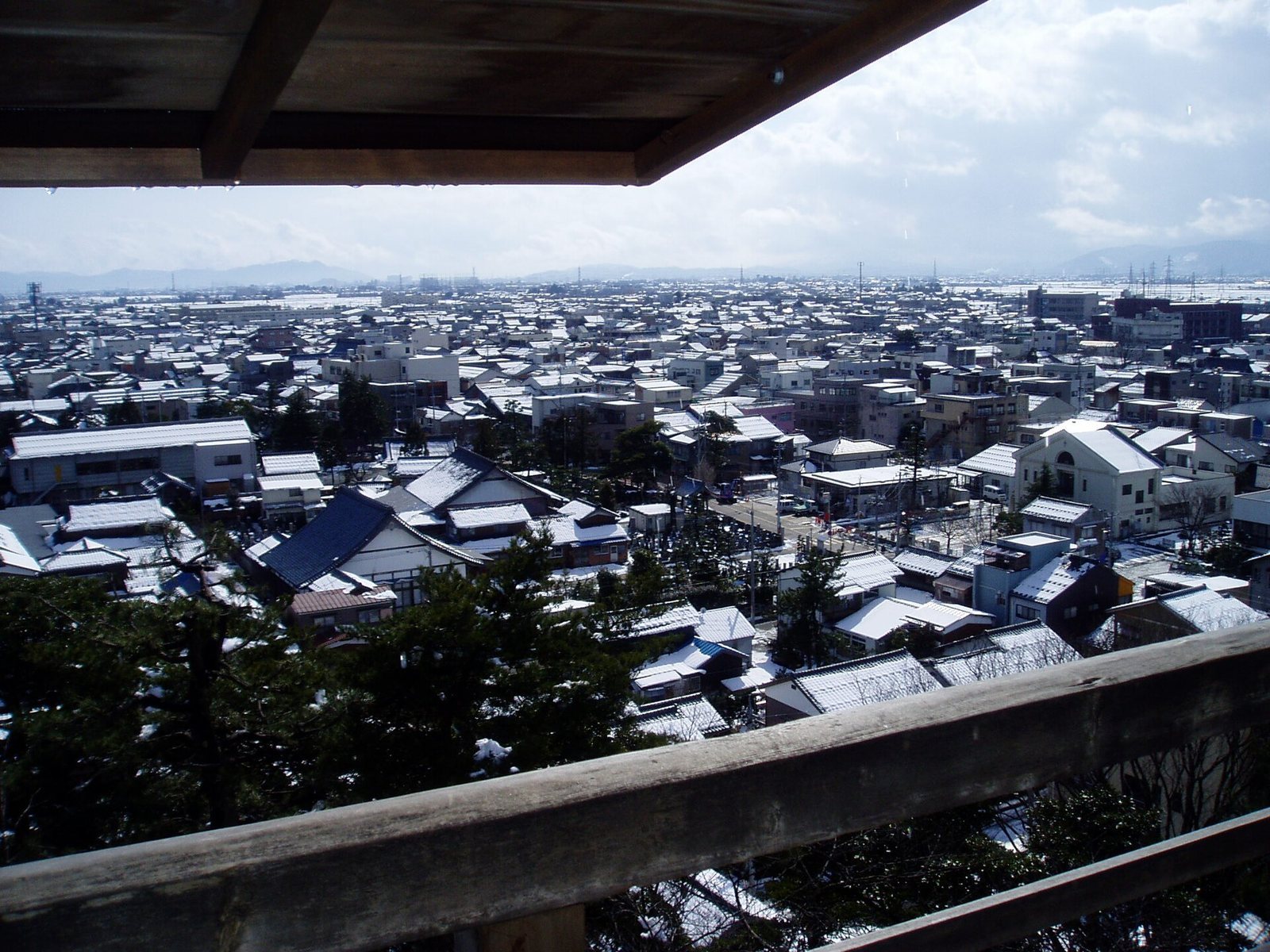
The castle occupies an isolated low hill east of Maruoka’s urban area on the Fukui Plain, near the junction of the route between Kaga and Echizen and the road linking inland Mino with the Sea of Japan. It is a hill-and-plain castle, combining a hilltop stronghold with the adjacent lowland. The hill’s base was levelled and the foothill area expanded in the early modern period. Connected defensive enclosures were bounded by ramparts and a pentagonal inner moat, now filled; traces of ramparts, stone walls, and moats remain. The former grounds are part of Kasumigajo Park, which has about 400 cherry trees and a small museum displaying weapons, armour, and household objects associated with former castle lords.
The main keep
Form and interior
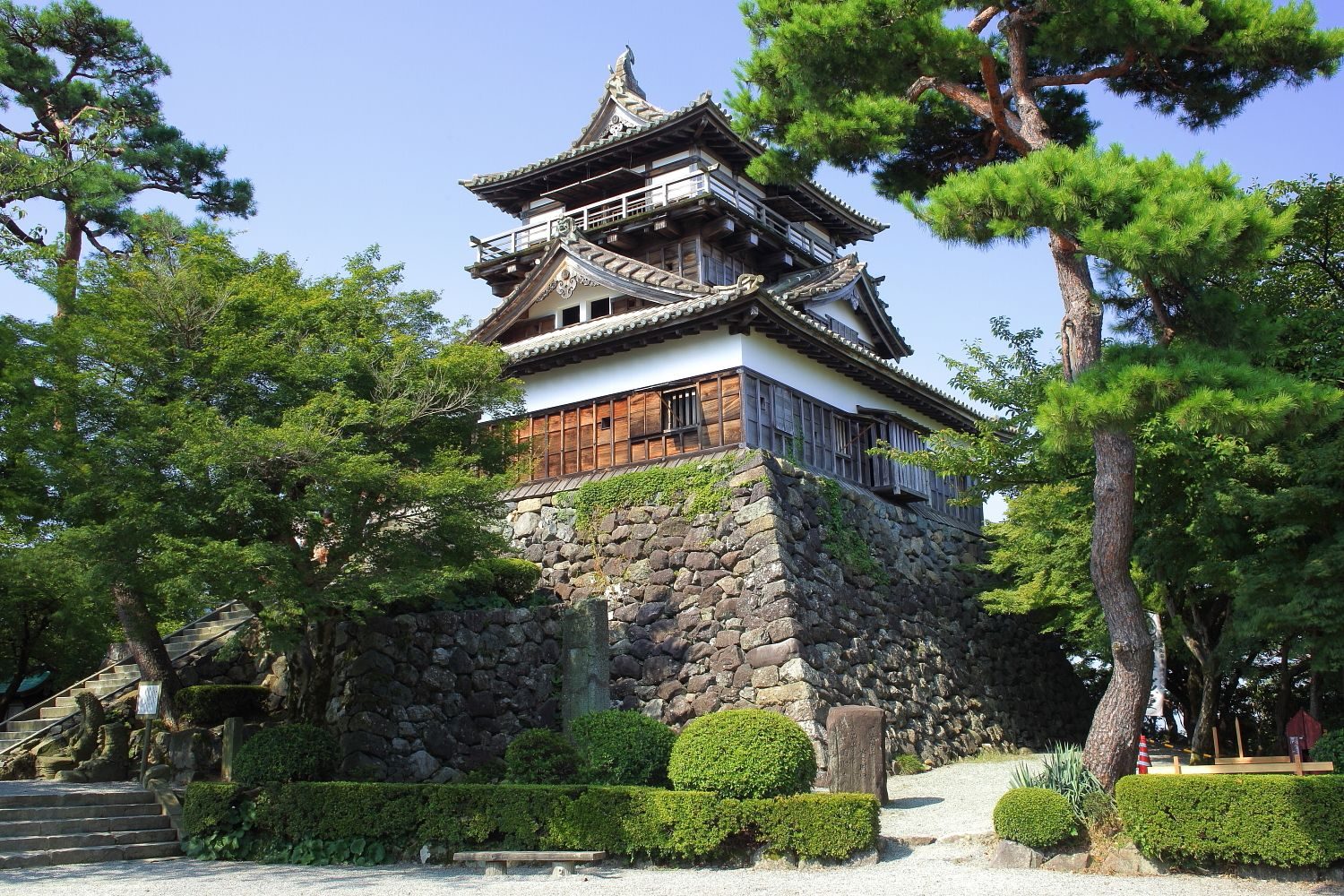
The keep stands on a stone platform 6.2 metres high among Japanese black pines and cherry trees. It is a freestanding watchtower-style building with three floors and two visible roof levels; the upper floor served as a lookout. The first floor extends beyond the stone platform, with a lower skirt roof covering the overhang. A long staircase leads into the black wooden interior, where the stairs between floors are steep and a concealed floor is not apparent from outside. The keep is the only surviving castle keep in the Hokuriku region and one of twelve surviving keeps in Japan.
Roof and defensive features
The exterior combines a large hip-and-gable roof with a small lookout tower and a surrounding veranda. Its earlier roof covering was wooden shingles, and wooden fish-and-tiger ornaments were finished with lacquer and gold. The covering later changed to tiles made from local shakudani stone; repairs, including work in 1941 and the 1955 reconstruction, used stone quarried at Komatsu in Ishikawa. The heavy stone-tile roof is estimated at about 60 tons, though estimates reach as high as 120 tons. The tiles may have been chosen partly for winter insulation. Stone shachihoko, roof ornaments with fishlike bodies and tigerlike heads, also decorate the roof. On the keep’s right-hand side, projecting openings allowed defenders to fire through wooden slats. Trapdoors provided a means to drop stones or pour oil or boiling water on attackers below.
Reconstructed fabric
The present keep incorporates a reinforced-concrete frame surrounded by stones from the original structure. About 70 percent of the original pillars and 60 percent of the beams were reused, along with nearly 80 percent of the materials recovered after the collapse. During reconstruction, the upper-floor sliding doors were changed to shutters that open upward. The keep’s old-fashioned appearance once prompted a claim that it was Japan’s oldest surviving castle keep, but comparisons with Inuyama and Matsumoto castles challenged that view.
Gates and earthen wall
Gates traditionally identified as parts of Maruoka Castle survive at Kōzen-ji temple in Komatsu, Ishikawa, and Renshō-ji temple in Awara, Fukui. Another, traditionally called the Unknown Gate, stands at a private residence in Maruoka. A section of the castle’s earthen wall also remains.