Toresund Church: A Medieval Church in Sweden
Site at a Glance
- Country
- Sweden
- Primary era
- Medieval
- Eras represented
- Iron Age, Medieval, Early Modern, Modern
- Civilizations
- Swedish
- Site type
- Religious
- Remains
- Church
On this page20 sections
History
Toresund Church is a medieval church between Stallarholmen and Mariefred in Strängnäs Municipality, Sweden. It belongs to Stallarholmen parish, a local congregation of the Lutheran Church of Sweden, and the Diocese of Strängnäs, a regional church jurisdiction. The church was built in the twelfth century.
Medieval development
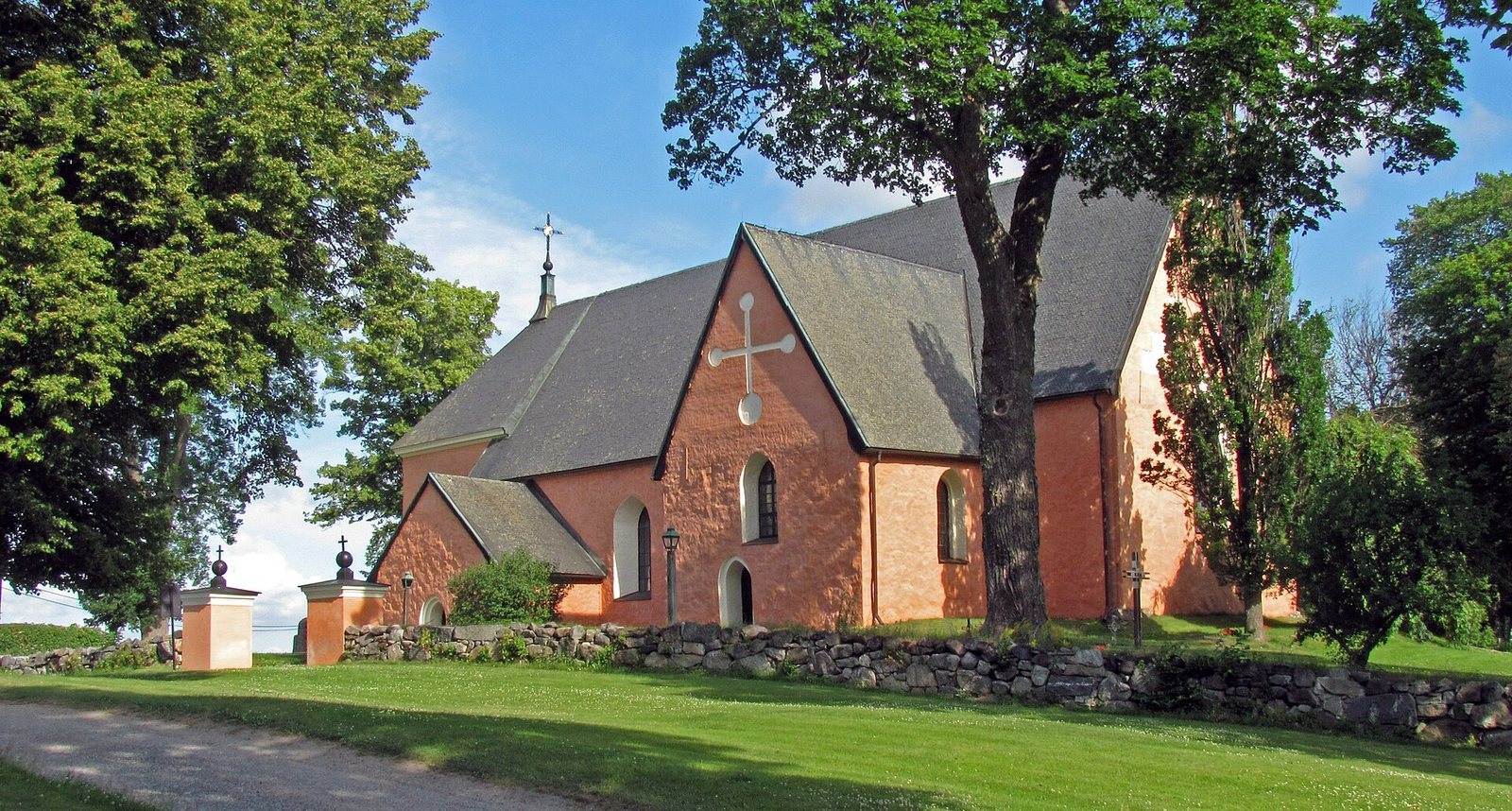
Stone vaults were added in the late fourteenth or early fifteenth century. A tower rose at the west end during the first half of the fifteenth century. In the late fifteenth century, the church was enlarged eastward, with a new sacristy beyond the older one, a south transept, and a porch on the south side.
Fire and changes to the tower
Lightning struck the church in 1502, setting fire to the tower spire and roof. Repairs followed, but the tower continued to suffer from structural weakness. It was repaired in 1684, and between 1748 and 1750 the tower builder Lars Ersson of Himlinge in Floda parish made a new cap for it. The bells remained in the tower until 1763, when they were moved to a separate belfry.
In 1795, stones began to fall from the tower. After inspecting it, Gustaf Pfeffer of the Office of the Superintendent, a state authority responsible for public buildings, judged the structure too deteriorated to keep and prepared plans for a replacement. Financial constraints ruled out that proposal. Instead, workers removed the unsafe parts between 1806 and 1808, and roofed the remaining tower together with the nave. What may have begun as a temporary solution became permanent.
Restoration
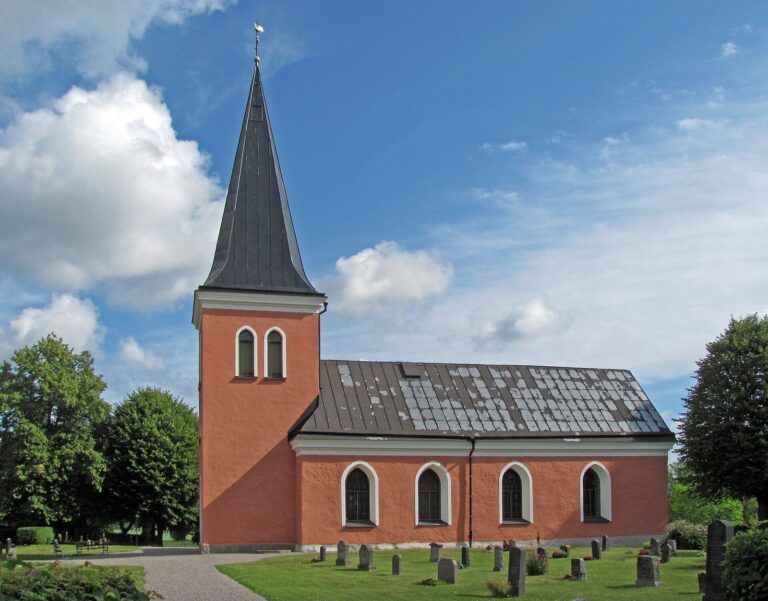
A forceful restoration led by Axel Lindegren in 1908 substantially damaged the church’s medieval character. Later work aimed to recover its earlier appearance. The former roof covering of tarred shingles was replaced with slate.
Remains
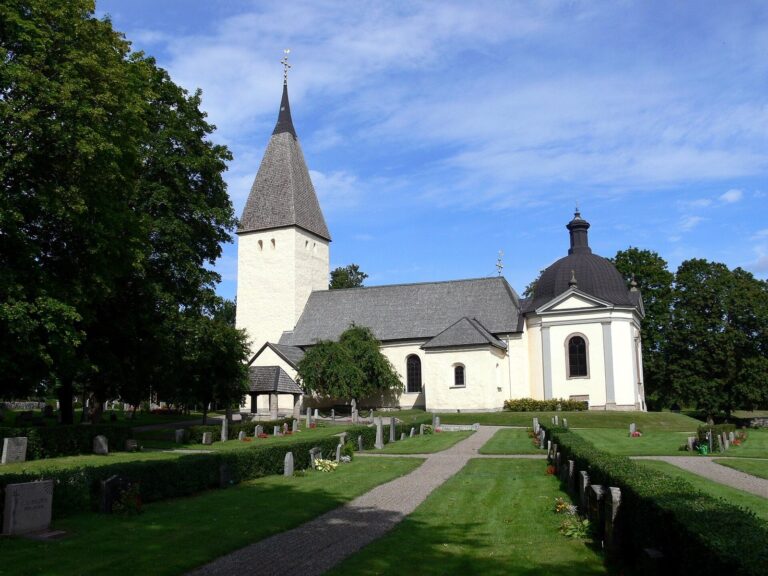
The church’s medieval body was enlarged to the east and given a south transept. Its western tower survives in lower portions, now covered by a roof shared with the nave. The exterior is finished in smooth, uneven plaster, and the surrounding cemetery includes entrances on three sides.
Exterior and churchyard
Church exterior
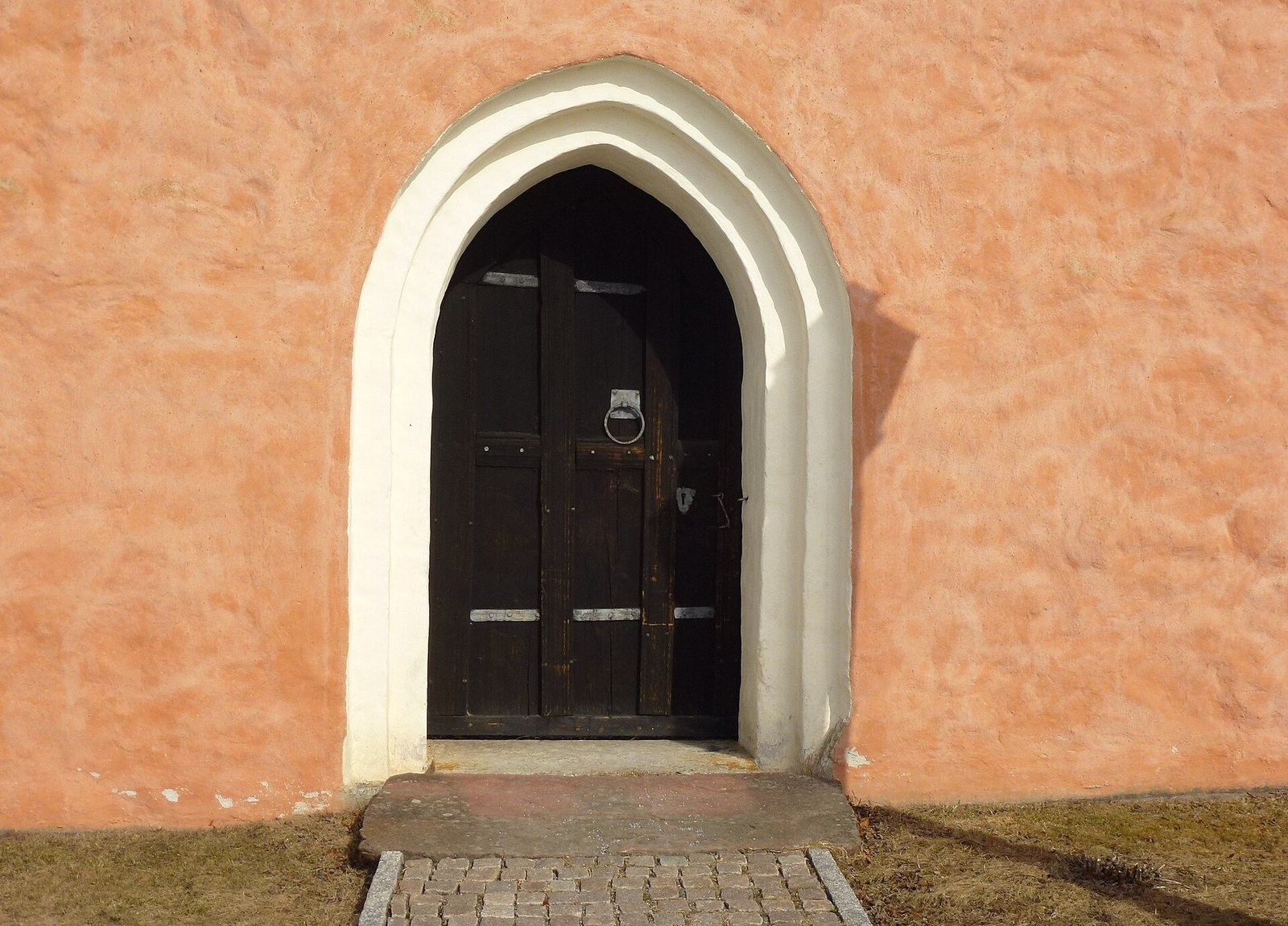
The renovated exterior plaster has a smooth finish, though its surface is uneven. Most window openings have pointed arches; the sacristy opening is round-arched. Fixed cast-iron frames are fitted to the windows along the church’s long sides. The sacristy and south transept instead have wooden windows, whose leaded panes probably date from the eighteenth century.
A light-granite Iron Age grave sphere is set into the tower’s south wall, about two metres above ground. It is roughly 50 centimetres across and bears decorated circles around a flattened central area, which is slightly damaged.
Belfry
The separate belfry stands on a rise east of the church. Master builder Kullberg built it in 1763 to plans by Malm, a master builder at Gripsholm Castle. Its paneling changed over time: simpler red-painted boards came before white-painted paneling, which was replaced with tarred boards in the early 1950s. Architect Sven A. Söderholm designed that later work.
Cemetery
The cemetery has entrances on its west, south, and east sides. Architect Erik Fant designed the eastern gate. The cemetery once reached only to the ground immediately beside the church, and its northern area was extended considerably in the 1930s. In 1789, workers from Dalarna built a stone wall beside the sacristy. A lychgate, a covered entrance to a churchyard, had a shingled roof in 1745.
Interior, art, and furnishings
Fonts, crosses, and altarpieces
The sandstone baptismal font dates from the twelfth century. Its smaller stand, made of carved, painted, and gilded wood, is from the middle of the eighteenth century. An early-sixteenth-century triumphal cross, a crucifix displayed at the arch between nave and chancel, is also in the church.
An altarpiece by the south choir was probably made in Lübeck between 1425 and 1450 and served on the high altar until 1785. The Last Supper altarpiece, signed and dated 1785, was painted by Carl Fredric von Breda. A fragment of a painting from the second half of the fifteenth century came to light during the 1908 restoration and was not restored. The altar table, altar rail, and pews now in the church were installed during that restoration; most of the earlier pews had been made in the 1730s. A special ‘cake altar’ for gifts associated with churching, a rite marking a woman’s return to church after childbirth, was removed in 1786.
Several medieval sculptures from the church are now held in museums. Two figures of Mary and John mourning at the foot of the cross, intended for placement near the triumphal cross, date to about 1250. A separate Virgin Mary sculpture is also from about 1250, while another probably dates to about 1300. A door from a triptych, an artwork made of three panels often joined by hinges, is probably a North German work from about 1330.
Lighting and metalwork
Five brass chandeliers remain in the church. Two unmarked, eight-arm examples date from the second half of the seventeenth century. Nils Lillieqvist donated another eight-arm chandelier in 1683. A smaller six-arm example carries the names Erich Jönson and Anna Christophersdotter and the date 1655. Johan Georg Lillienberg of Herresta gave a small six-arm chandelier in 1767.
Other lighting includes two silver candlesticks with floral decoration in raised and chased work, given in 1722 by Admiral Jonas Fredrik Örnfelt and Eva Catharina Schaeij. A pewter candlestick bears the mark of Stockholm maker Viet Fijthsson, who was active from 1637 to 1686. A five-candle candlestick of silvered copper was given from Herresta in 1748 and is probably older.
Communion vessels and baptismal bowls
A gilded-silver chalice and paten, the plate used to hold communion bread, were made in Stockholm in 1739 by goldsmith Henrik Wittkopf the Elder. The vessels bear the arms of the Örnfelt family, who held Herresta manor in the parish. Maria von Numers gave a silver wafer box in 1707. Another silver box, made by Stockholm goldsmith David Richter, was given by cavalry captain Peter Cremer and his wife Anna Silfverax. Cremer died at the Battle of Lund in 1676.
A silver pitcher marked as London-made in 1580 to 1581 has engraved Renaissance ornament. Of two other pitchers, one was made in Stockholm in 1738 by Gustaf Henning and given by Christina Charlotta Örnfelt of Herresta. The other was made in Strängnäs in 1836 by Johan Petter Ahlforss using old church silver. Goldsmith Johan Hackzell made the church’s communion set for visits to the sick in Mariefred in 1761.
The church also has baptismal bowls in pewter and silver. A pewter bowl decorated with flowers and a scene of the baptism of Jesus was made by Stockholm pewterer Viet Fijthsson Drenckler and given in 1664 by war commissioner Anders Lillieqvist. A silver bowl made in Stockholm by Arvid Floberg bears the arms of the Lillienberg and Jennings families. Johan Georg Lillienberg of Herresta and his wife, Maria Juliana Jennings, gave it in 1764.
Textiles
Two older collection bags are among the church’s textiles. One has four apostles embroidered on its exterior, using embroidery taken from a late-medieval chasuble. The other is made of green velvet with silver braid. Hacker, an inspector at Åker gunpowder works, gave it in 1728.
Graves and memorials
Gravestones and epitaphs
A gravestone for Anund Sture, a knight and privy councillor, was concealed beneath the floor during the 1908 restoration and later brought back to light. His shield, formerly displayed in the church, is now held by the Swedish History Museum. Several other gravestones are set into the choir floor, including one for war commissioner Henrik Örnfelt, who died in 1684, and his wife Margareta Appelberg.
Three stones in the altar rail commemorate parish priests Petrus Georg Silnaeus, who died in 1629; Jonas Laurentij Chenelius, who died in 1686; and Hans Thunman, who died in 1757. A stone dated 1686 for cavalry captain Petter Cremer and his heirs is above the steps to the central aisle. Near the sacristy steps, a stone dated 1692 commemorates Lars Olofsson Lan, an innkeeper at Pålsundet, his wife, and their heirs. Another stone north of the altar rail is for war commissioner Anders Nilsson Lillieqvist.
A carved-stone epitaph painted black, white, and gold on the north choir wall commemorates Anders Nilsson Lillieqvist, who died in 1668, his wife Maria Nilsdotter Bom, and their children. On the south choir wall, a memorial in Gustavian style, a Swedish neoclassical style of the late eighteenth century, honours President Jean Georg Lillenberg of Herrestad, who died in 1798.
Heraldic memorials and hunting sword
Funerary armorial displays, heraldic memorials for the dead, commemorate Admiral Göran Barck, who died in 1681, and his sons. Carl Johan and Jacob Gabriel died in 1669, aged seven and three; Gustaf Otto died aged seven in 1671; and Jöran died aged twenty-two in 1685, ending the family line. Other displays remember war commissioner Henrik Örnfelt; cavalry captain Peter Cremer, who died in 1676; cavalry captain and chief forest officer Paul Hillethan, who died in 1784; Admiral and Governor Jonas Fredrik Örnfelt, who died in 1733; and Lieutenant Johan Cremer, who died in 1698.
Further memorials honour Captain Ulrik Alexander von Hercules, who died in 1759; war commissioner Anders Nilsson Lillieqvist; Major Gustaf Gyllenspång, who died in 1705; and field sergeant Carl Gustaf Gripenberg, who died in 1741. A hunting sword hangs in the vault by the organ gallery. It formerly hung above von Hercules’s grave and probably belonged to him. Its decoration includes etched hunting scenes and a verse in German.
Organs
Gallery organ
An eight-stop organ, with each stop controlling a set of pipes, was bought from Stora Mellösa Church in 1769. The Gönholm family had given that instrument to Stora Mellösa in 1691. Johan August Josefsson of Stockholm built a thirteen-stop organ for Toresund in 1840. Johan Albert Johnsson of Duvbo made the present pneumatic organ in 1933; its mechanism uses air pressure. It has two free combinations, one fixed combination, and a register crescendo that progressively brings stops into use. Its case and some of its stops came from the 1840 organ. Setterquist & Son reorganized the stops in 1956.
Choir organ
Matts Arvidsson, an organ and harpsichord builder from Stallarholmen, made the choir organ in 1987 in Baroque style. It has nine stops and mechanical action, meaning that keys connect directly to the pipes. Carl-Gustaf Lewenhaupt designed its case. The organ’s compass is 54/27, and it uses Werckmeister III temperament, a historical system for tuning pitches.