Palacio Quemado: Bolivia’s Presidential Palace
Site at a Glance
- Country
- Bolivia
- Primary era
- Modern
- Eras represented
- Modern
- Civilizations
- Unclassified
- Site type
- Civic
- Remains
- Palace
On this page15 sections
History
Palacio Quemado is Bolivia’s presidential palace on Plaza Murillo in La Paz. Built in the neoclassical style, it was begun in 1846 to replace the colonial government house and inaugurated on 25 March 1853. A fire in 1875 gave the building its popular name, “Burnt Palace,” and it became the country’s official presidential seat in 1899.
The colonial cabildo and the republic
The palace’s predecessor was La Paz’s cabildo, a municipal council whose building also served administrative and judicial purposes. Spanish colonial authorities built it from 1559 to 1561. Indigenous people from Chucuito, Tiahuanaco, and Callapa were assigned construction work as yanaconas, Indigenous people assigned labor or service under the colonial system. Andrés Hurtado de Mendoza, the viceroy of Peru and a senior Spanish colonial authority, sent 12,000 pesos toward construction, while new settlers also contributed. Improvements followed in the late sixteenth and seventeenth centuries. Paintings made in 1781 show the Cabildo arranged around courtyards, with arcades, an upper gallery, a staircase, a tiled roof, and a prison in its second courtyard.
After Bolivian independence, the Cabildo became La Paz’s government house and prefecture. Simón Bolívar, a leading South American independence figure, was formally received there in August 1825. A local tradition credits Andrés de Santa Cruz with planning a palace. During visits to La Paz, Santa Cruz governed from his own residence, now San Calixto College; from 1836, he governed from Peru as Supreme Protector of the short-lived Peru–Bolivian Confederation. The present palace, however, was not begun until 1846.
Construction, fire, and political conflict
In 1846, President José Ballivián ordered the Cabildo demolished and a new government palace built. Architect José Núñez del Prado designed its replacement. Construction took six years and four months, and President Manuel Isidoro Belzu inaugurated the building on 25 March 1853. Early republican government was divided between Sucre and La Paz, whose political and strategic importance, including its proximity to Peru, helped make it a government center.
On 23 March 1865, during an uprising, a rifleman accompanying Mariano Melgarejo killed Belzu inside the palace. Melgarejo did not make the building his own seat; he preferred the former archiepiscopal palace, a choice associated with his frequent journeys to suppress uprisings and his fear of Belzu’s spirit. President Agustín Morales also died after being shot inside the palace by his nephew, Federico Lafaye. Morales had struck his aides, and died a few hours after Lafaye fired.
The name Palacio Quemado dates to an uprising against President Tomás Frías on 20 March 1875. After rioters’ attempt to storm the palace failed, people led by Carlos Ressini and Modesto Moscoso threw flaming torches from the nearby cathedral. The resulting fire left the building effectively uninhabitable. Restoration began in 1882. In the meantime, Frías and later President Hilarión Daza directed the government from a nearby building at Potosí and Ayacucho streets known as the Palacio Chico.
From the presidency of Narciso Campero through that of Fernández Alonso, governments were based in Sucre. Campero and President Pacheco used a former archbishop’s palace confiscated from the Archdiocese under Antonio José de Sucre; President Arce governed from his La Florida residence, and President Baptista from his private home. The monumental National Palace in Sucre was occupied only by Fernández Alonso. Bolivia’s 1898 Residence Law required the president to live in the republic’s capital and obtain legislative permission to leave. It heightened tensions with Chuquisaca and helped precipitate the Federal War, the 1898–1899 civil war fought amid a dispute over the seat of government. After the war, Palacio Quemado officially became the presidential seat in 1899.
Renovation and twentieth-century upheaval
President Ismael Montes ordered a major remodeling in 1913. In 1923, President Bautista Saavedra began a comprehensive renovation ahead of Bolivia’s centenary, completed in 1925. The work altered interior spaces and part of the exterior, turned a paved courtyard into the main vestibule, removed the stables, and replaced the high roof with a metal zinc covering concealed from the street.
On 21 July 1946, a revolt and assault on the palace led to the killing of President Gualberto Villarroel. A crowd threw him from a balcony into Plaza Murillo, hanged his body from a lamppost, and attacked the bodies of his aides. During Bolivia’s National Revolution, a major revolutionary period in the mid-twentieth century, President Víctor Paz Estenssoro expanded his office into the cabinet-room area and commissioned Miguel Alandia Pantoja to paint a mural about the revolution on the main staircase. President René Barrientos later ordered the mural destroyed because of its criticism of the army. Work in this period also added marble to the entrance arch and staircase and installed an elevator behind the stairs.
In 1973, during General Hugo Banzer’s government, the third floor stopped serving as the presidential residence, and a separate Presidential Residence of San Jorge was built in La Paz. An attempted rooftop helipad was also part of that year’s work. During Jaime Paz Zamora’s administration, interior remodeling restored cream and brown colors with vermilion details, especially in the vestibule. The third floor was again equipped for occasional presidential stays, and a small museum of portraits of the country’s rulers was established.
President Jorge Quiroga modernized the building in 2001 with computer equipment and armored windows. During Carlos Mesa’s administration, restoration reinforced the windows and renewed plumbing, electrical, communications, and security systems. The work also included an independent generator, new roofing, replacement of the vestibule ceiling’s glass panels, and restoration of the main façade. Artworks kept in the National Museum of Art’s storerooms were recovered, and the interiors were refurbished with the aim of restoring their 1923 decoration.
Changing government use
Palacio Quemado served as the presidential residence in 1853–1875 and 1899–2018. The newly built Casa Grande del Pueblo, announced in 2011 for land behind the palace, opened on 9 August 2018 and took over as the government’s main offices later that year. The older palace was intended for use as a museum. Jeanine Áñez’s government returned to it in 2019–2020. Luis Arce’s administration used Casa Grande del Pueblo as its government seat while holding some state ceremonies, including official visits by international leaders, at Palacio Quemado.
The palace is identified as a Bolivian National Monument and received the UNESCO Blue Shield emblem in 2019. The emblem is used to help identify and protect cultural property during armed conflict and other emergencies. Military personnel damaged parts of the building during an attempted coup on 26 June 2024. In 2025, President Rodrigo Paz’s administration restored its use as the principal offices of the Bolivian executive, while ministries remained in Casa Grande del Pueblo.
Remains
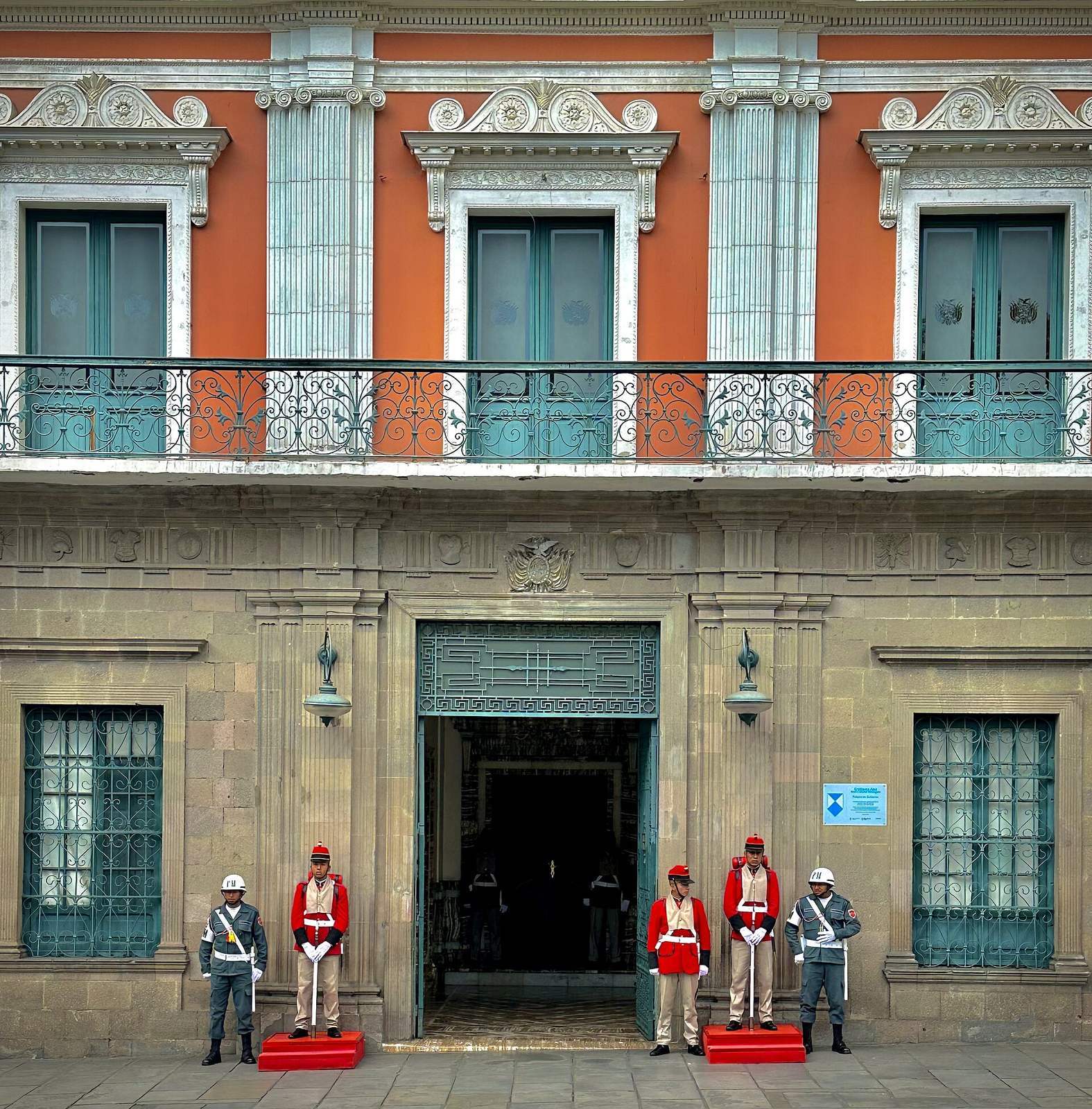
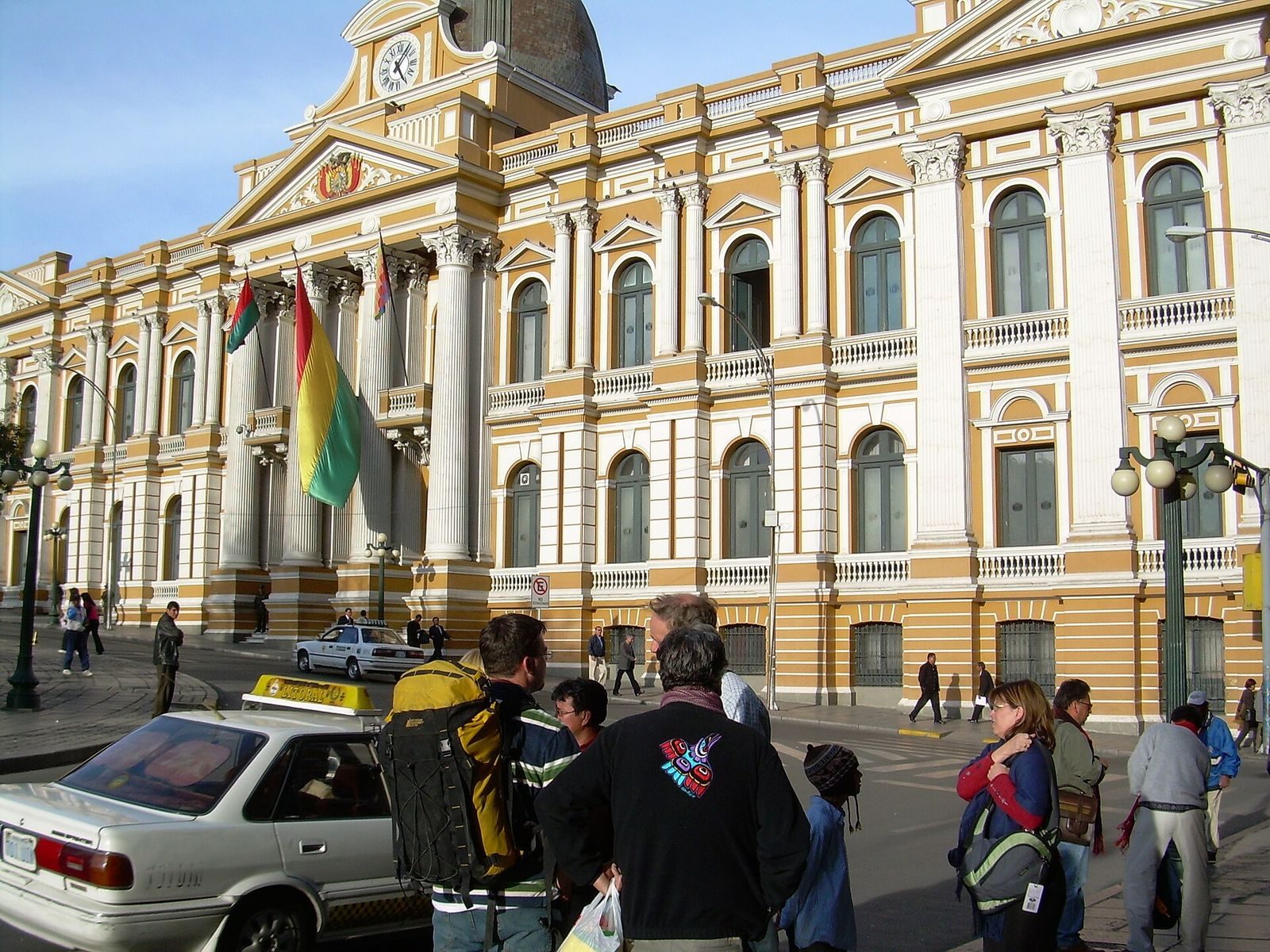
Palacio Quemado occupies a rectangular plot on Plaza Murillo, beside the Metropolitan Cathedral and diagonally opposite the former Legislative Palace. Its approximately 37-by-39-metre plan and neoclassical exterior organize the building across three principal floors. The slope of Ayacucho Street means the side facing that street has an additional basement level.
Facade and construction
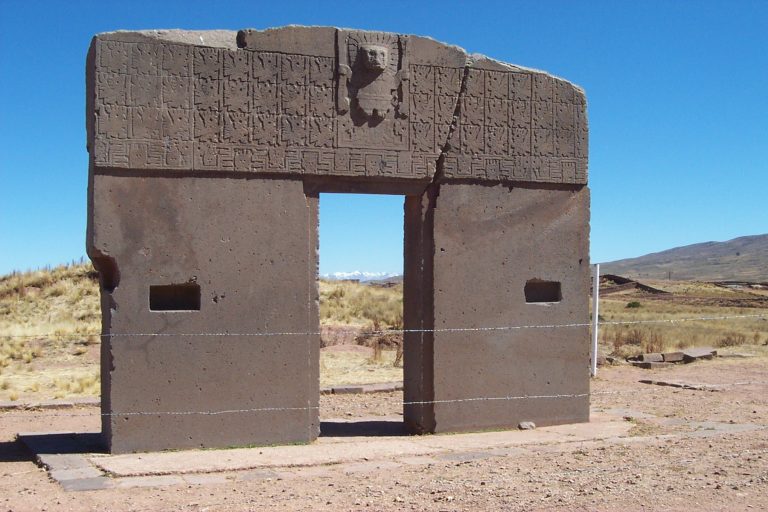
The façade facing the plaza is about 15 metres high. Flat, column-like pilasters divide its levels, using Doric forms on the ground floor, Ionic on the second, and Corinthian on the third. The windows have simple cornices below, scroll-shaped ornament on the second floor, and triangular tops on the third. Balcony doors open onto balconies with turned-iron railings; the Red Room’s long balcony is reached through three doors. Stone forms the ground-floor walls, while brick and adobe were used on the upper floors. Stone, brick, adobe, and wood are among the building’s structural materials. Some ground-floor stone has been attributed to archaeological material brought from Tiahuanaco, though that attribution is questioned because stone is plentiful around La Paz. A rear extension was commissioned in 1973.
Vestibule and principal rooms
The principal reception and government rooms are distributed across the building’s floors. The main vestibule provides access to a broad marble staircase and to the upper levels, where several rooms retain elaborate furnishings and finishes.
Vestibule and staircase
The vestibule has Doric supports and a marble staircase. A semicircular arch built from yellow and black marble blocks opens toward the second floor, where the principal rooms are supported by Ionic pillars. An elevator is installed behind the staircase.
Red Room
The Red Room occupies the second floor facing Plaza Murillo and is used for receptions and meetings. Its name comes from its carpet and curtains. Chandeliers and paintings concerning independence and the country’s conflicts accompany Louis XVI-style furniture upholstered in vermilion, cream, and pink tones.
Hall of Mirrors
Beside Ayacucho Street on the second floor, the Hall of Mirrors has been used for protocol events, diplomatic receptions, and the presentation of ambassadors’ credentials. Beveled mirrors framed in gold leaf are arranged like paintings; the room’s painting is the first map of Bolivia. Emerald-green curtains, patterned wood flooring, Rococo chairs with Beauvais upholstery, and chandeliers with spherical shades complete the interior.
Presidents’ Hall
Also called the Portrait Hall, this ground-floor room displays portraits of former rulers, historical uniforms of the Presidential Guard, clothing worn by rulers, and historical flags. It also contains a small library. A long, narrow red carpet lies over simple patterned wood flooring.
Main dining room
The second-floor dining room beside the cathedral is used for protocol lunches and dinners. Its window faces the cathedral. Rococo-style furniture stands on a sand-colored carpet with brown details over Siena parquet flooring, while beige curtains frame the room.
Cabinet Room and presidential office
The Cabinet Room is on the third floor beside the presidential office. Its furnishings include an oval table and Louis XVI-style chairs upholstered in brown leather. A distinctively carved chair bearing Bolivia’s coat of arms stands at the head of the table, with an oil portrait of Andrés de Santa Cruz behind it, between two doors to the presidential office. Wall-mounted candelabra, a chandelier, white Navajo marble panels, and four Ionic columns at the room’s corners complete the space. The presidential office contains a carved mahogany desk and another portrait of Santa Cruz, along with a small blue-and-grey sitting area and an eclectic-style dining area.
Presidential bedroom and administrative spaces
The third-floor bedroom beside the cathedral is equipped for occasional presidential stays. It contains an eclectic-style silver bed and a small sitting room decorated in pink tones. A staircase links the sitting room to the second floor and resembles the main vestibule staircase. The private bathroom was fitted in the 1990s with fixtures recovered from antique dealers. Elsewhere on the third floor, the Ministry of the Presidency occupies a functional office beside Ayacucho Street. The basement houses the Official Gazette of the State, which distributes executive bulletins, laws, decrees, resolutions, and ordinances; its public entrance is through a side door on Ayacucho Street.
A bust of President Gualberto Villarroel stands in the palace foyer.