Maebashi Castle: A Japanese Castle and Domain Seat
Site at a Glance
- Country
- Japan
- Primary era
- Early Modern
- Eras represented
- Early Modern
- Civilizations
- Tokugawa
- Site type
- Military
- Remains
- Castle
On this page13 sections
History
Maebashi Castle was a Japanese castle in present-day Maebashi, Japan, whose origins lay in a fifteenth-century Nagano-clan fortification near its later site. Traditionally counted among the Seven Famous Castles of the Kantō region, it developed through centuries of military conflict, river damage, rebuilding, and changes in political rule.
Origins and early conflicts
The castle’s beginnings are associated with a Nagano fort at Ishikura. A local chronicle compiled in 1684 places its foundation in 1489 and credits a founder identified by a Buddhist name together with a Nagano official who held the post of lieutenant of the Left Division of the Outer Palace Guards. The founder’s personal identity and the early history of the Nagano family remain uncertain.
A foundation tradition tells that a flood in 1534 diverted the Tone River into Ishikura Castle’s waterways, destroying its main and second enclosures. The third enclosure survived and became the base for rebuilding. The castle was subsequently known as Mayabashi Castle. By the middle of the sixteenth century, the Tone had shifted west of the castle, although flooding continued to cause damage.
After the Uesugi defeat at the 1546 Battle of Kawagoe, the Nagano clan turned toward the Hōjō around the middle of the century. In 1560, the prominent warlord Uesugi Kenshin captured the castle, used it as a base for campaigns in the Kantō, and appointed Kawada Nagachika as its castellan. Combined Hōjō and Takeda forces seized the castle in 1562–63 but failed to retain it. The Uesugi recovered it and installed Kitajō Takahiro as castellan.
The Uesugi later purged the Nagano family, but the circumstances are unclear. One tradition attributes the purge to a commander missing a battle because of illness; another says a horse’s behavior was taken as evidence of rebellion.
Contested rule and the Tokugawa takeover
Kitajō Takahiro defected to the Hōjō in 1567. An agreement between the Hōjō and Uesugi later returned him to the Uesugi side. After losing his base in Echigo in 1579, however, he submitted to the Takeda and remained castellan. In 1582, following Oda Nobunaga’s elimination of the Takeda, the castle passed to Nobunaga’s general Takigawa Kazumasu, who held it for about three months. The Hōjō recovered it after Nobunaga’s death.
In 1590, during Toyotomi Hideyoshi’s campaign against the Hōjō, Asano Nagamasa captured the castle. After Tokugawa Ieyasu took control of the region, he installed his retainer Hiraiwa Chikayoshi and assigned him a domain, a lord’s territory and administrative unit, assessed at 33,000 koku. Koku measured assessed rice yield and was used to express a domain’s scale. In 1601, Sakai Shigetada replaced Hiraiwa as lord, initially with the same assessed revenue.
Sakai rule and damage from the Tone
Sakai Shigetada carried out an extensive reconstruction, turning the castle into an early-modern fortified complex. The Sakai family ruled for seven generations, and the domain’s assessed revenue rose to 150,000 koku. The family moved to Himeji in 1749. During the seventeenth century, the names of both castle and town changed from Mayabashi to Maebashi. The family’s standing was also reflected in Sakai Tadakiyo’s service as chief elder of the Tokugawa shogunate.
River erosion repeatedly forced changes to the castle and its surroundings. An outer-enclosure corner turret was dismantled in 1699, followed by a river-channel diversion in 1702 and further river works in 1714. In 1710, a former domain lord asked the shogunate to transfer him elsewhere, citing the loss of land to the Tone and the shrinking castle grounds. By 1748, erosion had reached the main enclosure. The lord sought permission to move his residence to the third enclosure, and a foundation ceremony took place in December, but the work remained unfinished when the Sakai left.
In 1749, Matsudaira Tomonori was transferred from Himeji to Maebashi with a domain assessed at 150,000 koku. His youth was considered unsuitable for governing the strategically important Himeji domain. His branch of the Matsudaira family had already undergone ten transfers and carried substantial debts, which hindered immediate construction. A new residence in the third enclosure was completed in 1752.
Traditions linked the castle’s decline to the death of a female attendant at the point where the Tone struck its western side. Versions of the story say she was drowned after rejecting a senior retainer, meeting a former lover in secret, or being framed by jealous attendants who placed a broken needle in the lord’s food. In the last version, she was put alive in a container with snakes and centipedes and sunk. A related tale set during Hiraiwa Chikayoshi’s tenure says that he ordered a woman drowned in a tub with snakes and centipedes after finding a needle accidentally left in a robe she had sewn. The attendant’s spirit was said to have caused the castle to collapse.
Abandonment and rebuilding
Continued erosion and flood danger led Matsudaira Tomonori to abandon Maebashi Castle in 1767 and move his seat to Kawagoe Castle. Maebashi became a detached territory administered by the Kawagoe domain, and the castle was demolished in 1769. Residents repeatedly sought the lord’s return. They petitioned the Kawagoe lord in 1817; in 1838, the lord asked the shogunate for permission to return and for an additional 20,000 koku. During the Tenpō era (1830–1843), the river’s course was redirected westward, reducing the danger of the castle collapsing.
Growing prosperity from silk exports after Yokohama opened for trade helped make reconstruction possible. In December 1863, the shogunate authorized Kawagoe lord Matsudaira Naokatsu to rebuild the castle. Local residents contributed more than 77,000 ryō and supplied labor. The work was complete by 1867, when Naokatsu entered the castle and the Maebashi domain was restored. It was the last Japanese castle built during the Edo period, the era of Tokugawa shogunal rule.
From castle to prefectural seat
The Meiji Restoration, which ended shogunal rule and established a new central government, began less than six months after the castle’s completion. When the domains were abolished in 1871, the main palace became the Maebashi Prefecture office, while other castle buildings were demolished. The palace also served temporarily as the headquarters of a training institution associated with the Seventeenth Middle School. After the prefectural office moved from Takasaki to Maebashi in 1872, it continued to occupy the palace. The building served the re-established Gunma Prefecture from 1881 until age led to its demolition in 1928.
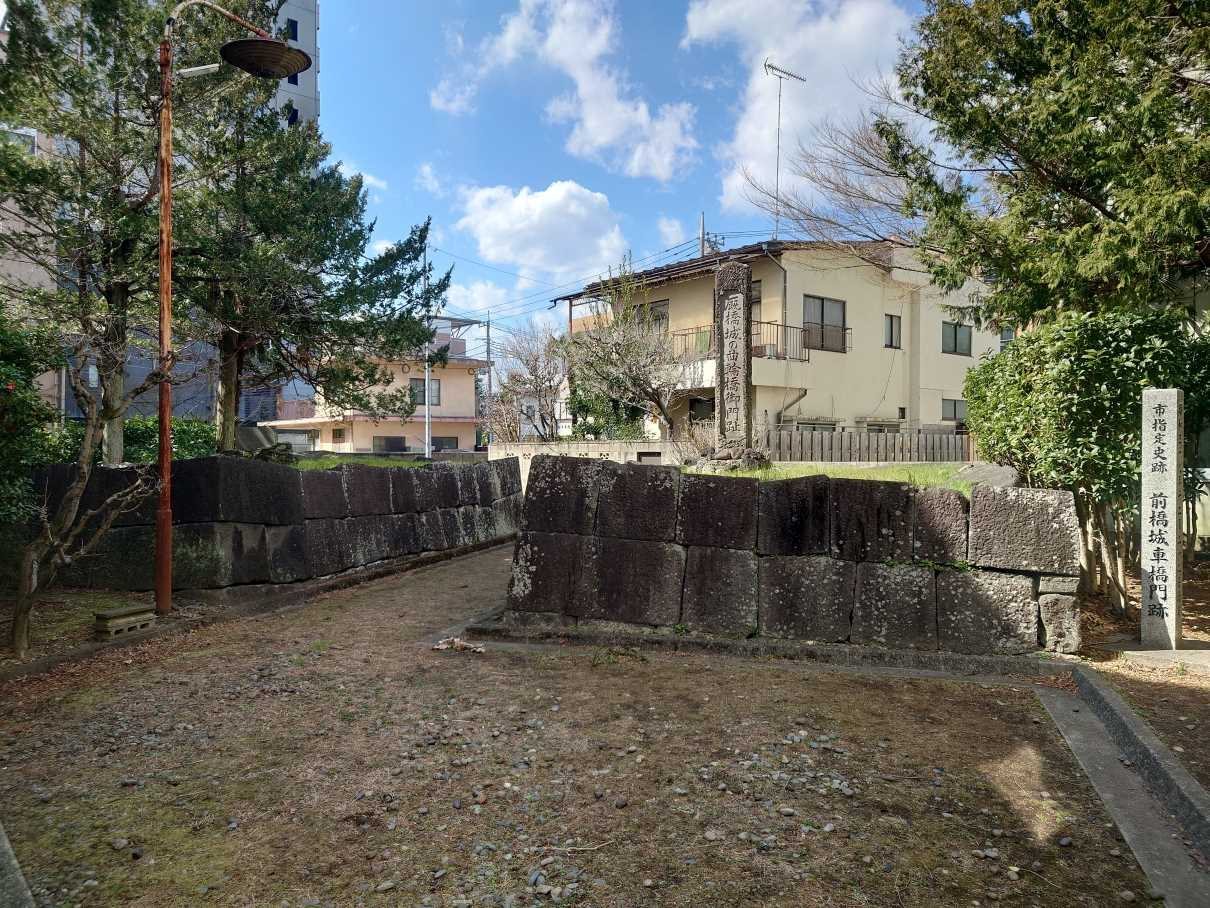
A later saying that Ieyasu gave Shigetada “the flower of the Kantō” when granting him the castle does not appear in the Mikawa Monogatari. Later texts instead attribute to Ieyasu praise of the castle as exceptional and a promise not to transfer it. The phrase “flower of the Kantō” first appeared in a Maebashi publication in 1891. The site of the Carriage Bridge Gate became a Maebashi municipal historic site in 1964, and Sakai-family castle plans and related materials received municipal Important Cultural Property status.
Remains
Maebashi Castle occupied the northeastern edge of the Maebashi plateau, beside a steep bank of the Tone River. It was a flatland castle arranged in several enclosed courts, with the Tone and Hirose rivers serving as outer moats. A castle town grew around the complex and developed into central Maebashi.
Defenses and landform
The rebuilt castle covered 157,159 tsubo, about 520,000 square metres; a tsubo is a traditional Japanese unit of area. The Sakai-era complex was laid out on higher ground and included several enclosures and a keep, or principal castle tower, with three tiers and three storeys. In the nineteenth-century reconstruction, the keep stood farther inland than its predecessor, and the outer walls followed zigzag lines intended to prevent blind spots. A natural depression, rather than a constructed moat, also formed part of the site. It measured about 300 metres from east to west and 70 metres across.
Surviving features
Stonework, earthworks, and walls
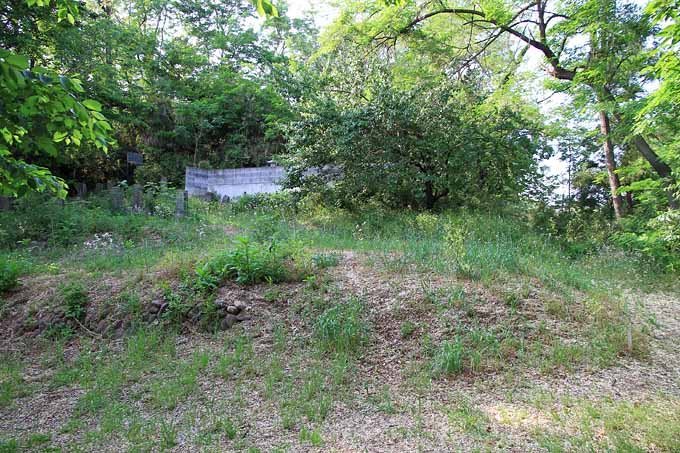
Surviving castle fabric includes stonework at the Carriage Bridge Gate and sections of earthwork north of the Gunma Prefectural Office and within Maebashi Park. Portions of the moats and short stretches of clay wall remain in the central and third enclosures. An excavation in 2021 uncovered seventeenth-century stonework from the main gate.
Relocated buildings
One original castle gate survives after being moved to the city’s Soja district. A residence belonging to a Matsudaira lord was also relocated and remains within Daikoji Temple in Kawaramachi.
Present-day land use
The former main-enclosure site now contains the Gunma Prefectural Government Building, the Gunma Prefectural Office’s Showa Building, and the prefectural police headquarters. The government building, with 33 storeys above ground and four basement levels, stands over the former keep area. The prefectural assembly building, Maebashi City Hall, and Gunma Kaikan occupy the former second enclosure, while the district court occupies the third. Maebashi Park was laid out in 1905 on land outside the third enclosure’s perimeter.
Plans and associated traditions
Castle plans associated with the Sakai family preserve the layout of the complex. One marks Tiger Pool, the name given to the pool where the Tone struck the castle’s western side. Behind the prefectural office remains Tiger Princess Kannon, associated with the attendant legend and with Kannon, the Buddhist bodhisattva of compassion.