Torres de Quart: Valencia’s Medieval Fortified Gateway
Site at a Glance
- Country
- Spain
- Primary era
- Medieval
- Eras represented
- Medieval, Modern
- Civilizations
- Crown of Aragon, Kingdom of Valencia, Spanish
- Site type
- Military
- Remains
- Gate
On this page9 sections
History
The Torres de Quart are a fortified gateway in Valencia, Spain, built in the 15th century in the Valencian Gothic style to defend the city’s western approach. They are one of the two gates of Valencia’s medieval wall that remain standing.
Earlier gate and construction
The gateway replaced an entrance in Valencia’s Islamic-period city wall, built under the rule of Abd al-Aziz ibn Abi Amir, dated 1021–1061. Known as Alcántara, the earlier gate was probably a cubic tower open on one side. The name Quart came from the road leading toward Quart de Poblet; the entrance also served the western route toward Castile. Its predecessor stood above a small bridge over the Favara irrigation canal.
Valencia began building a new wall in 1356, extending the defenses to include expanding suburbs. The work addressed the city’s growth and conflict with Castile, while concern about flooding from the Turia River was also part of the project’s context. Peter IV of Aragon ordered the replacement of the old walls and gates, and Guillem Nebot directed the work. The former western entrance was considered insufficiently defended.
At the request of the city’s magistrates, work on a larger gate began around 1441. Pere Bonfill was entrusted with the project, and Jaime Gallén and his son Andrés de Montoro completed the foundations between 1441 and 1443. Francesc Baldomar directed construction from 1444 to 1460, with Jaime Pérez, Pere Compte, and Bonfill also involved. A market fire in 1447 and a plague outbreak in 1450 interrupted the work; progress later slowed as attention shifted to another gate. Construction was completed in 1460, and wooden doors were fitted in 1489.
Civic and military uses
The gate handled traffic from Castile and trade travelling from Valencia’s port toward the western kingdoms. Until the 18th century, it was also called the Lime Gate because lime brought into the city passed through it and was taxed there. In 1562 the towers became a storehouse for arms and gunpowder belonging to the Valencian Provincial Council. After Valencia’s City Hall burned in 1585, the gate served temporarily as a prison, and a prison was authorized there in 1626.
From 1649, the interior housed La Galera, a women’s prison founded by Archbishop and Viceroy Pedro de Urbina. A viceroy governed a territory on behalf of a monarch. The prison operated until 1868 and held, among others, women imprisoned for prostitution. In the 18th century the entrance also housed a customs office for meat and wine, and its crenellated barbican was demolished.
The towers withstood fighting during the War of the Spanish Succession, a European conflict over the succession to the Spanish throne. During the 1808 siege of Valencia in the Peninsular War, the conflict in Spain and Portugal during the Napoleonic Wars, French artillery under Marshal Moncey damaged the gate, but the besiegers were defeated. Government troops occupied the towers in 1813. They became a military prison in 1823, a use that continued until 1931.
Demolition of the wall and modern preservation
Valencia’s old city wall was demolished in 1865, but the Quart and Serranos gates survived because they were being used as prisons. In 1873, troops of Spain’s First Republic, the republican regime of 1873–1874, bombarded the towers while suppressing the Cantonal rebellion, an uprising by advocates of autonomous cantons.
The towers were declared a national historic-artistic monument in 1931. They were again used as a prison during the Spanish Civil War of 1936–1939 and the early postwar period. Penal-use annexes were removed in 1947. After the municipality acquired the property in 1952, architect Emilio Rieta López directed recovery work. Restoration in 1976–1982 added a modern access stairway; a comprehensive intervention in 2006 uncovered paintings and graffiti and preserved marks from projectiles. The towers remain a protected Spanish cultural-heritage monument.
Remains
Form and construction
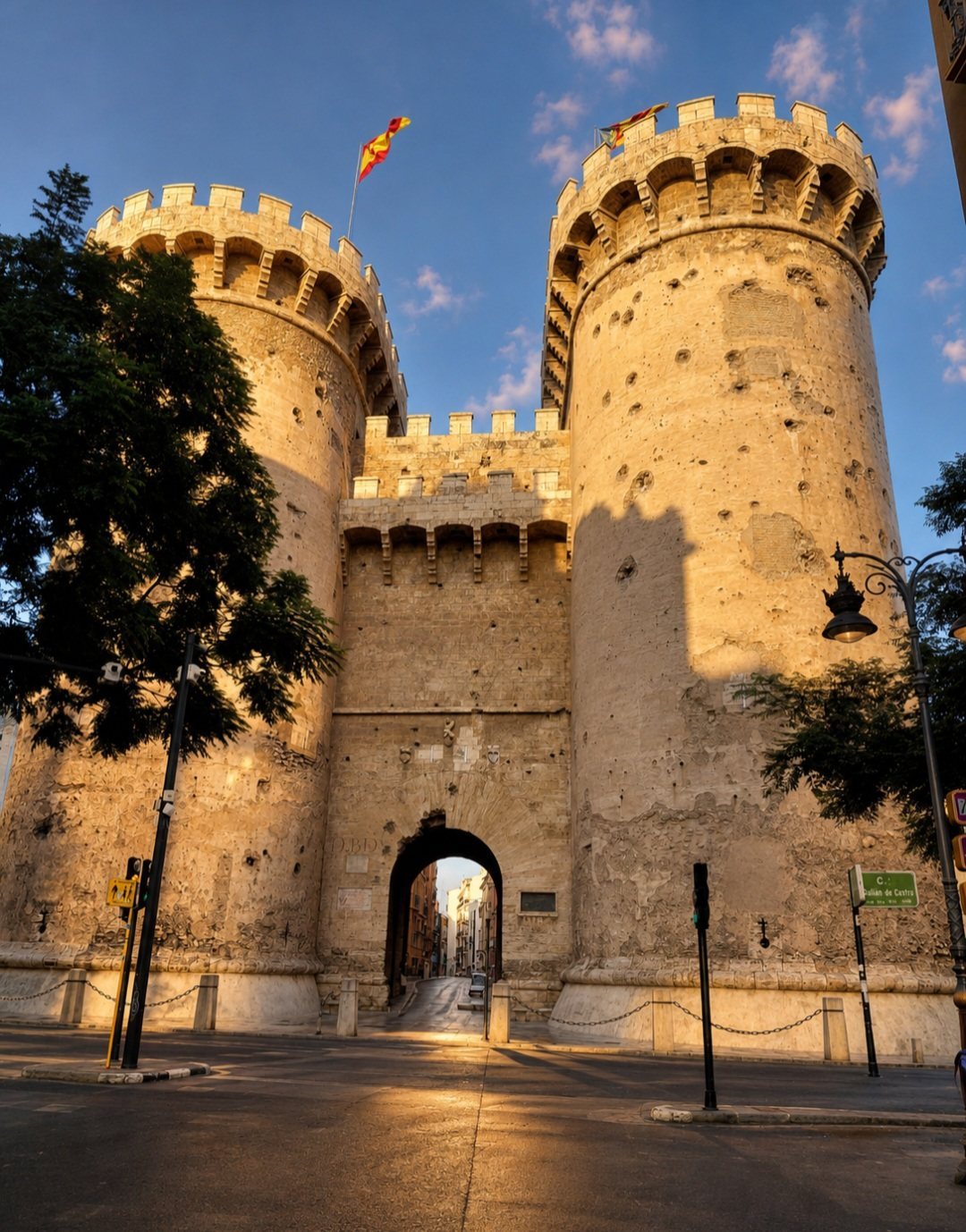
The 34-metre-high gateway stands at the junction of Guillem de Castro and Quart streets, meeting the line of the former city wall at an angle that follows Quart Street’s diagonal approach. Its symmetrical plan places a central portal between two three-tiered towers. The portal has a semicircular arch; each tower has a modified rectangular plan, with a rounded outer face and a chamfered face toward the city. Thick walls of lime and rubble were built in forms and finished with smooth plaster. Carefully cut stone blocks were used at the base, corners, arches, and vault edges, while brick also appears in the vaults and other parts. The exterior surfaces are mostly plain, with slight plaster decoration on their lower sections. The design drew on Valencia’s Torres de Serranos and on the towers or triumphal arch of Naples’ Castel Nuovo, designed by Guillem Sagrera.
Interior and defenses
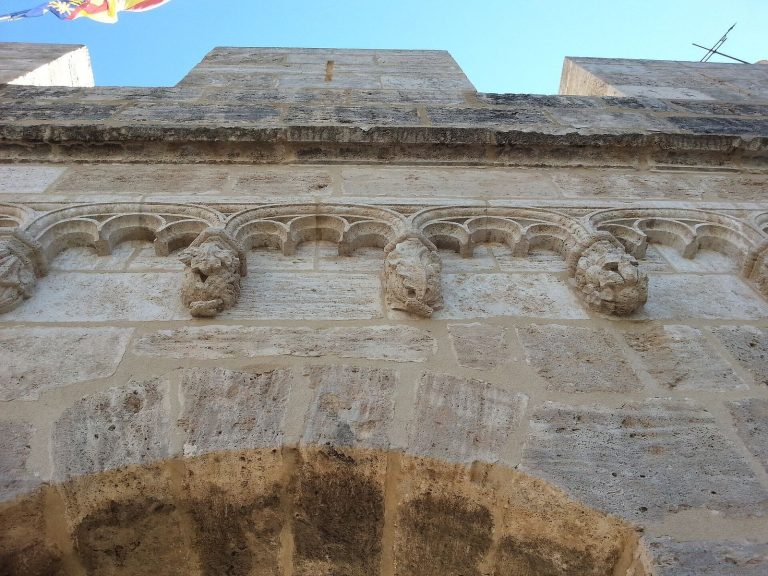
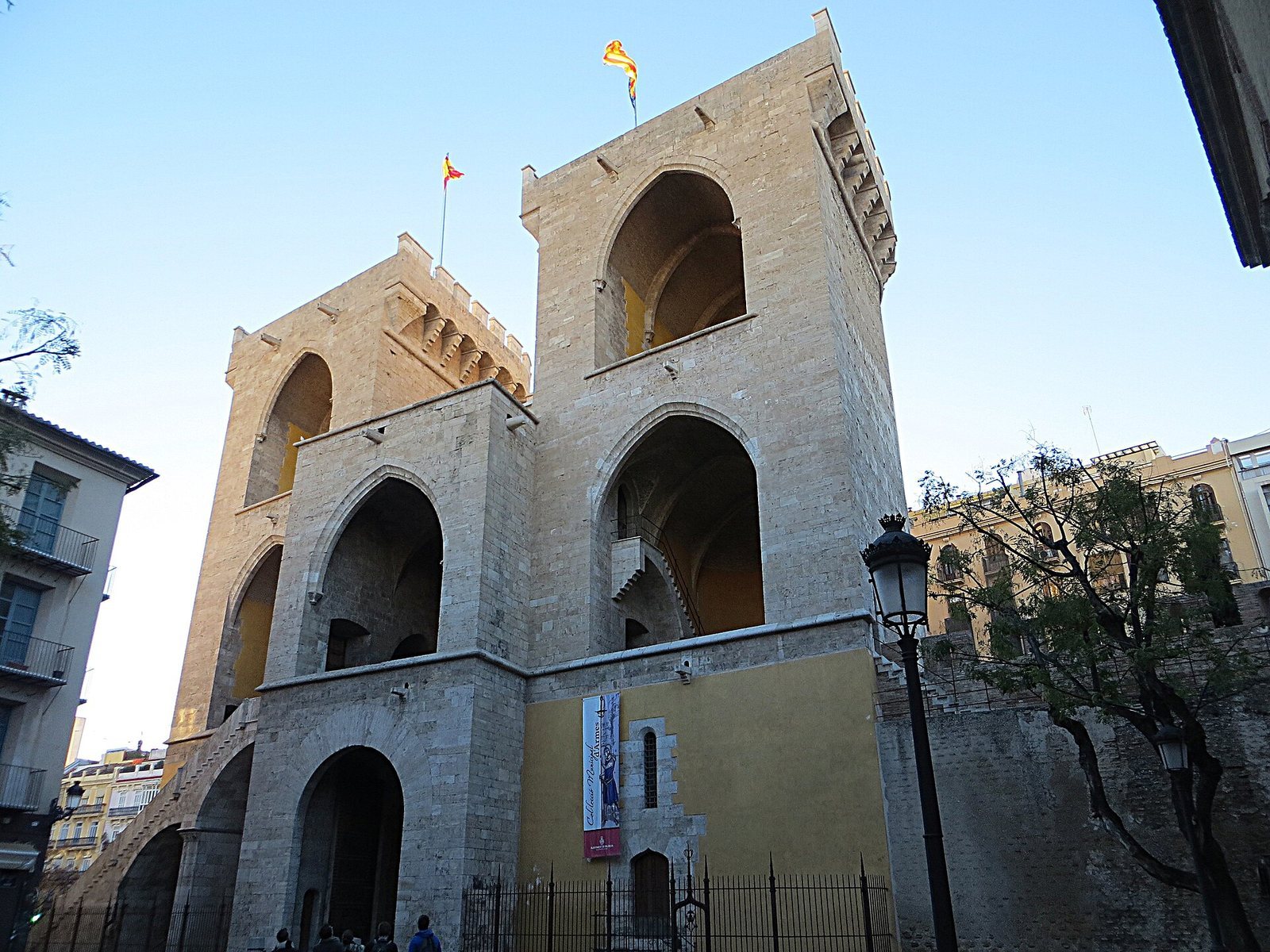
On the city-facing side, open chambers have vaulted ceilings framed by projecting ribs. Pointed arches feature on the rear facade, apart from the round arch of the portal. Spiral staircases served the interior, and a projecting defensive gallery on the second level had openings through which defenders could attack people below. A small opening above the entrance arch also allowed defenders to strike at people attempting to enter.
Sculpture and heraldry
A stone statue of Valencia’s Guardian Angel, believed to protect the city, was placed above the portal in 1453. Valencia’s arms and those of the Crown of Aragon later occupied that position. The portal vault’s keystone also bore royal arms painted by Berenguer Mateu.
Later features and surviving traces
The crenellated barbican, demolished in the 18th century, was reinstated after the 1808 siege. Cannonball and musket marks from the fighting remain visible on the towers. Recovery work added the modern access staircase, while a later intervention revealed paintings and graffiti.