Civic Tower of L’Aquila: The City’s Civic Clock and Bell Tower
Site at a Glance
- Country
- Italy
- Primary era
- Medieval
- Eras represented
- Classical, Medieval, Early Modern
- Civilizations
- Kingdom of Naples, Roman, Spanish
- Site type
- Military
- Remains
- Tower
On this page11 sections
History
The Civic Tower of L’Aquila is a medieval civic tower in Piazza del Palazzo, L’Aquila, Italy, with origins dating to the 3rd century. It was already standing when L’Aquila was definitively founded in 1254.
Medieval civic center
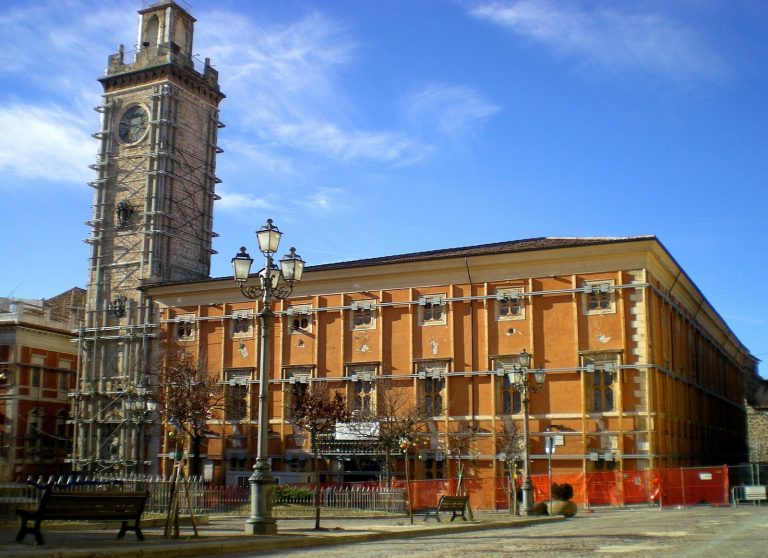
By the end of the 13th century, the city’s civic center had developed around the tower. Nearby institutions included the residence of the Captain of Justice, an official responsible for administering justice, the municipal seat, and Palazzo della Camera. The tower is the only surviving part of the 14th-century Palazzo del Capitano and is now incorporated into Palazzo Margherita, the city hall.
In 1310, Captain Francesco Di Crescenzo ordered the tower rebuilt at greater height and set apart from the Palazzo del Capitano di Giustizia complex. Three years later, people from Rieti stole one of its bells. It was recovered in 1320 and given the pointed name Reatinella.
Public clock and civic bells
In 1374, Captain Tommaso degli Albizi commissioned a public clock for the tower. It was the first public clock in the Kingdom of Naples, a historical kingdom in southern Italy, and the second in Italy, after those at Palazzo Vecchio in Florence and Torre Marchesana in Ferrara. The tower’s bells marked civic routines, warning residents to close the city gates an hour after sunset and summoning them to public events, including municipal council meetings.
The tower’s strategic function had ended by the 16th century. In 1545, the Spaniards brought down the Reatinella, the Bell of Justice, and the Bell of the Sentence, which was used during executions. The bells were melted to make artillery for the Spanish Fort, then under construction.
Rebuilding and restoration
During major rebuilding of Palazzo Margherita from 1838 to 1846, demolition of the tower was proposed. Its clock was dismantled early in 1838 to facilitate the plan, but the proposal was abandoned. The clock was restored that October with illumination. The original mechanism was replaced late in the 19th century after it stopped working, and the tower was added to Italy’s national-monuments list in 1902.
The earthquake of 6 April 2009 damaged both the tower and Palazzo Margherita. Joint reconstruction work on the two buildings began on 4 November 2016.
Civic and religious observances
The tower is part of the annual Celestinian Forgiveness, a Catholic observance centered on the indulgence associated with Pope Celestine V, a 13th-century pope. Usually on 23 August, lighting the tripod known as the Fire of Morrone on the tower opens the celebrations. Its summit bell also rings 99 times at sunset in remembrance of the 99 castles that contributed to L’Aquila’s foundation.
The Bull of Forgiveness, a formal papal document, records Celestine V’s grant of a plenary indulgence, understood in Catholic teaching as full remission of temporal punishment for sin under prescribed conditions, in return for an annual pilgrimage to the Basilica of Santa Maria di Collemaggio. The document was kept in a secured chapel in the tower and brought out on 28 August for the opening of the Holy Door, a church doorway opened for special religious observances. After the 2009 earthquake, it was moved elsewhere for safety.
Remains
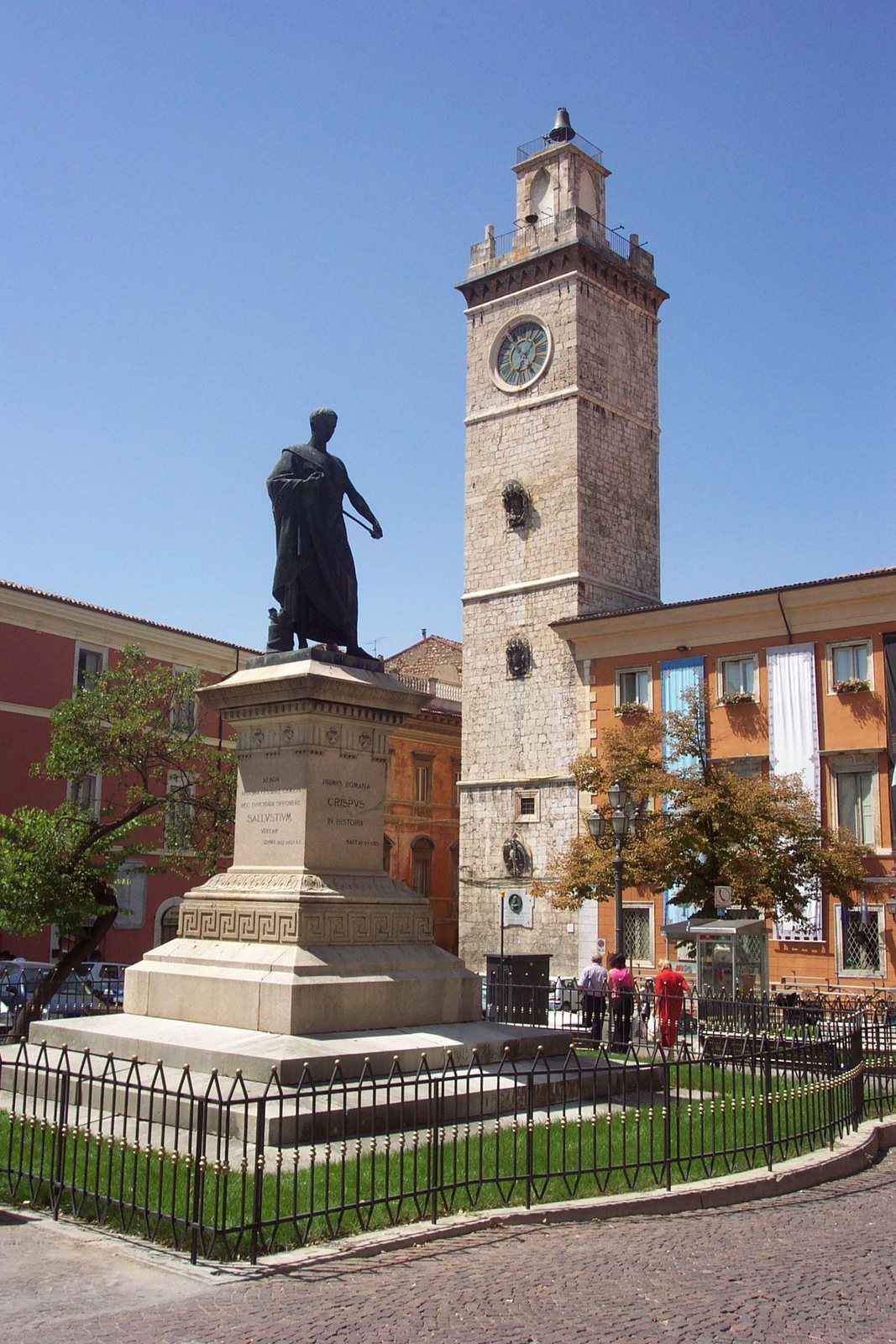
The tower stands at the southwestern end of Piazza del Palazzo, L’Aquila’s political center. It forms a complex with adjoining Palazzo Margherita while remaining architecturally distinct. Its four-sided footprint rises through three and a half levels, divided by horizontal stringcourses, bands that mark levels on a building’s exterior. The stone facing, made of ashlar, or regularly cut blocks, dates to the second half of the 13th century. The tower now stands about 26 to 27 metres high. It originally reached about 52 metres and could survey the surrounding area within a radius of 18 miles, more than 33 kilometres.
Exterior details
Main facade
On the facade facing Piazza del Palazzo, features rise in a set sequence. At the bottom is an effigy of Giuseppe Garibaldi, an Italian nationalist and military leader associated with the country’s unification. Above it is the first example of L’Aquila’s coat of arms, dating to the late 13th century. It shows a spread-winged eagle associated with the Hohenstaufen, a medieval ruling house from Swabia, inside a shield with a Gothic outline. Higher up are the arms of Charles V, the Habsburg king of Spain and Holy Roman Emperor, followed by those of a Spanish captain and the clock.
Wall facing Piazza Santa Margherita
The opposite wall bears an image of a woman holding a lily in one hand and a serpent in the other. It resembles the arms of Cascia and is attributed to Captain Leone di Cecco da Cascia, who is also credited with building L’Aquila’s walls.
Upper terrace
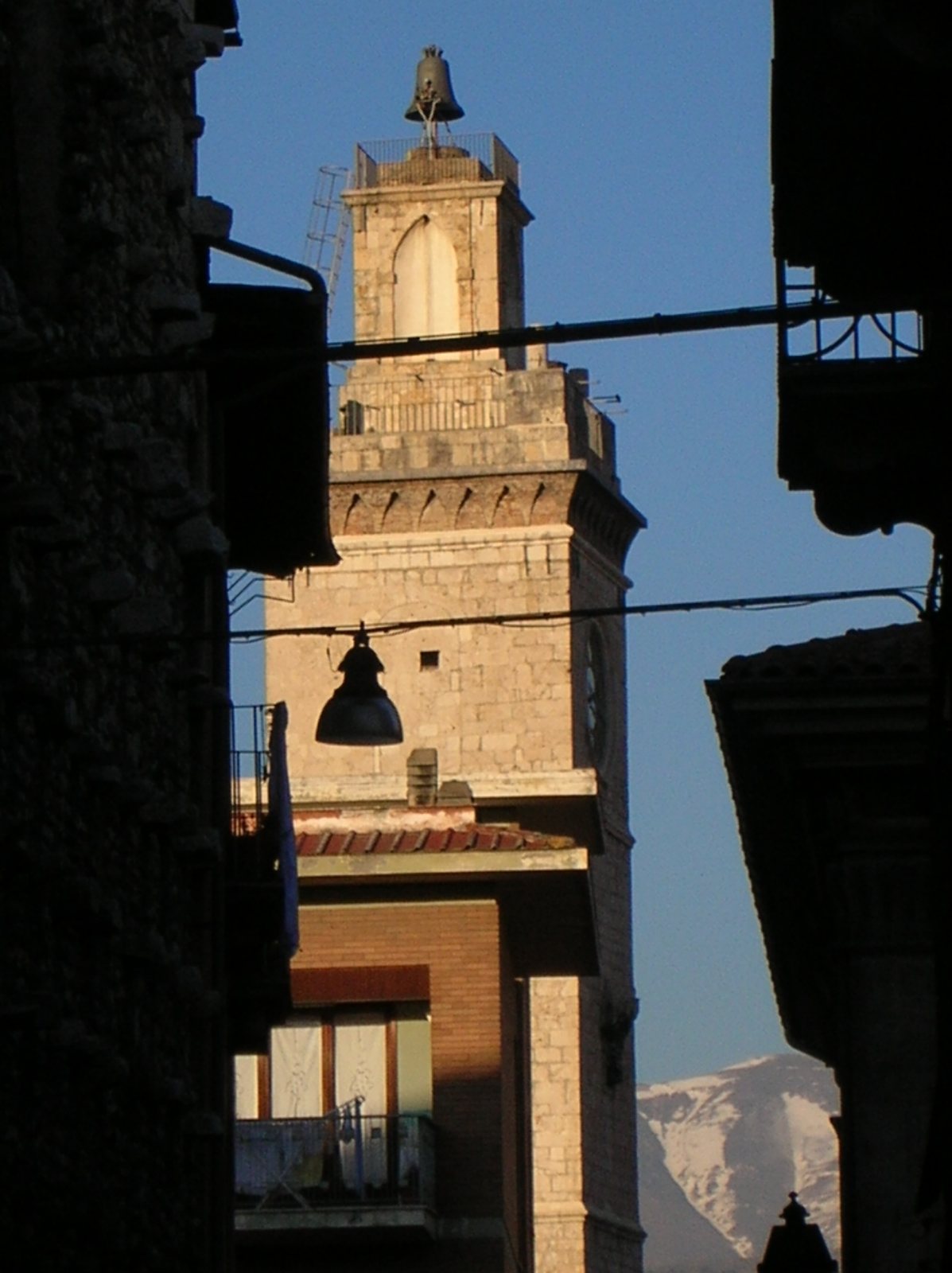
The upper part of the tower has been cut down and now ends in a small shrine-like structure on a terrace. A bell stands at the summit.
Interior chapel
The lower interior contains a chapel dedicated to Our Lady of the Angels, where people condemned to punishment received comfort. A separate secured chapel is also located within the tower.