Banditaccia Necropolis: Etruscan Cemetery of Caere
Site at a Glance
- Country
- Italy
- Primary era
- Classical
- Eras represented
- Iron Age, Classical
- Civilizations
- Etruscan
- Site type
- Burial
- Remains
- Necropolis
On this page26 sections
History
The Banditaccia Necropolis is the burial ground of Caere, an Etruscan city northwest of modern Cerveteri, Italy. The Etruscans were an ancient people of central Italy. Burials at the site began in the ninth century BC, during the Villanovan period, an early Iron Age culture associated with the origins of Etruscan civilization, and continued into the Hellenistic period, which followed Alexander the Great’s conquests and saw Greek culture spread across the Mediterranean.
From early graves to an urban cemetery
The earliest burials included cremated remains placed in pits and graves for inhumation. From the seventh century BC, tombs increasingly took the form of dwellings. By the end of that century, streets, squares, and intersections organized the cemetery into a planned landscape resembling a city.
The scale and form of burials reflected differences in wealth. Large burial mounds belonged to affluent families, while simpler graves served people of more modest means. Gold jewelry and imported pottery placed with the dead also reflect the wealth of Caere’s aristocracy.
Changing customs and Greek influence
Greek artistic influence shaped Etruscan funerary buildings and decoration, especially during the sixth century BC. During an economic crisis in the late fifth and early fourth centuries BC, tombs generally became more restrained, though large, elaborate burials continued to be built. Later graves were sometimes arranged like rows of houses; poorer families also returned to using pits and trenches.
Excavation, damage, and protection
The name Banditaccia is associated with the Italian word bando, meaning a public notice or tender. From the late nineteenth century, Cerveteri landowners leased the area to local people. Earlier, nineteenth-century antiquities collectors had excavated there in search of valuable objects. In 1845–46, Giampietro Campana’s excavations uncovered Etruscan terracotta slabs, and around 1850 he found sarcophagi of the type now known as the Sarcophagi of the Spouses.
Raniero Mengarelli directed excavations and other work from 1909 to 1933. In 1927 he uncovered Via degli Inferi, the principal funerary road, and carried out topographic studies. His work also helped establish the area as an archaeological site. Some repairs were made in ways intended to distinguish them from ancient fabric, while other reconstructions and reassemblies lacked adequate documentation or historical study.
After the site was abandoned in 1936, clandestine digging supplied private collectors. German soldiers were present in the area from February 1944 during the Second World War. Their heavy vehicles damaged ancient roads, cart ruts, and drainage channels. Mario Moretti began new excavation campaigns in 1957, including work among the large burial mounds and in the area called the new enclosure. Legal archaeological research resumed in the 1960s.
In 2004, the Banditaccia Necropolis and the Monterozzi Necropolis at Tarquinia were added to UNESCO’s World Heritage List. The United Nations agency recognized the two sites for the evidence their tombs preserve of Etruscan domestic architecture and decorative art.
Remains
The necropolis covers about 20 hectares on a hill and contains around 1,000 tombs; estimates for the area exceed 20,000 chamber tombs. About 10 hectares have been excavated. A funerary road roughly two kilometres long crosses the site, with Via degli Inferi as its principal route. The sixth-century-BC streets Via dei Monti Ceriti and Via dei Monti della Tolfa also form part of the surviving layout.
Layout and tomb forms
Early graves and burial mounds
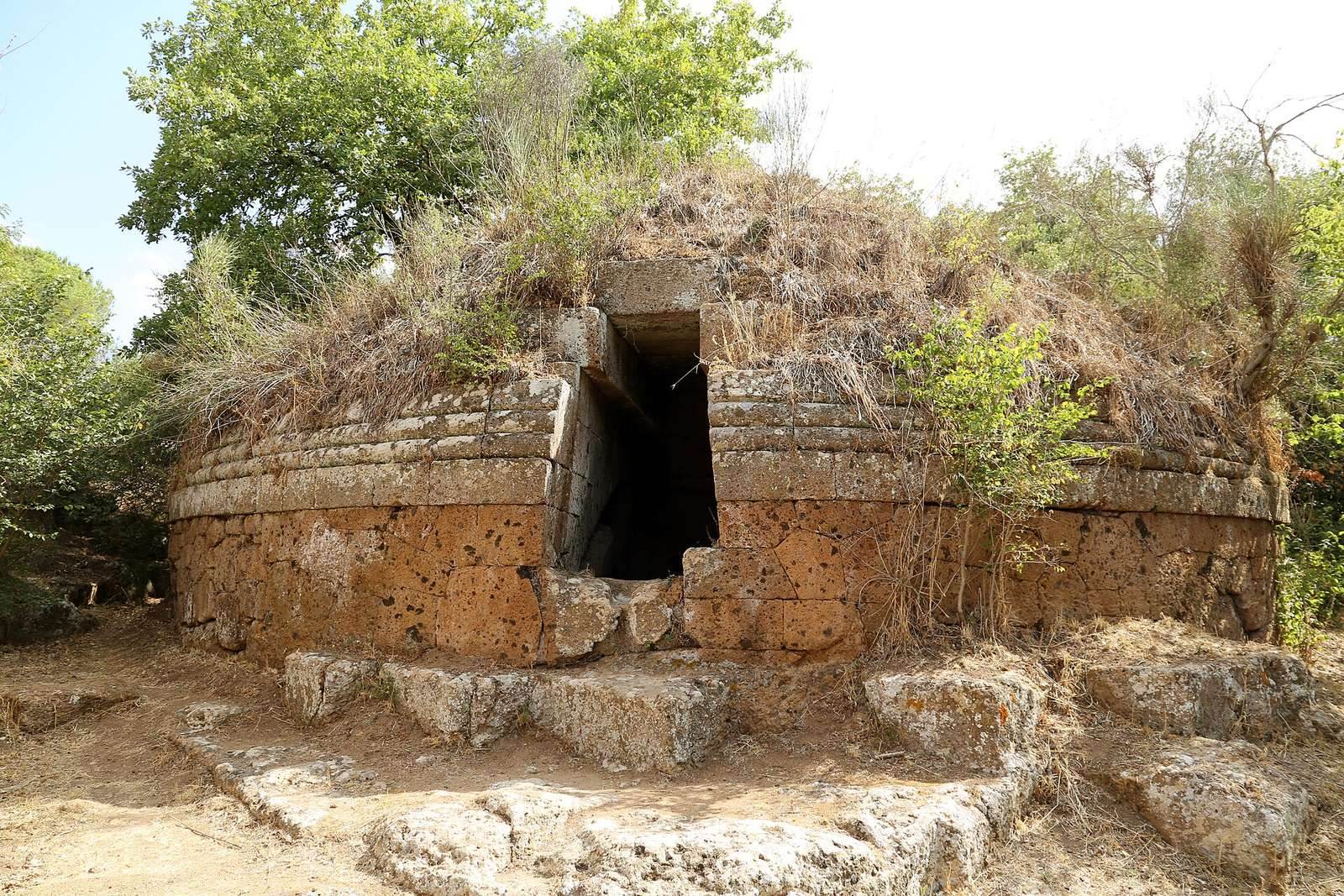
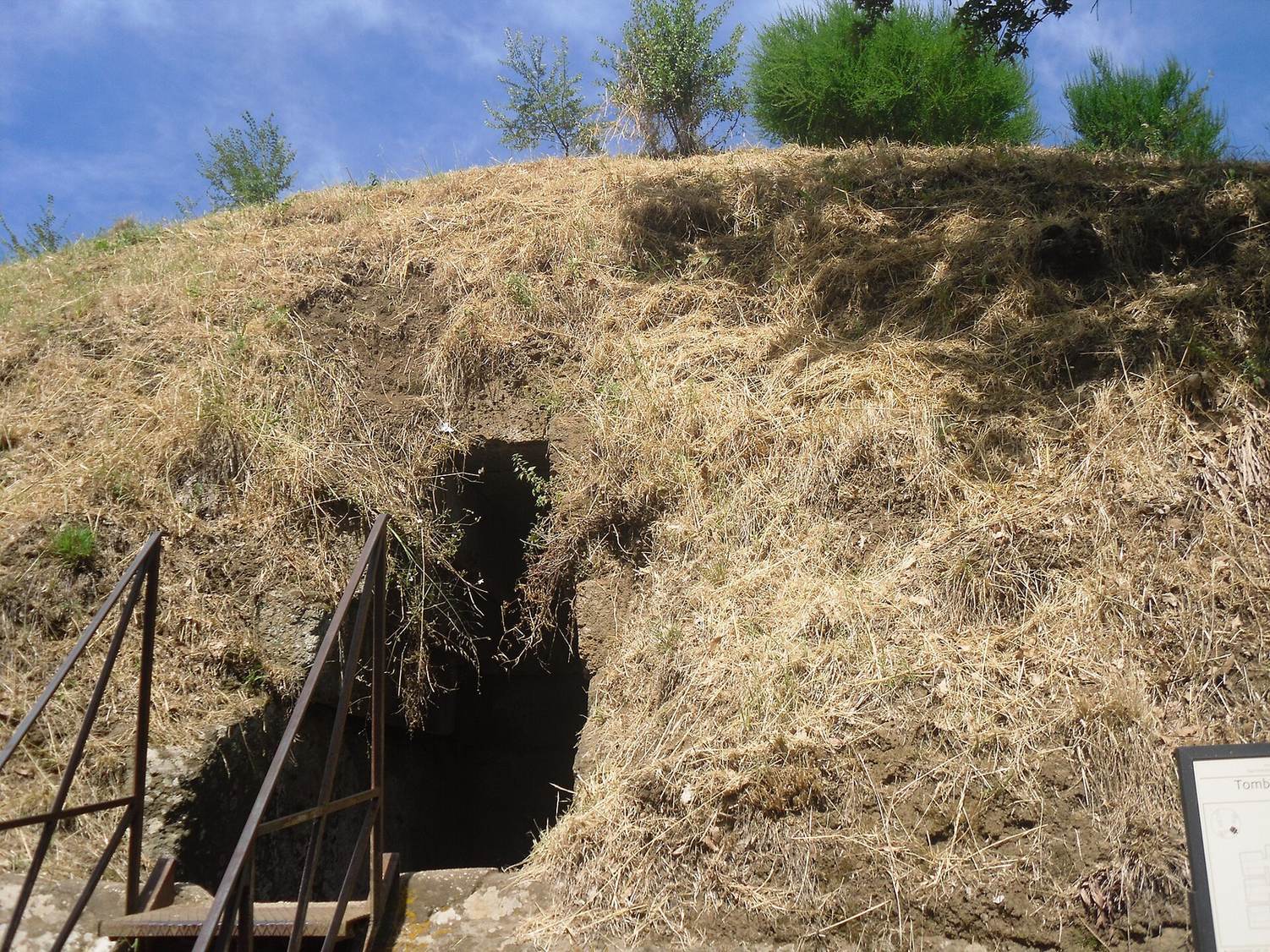
The earliest forms include shaft graves containing cremated remains, pits for inhumation, and simple niches. From the seventh century BC, circular tumuli, or burial mounds, commonly enclosed chambers cut into volcanic tufa, a porous rock formed from volcanic material. A typical mound tomb has an entrance passage leading to a vestibule and burial chambers. In the second half of the seventh century BC, circular vestibules and side niches became more common. Some mounds reached 30 metres across and had stone rings around them, with several burial chambers inside.
Rows and external markers
From the sixth century BC, cube-shaped tombs were set in rows beside intersecting streets. Some vestibules have a ceiling opening closed by a movable stone slab. In later burials, external markers included cylindrical forms for men and small hut-shaped forms for women.
Selected chamber tombs
Tomb of the Capitals
This sixth-century-BC hypogeum, or underground tomb, was cut into volcanic tufa. A short passage from its single entrance leads to a large chamber. Two columns with Aeolic capitals, decorated with volute-like forms, support a carved ceiling modeled on a house’s beams and floorboards. Eight benches connect through three doorways to three burial chambers, each intended for two people. Men were placed on the left and women on the right. The women’s funerary beds have raised triangular ends, while the men’s are shaped like couches.
Tumulus II
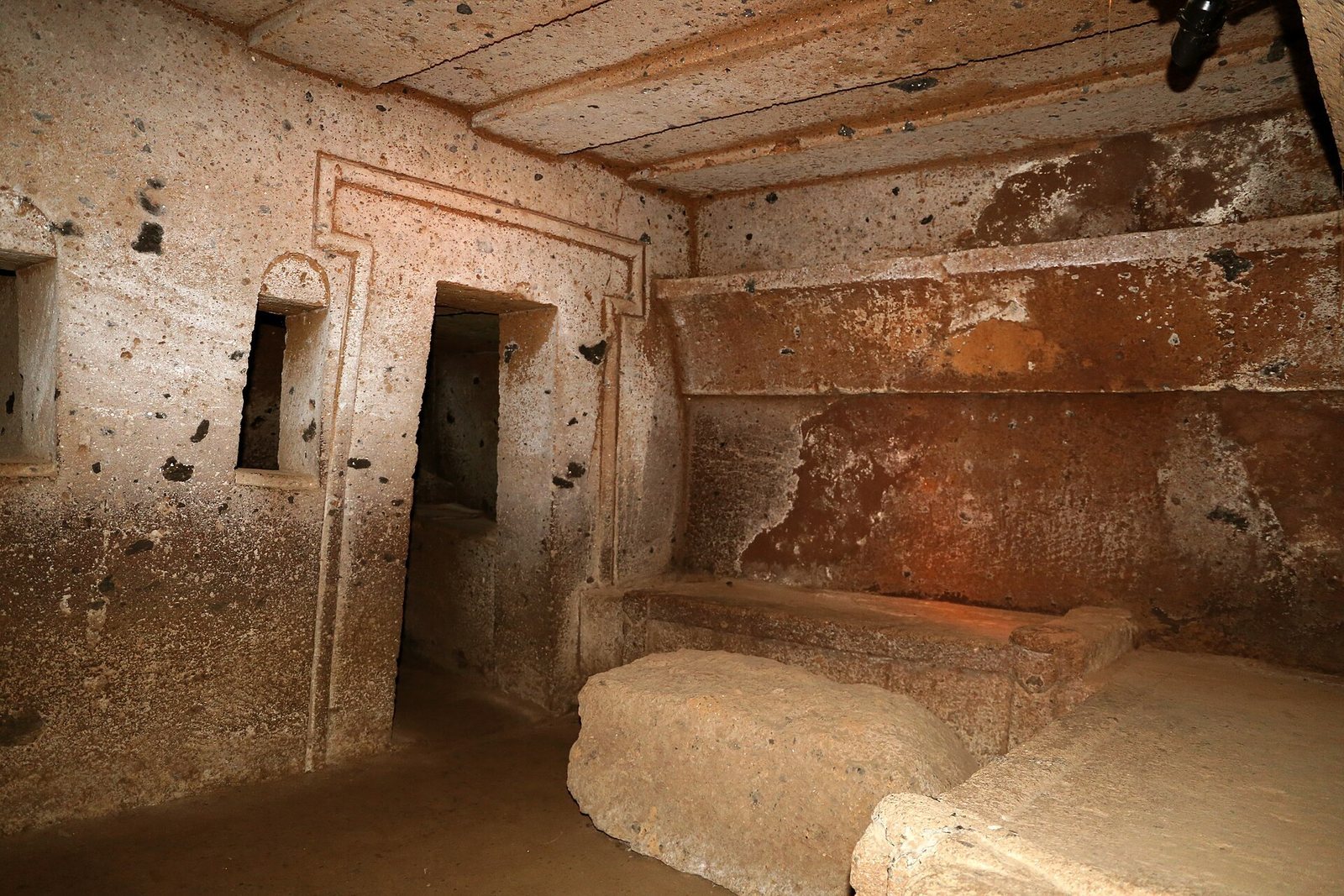
Dating to the seventh century BC, Tumulus II contains four tombs. One tomb has a long, open passage leading to two chambers cut into the rock. The first served as a vestibule to the smaller burial chamber beyond. Its gabled ceiling imitates wood and thatch, and benches run along its walls.
Tomb of the Jars
This sixth-century-BC tomb takes its name from the many vessels for storing wine and food found inside, along with Proto-Corinthian and Corinthian vases, two styles of ancient Greek pottery. Its single entrance leads to two chambers arranged along one axis. The tomb shares its passage with the Tomb of the Andirons.
Tomb of the Andirons
Andirons are metal supports for fuel in a fireplace. This sixth-century-BC tomb shares an entrance with the Tomb of the Jars and has two side chambers. It was found intact with cooking vessels, bronze cauldrons, meat spits, tripods, and a table service of 109 pieces. Some Proto-Corinthian vases remained fixed to the walls by corroded nails. Gold ornaments, small boxes, and perfume vessels indicate that the burial was for a woman.
Two-axis chamber tomb
Another sixth-century-BC tomb has two side chambers and two chambers along its main axis. The first main chamber measures 4.30 by 3.70 metres, and the rear one measures 3.20 by 2.70 metres. Both have pitched ceilings with carved ridge beams. Beds and sarcophagi in the first chamber were probably intended for women; the rear chamber has stone benches along three walls.
Temple-form tomb
A further tomb reached by a passage imitates an Etruscan temple. Its main chamber is 8.70 metres wide, with a pitched ceiling and a carved ridge beam running across the room, perpendicular to the entrance and extending above the side chambers. Benches for urns and sarcophagi line the main chamber. Three additional chambers, each entered through its own doorway, also contain benches.
Family tombs and decorated chambers
Tomb of the Reliefs
This fourth-century-BC tomb belonged to the Matunas family, named in an inscription. Its single rectangular chamber measures 6.5 by 7.8 metres. Two columns with Aeolic capitals support the pitched ceiling and carved ridge beam. Ledges, shallow niches, and small burial recesses around the walls accommodated funerary beds. The chamber has 13 recesses and 32 beds, each with two pillows, as well as a carved projection intended to make room for 34 bodies.
Painted stucco covers the chamber. The reliefs include weapons, objects used in worship and daily life, cooking tools, ropes, musical instruments, and a board game. Busts of the family head and his wife appear beside a central double niche. In front of it are Typhon, a monstrous figure in Greek mythology, and Cerberus, the multi-headed dog guarding the underworld. A stool with slippers and carvings of a cat, goose, and marten add further details. The chamber is exceptionally well preserved; its delicate paintings can be seen through glass.
Tomb of the Cornice
This fourth-century-BC tomb is a burial mound containing several chambers arranged to imitate an Etruscan dwelling. A cornice runs along the walls of the main chamber, where two thrones with footrests stand on either side of the doorway.
Tomb of the Shields and Chairs
This tomb, dated to the late seventh or early sixth century BC, lies within a burial mound 40 metres in diameter, alongside the Tomb of the Painted Lions and the Tomb of the Clay. A passage leads to a vestibule with two side chambers and a rectangular room with a flat ceiling and raised beams. Six beds carved from tufa, with pillar-shaped legs and crescent-shaped pillows, were intended for male burials; women were placed in sarcophagi. Fourteen shields are carved on the walls, between doorways and above chairs cut from the rock.
Tomb of the Five Chairs
Dating to about 650–625 BC, this tomb has three burial chambers reached by a stepped passage partly open to the sky. Five seats with carved footrests stand along one wall. When the Castellani family of antiquarians discovered the tomb in 1865, each seat held a terracotta statue. One statue is now in the Museo dei Conservatori and another in the British Museum.
Tomb of the Alcove
This underground tomb belongs to the late Classical and Hellenistic phases of Etruscan culture. A stepped passage leads to a large chamber with fluted wall projections and a ceiling that imitates wooden beams. Between two of these projections, a closed structure frames a raised alcove bed intended for a married couple.
Tomb of the Cottage
Cut into a bed of tufa in the late sixth century BC, this tomb has a short entrance passage leading to a main burial room and three more rooms arranged in a cross-shaped plan. Small arches surmount the doorways, and small windows face the central burial chamber. Six funerary beds survive within the tomb.
Other tombs and funerary objects
Additional burial features
The seventh-century-BC Tumuli of Maroi and Mengarelli are among the other burial mounds. A sixth-century-BC mound called the Polychrome Tumulus is named for its differently coloured tufa. The Tomb of the Well has a well opening in its vestibule. Other named graves include the Tomb of the Hut, the Ship Tomb, the Tomb of the Pillar Capitals, the Little House Tomb, the Tomb of the Greek Vases, the Triclinium Tomb, the Tomb of the Aretine Vases, the Tomb on Via dei Serpi, and the Tomb of Marcus Ursus.
Sarcophagi of the Spouses
Made at Caere in the sixth century BC, these terracotta, or fired-clay, sarcophagi take the form of reclining couches in the Greek Ionic style. Each shows a married couple reclining or partly upright. Early Etruscan sarcophagi were made of fired clay; carved stone became the more common material in later periods. One example is held by the National Etruscan Museum of Villa Giulia in Rome, and another by the Louvre in Paris.
Excavated objects and collections
The terracotta slabs uncovered during Campana’s 1845–46 excavations are now displayed at the Louvre. Finds from the necropolis are also held at the National Etruscan Museum of Villa Giulia and the National Archaeological Museum in Cerveteri. The Cerveteri museum holds only a small portion of the recovered funerary objects; other finds are in museums elsewhere.