Santa Maria del Carmine, Florence: A Carmelite Church and Convent
Site at a Glance
- Country
- Italy
- Primary era
- Early Modern
- Eras represented
- Medieval, Early Modern
- Civilizations
- Grand Duchy of Tuscany, Republic of Florence
- Site type
- Religious
- Remains
- Church
On this page25 sections
History
Foundation and medieval development
Santa Maria del Carmine is a Carmelite church in Piazza del Carmine, Florence, Italy, begun in 1268 by friars who came from Pisa. It formed part of a convent that became the sixth Carmelite foundation in Italy. The project followed a bequest made in 1267 by Cione Tifa di Ranieri Vernaccia for the poor. His wife, Agnese, instead gave the money, land, and houses to the Carmelites and agreed to help pay for a church and convent. The complex appears to have begun with a convent and a small attached church, which later became its principal institution.
Dedicated to the Virgin of Mount Carmel, the church was associated with an image of the Madonna and Child later called the Madonna del Popolo. Believed to have come from the East, it was venerated as miraculous, and devotion to it may have encouraged further gifts. The transept and main chapel were complete by 1318, while work on the nave continued during the fourteenth century. In 1328, Florence granted the Carmelites adjoining land beside the city’s fifth circuit of walls. A convent enlargement followed, including a new dormitory in 1340; the convent had a library by 1349.
Medieval religious and cultural life
The church was consecrated in 1422. The convent expanded again from 1464, adding a chapter house and refectory in a building phase completed by 1476. Andrea Corsini, a Carmelite prior associated with the convent’s religious and cultural standing, contributed to its construction and embellishment. Although he had been buried at Fiesole Cathedral, his remains were brought to the Carmine in 1385, contrary to his wishes.
Fra Filippo Lippi took his religious vows at the convent in 1421 and became its subprior in 1428. He painted the Madonna Trivulzio there, now in the Pinacoteca of the Castello Sforzesco in Milan. The church and convent also hosted confraternities, organized religious associations that often included lay members. Among them were groups devoted to Saint Barbara, the Ten Thousand Martyrs, Saint Nicholas of Bari, and Saint Sebastian. The Company of Saint Agnes, made up of widows, staged recurring religious plays that attracted audiences from Florence and the surrounding area.
Early modern renovation
From 1568, Giorgio Vasari directed a renovation shaped by the Counter-Reformation, the Catholic Church’s movement of renewal in response to Protestant reform. The screen between the nave and the convent choir was removed, the choir was transferred to the main chapel, and seven stone altars were placed along the church walls. Andrea Corsini was canonized in 1629. The Corsini family commissioned a chapel in his honor in 1675, and its construction and decoration continued until 1683.
Further changes altered both the church’s interior and its appearance. Between 1690 and 1704, ten Gothic windows in the nave were blocked and replaced with twelve rectangular ones. Giovanni Domenico Ferretti directed decoration of the tribune in 1755 and the facade in 1758. A large wooden ceiling designed by Zanobi del Rosso was installed between 1765 and 1770, with three medallions commissioned from Ferretti, Gesualdo Ferri, and Filippo Burci.
Fire, rebuilding, and later status
A major fire in January 1771 destroyed almost all of the church’s interior. The old sacristy, Corsini Chapel, and Brancacci Chapel escaped. Giuseppe Ruggieri was appointed to plan the reconstruction; after his death in 1772, Giulio Mannaioni continued the work. Rebuilding and interior decoration extended into the early 1780s, but the facade was left unfinished. During the restoration, frescoes in the Brancacci Chapel were at risk of being covered until a Florentine noblewoman opposed the proposal. The fresco cycle was restored in 1990.
The convent endured repeated destruction, rebuilding, fires, bombardments, and damage from the 1966 Arno flood, leaving its original arrangement difficult to establish. In July 1954, Pope Pius XII raised the church to the rank of a minor basilica, an honorific status granted by the Catholic Church. Santa Maria del Carmine is also within Florence’s historic centre, which UNESCO inscribed as a World Heritage site in 1982.
Remains
Church exterior and nave
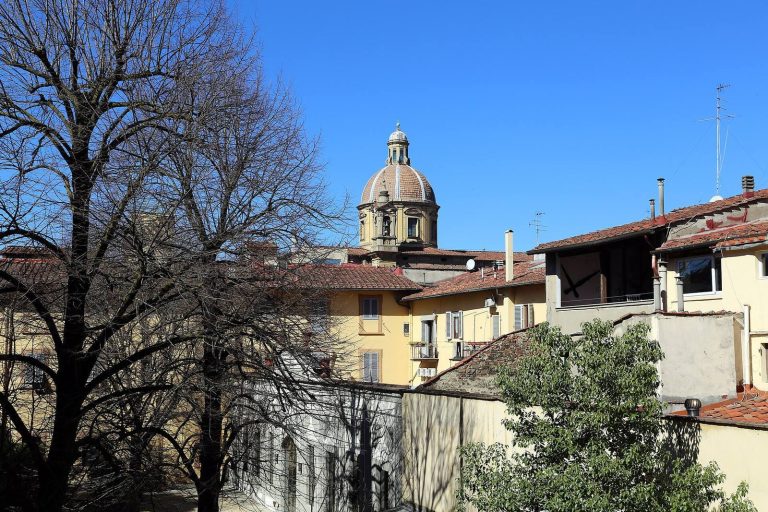
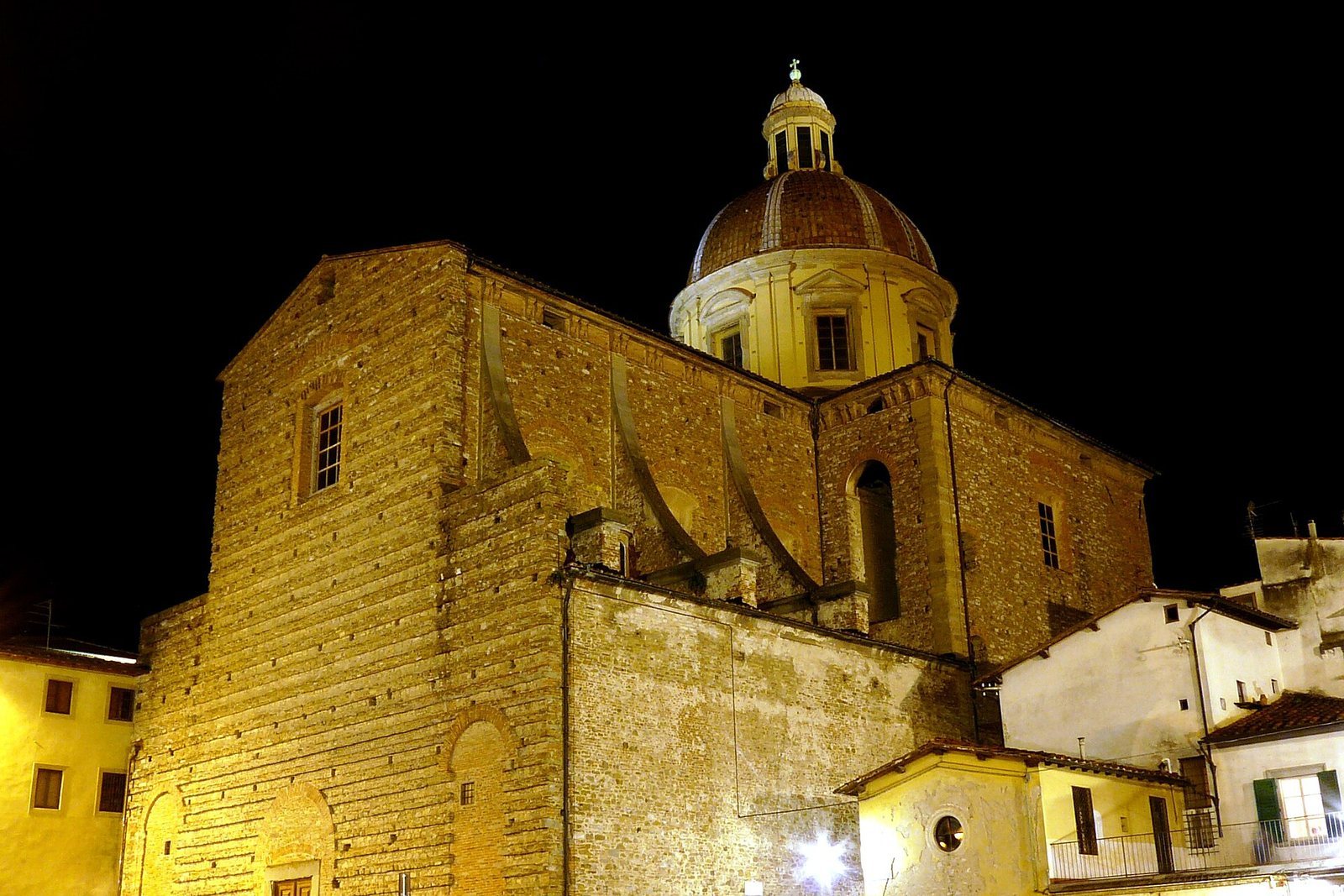
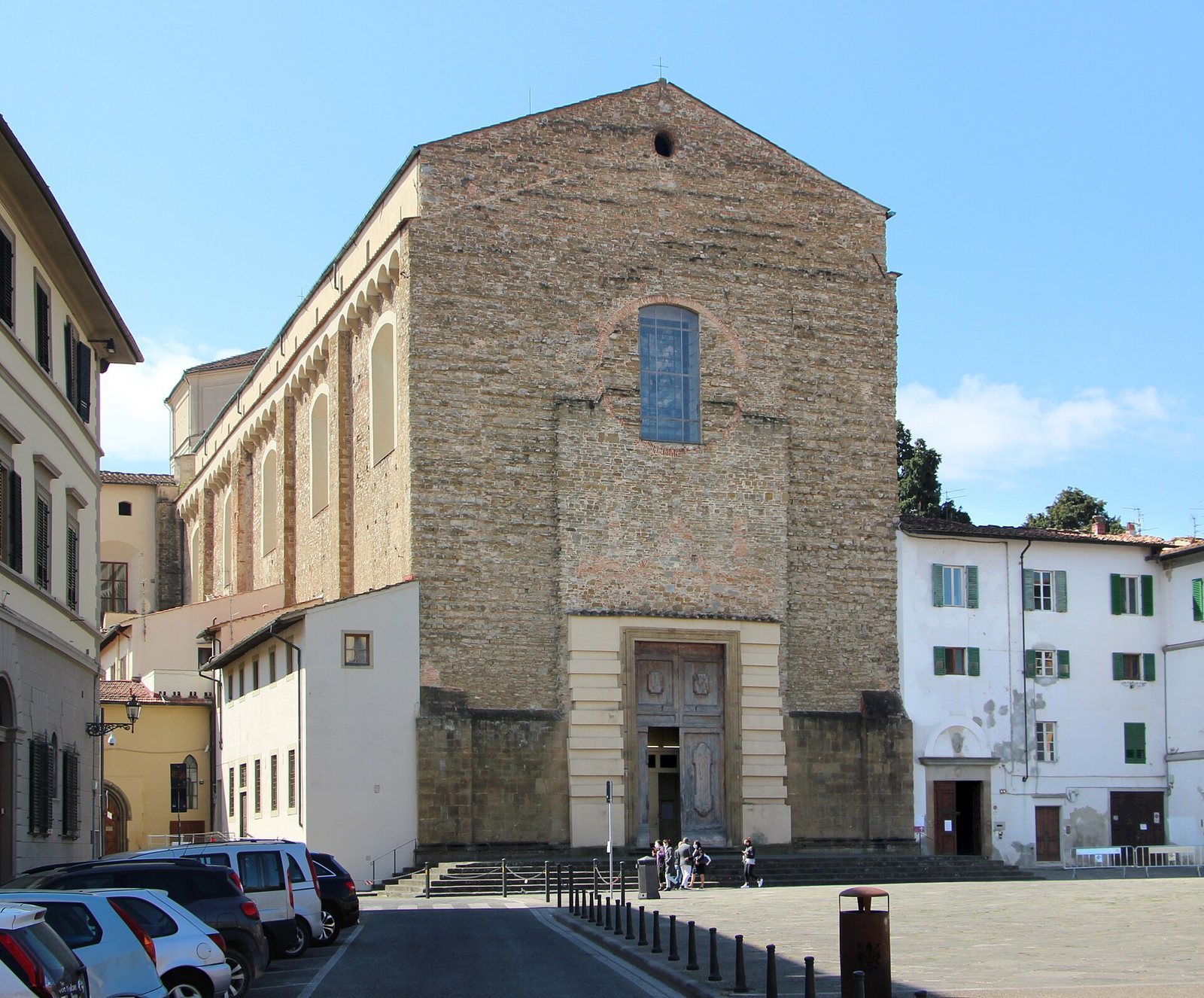
The church stands in Florence’s Oltrarno, the district across the Arno River from the historic centre, and faces the square of the same name. Its plan forms a cross, with a long central hall and side arms. The hall measures about 82 metres by 15 metres, and the dome rises approximately 35 metres. The surviving exterior combines an unfinished front of rough stone and brick with Romanesque-Gothic remains along the sides.
Nave architecture and decoration
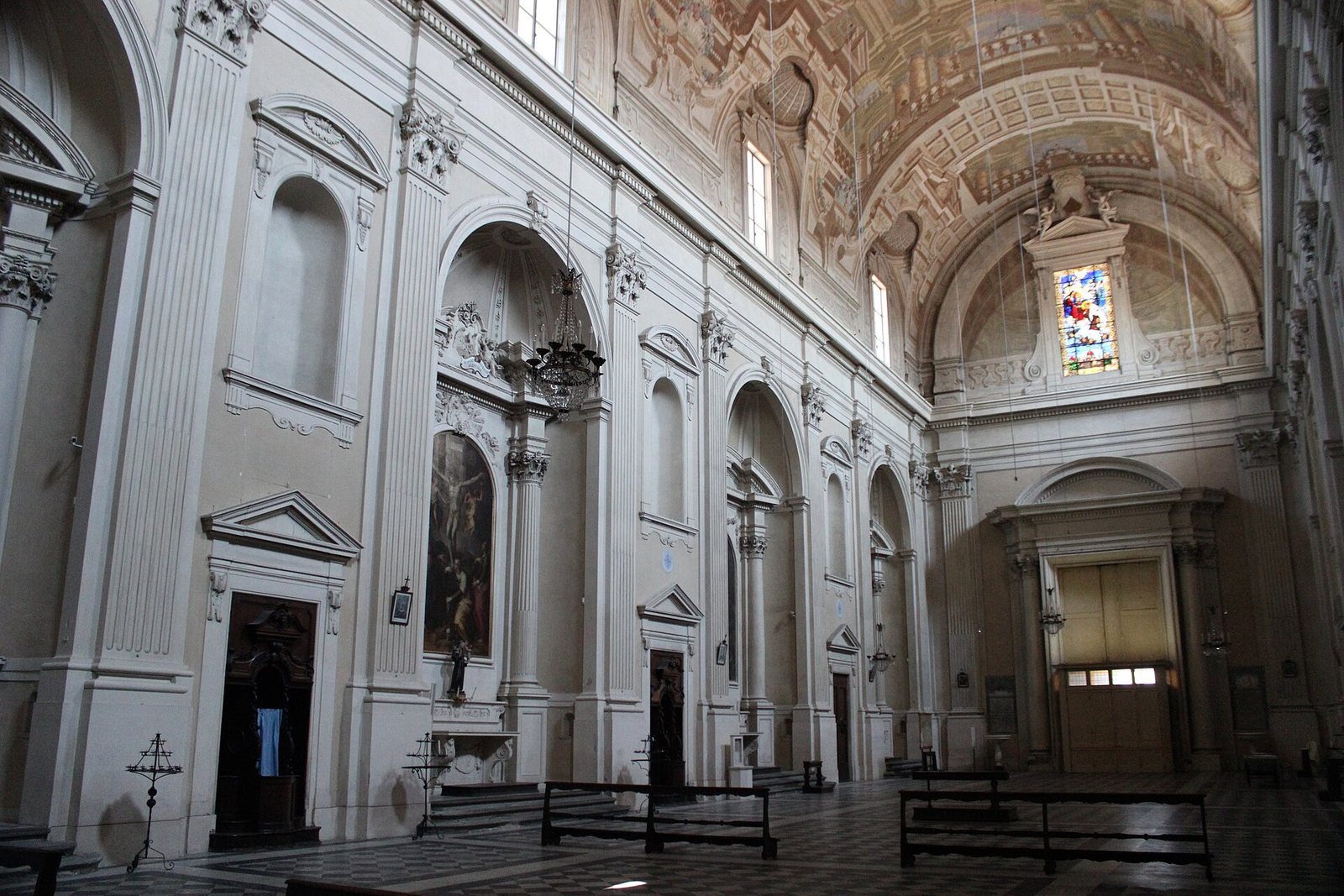
After the eighteenth-century rebuilding, five shallow chapels lined each side of the nave. Their altars have triangular or curved tops supported by Corinthian half-columns, with stucco ornament and painted altarpieces. Four wooden confessionals, carved in 1779 by the workshop of Pietro Pertici, stand between the chapels. Walnut doors between them lead to the cloister and other convent rooms.
The nave’s painted decoration includes architectural illusionism by Domenico Stagi, whose painted structures create an effect of three-dimensional architecture. Giuseppe Romei painted the Ascension of Christ in the nave and, in the dome, the Trinity and the Virgin in Glory among saints from the Old and New Testaments. He also painted the prophets Isaiah, Jeremiah, Ezekiel, and Daniel on the curved triangular surfaces supporting the dome. Stagi placed the Carmelite arms on the interior facade, between two white-painted wooden angels carved by Pertici to resemble stucco.
First nave chapel
The first chapel belonged to the Company of Wool Weavers and now contains a late eighteenth-century Pietà by Antonio Guiducci. It formerly held a much-revered wooden crucifix. A tradition associated the crucifix with Andrea Corsini, who was said to have heard it speak while he prayed. Bernardino Poccetti depicted Corsini praying before it for the people of Florence.
Right-hand nave chapels
The right-hand altars include Bernardino Monaldi’s signed 1613 painting of the Funeral of Saint Albert the Carmelite. Giorgio Vasari’s Crucifixion, painted in 1561 and installed in 1563, also belongs to this side; its lower panel and altar frontal were lost in the 1771 fire. Aurelio Lomi’s Visitation, made around 1617–18 for the Biuzzi family, was repainted by Romei in 1781. It replaced an Assumption by Girolamo Macchietti. Francesco Gambacciani’s Tobias Restoring His Father’s Sight, painted around 1782, took the place of a Nativity by Santi di Tito.
Left-hand nave chapels
Paintings on the left include Giuseppe Fabbrini’s image of Saint Mary Magdalene de’ Pazzi covered by the Virgin’s veil, made around 1781–82; Giovanni Maria Butteri’s Centurion of Capernaum Begging Christ to Heal His Son, from around 1583–84; and Francesco Gambacciani’s Nativity, dated 1776. Bernardino Poccetti’s signed Annunciation of 1601 and Gregorio Pagani’s signed Adoration of the Magi of 1603 are also displayed here. Pagani’s painting was enlarged above and below to fit its frame and placed on the altar in 1782. Neri Alberti may have commissioned it.
Transept and principal chapels
Brancacci Chapel
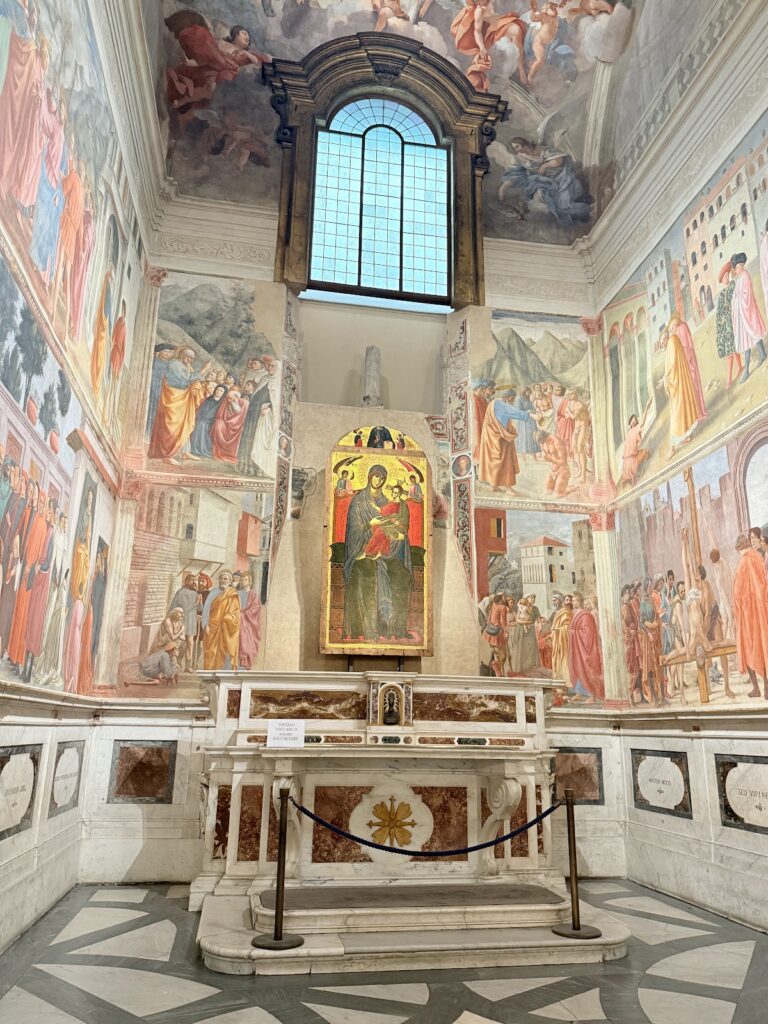
At the far end of the right transept, the Brancacci Chapel contains a fresco cycle begun by Masolino around 1425 for the merchant Felice Brancacci, with Masaccio joining the work. Filippino Lippi completed it. The scenes include the Expulsion of Adam and Eve from Paradise, the Tribute Money, episodes of Saint Peter healing and preaching, and his martyrdom. The cycle is regarded as a landmark in the development of Renaissance painting, and Michelangelo copied sections painted by Masaccio.
The chapel’s altar holds the thirteenth-century Madonna del Popolo, possibly made soon after the church’s foundation for its high altar. The chapel is unusually narrow and large in form; its shape was altered in an effort to protect the earlier frescoes.
Passion Chapel
The Passion Chapel in the right transept formerly belonged to the Nerli family. Its stucco work, made around 1782–88 by an unidentified sculptor, includes medallions of Saint James preaching and being led to his execution. Lorenzo Lippi’s Martyrdom of Saint James the Greater, painted in 1642 and placed in the chapel in 1788, is now in the sacristy. The present altar painting is a sixteenth-century Saint Anne with the Virgin and Child from the school of Andrea del Sarto, possibly by Alessandro Allori.
Chapel of Saint John the Baptist
Formed in 1781 by joining three older Gothic chapels once owned by the Manetti, Bonsi, and Lanfredini families, this chapel retains fragments of fourteenth-century wall paintings. They were traditionally assigned to Giotto but are more likely by Spinello Aretino. Domenico and Giuliano Ruschi made the present altar’s stucco decoration. Cipriano Lensi painted scenes of the Preaching and Beheading of Saint John the Baptist, the Visitation, the Baptism of Christ, and the saint in Glory. Francesco Gambacciani’s 1781 altarpiece shows the Virgin Giving the Habit to Blessed Bonagiunta Manetti dell’Antella.
Corsini Chapel
In the left transept, the Corsini Chapel was designed by Pier Francesco Silvani in the Baroque style. Its decoration includes stucco by Giovanni Battista Foggini, dated 1676–83, with scenes of Saint Andrea Corsini, the Battle of Anghiari, the Mass of Saint Andrea, and his Apotheosis. Luca Giordano painted the dome’s Glory of Saint Andrea Corsini in 1682, and Giovanni Domenico Ferretti painted the ceiling. The frescoes were later damaged and restored by Stefano Fabbrini.
Chapel of the Crucifix of Providence
Beside the main chapel, this chapel was rebuilt for the Company of Saint Albert the White beginning in 1780 and completed in 1782. Domenico and Giacomo Ruschi created its stucco work, including an altar with a broken pediment, full-length angels, and medallions bearing symbols of the Passion. Agostino Rosi painted the frescoes: the dome shows the Glory of Saint Alberto, the curved supports depict the virtues of Prudence, Justice, Temperance, and Fortitude, and the lunettes show the Dream of Jacob and Moses with the Bronze Serpent.
Two angels by Gennaro Landi, set within a painted architectural surround by Antonio Donati, frame a tabernacle made by Giuseppe Piamontini in 1740. Transferred from a chapel of Saint Alberto that was later destroyed, it contains a paper painting of a crucifix regarded as miraculous. The cover shows a Byzantine-style Virgin and an Eternal Father surrounded by twelve angels in adoration, painted in the style of Botticelli. Other works include Landi’s Finding of the Cross, copied from a painting by Gregorio Pagani destroyed in the 1771 fire, and Gesualdo Francesco Ferri’s Exaltation of the True Cross. The Marquis Alessandro Rinuccini helped finance the chapel’s decoration.
Former Del Pugliese Chapel
Rebuilt for the Buonaccorsi Perini family and completed in 1782, this chapel was formerly known as the Del Pugliese Chapel. Fragments of frescoes by Gherardo Starnina, painted around 1404, are now in the convent’s Column Room. The chapel has stucco by Giovanni Nobili, Ferretti’s Deposition of about 1758, and a dome painting by Romei of Melchizedek Offering Bread and Wine to Abraham, accompanied by Eucharistic symbols. Paintings of Saint Paul by Masaccio and Saint Peter by Masolino, probably once on the chapel’s outer pillars and dated around 1424, are lost. They may have helped the painters obtain the commission for the Brancacci Chapel.
Main chapel and choir
The main chapel has a monumental altar faced with colored marble, bronze, and hard stones. The Marquis Lorenzo Niccolini paid for its marble facing in 1780. The remains of Blessed Angiolo Mazzinghi lie beneath it, and Romei’s painting in the elliptical dome shows Elijah ascending in a chariot of fire. Among the furnishings are a marble funerary monument to Pier Soderini by Benedetto da Rovezzano, made in 1512–13 before Soderini’s death in 1522, and a lectern made around 1594 by Domenico Atticciati, which came from the Galluzzo Charterhouse. Above the choir gallery is a pipe organ made by Alamanno Contucci in 1777, enclosed in a large carved wooden case designed by Giulio Mannaioni.
Sacristy and convent rooms
Sacristy
The Gothic sacristy dates to 1394. Its wall paintings, attributed to Lippo d’Andrea and made around 1400, depict the Stories of Saint Cecilia. Above its two doors are a Pietà and a Madonna and Child in a style close to that of Agnolo Gaddi. The original stained-glass windows carry the arms of the Serragli and Corsini families.
The sacristy altar has a small Crucifixion in the manner of Jacopo del Sellaio above a panel showing Stories of Saint Andrew. Other paintings include a multi-panel Virgin and Child with saints attributed to Andrea di Bonaiuto, Lorenzo Lippi’s 1642 Martyrdom of Saint James, and Bernardino Poccetti’s Saint Andrea Corsini Healing a Blind Man, from around 1600. A bust of Saint Mary Magdalene de’ Pazzi by Dante Sodini, dated 1908, stands above a cabinet. The walnut counter dates to 1660, and a bishop’s chair associated with Saint Andrea Corsini was made around 1629.
Cloister and chapter house
The convent adjoins the church. Its entrance hall has a barrel-vaulted ceiling and a round painting by Giuseppe Romei showing the Virgin giving a scapular, a devotional garment or object worn over the shoulders, to Saint Simon Stock, an early Carmelite leader associated with the devotion. A bell tower is also part of the complex.
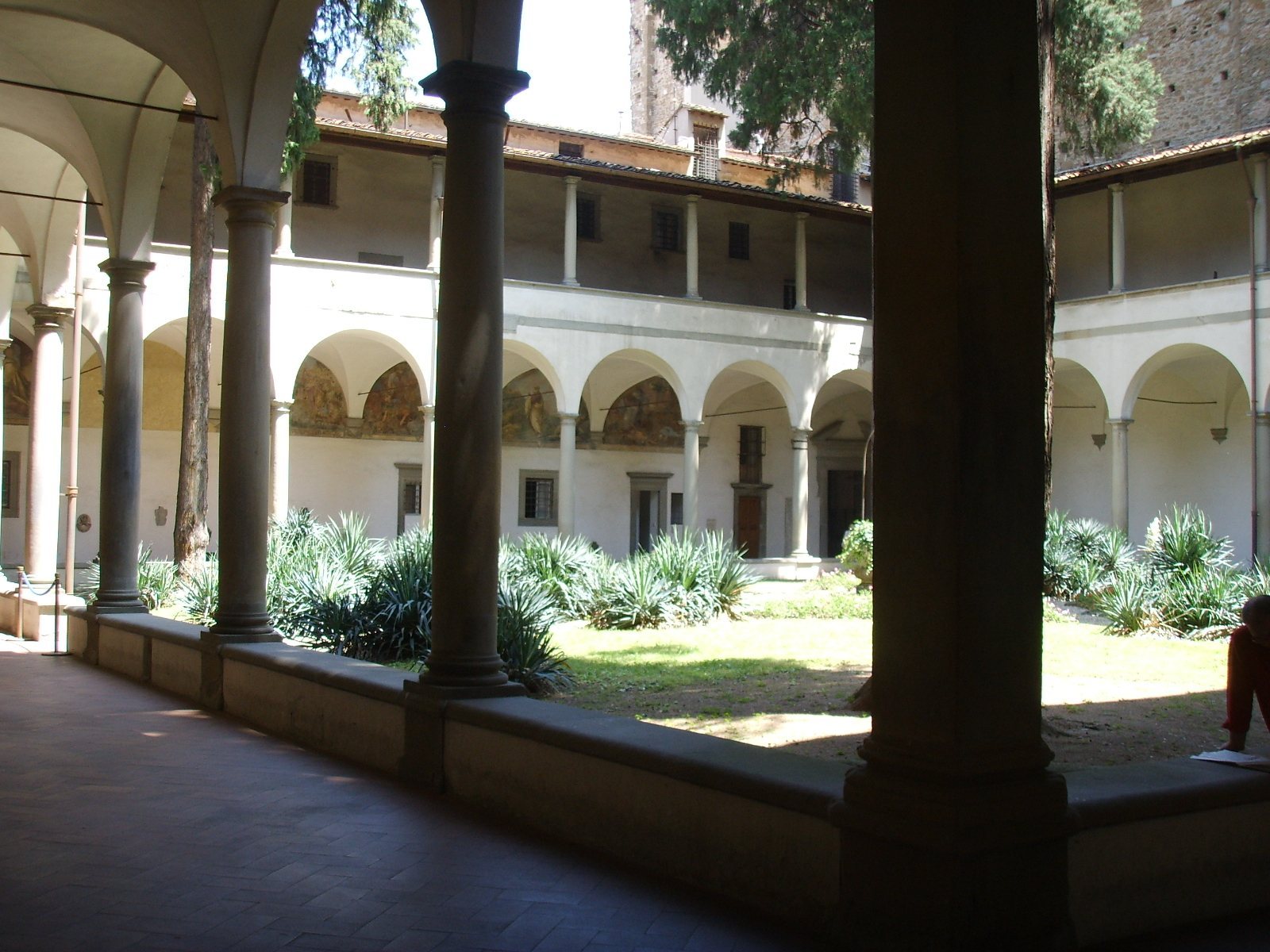
Built between 1597 and 1612, the square cloister has semicircular arches resting on gray sandstone columns and an upper covered gallery open along its sides. Artists including Galeazzo and Giovan Battista Ghidoni, Domenico Bettini, Cosimo Ulivelli, and Antonio Nicola Pillori painted its lunettes, the curved spaces above the arches, during the seventeenth and eighteenth centuries; some survive. Restored lunettes are displayed in the thirteenth-century chapter house. The cloister also contains family coats of arms from Oltrarno, funerary monuments, and a bust of the Carmelite mathematician Giuliano Ristori da Prato.
Last Supper Room
The Last Supper Room takes its name from Alessandro Allori’s large painting of the Last Supper, made in 1582 for Friar Luca da Venezia. Allori included his own portrait at one end and the friar’s at the other. Beneath the painting are fragments of late-thirteenth-century vegetal ornament within Gothic arches. The room also displays detached, single-color fresco fragments of the Passion, the Annunciation, and saints, made by an unknown Florentine artist in the late fourteenth century and originally belonging to the Company of Saint Niccolò del Ceppo.
Column Room
The Column Room holds detached fresco fragments from the fourteenth and fifteenth centuries, taken from the cloister and the old church. They include Gherardo Starnina’s Stories of the Life of Saint Jerome, from the Del Pugliese Chapel and dated 1401–04; a Madonna Enthroned with Saints attributed to Pietro Nelli, from around 1385; and Filippo Lippi’s early Conferment of the Carmelite Rule, made before 1431. A separate work, a Crucifix with Carmelite Friars by Paolo Schiavo, came from the chapter house and dates to around 1425.
Vanni Room and vestibule
The second refectory, also called the Vanni Room, contains Giovan Battista Vanni’s Supper in the House of Simon the Pharisee, from around 1645. It also displays frescoes from the Nerli Chapel attributed to Lippo d’Andrea and dated 1402, including a Crucifixion with its preparatory drawing, a fragment of a Flagellation, and an incomplete Last Supper with Saints. Other works include a Saint Vivaldo by an anonymous painter of the late fourteenth century and a Saint Cyril attributed to Spinello Aretino.
A vestibule between the chapter house and the church transept contains a lunette painting of two angels from around 1420–30, surrounding a marble Madonna and Child attributed to the young Michelozzo.