The Mury of Vinnytsia: A Religious and Defensive Complex
Site at a Glance
- Country
- Ukraine
- Primary era
- Early Modern
- Eras represented
- Early Modern
- Civilizations
- Polish–Lithuanian Commonwealth
- Site type
- Religious
- Remains
- Fortified Monastery
On this page9 sections
History
Jesuit and Dominican foundations
The Mury is a seventeenth-century religious and defensive complex in Vinnytsia, Ukraine, developed around Jesuit and Dominican institutions. Its Renaissance architecture includes early Baroque elements, and the Jesuit complex became the city’s principal defensive work. The name Mury derives from the Latin murus, meaning wall.
Construction of the main Jesuit buildings began in 1610. That year, Walenty Aleksander Kalinowski, a local administrator known as a starosta, endowed the Jesuits with 30,000 zlotys and two villages. He also built a fortified stone college and gave the order four villages and a substantial part of Vinnytsia, including a privately governed urban district. The Jesuits had a permanent residence in the city by 1619.
The Dominican church was founded in 1616. Dominican monks arrived in Vinnytsia in 1621, when the local starosta granted them a site beside the Jesuit buildings and substantial estates, and they established a monastery. By 1617, walls and towers enclosed the Jesuit and Dominican monasteries within a single fortress.
Further gifts increased Jesuit property. In 1628, Aleksander Piasoczyński granted the monastery half the town and castle of Piasoczno, along with the neighboring village of Starostavtsy. Around 1630, Lew Sapieha gave it two villages in Ovruch district. In 1647, Hetman Marcin Kalinowski, a senior military commander, endowed the order with 30,000 zlotys secured on two villages, yielding annual payments of 2,100 zlotys. In the same year, the wife of Vinnytsia’s starosta left 20,000 zlotys to buy an estate. Paweł Piasoczyński added 20,000 zlotys secured on three villages in 1663. The Jesuits also owned the town of Batoh, while Bratslav provincial assemblies repeatedly asked the government to confirm the monastery’s property rights and grant it tax exemptions.
Defence and the end of Jesuit control
Vinnytsia suffered repeated destruction during raids by Cossack forces and Tatars, especially during the mid-seventeenth-century uprising led by Cossack leader Hetman Bohdan Khmelnytsky. The Mury’s defenses were intended to guard against Tatar attacks from the Wild Field, the frontier steppe north of the Black Sea, as well as raids by Zaporizhian Cossacks. In the eighteenth century, residents took shelter from Haidamak attacks in the Jesuit college. Haidamaks were armed insurgents active in the region. King Władysław IV founded the college in 1649, and it was enclosed by a stone wall.
The Jesuit complex’s prosperity ended in 1773, when a papal decree suppressed the order. Its estates passed to public education, while Basilian monks, members of an Eastern Christian monastic order, took over the college and established a model school.
Schools and civic institutions
The college continued to serve successive educational systems. It became a subdistrict school in 1776 and a district school in 1785 under the Polish Commission of National Education, the Commonwealth body responsible for public education. A county school operated there from 1799 to 1814, followed by a Polish secondary school, or gymnasium, from 1814 to 1831. Russian gymnasiums included a boys’ school from 1832 to 1847 and again from 1907 to 1919, and a girls’ school established in the early 1910s.
Over time, the complex also accommodated government offices, a court, treasury, prison, military units and stores, a hospital, fire brigade, church, almshouse, pawnshop, municipal printing press, and newspaper editorial office. The southern part of the defensive wall, adjoining cells, and other buildings were dismantled in the 1870s because of their dangerous condition. Part of the wall beside the church’s main façade collapsed in 1891. Minor repairs followed in 1901, and renovation began in 1907 as buildings were adapted for the boys’ gymnasium.
Twentieth-century institutions
From 1920 to 1930, a Vinnytsia branch of the Ukrainian People’s Library associated with the All-Ukrainian Academy of Sciences occupied part of the complex. The Ukrainian Autocephalous Orthodox Church, a self-governing church, used it from 1923 to 1938 and again from 1942 to 1943. A pedagogical institute operated there from 1932 to 1943 and changed its name three times. The Dynamo sports society used the complex from 1950 to 1973.
The State Archive of Vinnytsia Region has been based in the complex since 1920, the regional local-history museum since 1929, and the regional art museum since 1987. A technical lyceum has occupied part of the site since 1993.
Remains
Layout and defensive remains
The ensemble grouped the Jesuit church, college, and boarding house with the Dominican monastery and church, with walls and towers enclosing the religious buildings. It stood on the high right bank of the Southern Bug, where the complex was visible from a distance and overlooked the river. A drawing made by nineteenth-century artist Napoleon Orda in the mid-1800s depicts the Mury and the Jesuit church.
Southwest corner tower
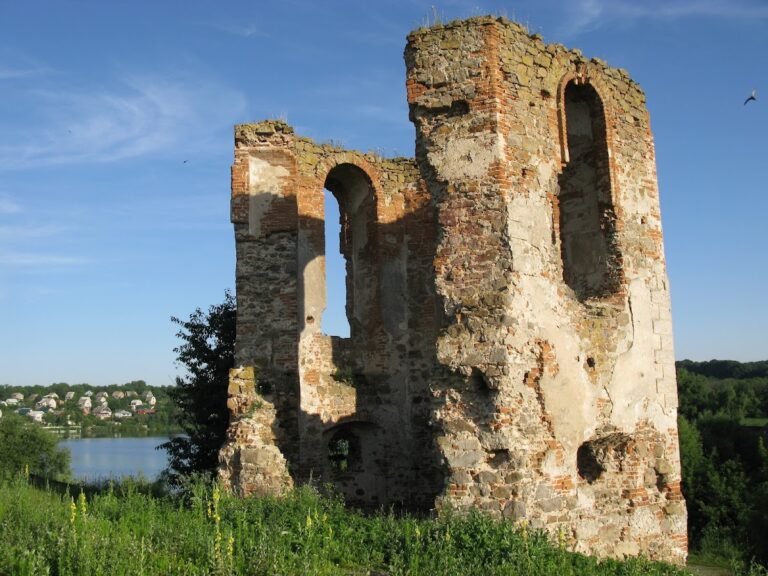
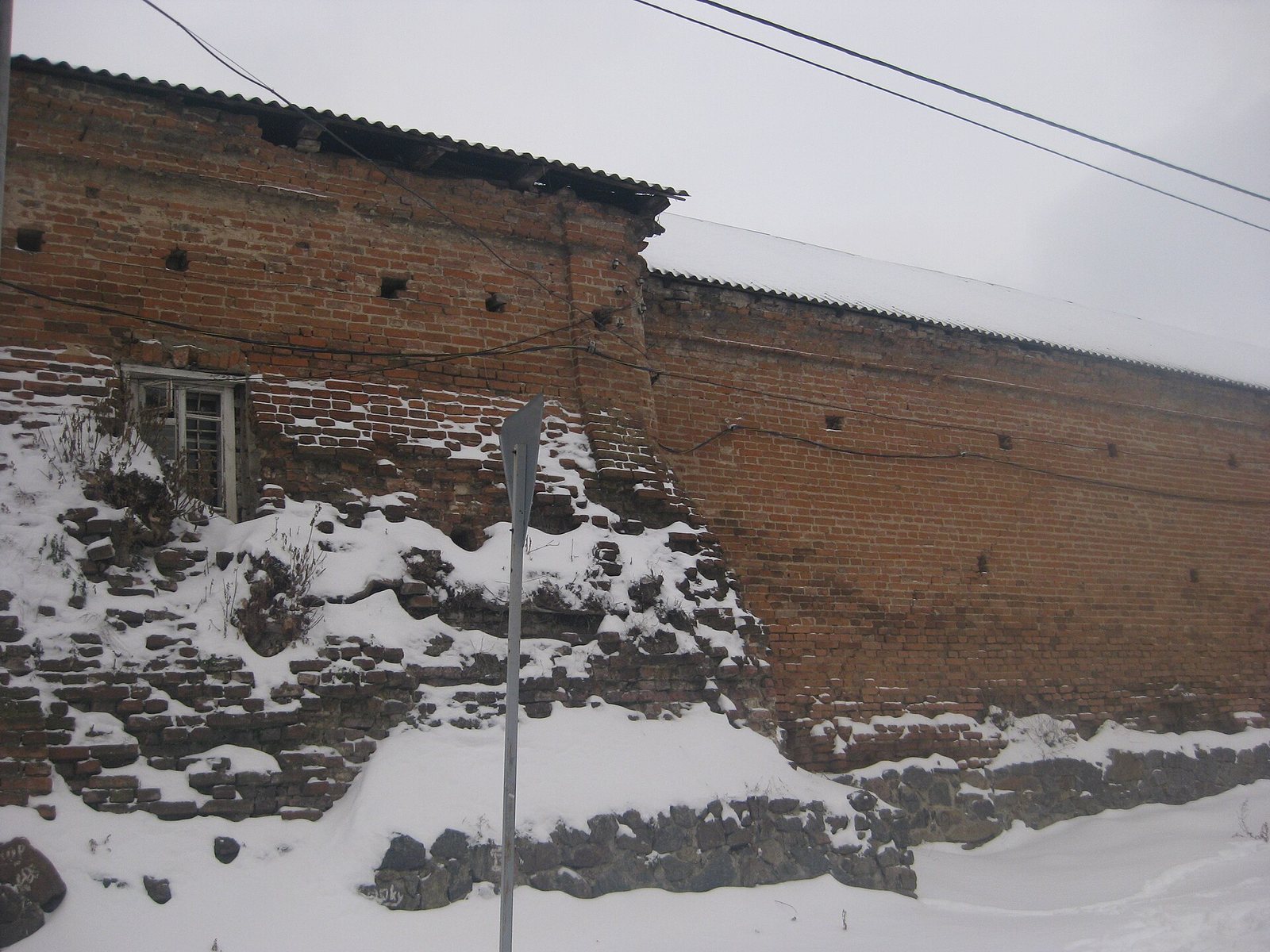
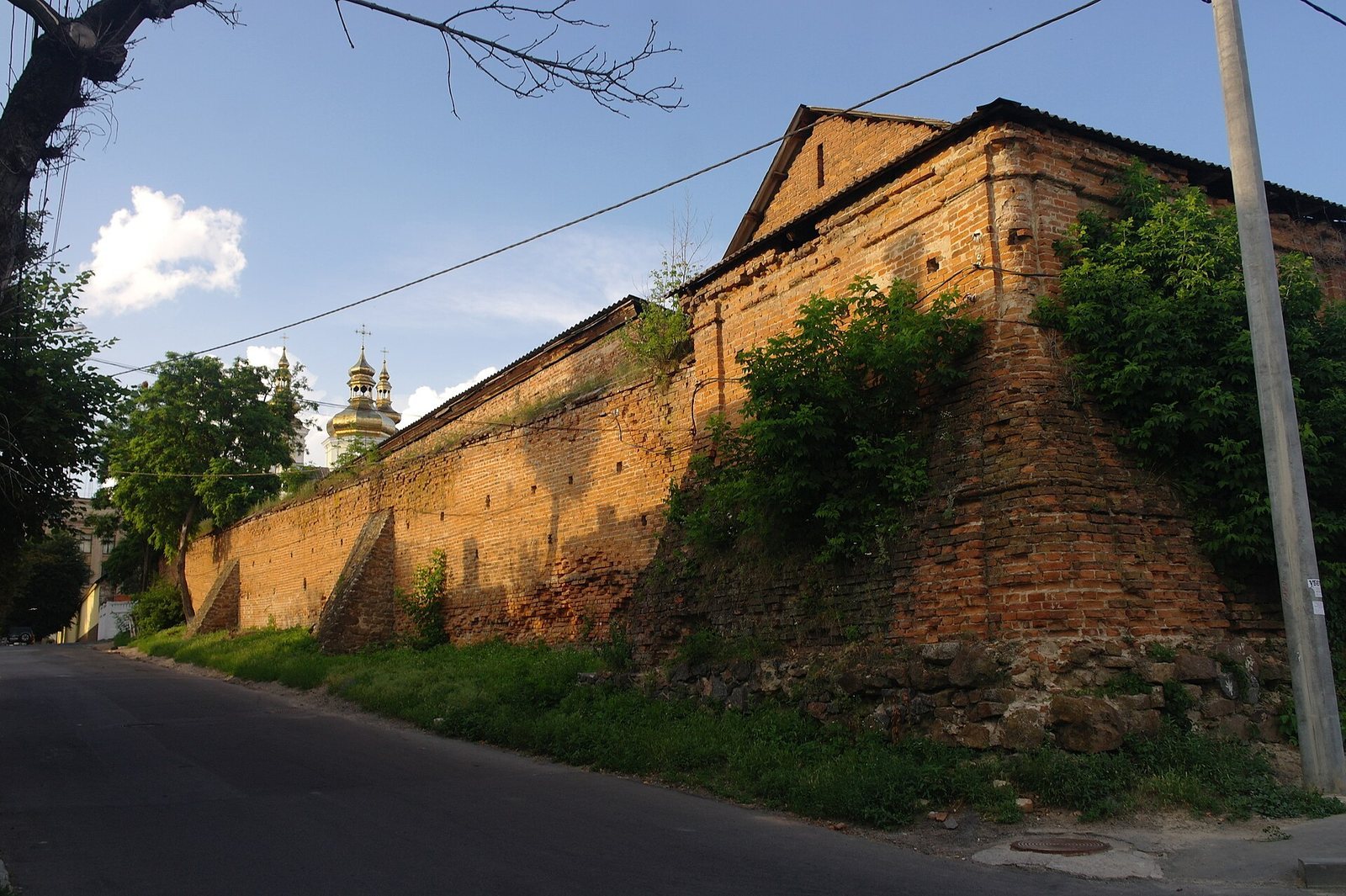
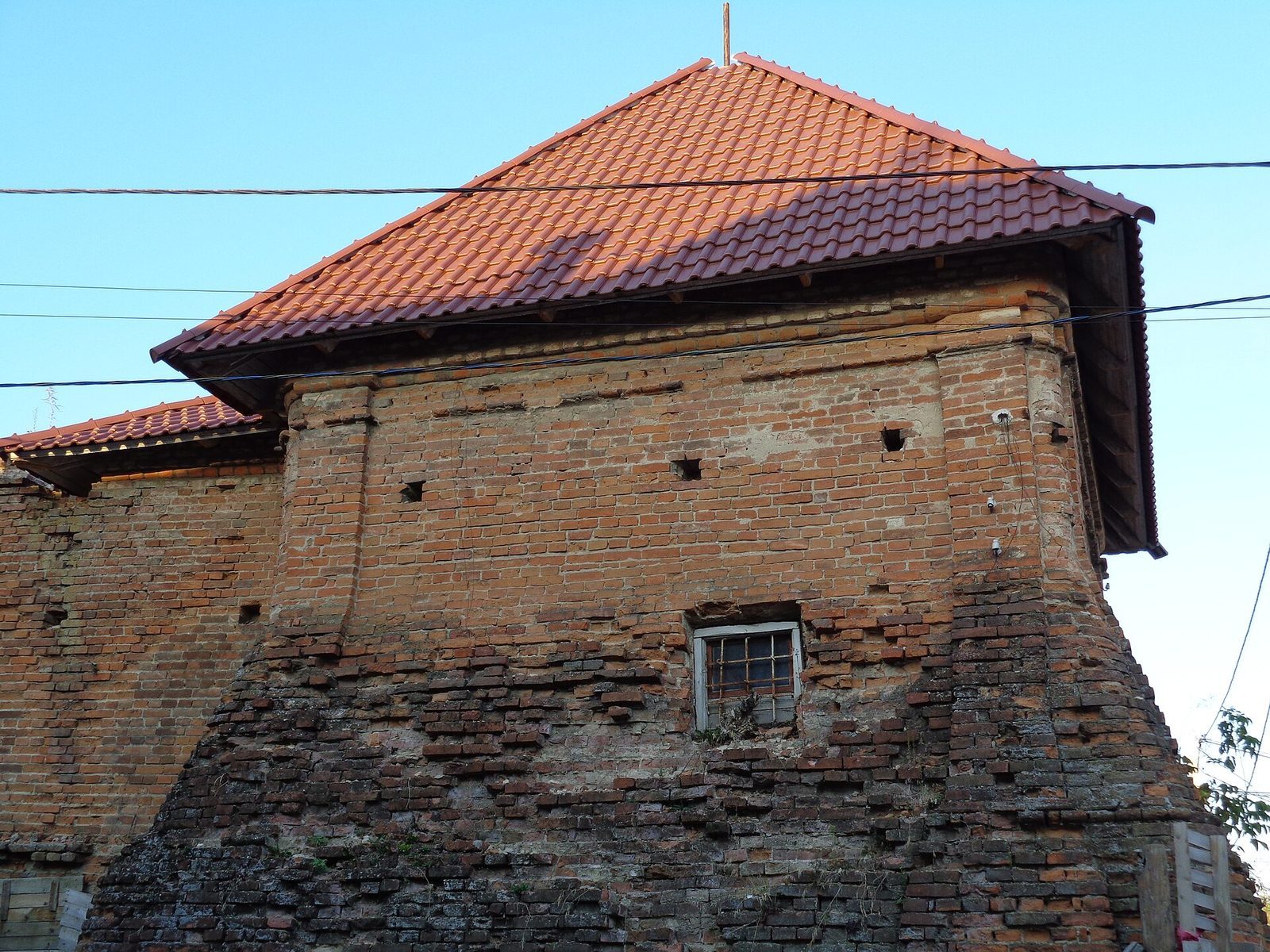
The surviving southwest corner tower is built of brick and has a single-storey, square plan with rounded corners. It rises from a tall base that widens toward the ground and is strengthened by buttresses, or exterior supports. Arched ceilings, known as vaults, cover the structure. Pilasters, shallow wall projections resembling columns, flank its rounded corners and emphasize its bell-like outline. The tower reaches the height of the adjoining wall sections.
Surviving walls
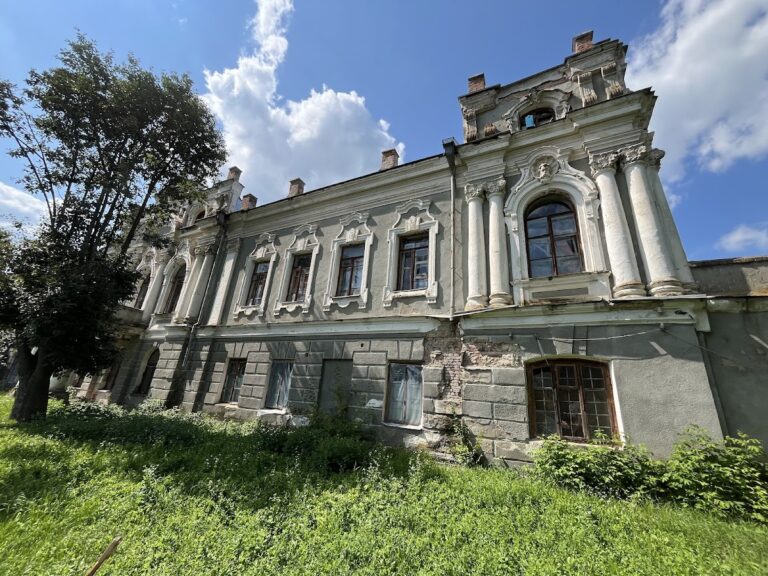
The surviving defensive walls include the southern wall and part of the western wall. Built from large red bricks on granite foundations, they contain numerous loopholes. Two rows of small square openings and a narrow Tuscan frieze, a horizontal band in a plain classical style, extend from the corner tower along the walls. Many buildings and wall sections within the complex are in poor condition.