Palace of Grokholsky in Voronovytsia: An Estate of Ukrainian Classicism


Site at a Glance
- Rating
- 4.5
- Popularity
- Low
- Country
- Ukraine
- Primary era
- Early Modern
- Eras represented
- Early Modern
- Civilizations
- Polish–Lithuanian Commonwealth
- Site type
- Domestic
- Remains
- Elite Residence
On this page7 sections
History
The Palace of Grokholsky in Voronovytsia, Ukraine, is an important historical and architectural monument of estate architecture associated with Ukrainian Classicism. Franciszek Ksawery Grocholski, an eighteenth-century Polish nobleman and landowner, promoted and financed its construction on the site of an older estate. The building date remains uncertain, but the palace was designed in the early Classical style by the architect Lorenz Gedon.
The Grocholski Estate
The palace remained connected with the Grocholski family through the political upheavals of the nineteenth century. Adolf Grocholski, Franciszek’s grandson, took part in the November Uprising, the Polish insurrection against Russian rule that began in 1830 and was defeated in 1831. After the uprising, Adolf was exiled to Siberia. He later returned and succeeded in preventing the estate from being confiscated.
After Adolf’s death, ownership passed to his brother Ludgard Grocholski. Ludgard participated in the 1863 uprising, a later Polish-Lithuanian revolt against the Russian Empire. The Russian government then confiscated the Voronovytsia estate. Ivan Mistota, identified as a Cossack, helped Ludgard avoid arrest and exile to Siberia. Cossacks belonged to historically organized military and frontier communities of Eastern Europe.
Russian and Soviet Periods
A Russian government law of 1865 restricted the purchase of estates in Ukraine to Russian subjects. The palace was subsequently acquired by Mykola Mozhaisky, the brother of Alexander Mozhaisky, a Russian naval officer and aviation pioneer of the nineteenth century.
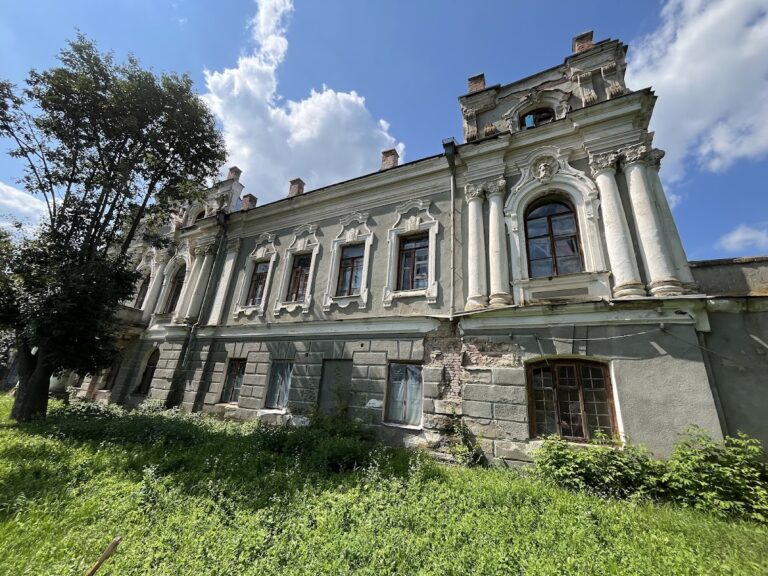
After the Revolution of 1917, the main palace building and the right wing were reconstructed. During the Soviet period, parts of the palace were used as a school, while other rooms housed a museum of aviation history. The building is preserved today but requires restoration.
Remains
The Palace
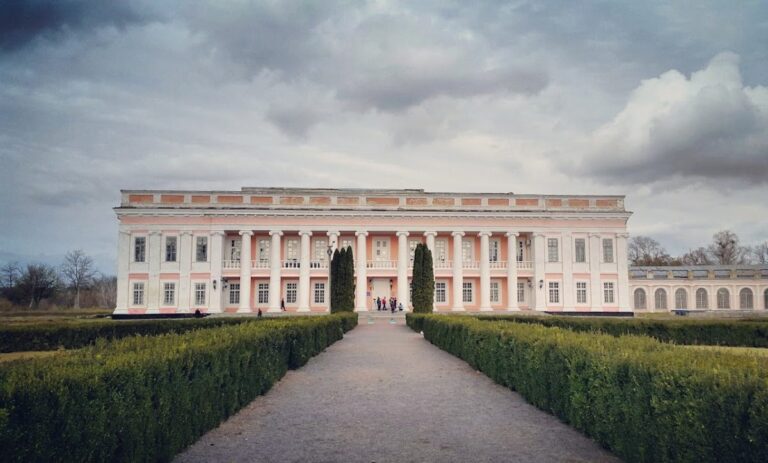
The three-storey palace stands on the highest hill in the surrounding area. Its composition centers on a main block with a portico and pediment. Slightly curved galleries extend from it and finish in pavilions, creating a horseshoe-shaped arrangement influenced by the Palladian architectural tradition. Palladian architecture derives from the Classical designs of the Italian architect Andrea Palladio, especially villa plans with a dominant central block and balanced side elements.
The façades and interiors follow the Classical style. Beneath the roof, a relief frieze of garlands and bucrania decorates the façades. Bucrania are ornamental representations of ox skulls, a motif associated with Classical decoration. The palace contains 43 rooms, with historic interiors surviving in its circular and oval halls. Other halls formerly had walls covered with mosaics, silk, or satin.
Park and Estate Grounds
A park extended behind and beside the palace, while a lawn occupied the area in front. Its principal lime-tree avenue followed a semicircular route, and a second avenue led from the lake. The park survives only partially. The estate also contained a vegetable garden, part of a fruit orchard, service buildings, and Cossack stables designed for 100 horses.
Church and Art Collection
A church built at the expense of Franciszek Grocholski stood near the palace. The estate also held a collection of 519 paintings acquired abroad in Rome and Livorno by Antoni Grocholski. The collection included works by Flemish, Dutch, and French masters, as well as a painting attributed either to Titian or to a member of his workshop. Another member of the Grocholski family later brought the collection to Voronovytsia from Tereshky in Volhynia.
Nearby sites