Gate of Dawn: A Late Gothic City Gate and Marian Shrine in Vilnius
Site at a Glance
- Country
- Lithuania
- Primary era
- Early Modern
- Eras represented
- Early Modern, Modern
- Civilizations
- Grand Duchy of Lithuania, Polish–Lithuanian Commonwealth, Russian
- Site type
- Military
- Remains
- Gate
On this page16 sections
History
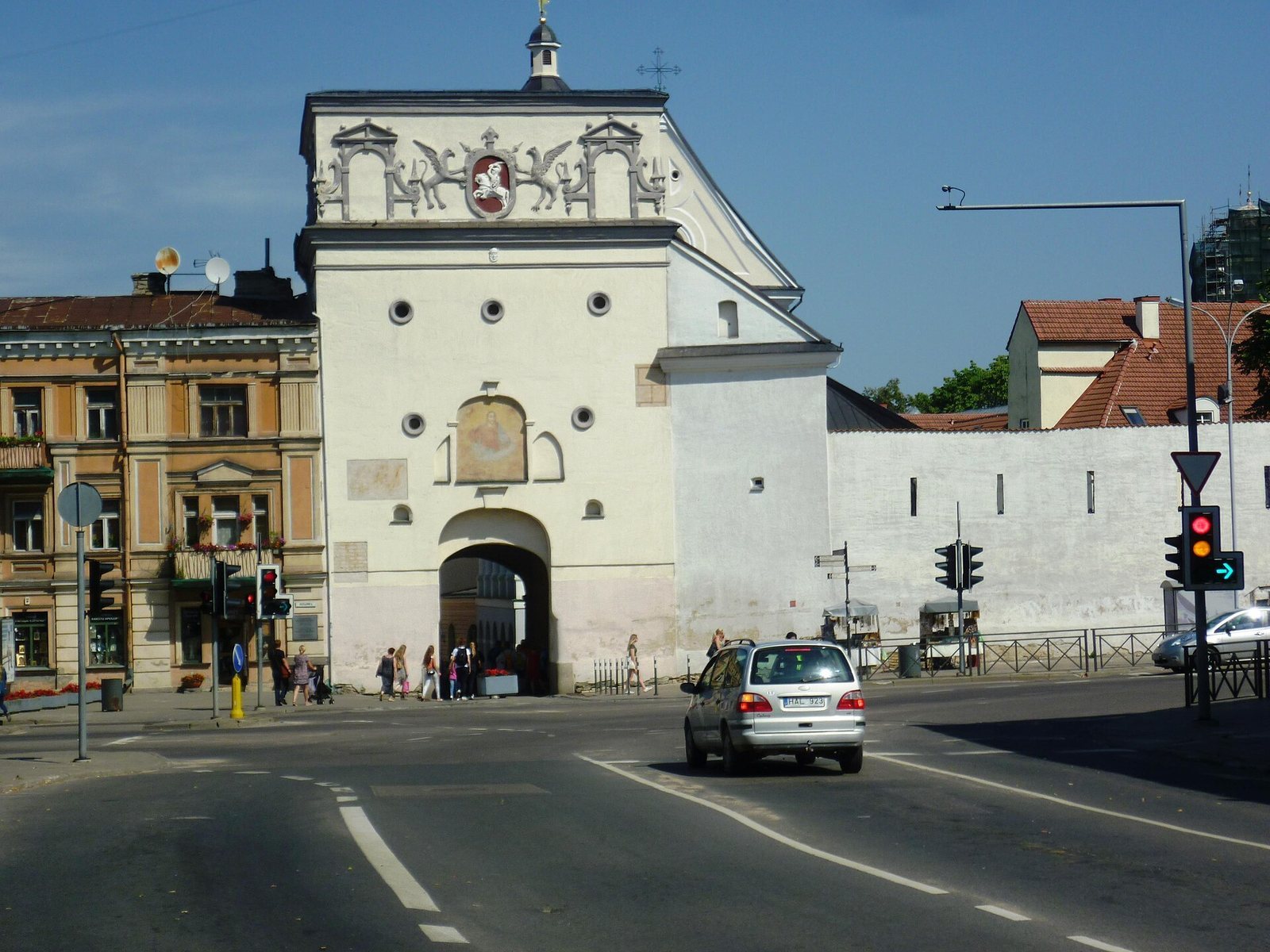
The Gate of Dawn is a late Gothic city gate in Vilnius, Lithuania, built between 1503 and 1514 as part of the city’s defensive wall. Its history became closely connected with a Marian shrine, and devotion to the image kept the gate in use after Vilnius’s other gates had disappeared.
Construction and changing names
A royal privilege issued to Vilnius’s townspeople by Alexander Jagiellon, Grand Duke of Lithuania and King of Poland, refers to the gate on 6 September 1503. The city first had five gates and later nine. The Gate of Dawn was also called Medininkai Gate, after the road leading toward Medininkai, and Sharp Gate. Sharp Gate may have taken its name from a southern suburb called Sharp End, although the origin of that name is uncertain.
The Lithuanian name Aušros Vartai, meaning Gate of Dawn, appeared in newspapers in the early twentieth century. Its association with Mary’s symbolism of dawn is religious, not directional: the gate does not face east.
The Marian image and Carmelite chapel
A Marian image may have been placed on the gate soon after it was built. In the first half of the seventeenth century, a new image was set on its southern side. Images of Christ as Savior and Saints Casimir and Stanislaus were also displayed on the gate’s outer face.
A community of Discalced Carmelites, a branch of the Carmelite order whose members traditionally went barefoot or wore simple sandals, and the Church of St. Teresa were established beside the gate in 1626. With the city’s permission, the Carmelites built a wooden chapel at the gate. It was completed in 1672, and the Marian image was solemnly placed inside. The chapel burned in 1711, but the image was saved. A brick chapel replaced the wooden one in the early eighteenth century, and the image was moved into it around 1713–1715; the exact installation date is uncertain.
War, devotion, and the city walls
During a Swedish attack in the Great Northern War, a conflict fought in northern and eastern Europe in the early eighteenth century, Antoni Nowosielski commanded the troops of the Grand Duchy of Lithuania defending the fortification, chapel, and image. A Swedish bullet struck the image. Many Swedish soldiers died, while no Polish or Lithuanian soldiers were injured. Nowosielski offered a silver plaque depicting the defense, and devotion to the image and gate spread. The shrine became a national symbol.
The image’s following grew during the eighteenth century. A feast in honor of Our Lady of the Gate of Dawn was established in 1735 and is held on 16 November. Its indulgence celebrations include an eight-day observance, or octave, running from Sunday to Sunday and encompassing the feast. Pilgrims have prayed while climbing the chapel stairs on their knees. By at least the mid-nineteenth century, custom also expected people passing beneath the gate to uncover their heads. Masses are held in Lithuanian and Polish.
When Vilnius’s walls were dismantled between 1799 and 1805, the gate was spared because of the image’s high veneration. The other gates were destroyed during the nineteenth century, leaving the Gate of Dawn as the sole surviving city gate. A covered stair gallery connecting the chapel with the nearby Church of St. Teresa was added in the late eighteenth century. The chapel and gallery were reconstructed in 1828–1830 with Neoclassical features.
Religious life under changing rule
The Russian government dissolved the Carmelite monastery in 1844, after which secular clergy took charge of the chapel. Following the January Uprising, the 1863–1864 revolt against Russian rule in the former Polish-Lithuanian territories, Vilnius governor Mikhail Muravyov planned to close the chapel and transfer the image to the Orthodox Monastery of the Holy Spirit. The chapel was defended, but preaching there was prohibited. Sermons resumed after the Russian Edict of Toleration in 1905, which eased restrictions on non-Orthodox religious practice. Religious-patriotic demonstrations took place before the chapel between 1861 and 1863.
The chapel’s inscription was set in Polish in 1828. In 1864, amid concern about the Russian authorities’ response, it was changed to Latin. After Vilnius became part of Poland following the First World War, a decision to restore the Polish wording was made in 1932, and replacement letters were installed on 29 September 1933. After the Second World War, the Polish inscription was removed and Latin wording was put in its place.
The shrine in the twentieth century and after
Archbishop Romuald Jałbrzykowski secured church authorization for the image’s canonical coronation, a formally approved ceremony crowning a Marian image. Cardinal Aleksander Kakowski crowned it on 2 July 1927 in the presence of Józef Piłsudski and Poland’s president, Ignacy Mościcki. Devotion at the shrine also became important to the development of Divine Mercy, a Catholic devotion centered on God’s mercy. The Gate of Dawn was the first place where the Divine Mercy image was displayed and where Divine Mercy Sunday was celebrated.
The chapel was restored in 1829–1830, 1927–1932, and 1993. During the 1931–1932 renovation, the organ was removed and oak paneling was fitted to the walls. Pope John Paul II prayed the rosary at the chapel on 4 September 1993, before which it had been restored. In 2010, repair work was halted after heritage authorities raised concerns and appointed a committee to oversee repairs and investigate who had authorized the work. Historic doors had been removed, tiles laid in 1932 were damaged by a new floor, railings were changed, and more than a century-old stairs were replaced with imitation-granite steps.
After the Second World War, devotion to Our Lady of the Gate of Dawn continued among Lithuanian and Polish communities around the world. Vilnius Old Town, including the gate, became a UNESCO World Heritage Site in 1994. Lithuania designated the gate a national cultural monument in 2008.
Remains
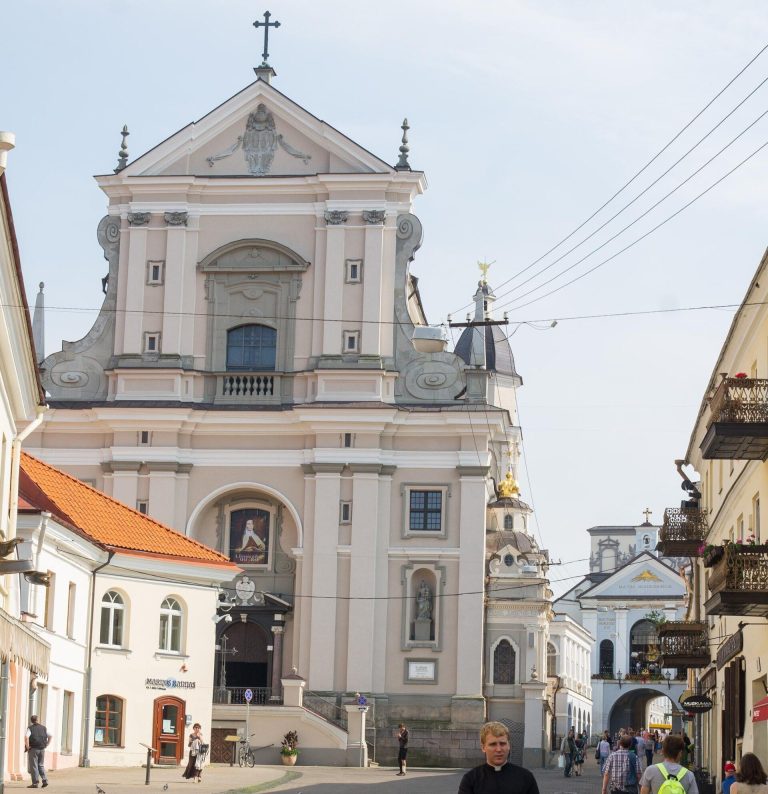
The surviving complex brings together the gate tower, an attached chapel on its north side, and a covered gallery with stairs connecting the chapel to the Church of St. Teresa. The late Gothic gate has defensive openings and a vaulted passage; the chapel and gallery combine later Baroque and Neoclassical features.
Gate and defensive fabric
Gate tower
The gate has an almost square plan, 11.2 by 10.8 metres, and walls up to two metres thick. Firing openings remain visible on the exterior. Its ground-floor passage is covered by a cross vault, formed by intersecting vaulted sections, and opens to the north and south through shallow arches. A higher niche and a slot for lowering a gate grille mark the southern façade. A ceiling divides the interior into two storeys, topped by a high, solid attic wall.
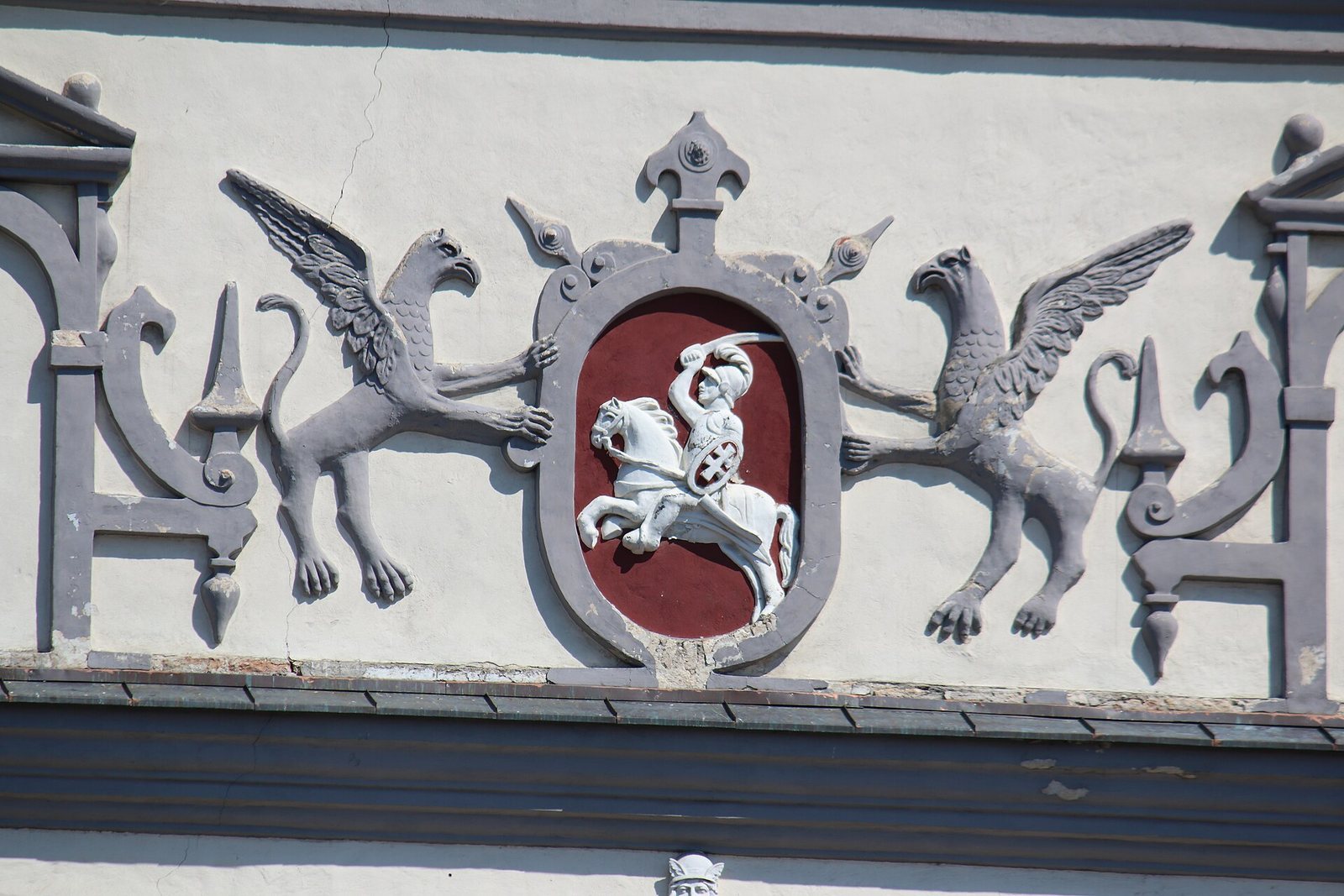
Plaster ornament formed from interlacing bands decorates the attic. On the north and south elevations, two small shrine-like frames stand between obelisks and are joined by scroll-shaped ornaments. Winged griffins support an oval medallion with a relief of the Vytis, Lithuania’s coat of arms showing a mounted knight. The upper façade also includes five firing openings and Renaissance decoration, among it a relief head of Hermes wearing a winged helmet.
Images on the outer face
The images of Christ as Savior and Saints Casimir and Stanislaus remained visible into the first half of the nineteenth century, were later covered with plaster, and were rediscovered by conservator Leszek Krzemiński in 1976. A relief of the Polish eagle was placed in a niche on the southern side in 1923.
Chapel and gallery
Chapel structure
The masonry chapel is attached to the gate’s north side. It is as wide as the gate and reaches the height of the tower’s inner upper storey, resting on an arch that spans the gate passage. The chapel’s elongated rectangular plan measures 10.8 by 5 metres. Its central bay has a cross vault, while the side bays have barrel vaults, shaped like continuous tunnel ceilings.
The chapel’s flat, one-storey façade has three bays and a triangular top with a cornice. Shallow attached columns divide the façade. Three large, round-arched windows have cast-iron railings across their lower sections. The central railing bears a medallion with Mary’s monogram; the side railings carry smaller medallions with the arms of the Polish Crown to the east and Lithuania to the west. A rectangular openwork structure for a bell rises from the roof ridge, topped by a cross on a central pedestal. The chapel’s design includes Baroque features as well as later Neoclassical elements.
The present Latin inscription translates as “Mother of Mercy, we take refuge under your protection.” It is arranged beneath a radiant eye of Providence in the triangular upper field, with the wording continuing above the windows.
Covered gallery
The gallery and stairs join the chapel to the nearby Church of St. Teresa. The covered gallery was built in the late eighteenth century. A stucco altar and stucco ornament made in 1785–1787 survive inside the chapel.
Marian image and offerings
Image and altar
The chapel contains the seventeenth-century image of Our Lady of the Gate of Dawn, also called Mother of Mercy. Painted on oak boards, it measures 200 by 165 centimetres and shows Mary without the Christ Child. Its painter is unknown. The image has been attributed to Łukasz, a Kraków artist who painted a similar work for Corpus Christi Church in Kraków in 1624. Both images may have taken inspiration from a painting dated around 1580 by the Flemish artist Martin de Vos.
A cover of silver with gilded surfaces was placed over the image around 1671. Gilded figures of Mary’s parents, St. Joachim and St. Anne, were installed beside it in the altar in 1799. Since 1849, a silver crescent bearing an inscription of thanks and a request for Mary’s continued protection has adorned the image. Two crowns, one above the other, complete its decoration.
Votive offerings
A silver offering depicting Nowosielski’s defense was hung beside the image. The chapel walls carry gold and silver objects dedicated in fulfillment of vows or as expressions of thanks and supplication. They include representations of hearts, hands, feet, a car, and an officer’s shoulder board. The earliest known offering was made in 1702.