Zähringen Castle: A Medieval Hilltop Fortress in Germany
Site at a Glance
- Country
- Germany
- Primary era
- Medieval
- Eras represented
- Medieval
- Civilizations
- Holy Roman Empire
- Site type
- Military
- Remains
- Castle
On this page6 sections
History
Zähringen Castle is a medieval hilltop fortress in Gundelfingen-Wildtal, Germany, above Freiburg-Zähringen. Berthold II built it before 1100 as the ancestral seat of the Zähringer family, a high-medieval noble and ducal house influential in what is now southern Germany and Switzerland.
Prehistoric and Alemannic occupation
Settlement on the hill began in prehistory. Traces are associated with the Neolithic Michelsberg culture, followed by Celtic occupation in the Hallstatt period and activity in the La Tène period, dated from about the seventh century BC. The Alemanni, a Germanic people of the region, established a hilltop settlement here in the fourth or fifth century AD. It was abandoned toward the end of the fifth century and may have been connected to an Alemannic petty king.
References to the name Zähringen appear shortly after 1000, though it is unclear whether they identify a fortification on the hill or the settlement corresponding to present-day Freiburg-Zähringen.
The Zähringer family and its castle
Berthold II made the castle the family’s ancestral seat. He first used the title Count of Zähringen and, from 1097, Duke of Zähringen, giving the ruling family its name. His father, Berthold I the Bearded, had borne the title Margrave of Limburg, after Limburg Castle, built around 1050.
In 1091, Berthold II began building another castle on Freiburg’s Schlossberg and moved there, judging its position more advantageous for trade and military strategy. The first unambiguous written mention of Zähringen Castle appears in 1128 in the Rotulus Sanpetrinus, a Latin parchment roll issued at the nearby monastery of St. Peter.
Capture, destruction and rebuilding
In 1146, during a feud between Welf VI and King Conrad III, Frederick Barbarossa besieged and captured the castle. Barbarossa, also known as Frederick I, was a Hohenstaufen ruler who became Holy Roman Emperor. After the Zähringer line ended in 1218, Emperor Frederick II took the castle as an imperial fief, land held under the authority of the emperor or Empire.
Between 1246 and 1250, Count Conrad I of Freiburg captured and destroyed the castle. It suffered further destruction in 1278 during territorial disputes involving the Empire, the counts of Freiburg and the city of Freiburg. After 1281, Rudolf I of Habsburg, King of the Romans, ordered its reconstruction.
Later ownership and destruction
Toward the end of the thirteenth century, the castle was held as an imperial pledge, first by the counts of Spitzenberg and, from 1296, by the counts of Freiburg. In 1327, the counts sold it to the knight Schnewlin Berenlapp for 303 marks of silver, a medieval unit used to weigh silver and reckon value. By the fifteenth century, the castle had several co-owners. Margrave Bernhard I of Baden acquired one quarter in 1422; later co-owners included Konrad Stürtzel von Buchheim and the Blumenecker.
The castle was finally destroyed during the German Peasants’ War in 1525. It passed fully into the possession of the House of Baden in 1815. Since 1851, the Freiburg student fraternity Teutonia has held its foundation anniversary festival at the castle. The City of Freiburg now owns the complex, while the hill lies within Gundelfingen-Wildtal.
Remains
The ruin occupies the summit of a projecting ridge on the northwestern side of the Roßkopf, at an elevation of about 478 metres. The summit was fortified with timber-and-earth works in the Hallstatt period and substantially levelled for the Alemannic settlement of the fourth or fifth century AD.
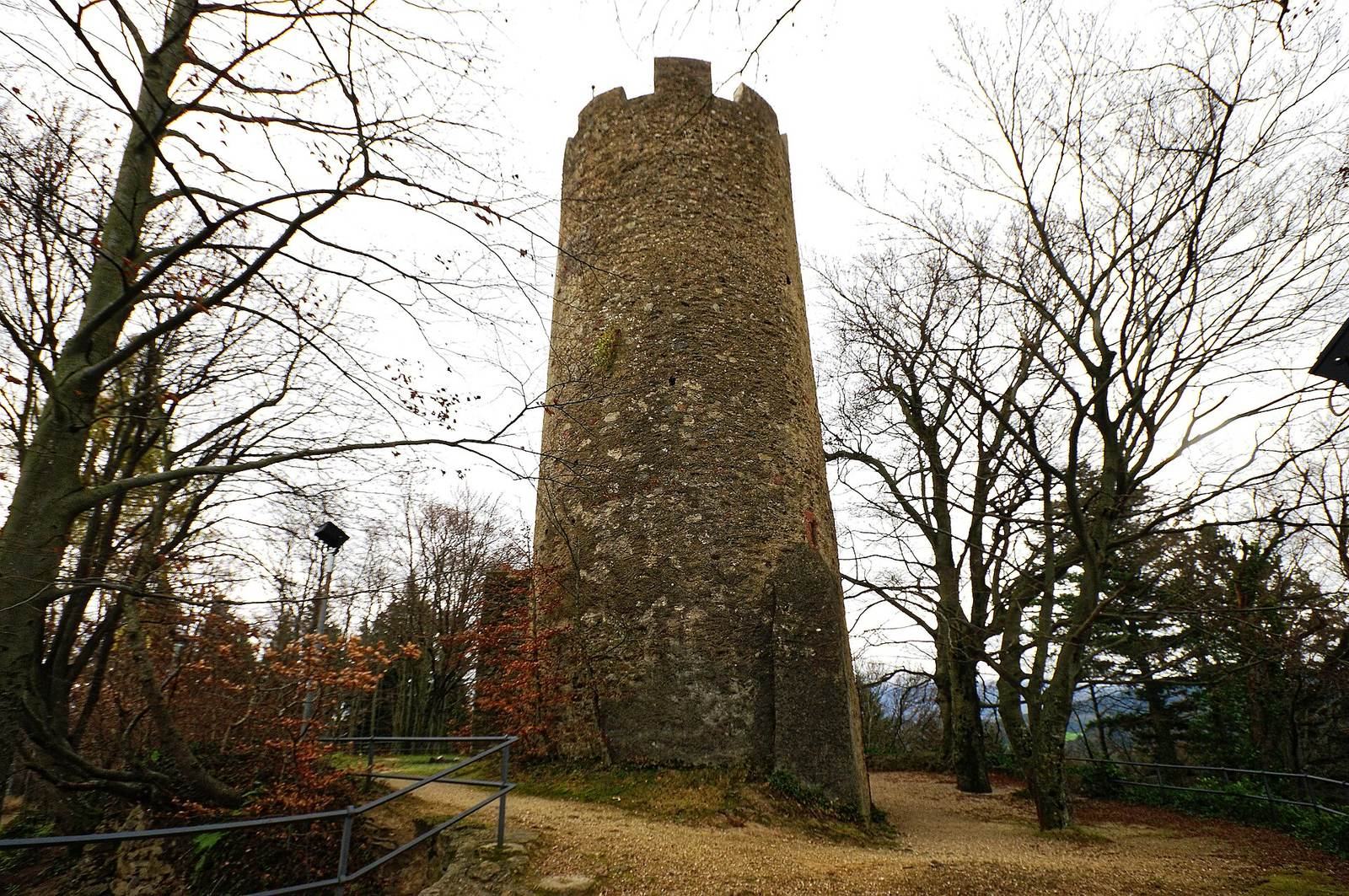
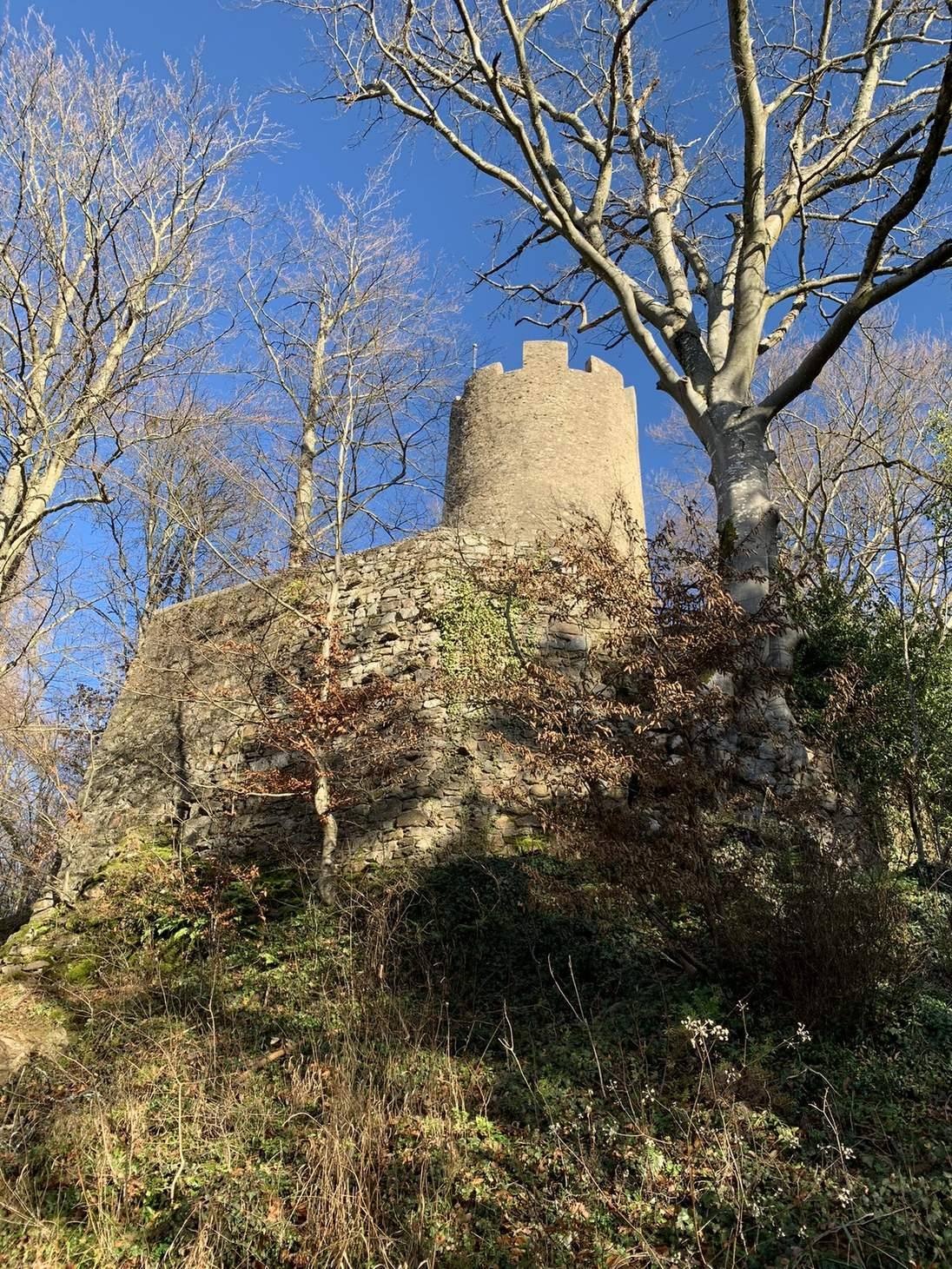
A surviving 18-metre-high round tower is the ruin’s intact major structure. Built in the thirteenth century, it has an observation platform surrounded by notched battlements.