Freiburg Castle: A Zähringer Fortress and French Fortress Site in Germany


Site at a Glance
- Rating
- 4.7
- Popularity
- Medium
- Country
- Germany
- Primary era
- Early Modern
- Eras represented
- Medieval, Early Modern
- Civilizations
- French, Holy Roman Empire
- Site type
- Military
- Remains
- Castle
On this page12 sections
History
Freiburg Castle, in Freiburg im Breisgau, Germany, was founded around 1091 by Duke Berthold II of the Zähringers, a medieval noble dynasty that held ducal authority in southwestern Germany. Built as the Romanesque Castrum de Friburch on the Schlossberg, it protected the settlement below and controlled access toward the Black Forest and the Dreisam Valley.
Foundation and the Zähringer settlement
The duke’s servants and craftsmen settled at the foot of the hill, in the area of Freiburg’s present southern historic center. In 1120, Berthold’s son Konrad secured imperial approval to grant the settlement market rights. This completed the initial foundation phase of Freiburg as a town associated with the castle. Medieval records later distinguished the fortress as Burghaldenschloss, or “castle on the hill,” to separate it from Zähringen Castle above the village of Zähringen to the north.
The castle is documented by 1146, when Bernard of Clairvaux recorded healing a blind boy near the fort of Freiburg. The Romanesque stronghold was also later praised by the poet Hartmann von Aue. Fires and warfare repeatedly destroyed its fortified buildings, but successive rulers rebuilt them because the hilltop position continued to protect Freiburg and the approaches to the surrounding region.
Counts of Freiburg and conflict with the city
When the Zähringer line ended in 1218, control of Freiburg passed to the counts of Urach. This dynasty adopted the title counts of Freiburg and resided in the castle. Disputes over the city’s financial obligations repeatedly damaged relations between the counts and Freiburg’s citizens, who occupied the castle twice during their conflicts with the ruling family.
In 1299, during a war against Count Egino II and his brother-in-law Konrad of Lichtenberg, bishop of Strasbourg, Freiburg’s citizens used siege engines to breach the castle. In 1366, they employed cannon fire to devastate it after Count Egino III attempted to enter the city at night. The confrontation permanently ruptured the relationship between the counts and the citizens.
In 1368, Freiburg bought itself free from the counts of Freiburg for 15,000 silver marks and voluntarily placed the city under Habsburg protection. The Habsburgs were a major European ruling dynasty whose Austrian branch controlled Freiburg thereafter. Leopold III, Duke of Austria, transferred the castle ruins to the citizens, who made only provisional repairs to the fortifications.
From medieval castle to mountain fortress
The incomplete repairs left the site vulnerable. The castle was easily captured during the German Peasants’ War in 1525, a widespread sixteenth-century revolt involving rural communities and towns, and again during the Thirty Years’ War, the major European conflict fought from 1618 to 1648.
In 1668, Leopold I incorporated the medieval castle into a mountain fortress called Leopoldsburg. The new works were intended to counter the threat posed to the Breisgau by Louis XIV of France, and the fortress was also known by the name Leopoldsburg from around 1670. French forces captured Freiburg and its fortress in 1677 during the Dutch War, a conflict in which France fought the Dutch Republic and its allies.
After the 1679 Treaty of Nijmegen transferred Freiburg to France, Louis XIV commissioned the military engineer Sébastien Le Prestre de Vauban to modernize the city’s defenses and the Schlossberg as a French outpost in Further Austria. Vauban’s artillery fortifications were arranged as a ring of defenses along the slope. In 1681, Louis XIV personally visited Freiburg and inspected the construction works on the Schlossberg. France relinquished the city after the War of the Palatine Succession under the 1697 Treaty of Ryswick.
Sieges, destruction, and the castle site
During the War of the Spanish Succession, French troops commanded by Marshal Louis Hector de Villars besieged and captured the fortress, which was held by a strong Austrian garrison. Its return to the Empire was agreed at Rastatt and took place in 1715. In autumn 1744, French forces allied with Frederick the Great occupied Freiburg again during the War of the Austrian Succession. Louis XV observed the siege from Lorettoberg and was nearly struck by a cannonball fired by the defenders. The 1745 Treaty of Dresden returned Freiburg to the Habsburgs.
Before withdrawing, the French extensively destroyed Vauban’s fortifications. The former castle and the surrounding city defenses then became a broad field of ruins covering the hill and the city for decades. Today, Freiburg Castle survives as a castle site represented chiefly by earthworks. In the early twenty-first century, the Kuratorium Freiburger Schlossberg re-exposed the course of the Fort Carée bastions with stone blocks and shallow terraces, making the extent of the French fortress works easier to infer.
Remains
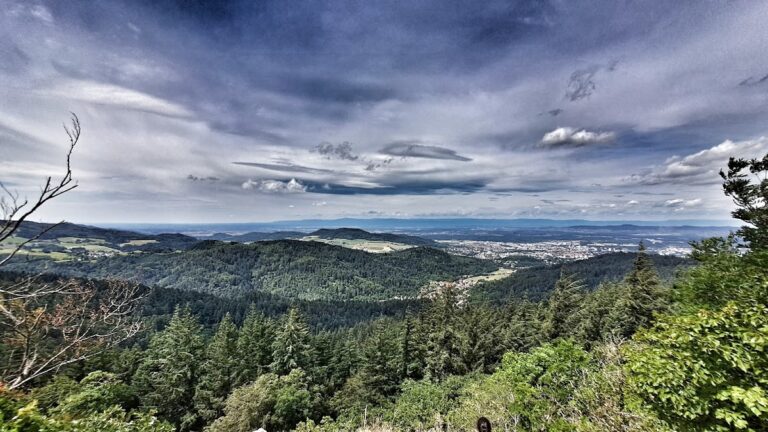
The site occupies the Schlossberg east of Freiburg’s city center. The castle stood at approximately 376.3 meters above sea level around the elevation now called Ludwigshöhe, while the Schlossberg rises to about 456 meters as a spur of the Rosskopf. Ludwigshöhe is a small elevation formed from accumulated debris and named in honor of Grand Duke Ludwig, or Louis II, of Baden. The surviving earthworks and reconstructed surface lines convey the former organization of the hilltop defenses.
Medieval castle site
Hilltop fortress and donjon
The original castle was a Romanesque hilltop fortress generally understood as a motte-and-bailey castle, combining a raised fortified mound with an adjoining enclosed court. Its principal structure was a donjon, the main fortified tower or keep, known from historical illustrations. After the eighteenth-century destruction, the former complex was represented by a debris cone and a neck ditch, which preserve elements of the castle’s defensive setting as earthworks.
Roman remains
Roman stone mosaics were discovered under Ludwigshöhe in 1819. Other remains have been interpreted as those of a Roman villa or fortress, indicating that the mountain may already have possessed strategic importance during the period of Roman settlement in the Rhine Valley.
French fortress works
Upper Castle
Vauban’s defenses incorporated the Schlossberg into a fortified system that included the Vieux Châteaux, meaning “old castle,” and a ring of works along the slope. The Upper Castle consisted of Fort Carée and Fort Saint-Pierre, named components of the French defenses, and included its own church. Stone blocks and shallow terraces now mark the course of the Fort Carée bastions, allowing the former outlines of the artillery defenses to be traced through the surviving earthworks.
Former garrison church
The former garrison church associated with the French fortress is commemorated by the Peterskreuz, or Peter’s Cross. The cross marks the church’s location within the Upper Castle area. Natural overgrowth later covered the ruins, and the surviving earthworks, terraces, and stone courses now provide the principal physical indications of the fortress that once occupied the Schlossberg.
Nearby sites