Adelhausen Monastery: A Dominican Nunnery and Educational Foundation in Freiburg


Site at a Glance
- Rating
- 4
- Popularity
- Very Low
- Country
- Germany
- Primary era
- Early Modern
- External website
- Open
- Eras represented
- Early Modern
- Civilizations
- French, Habsburg, Holy Roman Empire
- Site type
- Religious
- Remains
- Monastery
On this page16 sections
History
Adelhausen Monastery in Freiburg im Breisgau, Germany, is a former Dominican nunnery created in 1687 by joining four medieval Dominican convents, with a fifth incorporated in 1786. Dedicated to the Annunciation of Mary, the Virgin and Mother of God, and Saint Catherine, it was built in the late seventeenth century as Freiburg was being reshaped into a French fortress. The church remains in religious use, while the former convent buildings and associated collections preserve the history of several communities of Dominican nuns.
The medieval convents
The oldest predecessor was the Convent of the Annunciation, founded in 1234 in the former village of Adelhausen, now part of Wiehre. A tradition attributed its foundation to Adelheid, Countess of Zähringen, and Chunigund, the widowed sister of Emperor Rudolf I and widow of the Count of Sulz. That story is regarded as legendary. The probable founder was the Freiburg citizen Heinrich Vasser, who acted with the participation of the abbess of Saint Margaret’s Benedictine convent at Waldkirch.
The Annunciation convent flourished during the early fourteenth century under the two priorates of Anna von Munzingen, from 1316 to 1317 and from 1319 to 1327. She wrote a book of sisters describing the lives of 36 nuns associated with mystical gifts and visions. Johannes Meyer, the convent’s confessor from 1462 to 1485, revised the work in the fifteenth century in support of monastic reform. Land registers from 1327 and 1423 show that the convent possessed substantial landed property.
The Convent of Mary Magdalene, also known as the Convent of the Penitents, was founded before 1250 in the Preachers’ Suburb. Its women first formed an independent order devoted to converting fallen or morally endangered women and girls. They were later incorporated into the Dominican Order. Saint Agnes’s Convent was founded in 1264 in the Lehen Suburb, with the Alsatian noblewoman Bertha named as its alleged founder. The Convent of Saint Catherine of Alexandria followed in 1297 in the former village of Wiehre. In 1419, the Convent of Saint Catherine of Siena, known as Saint Catherine of Siena on the Moat, was established in the Preachers’ Suburb.
War, destruction, and union
The Thirty Years’ War, the major European conflict of 1618–1648, brought destruction and displacement to Freiburg’s convents. Saint Catherine of Siena on the Moat was damaged in 1644 and moved inside the city walls to the site of the present Rathausgasse. In 1647, the Convent of the Annunciation received the nuns of Saint Agnes’s Convent, which had been destroyed. Four years later, Saint Catherine of Alexandria received the nuns of the destroyed Mary Magdalene convent.
The destruction of Saint Agnes’s complex was followed by a detailed description of its buildings and grounds. It recorded gardens, a stream, vineyards, a farmyard, service buildings, a church, dormitory, refectory, kitchen, infirmary, bath, laundry, and other facilities. This account preserves an unusually full picture of the physical organization of a medieval Dominican women’s community before its remains were lost.
Further changes followed the French military expansion of Freiburg. From 1678, Louis XIV, the Bourbon king of France, ordered Sébastien Le Prestre de Vauban to expand the city as a fortress. The buildings of the Annunciation convent and Saint Catherine of Alexandria were demolished. Their nuns lived temporarily in private houses and planned new convents within the city, but the authorities allowed only one new monastery because the fortified city had less space and housed a large garrison.
Construction of the united monastery began in 1687 in the Schneckenvorstadt, also called Upper Gerberau, on the site of the Tennenbach Monastery’s urban court. The property had formerly been the court of the Counts of Freiburg. Louis XIV supplied substantial financial support, French soldiers assisted the work, and the military architect Jean La Douze directed construction. The new institution was initially named Ad Annuntiationem B.M.V. et S. Catharina V.M., later becoming known as Adelhausen or the New Monastery.
The New Monastery and its changing roles
Construction was marked by serious structural accidents. Part of the church vault collapsed in 1693, killing the master mason Jacob Martin. Despite this disaster, 19 nuns moved into the convent buildings on 12 October 1694. Konrad Ferdinand Geist von Wildegg, auxiliary bishop of Constance, consecrated the church on 13 May 1699, after Freiburg had returned to Habsburg rule through the Peace of Ryswick in 1697. A further ceiling collapse threatened the building in 1709, leading to the replacement of the ceiling and one side wall.
After the union of the four convents, Freiburg still contained two Dominican nunneries, Saint Catherine of Siena on the Moat and the New Adelhausen Monastery. The monastic reforms associated with Emperor Joseph II, known as Josephinism, reorganized or suppressed religious houses considered insufficiently useful to the state. Adelhausen and Saint Catherine’s escaped relatively lightly. Saint Catherine’s had received permission from the city council in 1663 to provide regular instruction for no more than 20 children, while the wealthier New Monastery mainly followed a contemplative way of life centered on prayer and enclosure.
In 1786, the government of Further Austria, a Habsburg territory in the southwestern German and Upper Rhine region, incorporated Saint Catherine of Siena into the New Monastery. Adelhausen was required to maintain a girls’ school in three rooms. The arrangement preserved a religious institution considered useful to the public while removing one separate house without requiring the government to support its members.
Adelhausen also survived the secularization carried out under the Imperial Deputation of 1803, the legal settlement that dissolved many ecclesiastical institutions in the German states and redistributed their property. Apart from the Ursuline convent, it was the only Freiburg monastery to survive because it operated a school. In 1811, Baden regulations for Catholic female teaching and educational institutions placed new restrictions on convent life. The school nevertheless expanded. About 650 pupils were enrolled in the 1850s and taught by 18 teachers, and a separate three-storey school building was erected beside the monastery in 1855–1856.
Maria Elisabeth Sautier made the last profession of religious vows at Adelhausen in 1861. In 1867, she and several fellow sisters founded a private school in Überlingen. That school moved to Bregenz in 1904, where the Adelhausen tradition continued in the Dominican convent of the Annunciation at Marienberg.
The Baden Kulturkampf, the nineteenth-century conflict between the government of the Grand Duchy of Baden and the Catholic Church, ended Adelhausen’s teaching community. On 15 November 1867, the city director announced the monastery’s dissolution, granted pensions to the teaching sisters, and transferred the former corporation’s assets to a Catholic-secular foundation for female education in Freiburg. Initially called the Higher Girls’ School Fund, the foundation has been known since 1978 as the Adelhausen Foundation of Freiburg.
The foundation continued to shape Freiburg’s educational landscape. It financed a Higher Girls’ School at Holzmarkt in 1890, now Goethe Gymnasium, and a Girls’ Civic School immediately east of the monastery complex on Marienstraße in 1903. The former convent school of 1855–1856 became the Museum of Natural History in 1931, now the Museum Natur und Mensch Freiburg. The west wing housed the Museum of Prehistory and Early History from 1938, while the east wing housed the Museum of Ethnology from 1961. The Institute of Prehistory and Early History moved out in 1985, and its rooms were incorporated into the natural-history museum.
The 1903 Girls’ Civic School has housed the Museum of New Art since 1985. After alteration and expansion, the former convent buildings became the administrative headquarters of Freiburg’s foundation administration in May 2013. The church alone continues to serve its original religious purpose.
Remains
Adelhausen stands at Adelhausen Monastery Square in the Schneckenvorstadt, or Upper Gerberau, within Freiburg’s present Altstadt-Ring district. The largely preserved monastery forms a quadrangle with mostly undecorated exterior walls. Corner pilasters, storey cornices, and window surrounds with projecting ear mouldings provide the principal exterior decoration. The church occupies the south wing, while the former school building and the later Girls’ Civic School stand beside the complex.
Church and convent quadrangle
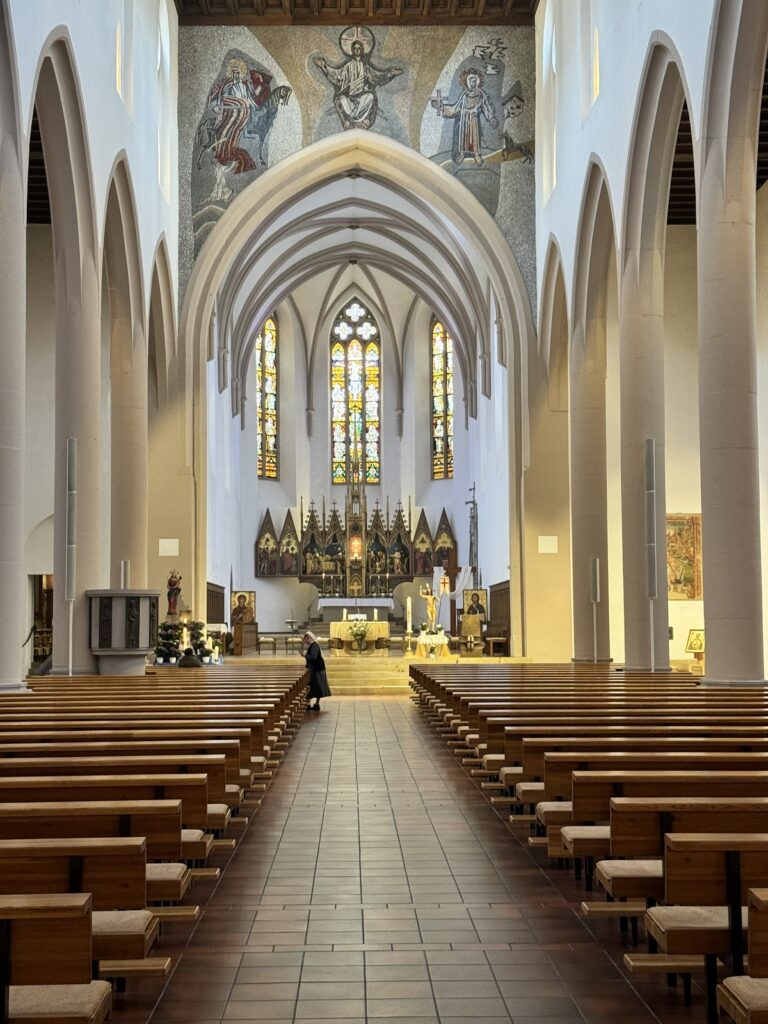
Church of the Annunciation and Saint Catherine
The original monastery church remains in use as the Church of the Annunciation of Mary and Saint Catherine. An oratory was attached to its east side and was occupied by a gymnasium after 1870. The nuns had three reserved ways to enter the church: a door from the oratory to the choir, a route to the nuns’ gallery and organ gallery at the west end of the nave, and access to an upper-floor room in the south wing. Two grilled windows in that room looked into the choir.
Cloister, service wing, and living quarters
A kitchen wing projects from the northeast corner of the quadrangle. The cloister has cap vaults, and its northeast corner contains the refectory. The refectory has a stucco ceiling from 1730–1740 and a tiled stove from the construction period bearing the convent arms. The upper storeys contained 31 cells for nuns and lay sisters, preserving the basic residential organization of the united community.
Former convent school and adjacent museums
School building of 1855–1856
The former convent school is a separate three-storey building erected beside the monastery in 1855–1856. It now contains the Museum Natur und Mensch Freiburg. Its later museum use forms part of the complex’s continuing educational history, which began when Adelhausen was required to maintain a girls’ school in the eighteenth century and expanded during the nineteenth century.
Girls’ Civic School of 1903
The Girls’ Civic School built immediately east of the monastery complex on Marienstraße in 1903 now contains the Museum of New Art. Together with the former convent school and the quadrangle, it forms part of the group of buildings associated with the foundation’s educational and institutional development.
Artistic and material collections
Medieval sculpture and crosses
Most of Adelhausen’s artistic and cultural property remained in Freiburg after the dissolution of 1867. More than 1,400 surviving objects form an unusually coherent body of monastic material culture, ranging from everyday utensils to major works of Western art. The Augustinermuseum holds works inherited from the five medieval convents incorporated into Adelhausen. Among them are a willow-wood statue of Saint Mary Magdalene from about 1250, the first Liebenau Cross from about 1342, and the second Liebenau Cross from the early fifteenth century.
The Saint Mary Magdalene statue shows the saint holding an ointment jar in her left hand. Her finely pleated garment and shell-like mantle envelop the body. The two Liebenau Crosses entered the Freiburg convent of Saint Catherine after the Liebenau Dominican nunnery was dissolved in 1563. A two-part leather case for the first cross also survives.
Altarpieces and Renaissance figures
The Dominican Altarpiece is a winged altarpiece, an altar image with hinged panels, painted around 1450. Its scenes include the Annunciation, Nativity, Crucifixion, and Resurrection of Christ. Saints John the Baptist and Paul of Tarsus appear with the Dominican saints Thomas Aquinas, Peter of Verona, and Dominic.
A linden-wood statue of Saint Agnes with her lamb, signed “HW” for Hans Wydyz and dating from about 1500, combines late Gothic detail with a broadly conceived early Renaissance figure. A second linden-wood statue from about 1500 shows the Madonna seated on a crescent moon with the Child and is attributed to Hans Wydyz; the Child’s left arm is missing. A separate linden-wood figure represents the Christ Child as Salvator mundi, or “Saviour of the World.” The 52-centimetre figure shows a naked child of about one year making a blessing gesture and holding a globe in the right hand.
Textiles, memorial art, and reliquaries
The surviving textiles include carpets from the fourteenth to the sixteenth centuries, among them heraldic, Malterer, dragon-and-parrot, Marian, and wild-men carpets. A winged altarpiece used as an epitaph, a memorial associated with the dead, dates from the end of the sixteenth century. When the nuns entered the New Monastery in 1694, it was converted into a death tablet listing 50 names, from the first death in 1694 to the last in 1756.
Adelhausen’s liturgical equipment includes gold and silver vessels, while its reliquaries, containers made to preserve or display religious relics, form a particularly extensive group. One reliquary contains the skull of Blessed Bertha, the traditional founder of Saint Agnes’s Convent. Wrapped in textile, the skull rests on a cushion and a black four-footed base. It dates from the third quarter of the seventeenth century and is one of eight reliquary skulls in the collection.
Books and domestic objects
The holdings include 432 tin household objects, described as the largest surviving assemblage of tinwork from monasteries. The former New Monastery also possessed approximately 158 manuscripts and 180 printed works. Some manuscripts and books remain in the Archiepiscopal Archive in Freiburg, while other objects are divided chiefly between the Adelhausen church, Freiburg museums, and named institutions outside the city.
A crucifix dating from about 1290 was transferred in 1953 to the Marienberg convent in Bregenz. A Christ-and-Saint-John group from the second quarter of the fourteenth century entered the Liebieghaus Museum in Frankfurt in 1950. Alongside these works, the Augustinermuseum preserves liturgical objects, reliquaries, paintings, sculptures, textiles, manuscripts, and domestic utensils derived from the five incorporated convents. Together with the furnishings of Freiburg Minster, the Adelhausen holdings constitute one of Freiburg’s most important historical and cultural legacies.
Nearby sites