St. Martin’s Church in Freiburg: A Franciscan Monastery Church and Catholic Parish


Site at a Glance
- Rating
- 4.3
- Popularity
- Very Low
- Country
- Germany
- Primary era
- Medieval
- External website
- Open
- Eras represented
- Medieval, Early Modern, Modern
- Civilizations
- German, Holy Roman Empire
- Site type
- Religious
- Remains
- Church
On this page13 sections
History
St. Martin’s Church is a Roman Catholic parish church in Freiburg im Breisgau, Germany, and the convent church of the Dominicans. Dedicated to St. Martin of Tours, a fourth-century Christian bishop, it originated as the monastery church of a Franciscan convent established in the medieval period. Its development began with a chapel known by 1206 and continued through repeated rebuilding, Baroque alteration, Neo-Gothic redesign, wartime destruction, and postwar reconstruction.
Franciscan foundation and medieval growth
Franciscans settled in Freiburg around 1226, first in one of the city’s suburbs. As the community expanded, the order established a second convent within the city. In 1246, Count Konrad I of Freiburg gave the Franciscans St. Martin’s Chapel, which had been known since 1206, together with additional land. The chapel was replaced by a church occupying the area of the present choir. Restoration work later revealed parts of a Romanesque cornice belonging to the earlier building.
The Franciscans acquired another plot in 1262, and a cloister was built during this period. The monastery complex continued to develop until about 1350. Strong support for the friars led the city council to prevent them from purchasing more land. The choir was completed in 1286, while the nave followed in 1318. The north wall of the side aisle bends inward because the builders had to respect the existing property boundaries.
Bishop Tillmann of Basel reconsecrated the church in 1518. A tradition also associates the Freiburg Franciscan monastery with the discovery of gunpowder by Berthold Schwarz around 1359. The claim belongs to the long-standing local tradition surrounding the friar, rather than to the church’s documented construction history.
Baroque transformation and parish development
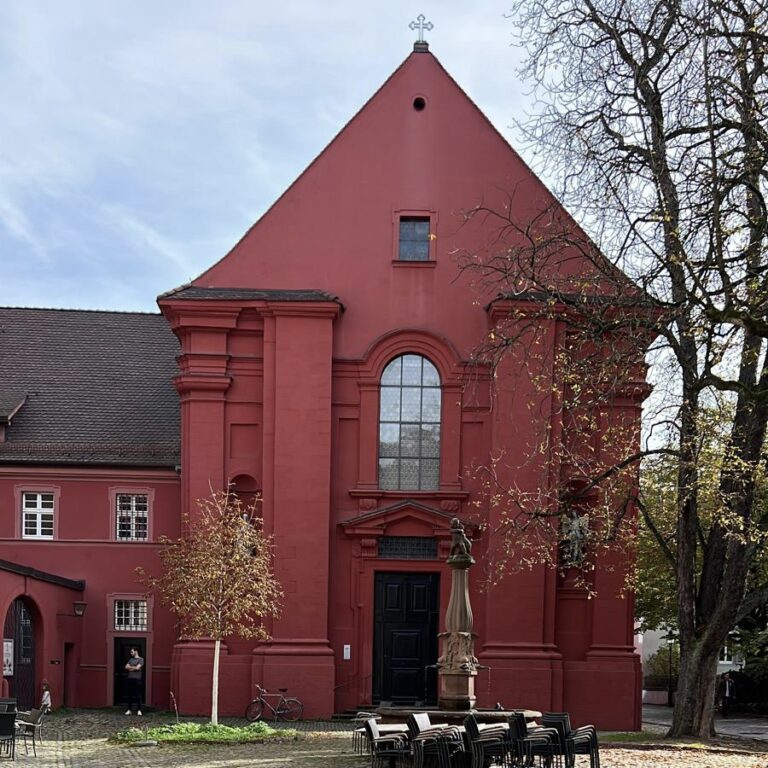
The church required extensive repairs after the Thirty Years’ War, the seventeenth-century conflict that involved major European powers and caused widespread destruction. Its interior was then adapted to Baroque taste. French forces heavily damaged the building during the siege of Freiburg in 1713 and 1714. A Baroque west portal had already been created in 1719, and repairs carried out from 1721 to 1724 included a new stucco ceiling by Franz Joseph Vogel. Trudpert Walter’s tabernacle was added in 1775.
The church is traditionally said to have become a parish church in 1785, although that status remains disputed. In 1792, paintings, statues, and the Nepomuk Altar were transferred from the dissolved Freiburg Predigerkirche. The altar was dedicated to John of Nepomuk, a fourteenth-century Bohemian priest and martyr venerated as a Catholic saint.
From 1807, parish priest Johann Nepomuk Biechele began removing the Baroque furnishings. He sought an interior defined by light, harmony, beauty, and religious simplicity. Several Baroque altars were taken out between 1816 and 1821, and the floor was repaired with stone slabs taken from Freiburg Minster.
Nineteenth-century redesign and the Second World War
Monastery buildings on the south side and part of the cloister were demolished in 1845, creating the present Rathausplatz. In 1875 and 1876, the Archiepiscopal Building Office, working under Lukas Engesser, cleared the interior and redesigned it in the Neo-Gothic style. The Rococo high altar was removed, and the choir windows were reopened. The Marian Chapel was converted into a confession and baptismal chapel between 1877 and 1879. Stained glass followed in 1880 and 1881, and a new organ was installed in 1882.
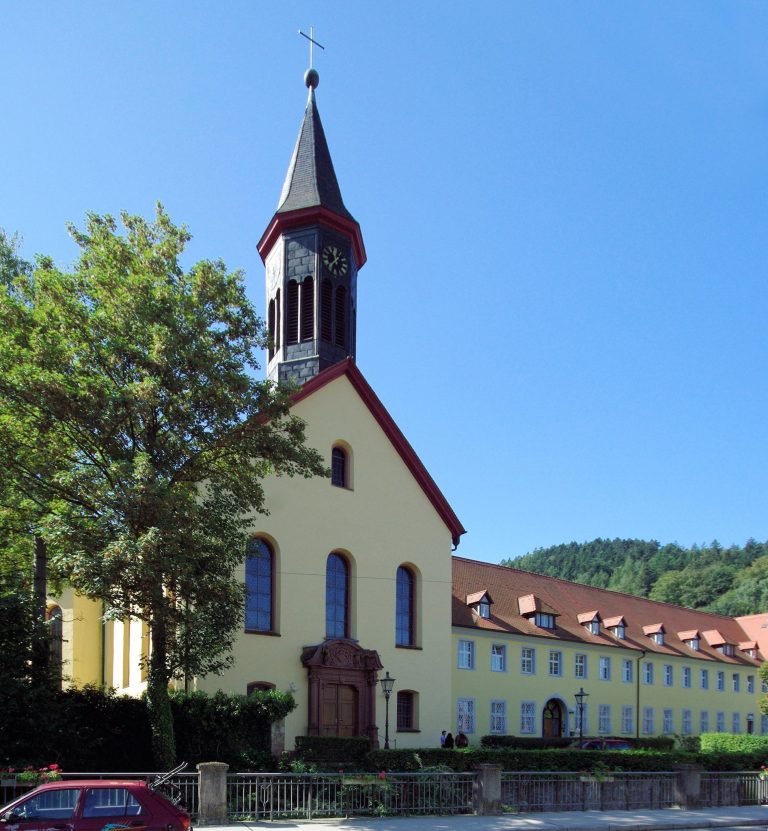
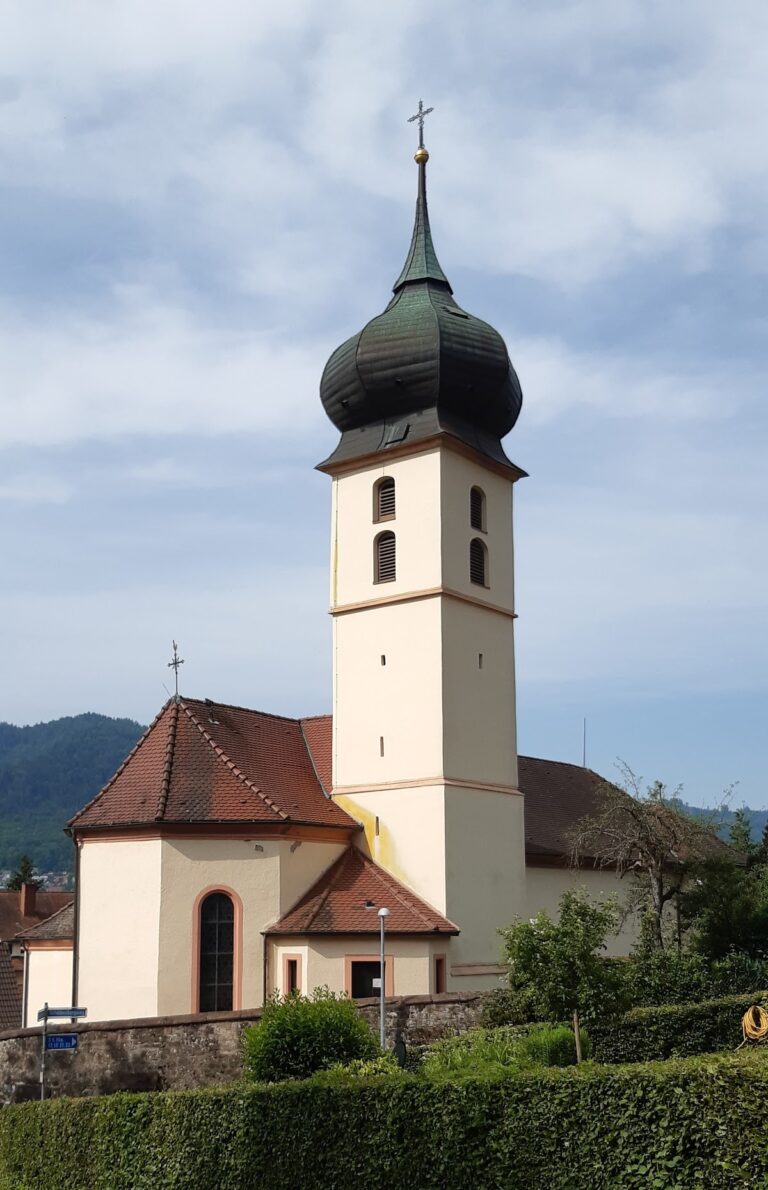
Freiburg architect Max Meckel built the church tower from 1890 to 1893. Until then, the church had only a small roof turret, a form associated with mendicant-order churches. Heinrich Hansjakob, parish priest from 1884 to 1913, helped promote the tower and the high altar that remains associated with this phase.
The church’s Neo-Gothic furnishings were destroyed in the air raid on Freiburg on 27 November 1944. Phosphorus bombs set the church and monastery on fire, and the tower spire collapsed into the nave. The outer walls of the side aisles and the west gable survived. Reconstruction took place from 1949 to 1951, and the church was rededicated on St. Martin’s Day in 1951. The rectory, which incorporates the former chapter house, was rebuilt in 1955 and 1956.
Recent religious and musical history
A renovation in 1974 and 1975 altered the tower roof. The tall spire was not restored. Instead, the flat pyramid roof used after the war was replaced by a steeper pyramidal form. The Dominicans assumed pastoral care of the church in 2009, and the St. Martin convent was formally established on 10 February 2012. The Ukrainian Greek Catholic community of St. Josaphat also uses the church. This Eastern Catholic tradition follows the Byzantine rite while remaining in communion with the pope.
After Easter 2017, the church closed for an interior renovation completed for its patronal feast on 12 November. The walls and columns were repainted, the acoustics were improved, the electrical system was renewed, and LED lighting was introduced. The existing organ was removed and replaced by a new instrument completed at Christmas 2020 and dedicated in November 2021. During the intervening period, an electronic organ was used.
Franz Philipp served as choir director and organist from 1919 to 1924 and probably composed St. Martin’s Patron Song. The song continues to be sung in the church, especially for the patronal feast on 11 November.
Remains
St. Martin’s Church is 65 metres long, including the choir, and 17.50 metres wide across its two side aisles. The nave is just under 12 metres high. A plain, bright central nave rises above two lower aisles. The aisles receive light through lancet windows with simple tracery, while a tall window illuminates the west front. The nave has a flat wooden ceiling, and the choir is vaulted.
Medieval fabric and surviving paintings
The church retains the spatial arrangement formed during its Franciscan development, although later rebuilding changed its appearance. The choir occupies the area of the medieval replacement for St. Martin’s Chapel, and the inward bend in the north side-aisle wall preserves the effect of the medieval property boundary. Parts of the former Franciscan cloister also survive, while the monastery buildings that once stood to the south and east were demolished and part of the cloister was removed in 1845.
Remains of fourteenth-century paintings survive in the front part of the nave. In 1975, a fragment depicting St. Martin was installed in the church after originally coming from Freiburg Minster. The choir windows contain stained glass designed by Freiburg glass painter Eduard Stritt in 1919. The other windows were redesigned during the 1950s reconstruction period.
Altar and liturgical furnishings
High altar
The present high altar is a reproduction of the altar in Doberan Minster. It was consecrated on 23 January 1887. Martin von Kiedrich designed and executed the panel paintings, while Josef Eberle of Überlingen made the shrine and its carving. The musical angels on the lower section of the altar structure, called the predella, were modeled on those at Oberwesel.
Two high reliefs in the shrine show the Wedding at Cana and the multiplication of bread in the wilderness. The inner wings depict the sacrifices of Melchizedek and Isaac, the manna from heaven, and the Paschal Lamb, a Christian symbol associated with Christ’s sacrificial death and resurrection. The outer wings show Augustine, Sebastian, Martin, and Francis of Assisi on the right, and Elisabeth, Clare, Barbara, and Catherine on the left.
Organ
The present organ was built by Johannes Klais of Bonn and Manufacture d’Orgues Thomas of Stavelot, Belgium, and completed at Christmas 2020. It has 38 stops distributed across three manuals and pedal, as well as three transmissions, six extensions, and a programmed registration system. It replaced an instrument built by Willy Dold in 1956.
Bells and devotional objects
Bell ensemble
Six new bronze bells were cast in 1968 by the Friedrich Wilhelm Schilling bell foundry in Heidelberg. A seventh, historical bell is kept in the rectory. Nicolaus Rossier II and Ioannes Caudrillier cast it in 1729. The bell has a diameter of 600 millimetres, is tuned to d”+8, and remains capable of ringing.
Ukrainian Greek Catholic icons
Several icons in the church reflect the presence of the Ukrainian Greek Catholic community of St. Josaphat. They form part of the church’s continuing use by more than one Catholic tradition while remaining within the building’s long history as a place of communal worship.