Lichtenthal Abbey: A Cistercian Monastery in Baden-Baden
Site at a Glance
- Popularity
- High
- Country
- Germany
- Primary era
- Medieval
- Eras represented
- Medieval, Early Modern, Modern
- Civilizations
- Grand Duchy of Baden, Holy Roman Empire
- Site type
- Religious
- Remains
- Monastery
On this page18 sections
History
Lichtenthal Abbey is a Cistercian women’s monastery in Baden-Baden, Germany, founded in 1245 by Margravine Irmengard of Baden, widow of Margrave Hermann V. Its first church was Romanesque, a style marked by rounded arches and massive forms; Gothic architecture, associated with pointed arches and ribbed ceilings, shaped later rebuilding. The abbey became the Baden margraves’ family monastery and burial place, and its close connection to the ruling house helped it endure the Reformation and later secularization.
Foundation and Cistercian beginnings
A reference from 1243 to spiritual care for women at Lichtenthal suggests that a religious community may have existed there before the Cistercian nuns arrived. Irmengard established the abbey near the Baden family seat at Hohenbaden Castle. Her sons confirmed and enlarged the foundation in March 1245. The Cistercian order, a monastic community that developed from the abbey of Cîteaux, was expanding across Europe, and foundations made by Irmengard’s relatives may also have encouraged her decision.
Irmengard called the monastery Lucida vallis, meaning “bright valley,” probably echoing the name Clairvaux. It was also initially known as Büren, while the name Lichtenthal was associated with the neighboring House of Lichtenberg. After transferring power to her sons, Irmengard retired to the monastery. Nuns from the Cistercian convent of Wald joined the new community to establish regular observance. Trudlindis of Liebenstein, who came from Wald, was elected abbess in 1247 and sought to bring the convent into the Cistercian Order. Following an inspection, the order placed Lichtenthal under the supervision of Neuburg Abbey in 1248. Heinrich von Stahleck, Bishop of Strasbourg, consecrated the church that year.
Growth, discipline, and reform
The Baden margraves supported Lichtenthal and used it as their family monastery and burial place. In return for the family’s material support, the nuns held memorial services for its members. Donations from the Baden family and endowments from noble and wealthy town families whose daughters entered the convent gave it extensive possessions. The community was initially planned for about 40 people, but its population had reached around 80 by the later Middle Ages. Growth, along with financial difficulties, contributed to a crisis in discipline during the 14th century.
In 1426 the Cistercian General Chapter, the order’s governing assembly, required Lichtenthal to renew its discipline. Abbots of Lützel, Maulbronn, and Herrenalb helped lead the reform, which reinforced enclosure, the rule limiting nuns’ movement outside the convent, and observance of the liturgy. It also ended private ownership within the community and called for a return to shared discipline. Nuns from the reformed convent of Königsbrück helped carry out the changes. Elisabeth Wiest, the first reform abbess, was appointed around 1440; the reformed community also saw its first abbesses from town families.
Prayer, work, and learning
Prayer structured the nuns’ daily lives. They observed the canonical hours, set times for communal prayer, seven times a day, beginning with a vigil around 2 a.m. and morning praise at daybreak. Worship, including a convent Mass and chapter meeting, occupied five to seven hours, alongside three to five hours of private reading and prayer. Annual memorials for deceased nuns, relatives, and benefactors included a vigil and Mass. The chapter also handled elections, property decisions, and the assignment of daily work. Nuns admitted breaches of the rule there; discipline could include extra fasting or, in serious cases, excommunication.
Work was prescribed for six to eight hours a day as a complement to prayer and a form of religious discipline. In the 14th and 15th centuries, the nuns commonly sewed, embroidered, and baked for their own use. Their clothing included a white tunic and scapular, a garment worn over the tunic, with an undyed hooded cowl, black belt, veil, stockings, and leather strap shoes. Novices wore white veils, while other nuns wore black ones. Before the 16th-century reforms associated with the Council of Trent, some nuns adopted fashionable clothing cuts and jeweled belts.
From about 1444 the convent maintained a scriptorium, a room for copying and preparing books. Sister Margaretha, known as Regula, spent more than 30 years copying, translating, compiling, correcting, and editing religious texts. The writing workshop flourished from about 1450. After the Council of Trent, a 16th-century Catholic reform council, Lichtenthal also sent nuns to renew convents at Friedenweiler, Neudingen, Wonnental, and Olsberg. Mariengarten is identified as another daughter convent.
Religious and military upheavals
Lichtenthal survived the Reformation despite changes in the Baden rulers’ religious positions and a decline in its revenues. Its links to the ruling family helped preserve the convent. During the Thirty Years’ War, it sheltered Benedictine nuns from Frauenalb. In 1689, when French troops burned parts of Baden-Baden and Heidelberg, Lichtenthal was spared, although younger nuns were evacuated to convents in Switzerland or Swabia. French raiders were repelled in August 1734, and French troops occupied the region in 1796 without destroying the monastery.
Secularization, education, and continued monastic life
In November 1802 Margrave Carl Friedrich placed the abbey under state administration, preventing its dissolution. In 1803 it came under his authority and surrendered its landed property in return for a subsidy. Secularization, the transfer of church institutions or property to secular authority, restricted the abbey’s finances and religious life. After Tennenbach Abbey was dissolved in the early 19th century, Lichtenthal was isolated from much of the Cistercian Order; it came under episcopal jurisdiction in 1811.
Educational work helped secure the convent’s continuation. Its monastery school opened in 1815, after teaching had been made a condition of the abbey’s survival. It became a state school for girls in 1877 and a coeducational school in 1980. During the Kulturkampf, a 19th-century political conflict over relations between the state and the Catholic Church, the nuns founded a daughter convent at St. Pauls in Austria-Hungary in 1883 as a safeguard against possible dissolution.
In the 1880s Friedegar Mone claimed manuscripts and printed books from the abbey that he had used while helping his father compile Baden historical sources. He sold some of the works; the Baden state bought back most of those sold illegally, and they entered the Grand Ducal Baden Library in Karlsruhe in 1889. Lichtenthal has continued as a monastery since the 13th century and belongs to the Mehrerau Cistercian Congregation, a federation of Cistercian monasteries. It combines monastic life with education and religious arts and crafts. Maria Bernadette Hein has led the abbey as its 46th abbess since 2001.
Remains
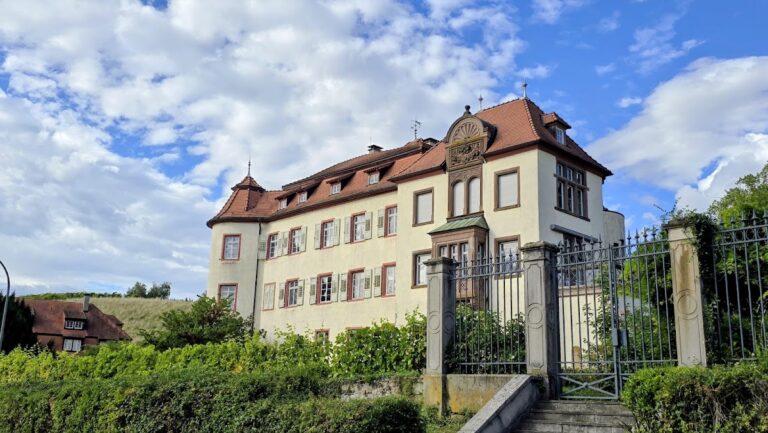
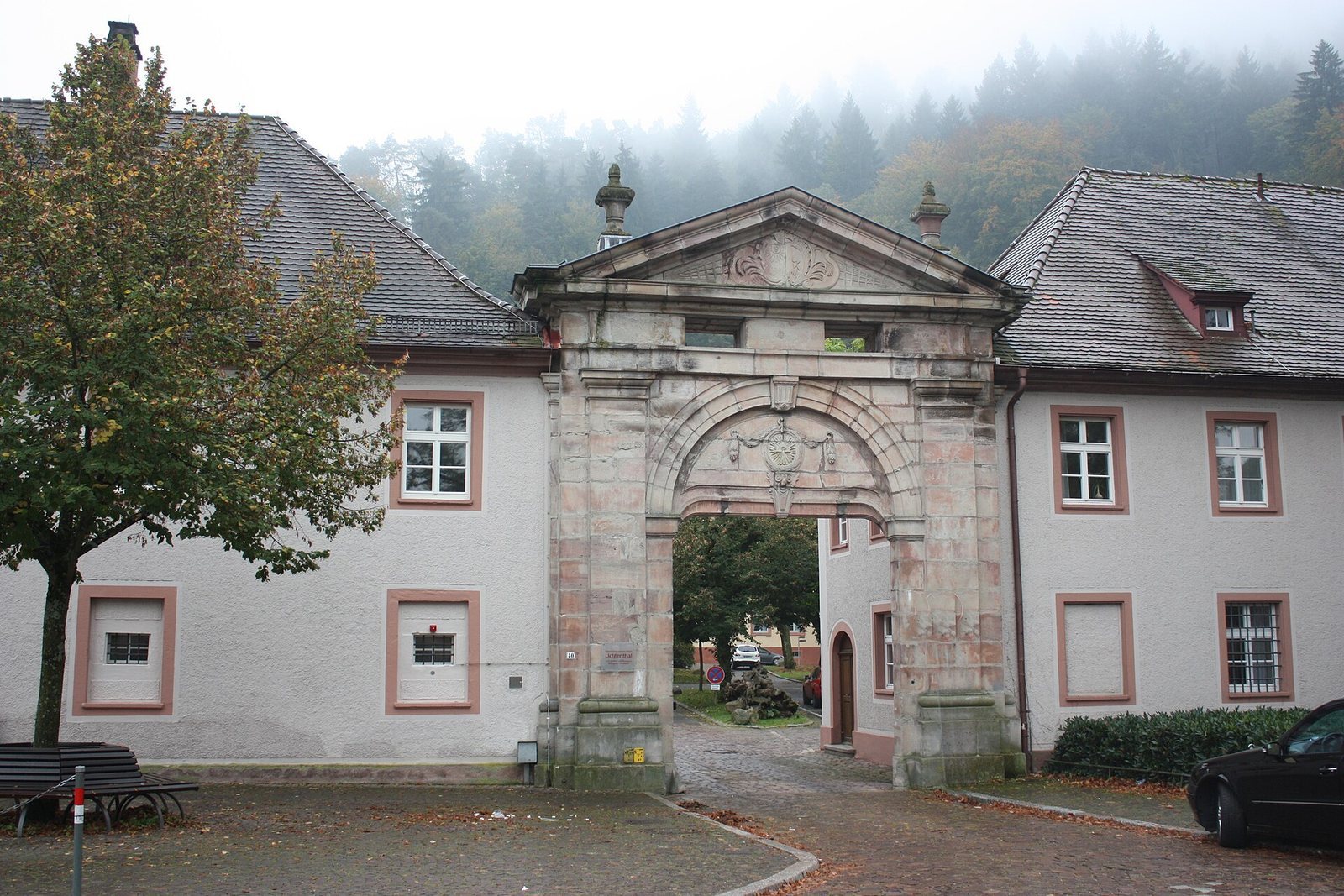
The abbey stands in a bend of the Oos River at the edge of the Black Forest, at the end of Lichtentaler Allee. Its walled precinct forms a broad triangle and contains buildings from several periods, including an 18th-century rebuilding that gave the complex a more Baroque character. The grounds are arranged around a three-sided courtyard entered through a substantial gate dating to 1781.
The abbey church
Early fabric and Gothic church
Construction of the first church began with the abbey’s foundation in 1245. The Romanesque building was still being completed when its high altar was consecrated in 1248; the church and altar were finished in 1252. A Romanesque window survives in the north wall, along with two arches from portals on the cloister side.
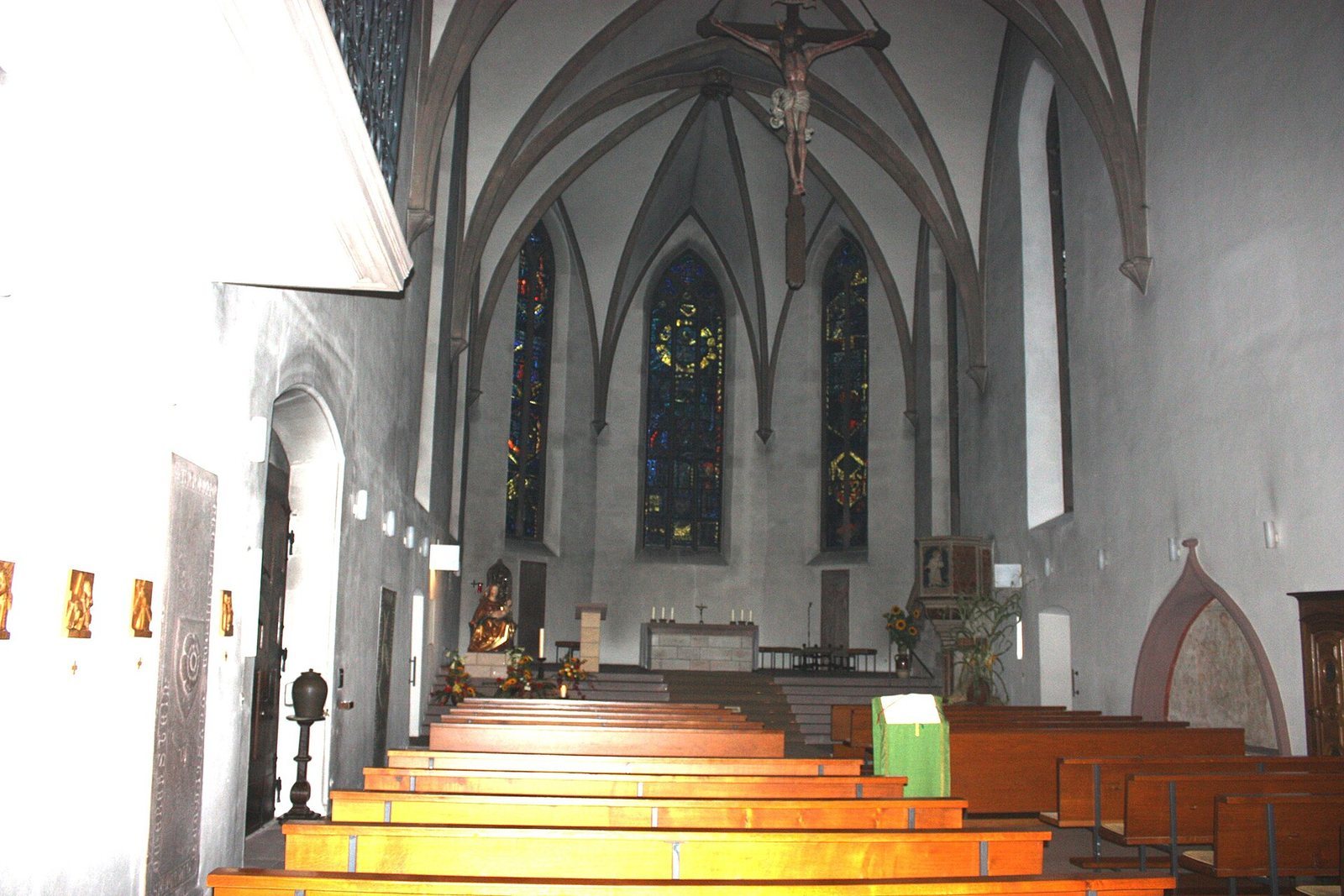
A new church was built after 1300 in the mature Gothic manner of large Cistercian nunneries in Franconia. Its long, narrow interior measures more than 56 metres by 9.5 metres. The choir, the part of the church used by the nuns for services, dates to the 14th century, while the main body, or nave, dates to the 15th. Around 1320 builders completed the choir’s east end, the entrance portal, and a ribbed ceiling. Carved ornaments where the ceiling ribs meet show a pelican feeding its young and the Coronation of the Virgin. The choir, high altar, and two side altars were consecrated on 1 November 1332. The nuns’ choir was consecrated on 11 June 1470, when the church was consecrated again. The church was renovated in 1723–24.
Furnishings and devotional art
The church’s furnishings include a crucifix, a multicolored stone pulpit dated 1606, a Madonna and Child, and a wall painting of the Crucifixion that was discovered in the 20th century. Stained-glass windows depict episodes from the life of Mary, and carved wooden stalls furnish the nuns’ choir. The 1606 pulpit belongs to the Baroque style, an ornate form of art and architecture.
Remains of the late Gothic high altar
Elements of the former late-15th-century high altar survive in several places. They include a Madonna and Child; the altar’s side wings are in Karlsruhe, while statues of the Three Kings are held by a museum in New York. The late Gothic furnishings accompanied the church’s artistic refurbishment under Abbess Margaretha of Baden.
Chapels
Prince’s Chapel
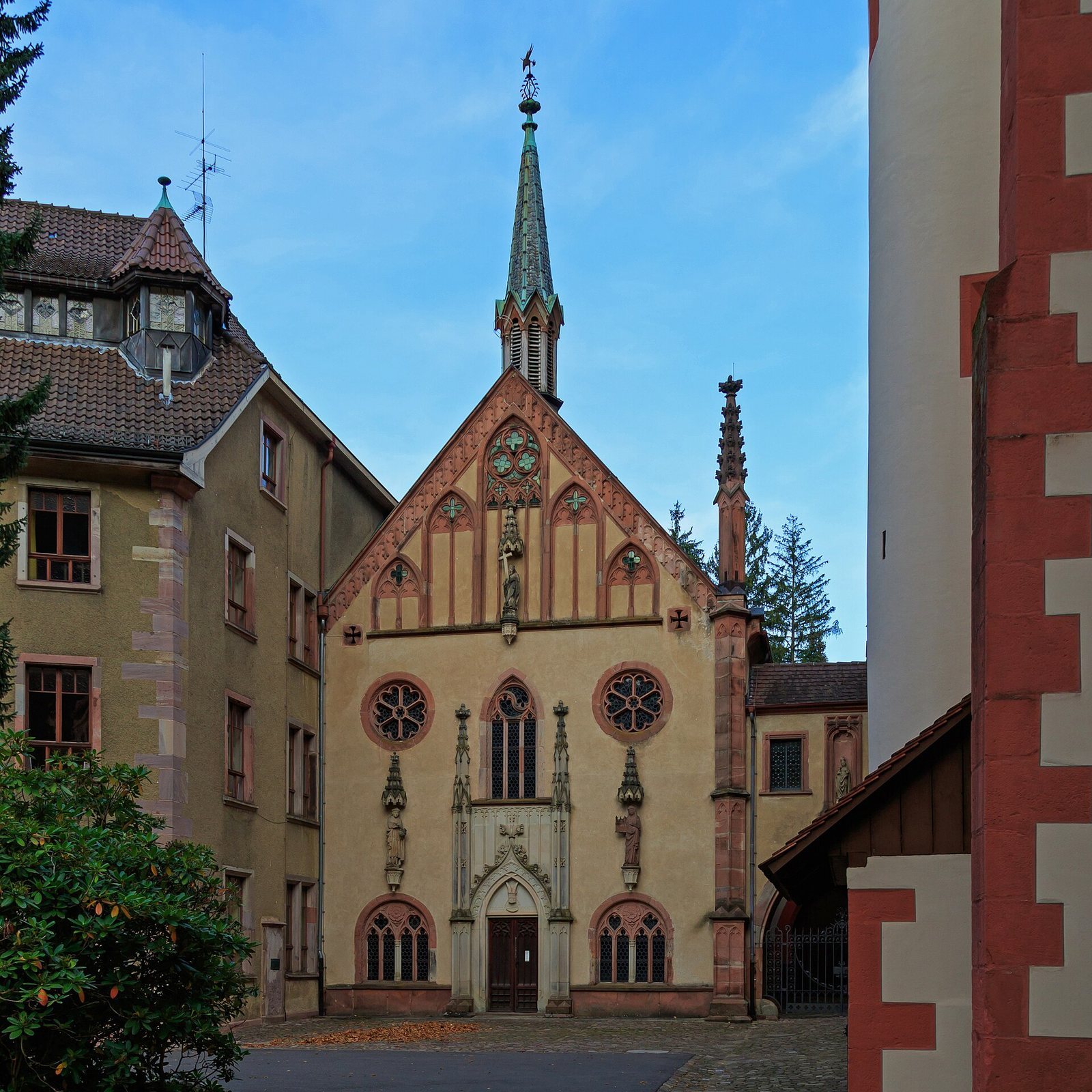
Founded by Margrave Rudolf I of Baden in 1288, the Prince’s Chapel retains 13th-century foundations. Dedicated to Saints Joachim and Anne, traditionally regarded as Mary’s parents, it served as the Baden margraves’ burial place until 1372. From 1424, limited space meant that only the hearts of deceased family members were placed there. One was the heart of Margrave Ludwig Wilhelm, buried in the chapel on 4 January 1707.
The chapel was rebuilt around 1830 in a 19th-century revival of Gothic forms, at the instigation of Grand Duke Leopold of Baden. It contains tombs, a high altar, several side altars, and Irmengard’s tomb. Older furnishings include the Saint Anne altar of 1503 and a statue, made around 1490, of Blessed Margrave Bernard II of Baden. The Madonna of the Keys is a statue of the Virgin and Child associated with the entrusting of the monastery’s keys to Mary in times of danger. Three statues above the chapel portal came from All Saints’ Abbey: Saint Helena stands above, with the abbey’s first abbot, Gerungus, on the left and its founder, Uta of Schauenburg, a relative of Irmengard, on the right.
Hermit’s Chapel
Built in 1678, the hermit’s chapel serves as the nuns’ cemetery chapel.
Precinct and courtyard
Layout and buildings
The precinct includes the abbey church and chapels, the abbess’s residence, convent and administrative buildings, service buildings, and a school. It also contains workshops and a psychotherapeutic practice. Together, these buildings form the broad triangular enclosure around the courtyard.
Marian fountain
A fountain dating to 1602 stands in the courtyard. It is identified as a Marian fountain.
Manuscripts and library
Manuscripts associated with Lichtenthal are divided between the monastery and the Baden State Library in Karlsruhe. The collection includes liturgical books, songs, and prayers from the 13th to 15th centuries, including works from Neuburg, Maulbronn, and Herrenalb. It also includes 15th-century Alemannic books, written in a group of German dialects associated with southwestern German-speaking regions, from Sister Regula’s literary work, as well as prayer books written by different hands. In the 16th century, Abbess Barbara Vehus translated Gertrude of Helfta’s The Herald of Divine Love from Latin into Alemannic.