Neues Schloss Baden-Baden: A Margravial Residence and Castle Complex in Germany


Site at a Glance
- Rating
- 3.3
- Popularity
- Very Low
- Country
- Germany
- Primary era
- Early Modern
- Eras represented
- Medieval, Early Modern
- Civilizations
- Holy Roman Empire
- Site type
- Domestic
- Remains
- Palace
On this page10 sections
History
Neues Schloss Baden-Baden is a late-medieval castle complex in Baden-Baden, Germany, established between 1388 and 1399 on older walls above the town’s market square. The town had received town privileges during the second half of the thirteenth century. From the late fifteenth century, the castle became the residence of the Margraves of Baden and later developed through repeated rebuilding and enlargement.
From castle to margravial residence
Around 1479, Margrave Christopher I converted the complex into a residence, making it the successor to Hohenbaden Castle. It served as the seat of the Margraves of Baden from the late fifteenth century until the end of the seventeenth century. From 1535, it was the seat of the Margraves of Baden-Baden, a branch of the Baden ruling dynasty. The castle also housed the margravial archive from 1529.
The complex was repeatedly altered from the late Middle Ages onward. Its principal buildings took their Renaissance form during the sixteenth century, when European architecture drew on classical forms and proportions. These changes transformed the medieval stronghold into a residential and administrative centre.
War, rebuilding, and the move to Rastatt
In 1689, during the Nine Years’ War, a conflict shaped by European power struggles and French military expansion, troops of King Louis XIV of France burned out the castle. Margrave Louis William then established a new residence at Rastatt. He moved his residence there in 1702 and transferred the seat of government in 1705.
Neues Schloss Baden-Baden was rebuilt in the early eighteenth century, incorporating the surviving exterior walls of the earlier castle. A cavalier house, an ancillary court building for members of a princely household, was added in 1709. During the nineteenth century, the castle served as a summer residence for the Grand Dukes of Baden. Grand Duke Leopold commissioned Friedrich Theodor Fischer to restore the palace between 1843 and 1847, when the state rooms were redecorated in a historicist Renaissance style. Historicism was a nineteenth-century approach that revived and recombined earlier architectural forms.
Private ownership, museums, and redevelopment
After the November Revolution and the separation of dynastic and state property, the castle became private property of the House of Baden in 1919. It received art treasures from other palaces assigned to the former ruling family, including holdings from the older Zähringer Museum in the nationalized Karlsruhe Palace.
In 1946, the South Baden Ministry of Culture in Freiburg, supported by Berthold von Baden, established a Baden historical museum in the castle. The museum also used the name Zähringer Museum and preceded the Wehrgeschichtliches Museum in Rastatt. A new Zähringer Museum opened in 1960 and effectively continued until 1981.
In 1995, the family collections and much of the castle’s furnishings were auctioned by Sotheby’s in the sale known as the Margrave Auction. The Baden family sold the castle in October 2003 to the Kuwaiti Al-Hassawi group of companies. Fawzia al-Hassawi developed proposals for new uses, including a luxury hotel and a family holiday residence.
Baden-Baden approved the conversion of the castle into a 130-room luxury hotel in April 2010. Work began in summer 2010 but was repeatedly interrupted. Proposals for condominiums in a new wing in the castle park and the late presentation of an operator required for approval of the additional construction contributed to the delays. Hyatt was announced as the planned operator at the end of 2012. Revised plans published in mid-2014 postponed the proposed opening to 2018 and increased the planned capacity to 146 rooms, with the sale of 16 condominiums intended to help finance the conversion.
After years of halted construction and doubts about the project’s financial viability, Baden-Baden’s municipal council cancelled the hotel development plan on 21 February 2022. The castle is protected as a cultural heritage monument in Baden-Württemberg.
Remains
Castle buildings
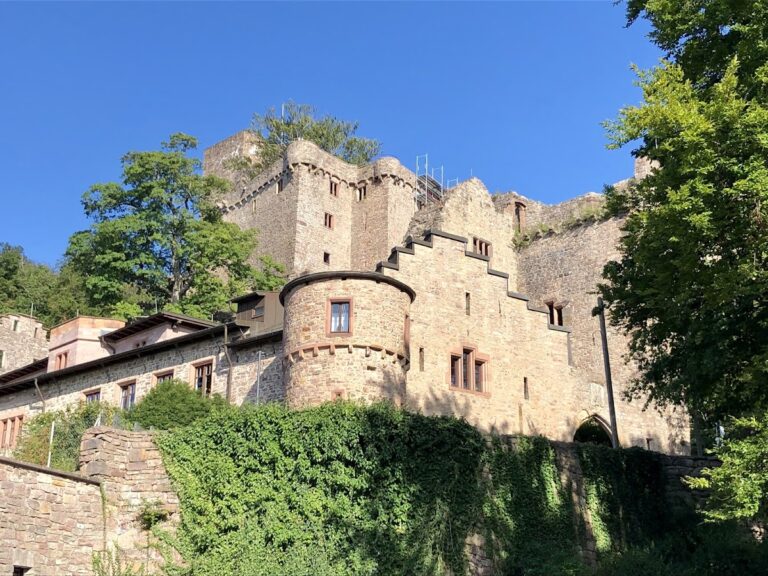
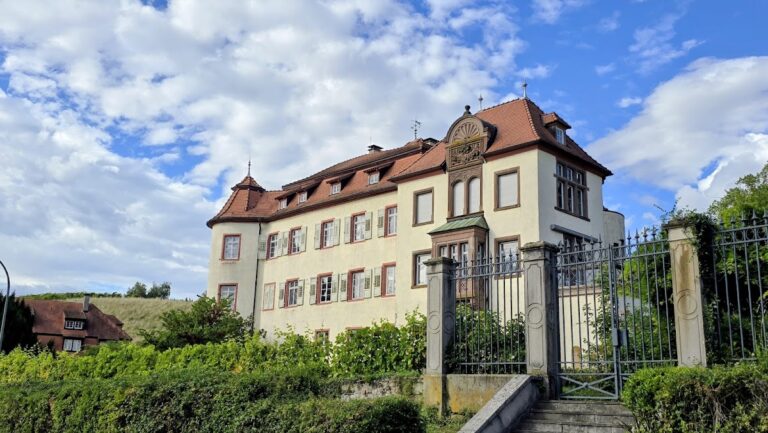
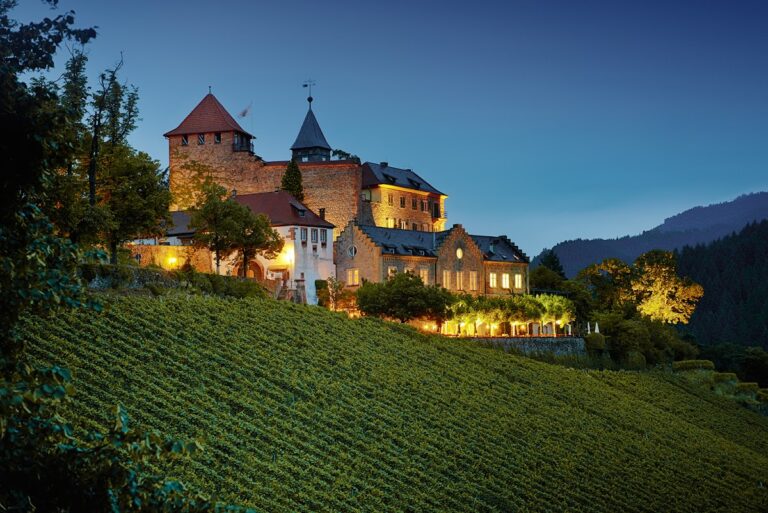
The surviving complex is a late-medieval castle ensemble organized around a three-storey main castle, a carriage house, a kitchen building, and an archive tower. These four principal buildings are Renaissance structures of the sixteenth century. Their present form also reflects the early-eighteenth-century rebuilding, which incorporated the exterior walls that survived the 1689 fire.
Cavalier house and western gatehouse
The castle courtyard contains a cavalier house built in 1709. It is entered through a western gatehouse dating from the fifteenth century. Together, these elements preserve the relationship between the later court residence and an earlier entrance structure.
Dagobert Tower
The so-called Dagobert Tower was a pavilion with a spiral staircase dating from the period after 1575. It was destroyed during the Second World War.
Cellar vaults
The cellar vaults contain stone and iron doors and were described as probably former dungeons. These below-ground spaces form part of the surviving evidence for the castle’s earlier defensive and custodial functions.
Palace garden and terrace
A palace garden extends east of the castle and contains rare plants and trees. A 130-metre-long viewing terrace, laid out in 1670, leads to terraced gardens containing numerous exotic plants. The park covers approximately 5.5 hectares, adding a landscaped setting to the castle’s buildings and courtyard ensemble.