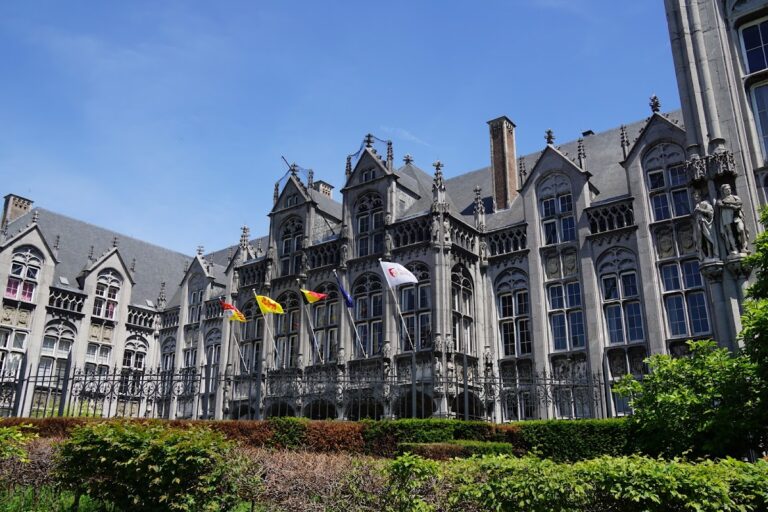
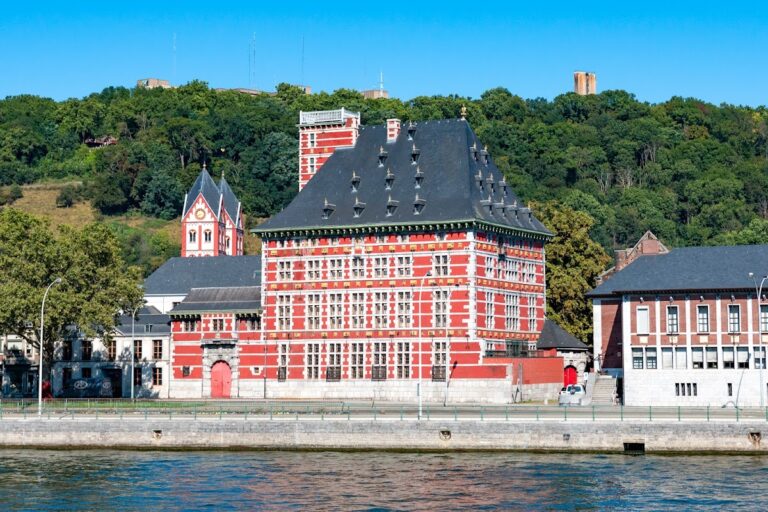
Saint-Jacques Abbey in Liège: A Benedictine Monastery and Collegiate Church
Site at a Glance
- Popularity
- Low
- Country
- Belgium
- Primary era
- Medieval
- Eras represented
- Medieval, Early Modern
- Civilizations
- Holy Roman Empire
- Site type
- Religious
- Remains
- Church
On this page15 sections
History
Foundation and pilgrimage center
Saint-Jacques Abbey is a former Benedictine monastery in Liège, Belgium, founded by Bishop Balderic II in 1016. He established it on land at the edge of the city after the defeat of Loon and Liège forces at the Battle of Hoegaarden in 1013. The new community, comprising 23 monks who followed the Rule of Saint Benedict, was intended to raise morale and to balance the city’s regular clergy, who lived under a religious rule, with its secular clergy, who served outside monastic communities. The abbey was dedicated to Saint James the Less.
Walbode completed the abbey in 1021, and Bishop Reginard consecrated it in 1030. Balderic was buried in its crypt. After Balderic’s death, Emperor Henry II supported the project, while later prince-bishops, rulers who combined a bishop’s religious authority with political power, continued to develop the church and monastery. From 1016, the Counts of Loon acted as the abbey’s advocates, or lay protectors and legal representatives.
Saint-Jacques acquired relics associated with both Saint James the Less and Saint James the Greater, two distinct apostles. A monk travelled to Compostela in 1055–56 and returned with relics in 1056; further relics arrived with a canon from Compostela in 1114. Compostela, associated with Saint James the Greater, became a destination for medieval pilgrims. Liège served as a hub for routes there, including penitential and court-imposed pilgrimages.
During the eleventh and twelfth centuries, the abbey maintained a respected school and a scriptorium, where manuscripts were copied and produced. It became a center for manuscripts and archives in the Prince-Bishopric of Liège. Clerical disputes between institutions subject to the prince-bishop and monastic orders were also settled at Saint-Jacques.
Financial strain and renewal
From the second half of the twelfth century, the abbey faced spiritual and financial difficulties, including heavy debts. In 1209, papal envoys ordered the community dispersed and some property sold to meet its obligations. Many monks lived outside the abbey during the thirteenth century. In 1246, the monastery came under direct papal supervision, and Pope Innocent IV granted its abbot the symbols of episcopal office. This privilege allowed the abbot to assist the bishops of Liège when the abbots of Lobbes, who otherwise performed episcopal functions in a bishop’s absence, could not do so. It did not make the abbot a bishop. The community then numbered 25 monks.
Abbot Guillaume I de Jullemont, who led the abbey from 1283 to 1301, restored discipline and reorganized its finances. A fire in 1369 damaged the refectory, the abbot’s quarters, and part of the dormitory. Between 1372 and 1393, Abbot Nicolas du Jardin renovated the hospital. Plague struck in 1401, although the number of monks later recovered. In 1408, knights killed at the Battle of Othée were buried around the abbey.
Political role, reform, and rebuilding
In 1487, after Charles the Bold, Duke of Burgundy, had sacked Liège, Saint-Jacques hosted peace negotiations between him and the prince-bishop. The resulting Peace of Saint-Jacques prevented Burgundian claims to Liège territory. The abbey also became the center of a Benedictine reform movement that spread into Germany and gave rise to the Bursfelde Congregation, an association that eventually included about a hundred monasteries.
Reconstruction began in 1420 and was completed in 1522 under Abbot Jean de Cromois. After the original Romanesque church, a medieval building style often marked by rounded arches and heavy masonry, collapsed, extensive building and repair work continued between 1513 and 1538. Prince-Bishop Everhard van der Marck sought to restore the abbey’s former standing, and Abbot Nicolas Balis completed further work in 1538. The rebuilt church was consecrated in 1552. About a century after these works, it was further embellished with marble, statues, and woodcarving.
The abbey also held estates and parish dependencies in numerous settlements, including Val-Saint-Lambert, Bassenge, Seraing, and Jemeppe. Its church served as the official place where Liège’s newly elected mayors swore to uphold the city’s liberties. Two mayors took the oath each year on 24 July, the eve of Saint James the Greater’s feast day. The abbey also held the city’s charters, privileges, and municipal archives.
Secularization and survival
By a papal brief dated 28 May 1785, Pope Pius VI changed Saint-Jacques from a monastery into a collegiate church, served by a chapter of canons rather than a monastic community. The monks had sought to live as canons without the compulsory monastic rule, and Emperor Joseph II approved the change. Saint-Jacques became Liège’s eighth collegiate church. From 3 to 18 March 1788, 1,178 books from its library were sold to benefit prisoners. Some volumes are now held by the British Museum and the municipal library of Darmstadt.
The French Revolution ended the chapter on 25 November 1797. The church closed, and the abbey buildings were destroyed except for the church; the former abbey was used as a stable for horses. Church silver disappeared, while relics associated with the two Saint Jameses were placed in safekeeping. The prefect Antoine Desmousseaux de Givré opposed demolishing the church. After the 1801 Concordat, it became a parish church, replacing the demolished collegiate church of Saint-Pierre, and was functioning in that role by 1803. The cloisters were converted into private housing.
Demolition campaigns in 1873 and 1890 removed further abbey buildings, though one eighteenth-century building remained and was occupied by the Sisters of Mary Reparatrix. The abbey’s cartulary, a register of copies of its charters, entered the State Archives in Liège. During the Christmas 1944 bombing, a German V-1 scattered the charters among neighboring documents and some wrappers were lost. The collection was subsequently reorganized and remained complete.
Remains
The island site and watercourse
The abbey occupied the southeastern tip of an island in the Meuse, between two arms of the river. Under Abbot Drogon in the second half of the twelfth century, the monks diverted a watercourse through the estate to irrigate orchards and operate a mill before it rejoined the main river. Excavations in 2001 uncovered sections of the channel’s arcades beneath buildings on Place Émile Dupont. The mill was later adapted for cutting marble.
The surviving church and its features
The church
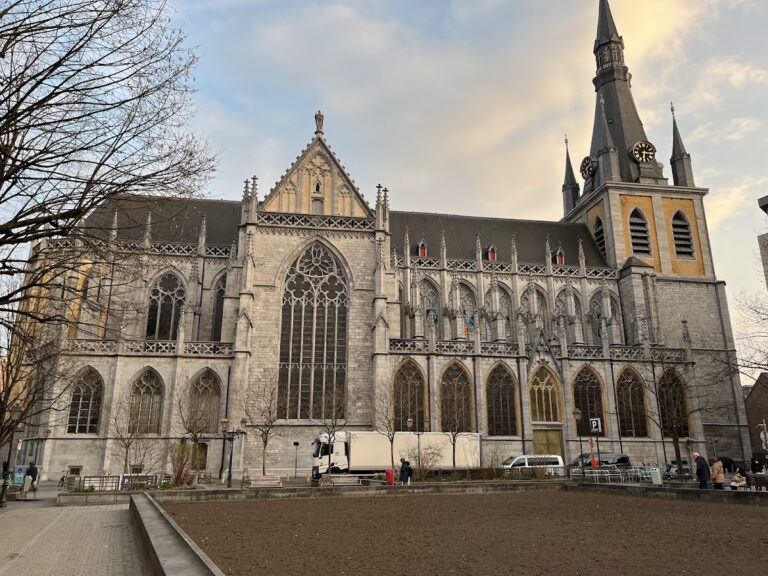
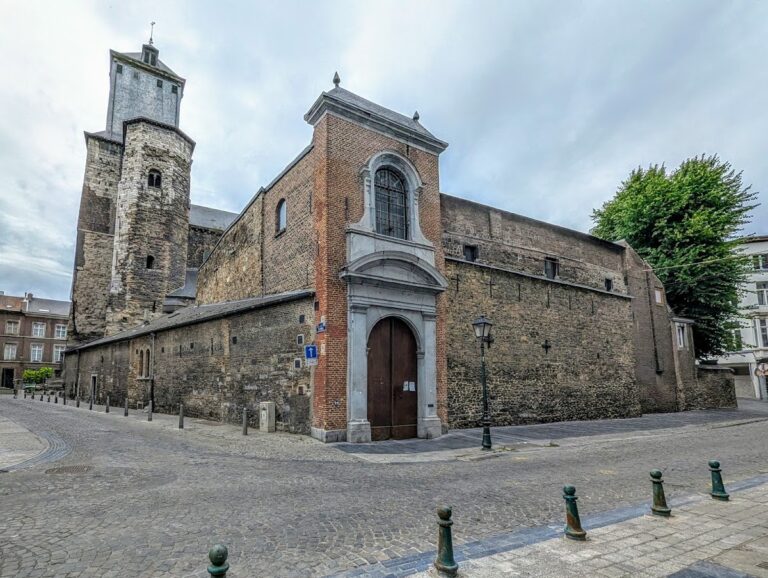
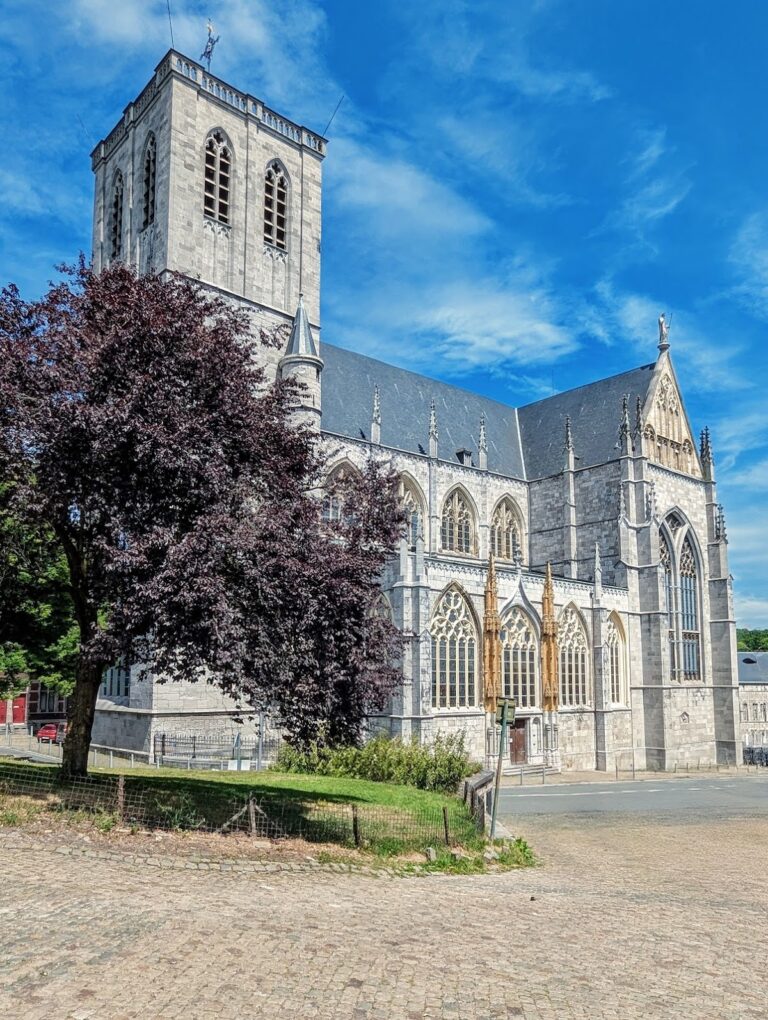
The surviving abbey church is dedicated to Saint James the Less. It stands apart from the former monastic buildings, most of which were demolished in the nineteenth century.
The Renaissance portal
A Renaissance portal was added between 1558 and 1560. Its design is attributed to the Liège painter Lambert Lombard.
Commemorative stones
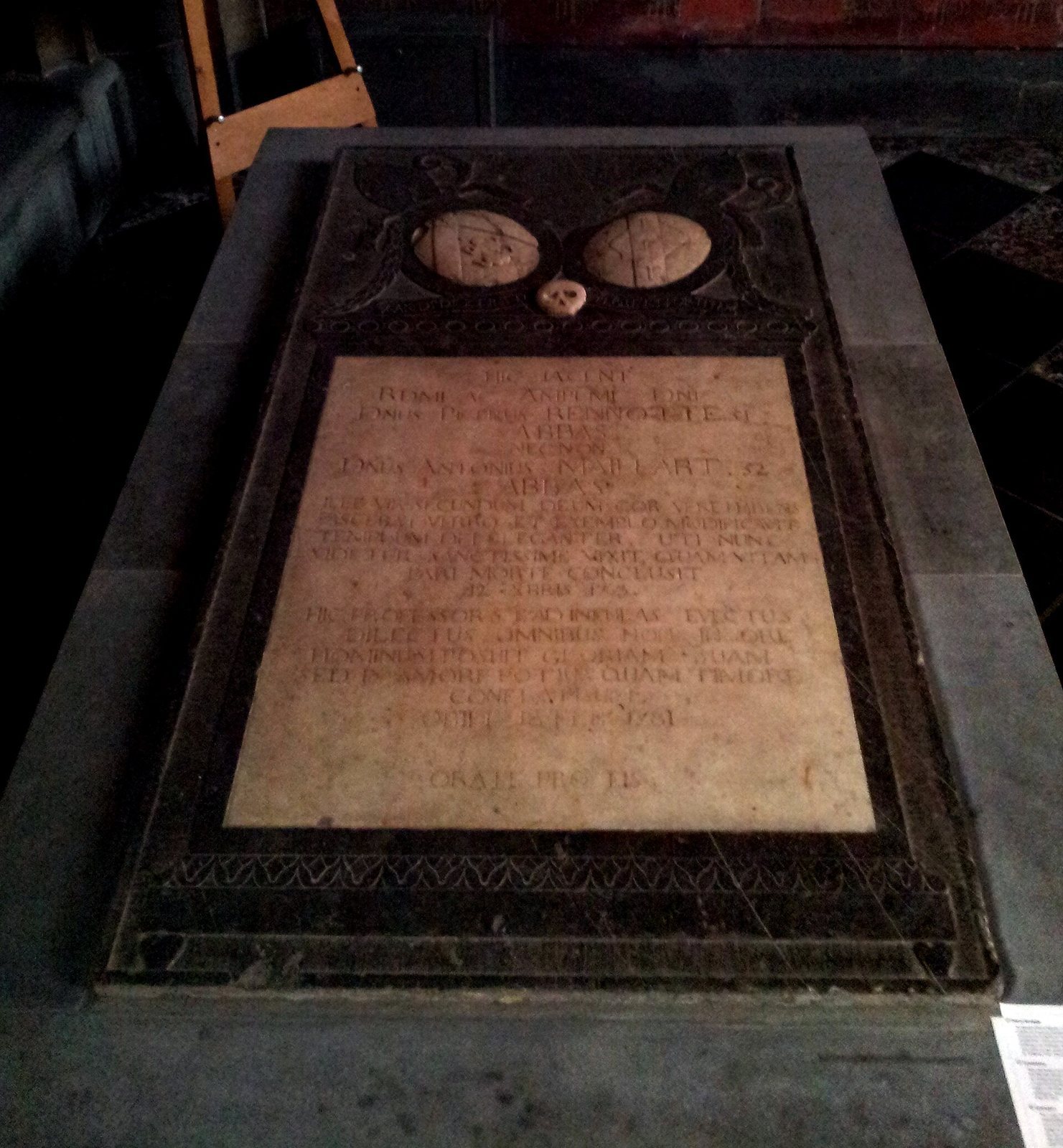
A stone honoring Balderic II, installed by Abbot Gilles Lambrecht, remains in the right transept, the crosswise arm of the church. A corresponding stone commemorating Bishop Reginard is set in the left transept.
Former monastic buildings
The abbey’s complex included a refectory, quarters for the abbot, a dormitory, a hospital, a library, and cloisters. After the monastery was suppressed, the cloisters were turned into dwellings. A separate eighteenth-century abbey building survived the later demolitions.
Relics and the treasury
The shrine and arm relic
The shrine of Saint James did not survive the French Revolution. Thirteenth-century documents refer to an arm relic of Saint James among the abbey’s relics.
The silver reliquary
The abbey treasury included a small oval reliquary box of Spanish manufacture, dated to the tenth or eleventh century. It was made of silver inlaid with niello, a dark material that contrasts with engraved designs, and bears a divine blessing in Arabic script. The box may have been brought back from Compostela by Robert in 1056 and used to carry relics. A copy of an altar-consecration certificate records that Compostela relics were included in an abbey-church altar that year, supporting this possible connection without establishing the box’s identity conclusively.