Former Charterhouse of Santa María de las Cuevas: Monastery and Ceramics Factory in Seville
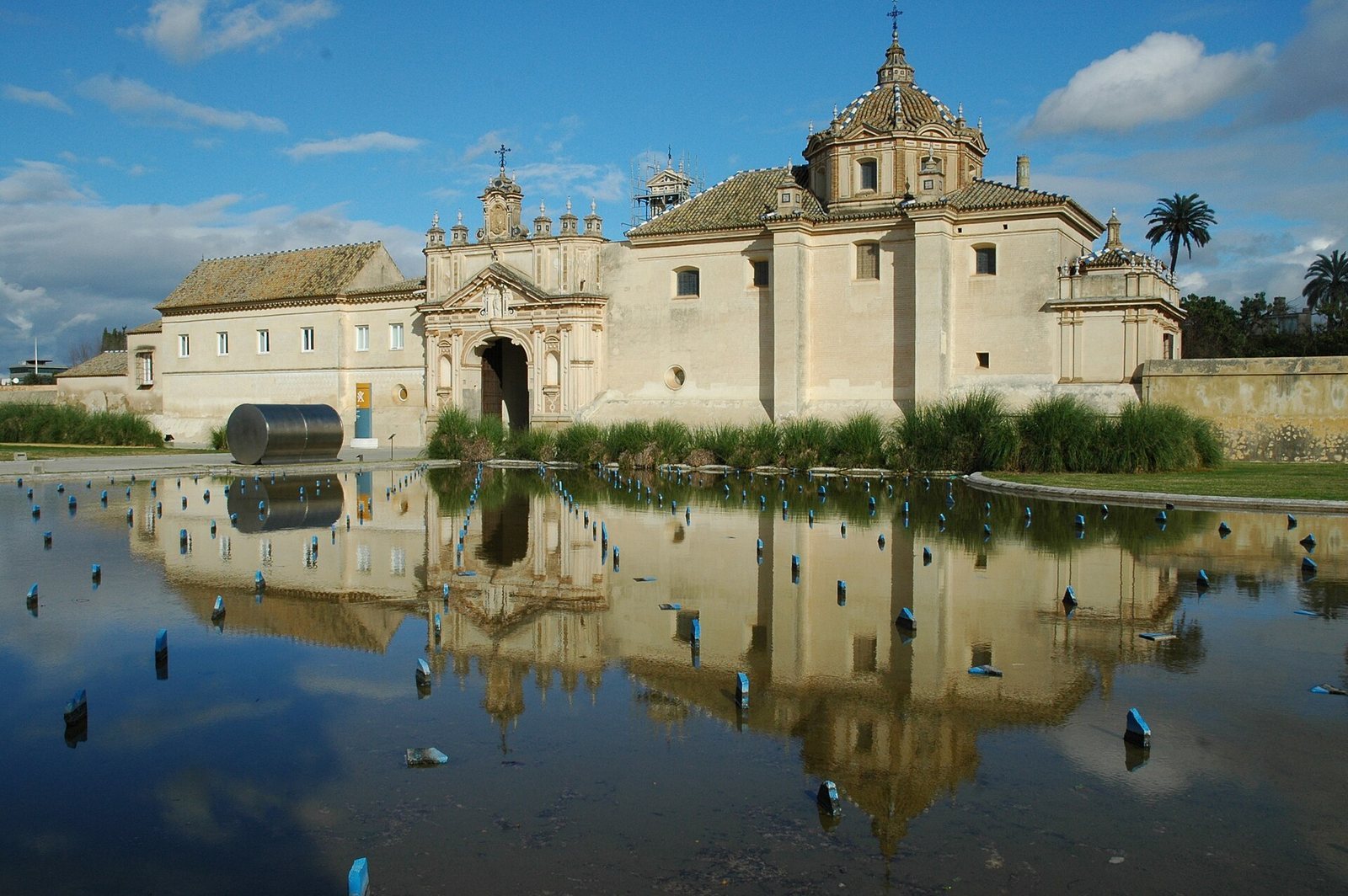
Site at a Glance
- Popularity
- High
- Country
- Spain
- Primary era
- Medieval
- Eras represented
- Medieval, Early Modern, Modern
- Civilizations
- Almohad, Crown of Castile, French, Spanish
- Site type
- Religious
- Remains
- Monastery
On this page25 sections
History
The Former Charterhouse of Santa María de las Cuevas is a former Carthusian monastery on La Cartuja island in Seville, Spain. Its monastic foundation dates to the early fifteenth century, and its layered buildings combine Gothic and Baroque work with Mudéjar forms, a Christian Iberian tradition drawing on Islamic art, and Plateresque ornament, a richly detailed Spanish Renaissance style. The complex became closely associated with Christopher Columbus and later served as a ceramics factory.
Kilns, a hermitage and the Carthusian foundation
The site first served an industrial purpose. In the twelfth century, the Almohads, a North African Muslim dynasty that ruled parts of the Iberian Peninsula, established pottery kilns here. The Guadalquivir was nearby, and local clay was dug from caves. Potters from Triana continued to extract clay from the area in later centuries.
A local legend tells that an image of the Virgin Mary, hidden during Muslim rule, was found in a cave around 1248. A chapel dedicated to Santa María de las Cuevas was built to house it, and the site subsequently became a Franciscan religious house. In the late fourteenth century, Archbishop Gonzalo de Mena y Roelas entrusted the hermitage to the Franciscans. Ruy González de Medina, a member of Seville’s municipal council and treasurer of its mint, urged the archbishop to establish a Carthusian community in the city after encountering the order at El Paular. The Carthusians, a Catholic monastic order founded by Bruno of Cologne in the eleventh century, lived in cloistered communities and held regular meetings of their priors, or monastic superiors.
The foundation was authorized in 1398. Monks arrived from El Paular in 1400 and took possession of the hermitage in 1401; formal approval followed in 1404. The archbishop supplied land and property valued at 20,000 morisco doblas, a dobla being a medieval Iberian gold coin. In 1400, the Franciscans agreed to exchange the hermitage for churches at San Juan de Aznalfarache and San Juan del Puerto. The archbishop also arranged a bequest of 30,000 gold doblas through his executor, Juan Martínez de Vitoria. After the archbishop died without a will in 1401, his estate passed to the Roman Curia. Prince Ferdinand of Antequera seized the bequest in 1407 to fund military campaigns. Pope Benedict XIII supported the monastery’s establishment, donating 5,000 gold doblas and liturgical ornaments in 1404, as well as 1,000 florins. In 1409 he sought royal approval for the monastery to receive a share of tithes from three church districts. Seville’s municipal council granted it civic status in 1402 and provided alms in 1410.
Landholding, Columbus and royal connections
Per Afán de Ribera the Elder, a senior royal official with judicial and military authority as well as chief notary of Andalusia, gave the monastery perpetual agricultural revenues and financed its church in return for burial rights for himself and his family. Other devout donors and wealthy Seville families also contributed. The monastery acquired the lordship of Casaluenga in two purchases in March and April 1456. Its lands supported agriculture and fishing, and the lordship included a prosperous village. Christopher Columbus is said to have spent extended periods there before and after 1492, accompanied by the Carthusian monks Diego Luján and Gaspar Gorricio.
By 1513, the monastery owned vineyards, gardens, olive groves and grain fields across the region, including at Dos Hermanas, Camas, Alcalá del Río, Carmona and Seville. It also held other estates in and around the city. In 1494, the traveler Hieronymus Münzer described the monastery’s gardens and orchards and ranked its wealth second among Christian monasteries, behind the Charterhouse of Pavia.
Columbus relied on several monks at the monastery. Gaspar Gorricio assisted him as he prepared voyages in Seville, and Columbus consulted the monastery library while preparing arguments for Salamanca before his first voyage. Gorricio also helped him assemble scriptural material for the Book of Prophecies, dedicated to the Catholic Monarchs, and safeguarded documents, jewels and money Columbus entrusted to him. Columbus proposed a Carthusian house on Hispaniola, with Gorricio as prior and six other monks, but the order declined because its priors had to attend regular meetings and elections. Diego Luján, who served three times as prior of the monastery, and Rodrigo de Marchena were also connected with Columbus. In 1502, preparing for his fourth voyage, Columbus wrote to Pope Alexander VI about his discoveries and the recovery of the Holy Sepulchre, and proposed that religious orders, including the Carthusians, send missionaries to the newly reached lands.
Columbus died in Valladolid in 1506. His son Diego arranged for his remains to be brought to the monastery, where the Carthusians received them in 1509. They were probably first placed in the Henríquez family vault and later associated with the Chapel of Santa Ana. Columbus’s son Diego, who died in 1526, was buried there with his father and uncle. Luis Colón y Toledo, a great-nephew of Columbus, was the last family member buried in the chapel; his remains were transferred to Santo Domingo in the early seventeenth century. Columbus’s remains were moved to Santo Domingo during the sixteenth century and placed in Seville Cathedral in 1899.
The monastery also attracted royal visitors and religious figures. Emperor Charles V visited during his Seville wedding celebrations in 1526 and gave the community a portable altar. Philip II stayed for three days in May 1570, while Philip IV visited in 1642, read the Ribera family epitaphs in the church and attended a solemn Te Deum, a Christian hymn of thanksgiving. The scholar Benito Arias Montano made several retreats there and left his library and other possessions to the monastery. Teresa of Ávila visited in 1575 and 1576, speaking with Prior Fernando Pantoja in the Great Garden. She asked him to bring the Eucharist to the Discalced Carmelite convent she founded in Seville in 1575 and later gave him two reliquaries, containers for religious relics. One held a thorn from Christ’s crown. The reliquaries were kept in the monastery sacristy and are now at the Convent of San José.
Damage, occupation and industrial reuse
The monastery’s position near the river made it vulnerable to floods in 1485, 1595, 1603, 1626 and 1784. The Lisbon earthquake of 1755 also caused severe damage to the complex.
During the French occupation of Seville, monks sent valuables toward Cádiz in 1810 to prevent their seizure, but French forces intercepted the vessel at Sanlúcar de Barrameda and confiscated its contents. In 1811, Marshal Soult turned the monastery into an artillery barracks and army headquarters under General Lery. The complex was stripped of religious furnishings and adapted for military use: the church became a food store, the sacristy a butcher’s shop, the Chapter Chapel a wine cellar, the Magdalena Chapel a pharmacy and the refectory a grain store. A kitchen was built in the cemetery, while orange trees were removed from a 2,000-foot orchard. French forces fortified the grounds with moats, a drawbridge, bastions and watchtowers, blocked the main entrance and laid out a parade ground. The monastery was also sacked, and decorative works were lost.
The Carthusians returned to Seville in 1812 and re-entered the monastery that October. Between 1820 and 1823, its property was confiscated and the building used for housing. It was returned to the monks in 1823, and the church reopened for worship in 1827. Following the 1836 confiscations of church property, the monastery was secularized and later used as a prison, holding about 200 inmates.
In 1838, the Liverpool-born merchant Charles Pickman acquired the monastery, at first leaving out the Great, Old and Compás gardens; he bought those gardens in 1879. He converted the buildings into a ceramics factory, which began production in 1841. The works made hand-decorated glazed earthenware and porcelain in an English style, using imported materials, moulds and machinery, along with British ceramic expertise and workers from nearby Triana. Its products became known in Europe and Latin America, and the factory won awards at exhibitions in Seville, Paris, Bayonne, London, Porto, Vienna, Philadelphia and Barcelona. In 1871, King Amadeo I named the factory a supplier to the Spanish Royal Household. Pickman received the title of Marquis in 1873, and the Garter emblem associated with his membership in the Order of the Garter became a trademark on some products.
Conservation and cultural use
Factory production ended in the early 1980s. After the Spanish Ministry of Public Works expropriated the monastery, the factory moved to Salteras in 1982. The complex had been declared a National Monument in 1964. Restoration work took place from 1971 to 1978; following a preliminary study in 1983, the Andalusian government commissioned a further restoration and rehabilitation project in 1986. The Monumental Ensemble of the Cartuja was established in 1989 to protect the site, develop it as a cultural centre and include it in the 1992 Seville Universal Exposition. The works restored parts of the buildings and gardens.
In 1992, the monastery hosted the exhibition Arts and Culture in the World in 1492. Ancillary buildings accommodated the Royal Pavilion, where visiting heads of state and government were received, and a purpose-built pavilion for the fifteenth century stood in the southern part of the enclosure. The Andalusian Institute of Historical Heritage has been based in the complex since 1990. In 1997, the Andalusian Centre for Contemporary Art established its headquarters there, bringing together surviving collections from the monumental ensemble and the Seville Museum of Contemporary Art. The complex also houses the rectorship of the International University of Andalusia.
Remains
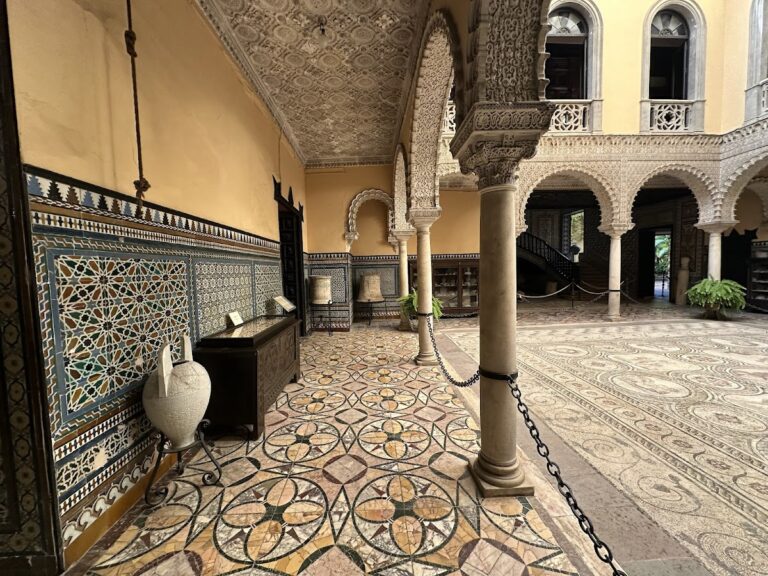
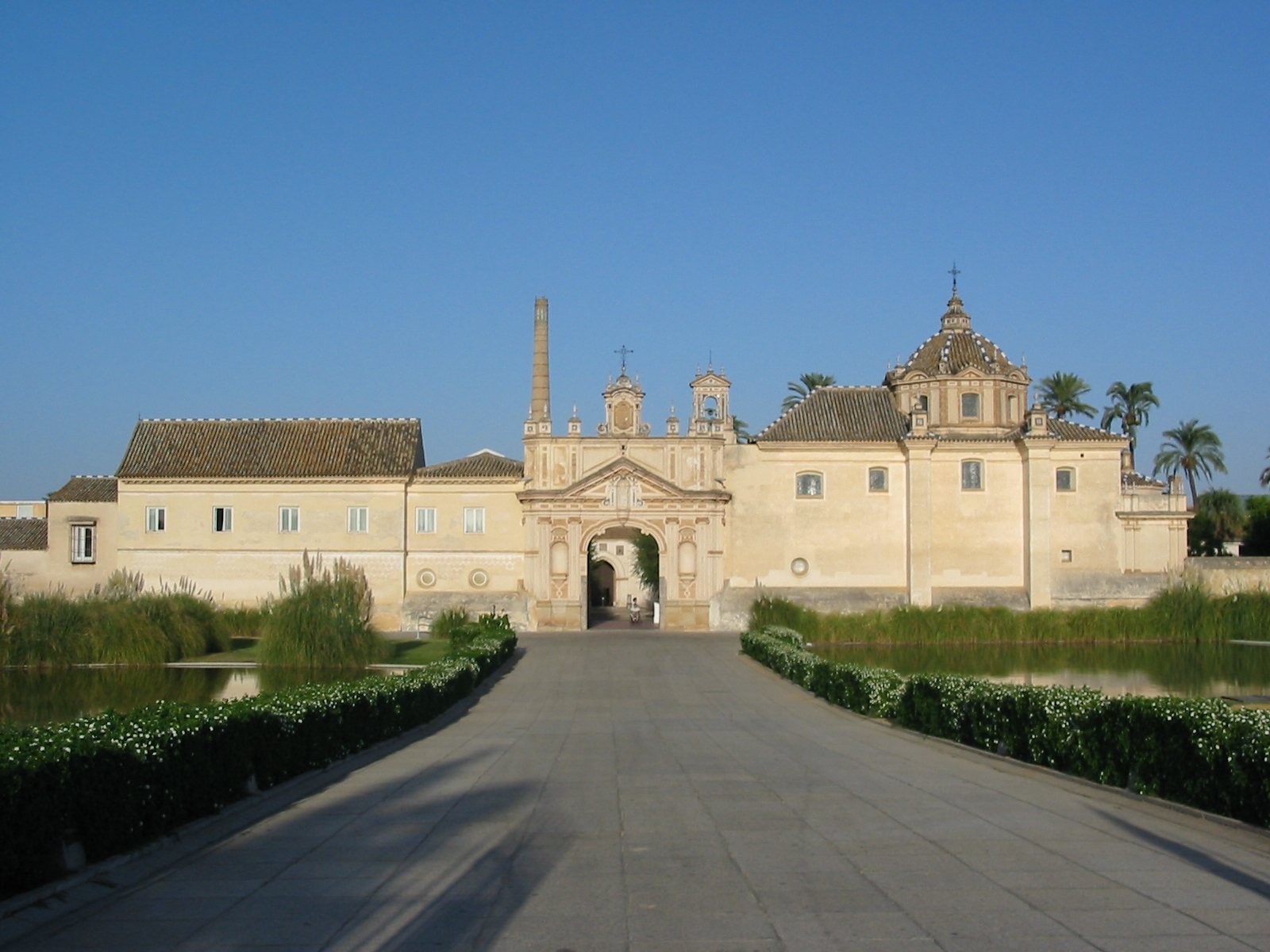
The complex covers 11 hectares on La Cartuja, an island beside the present Alfonso XIII Canal, which follows an earlier course of the Guadalquivir. The river was later diverted west of Seville. Buildings occupy 35,000 square metres within an outer enclosure of rammed earth and brick. The layout brings together the original monastic core, gardens and service areas with the remains of the ceramics factory. Its accumulated architectural character includes Gothic, Mudéjar and Plateresque work alongside Renaissance and Baroque features.
Enclosure and entrances
Western entrance and Ave María Gate
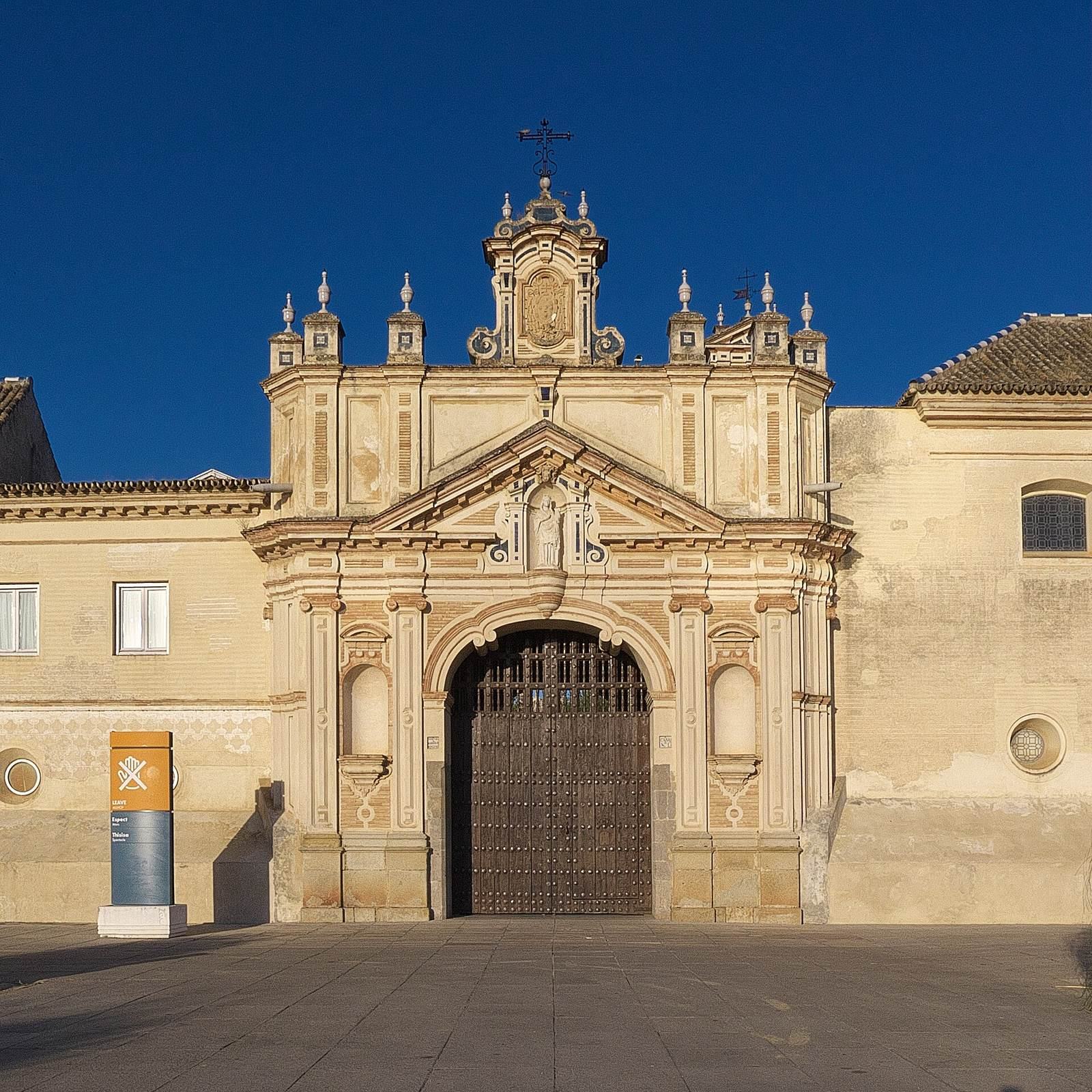
The main entrance pierces the western side of the outer wall and dates to 1766. Beyond it, an open space leads to the early-fifteenth-century Ave María Gate, also called the Chains Gate. Two heraldic shields of Gonzalo de Mena flank the gate. Each displays a cardinal’s hat and five gold suns on a blue field, a design adopted as the monastery’s official emblem.
River Gate
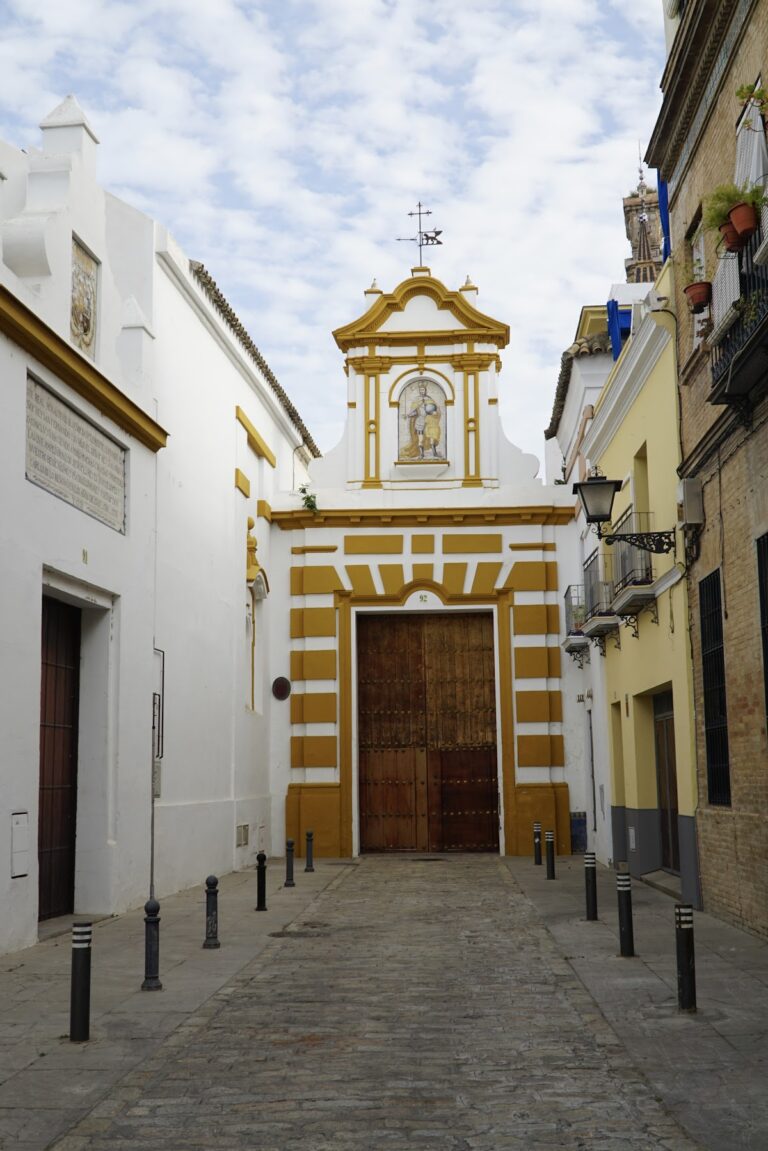
The River Gate faces the Guadalquivir’s former course and dates to the late seventeenth or early eighteenth century. Tiles from the same period decorate its surface. During the factory era it became the principal entrance, and a new path connected it to the church entrance and the prior’s cell, which was converted into the owner’s residence.
Churches and chapels
Principal church
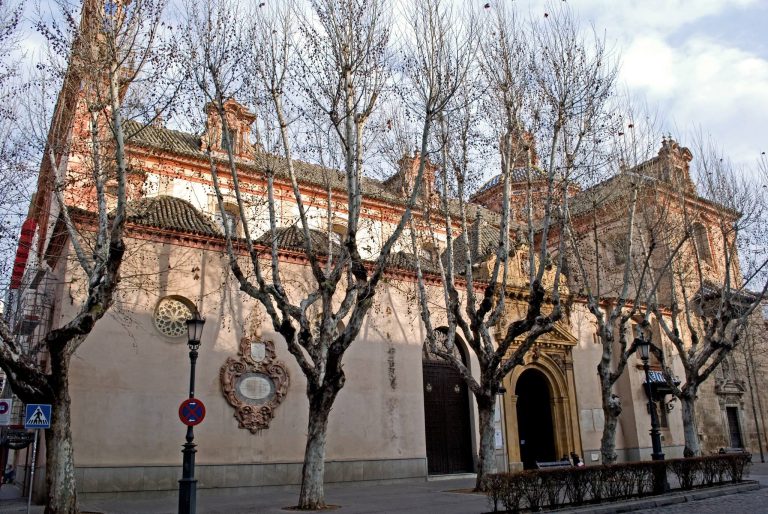
The principal church was built between 1410 and 1419 and enlarged in 1526. Its splayed Gothic front carries Mudéjar and Plateresque decoration. Inside, a single nave, the main body of the church, sits beneath a rib vault, a ceiling supported by intersecting ribs. The sanctuary has a fan-shaped vault whose ribs spread outward. Stucco was added to the vault in 1613 and 1614. Sixteenth-century wall tiles attributed to Alonso García were removed in the late twentieth century and placed in storage.
Magdalena Chapel
The Magdalena Chapel occupies the site of the monastery’s first church, and its earliest adjoining rooms date to the early fifteenth century. The central figure in its principal altarpiece was originally Saint Mary Magdalene; a new statue by Pedro Duque Cornejo replaced it in 1751. A second altarpiece, donated by Alfonso V of Portugal in 1467, centred on a Crucifixion image and was restored in 1709 and 1710. Gonzalo de Mena’s tomb was moved here in 1594 from the Chapel of Santiago in Seville Cathedral, then returned to Santiago in 1837.
Chapel of Santa Ana
Per Afán de Ribera the Elder built a church for the Carthusians in 1419, later extended by the Chapel of Santa Ana, completed in 1523. The chapel measures 13.80 metres long by 4.84 metres wide and received stucco decoration in 1604. An old painting of Saint Anne once stood above its original altar. After the painting was removed, the altar held the Christ of Clemency, given by cathedral canon Mateo Vázquez de Leca and now in Seville Cathedral. A funerary vault associated with Columbus lies beneath the chapel’s centre.
Chapel of Afuera
The Chapel of Afuera, also known as the Public Chapel, was damaged by the 1755 earthquake, a flood in 1757 and a severe storm in February 1759. A replacement chapel was completed in 1766. Its principal altarpiece, made around 1780 by Francisco de Acosta the Elder, remains in its original position.
Community rooms and cloisters
Ave María courtyard and monastic group
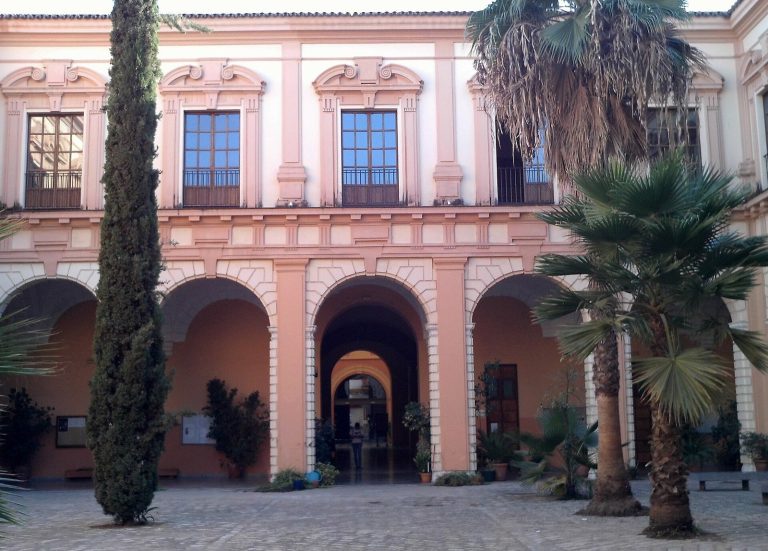
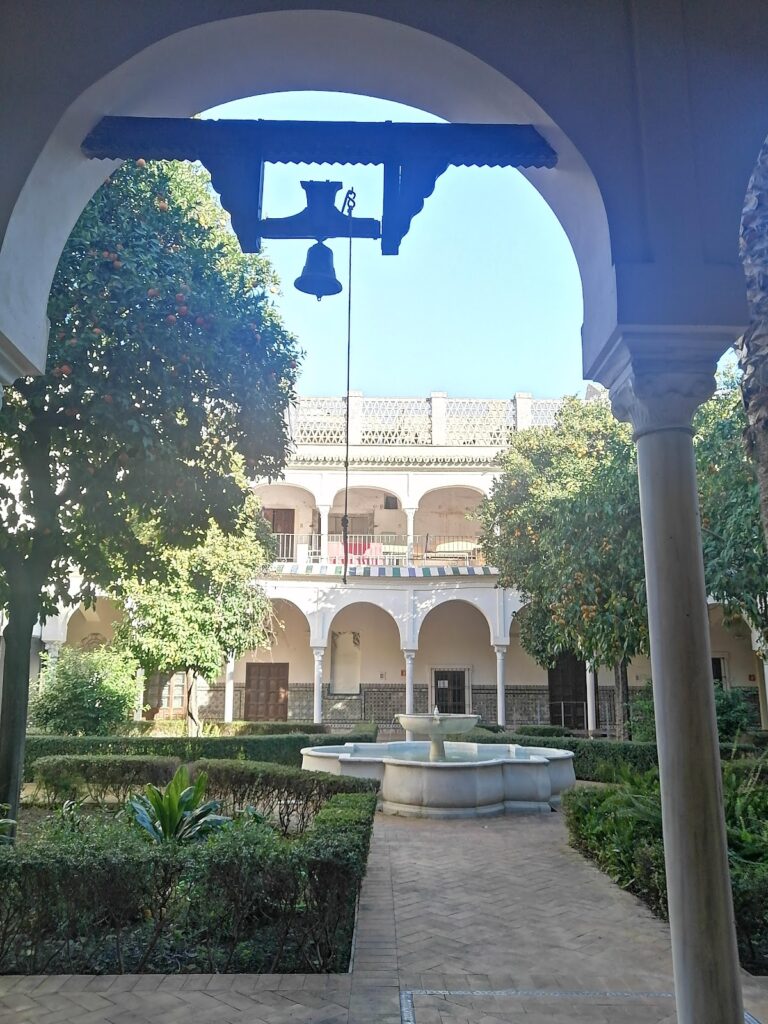
The principal courtyard, called the Ave María, opens onto the forecourt of the church. Monks’ cells stand on one side, while remains of a guesthouse loggia lie on the other. The church, sacristy, De Profundis Chapel, San Miguel cloister, other chapels and a large refectory, the community dining hall, formed the principal monastic group.
Chapter House
The fifteenth-century Chapter House was the community’s meeting room. Its vault and Gothic decorative sculptures are among its defining features, while ceramic tile panels dated 1607 cover the lower walls. The room contains tombs of the Ribera family made by sculptors Antonio María Aprile da Carona and Pace Gazzini. The tomb of Pedro Enríquez and Catalina de Ribera dates to 1525; the other named family tombs date to 1531 and commemorate Per Afán de Ribera and his wives, Ruy López de Ribera and Inés de Sotomayor, Per Afán de Ribera II and his wives, and Diego Gómez de Ribera and Beatriz de Portocarrero.
Refectory
The refectory was enlarged in 1588, when ceramic panels were added to its walls. Its coffered ceiling, made from pine of Flanders, was constructed in 1587 by carpenters Diego Cerezo and Lucas de Cárdenas. A small cloister connects the church’s Epistle aisle with the refectory.
Cloisters and service areas
The small cloister is a fifteenth-century Mudéjar structure. The Great Cloister, also called the Cloister of the Monks, was begun in the fifteenth century and altered in the seventeenth and eighteenth centuries; about a quarter of it served as a cemetery. A kitchen was built in the cloister during the French occupation, and the factory later installed kilns there. The fifteenth-century Cloister of the Lay Brothers was partly demolished to make way for factory use. Behind the church apse are remains of the Great Cloister. Farther south, the Lay Brothers’ cloister and the steward’s residence formed part of a zone of service buildings that included cellars, mills, workshops, barns, granaries and stables.
Factory structures and gardens
Kilns and chimneys
Factory work spread through former monks’ cells and convent rooms and later extended into the gardens. Pickman installed ten kilns with chimneys. Nineteenth-century bottle-shaped chimneys were followed by tunnel-type chimneys in the 1950s. Five ceramic kilns with tall chimneys are identified within the grounds.
Gardens and waterworks
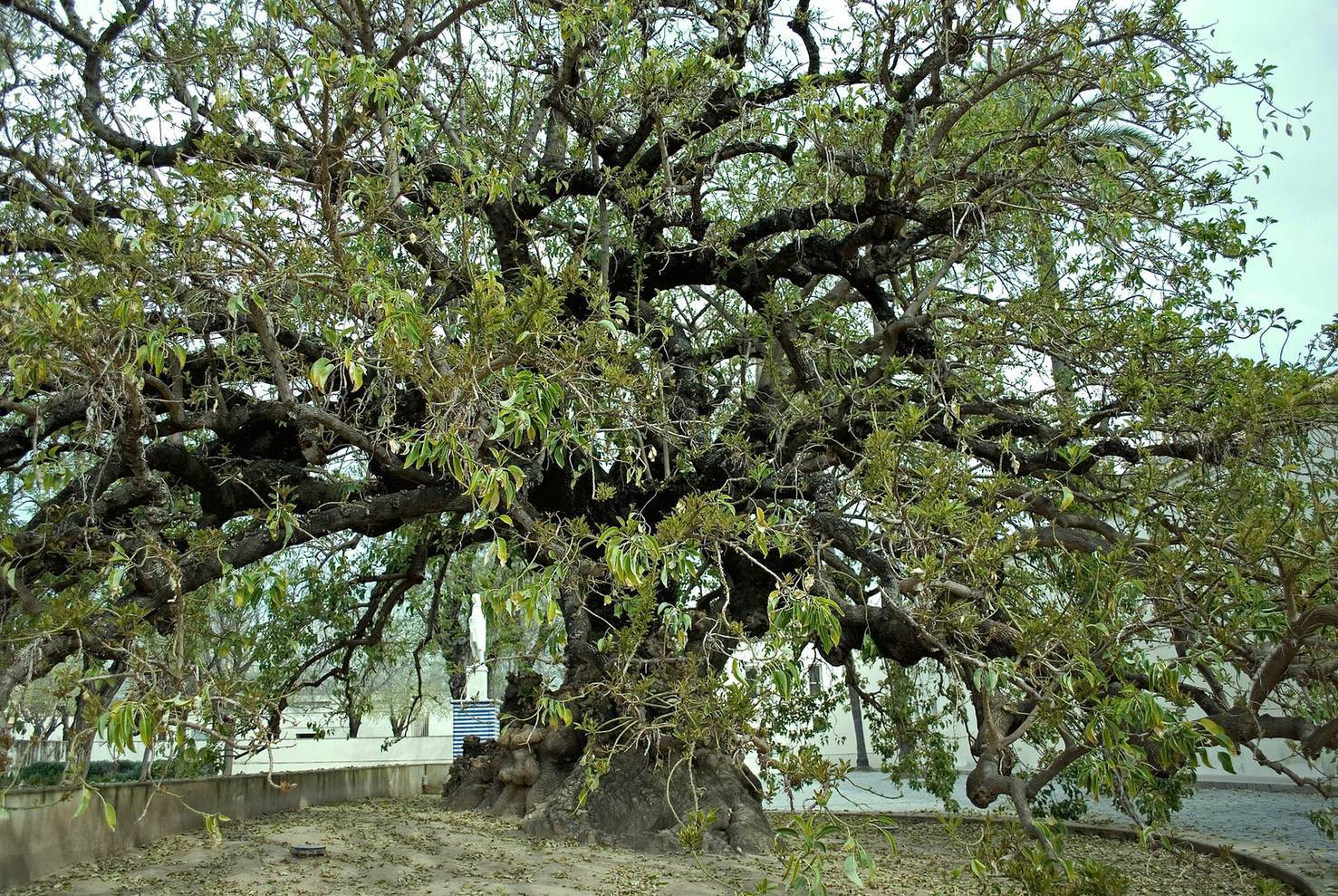
The monastery grounds included vegetable gardens, three water-lifting wheels, a mill powered by a horse or mule, a kitchen and separate dining halls for staff and the poor. A surviving ombu, a large tree-like South American plant, stands in the gardens. Local tradition attributes its planting to a member of the Columbus family.
Funerary works and Columbus remains
Ribera family memorials
A bronze funerary slab for Per Afán de Ribera y Portocarrero, made in 1573 by sculptor Juan Bautista Vázquez the Elder and bronze caster Bartolomé Morel, is set into a wall of the Mudéjar cloister. That cloister also holds funerary statues of Juana de Zúñiga and Catalina Cortés, sculpted by Diego de Pesquera in 1575. Lay-brother choir stalls made by Agustín de Perea and Juan de Valencia between 1697 and 1710 are kept in the monastery’s stores.
Columbus family remains
The Museum of the Cartuja Factory, inside the former factory complex, holds the remains of Columbus’s brother Diego. Examination of these remains helped establish the location of Christopher Columbus’s burial.