Cyme: An Ancient Aeolian City on the Aegean Coast
Site at a Glance
- Popularity
- High
- Country
- Turkey
- Primary era
- Classical
- Eras represented
- Classical, Medieval
- Civilizations
- Achaemenid, Ancient Greek, Byzantine, Roman
- Site type
- City
On this page17 sections
History
Cyme was an ancient Aeolian Greek city on the Aegean coast of present-day Turkey. The Aeolians, one of the ancient Greek-speaking peoples, regarded it as the largest and most important of their twelve cities. Archaeological dating places settlement at Cyme in the Proto-Geometric period, an early phase of Greek archaeology, about 1050–900 BC. The city’s establishment is conventionally placed in the eighth century BC, while another foundation chronology gives a date of about 700–600 BC.
Foundation and Aeolian growth
Traditions offer different accounts of Cyme’s beginnings. One credits the city’s foundation to Kyme, an Amazon of Greek myth. Another says settlers from Locris in central Greece captured the Pelasgian stronghold at Larissa near the Hermus River after the Trojan War. Greek tradition associated the Pelasgians with peoples of the Aegean before or alongside Greek settlement. A separate migration story places people from mainland Greece, probably Euboea, in the region during the Late Bronze Age. The name Phriconis was associated with Mount Phricion.
Cyme became a regional center and founded about thirty towns and settlements in Aeolis, including Side around the seventh century BC. Farming was a major livelihood despite the city’s harbor and access to the sea, and trade is also thought to have prospered. Cymeans were ridiculed for not collecting harbor dues for roughly three centuries. Cyme and other coastal settlements did not trade with inland Anatolian communities.
Accounts variously describe the early government as a monarchy or a democracy established by settlers, and one tradition names Agamemnon as king. From the seventh century BC, wealthy aristocrats ruled the city. Aristotle argued that Greek democracies, including Cyme, developed into tyrannies rather than rule by a small elite. In this context, a tyrant was a ruler who held power outside established constitutional arrangements. Cyme’s people spoke Aeolic Greek, a dialect closely related to those of Thessaly and Boeotia, and practiced Greek polytheism.
Stories about Cyme’s royal family connected it with Phrygia. Demodike, said to be Agamemnon’s daughter, was described as the wife of the Phrygian king Midas. Pollux and Aristotle credited her with a part in the invention or introduction of coinage. Hermodike I was associated with bringing Persian writing to Greece, while Hermodike II was credited with spreading coinage. These traditions do not fit neatly with the chronology of early coinage, which in Lydia is associated with King Alyattes.
Cyme also became known through literary associations. Ephorus, a historian of the fourth century BC, came from the city. A tradition says that Hesiod’s father sailed from Cyme to settle at Ascra in Boeotia; this does not establish that Hesiod himself was born at Cyme.
Persian rule and Ionian resistance
After the Lydian kingdom fell to Cyrus the Great, Cyme came under Persian control, conventionally dated to the mid-sixth century BC. Cyrus founded the Achaemenid Empire, the Persian state ruled by the Achaemenid dynasty. Around 546 BC, the Lydian rebel Pactyes sought refuge at Cyme. The citizens asked Apollo’s oracle whether they should surrender him, then avoided handing him over directly by sending him to Mytilene on Lesbos.
In the fifth century BC, Cyme took part in the politics of the Ionian coast. Aristagoras of Cyme opposed Miltiades’ proposal to free the coast from Persian rule. He, Histiaeus of Miletus, and other tyrants argued that revolt would put their own power at risk. Cyme later joined the Ionian Revolt, an uprising against Persian rule under Darius I, but Persian forces retook the city. Otanes captured it during a campaign against the Ionian cities.
Before 480 BC, Cyme served as an important Persian naval base. Sandoces, possibly the city’s governor, commanded fifteen ships in Xerxes I’s expedition against Greece. After the Battle of Salamis, surviving Persian ships spent the winter at Cyme.
Hellenistic, Roman, and Eastern Roman phases
Cyme came under the Attalid dynasty from 241 to 133 BC. The Attalids ruled the Hellenistic kingdom centered on Pergamon. After Rome defeated Antiochus III in 190 BC and concluded the Treaty of Apamea in 188 BC, Cyme became exempt from taxation. It was later incorporated into the Roman province of Asia, an administrative territory governed by Rome in western Asia Minor.
The city remained important under Roman rule and suffered a major earthquake during the reign of Emperor Tiberius; another earthquake is dated to AD 94. In the Eastern Roman, or Byzantine, period, Cyme was a bishopric, a church district overseen by a bishop, subordinate to the metropolitan see of Ephesus. Its bishop held this subordinate position from the sixth century into the thirteenth century. From the seventh century, settlement at Cyme was largely abandoned. By the thirteenth century, habitation was limited to the area around a harbor fortress. Ottoman forces captured the fortress in 1415, after which settlement there ended.
Archaeology and modern pressures
Archaeological exploration began in the nineteenth century. Demosthenes Baltazzi started excavations in 1874, and Salomon Reinach investigated the southern cemetery between 1881 and 1895. A Czech mission working under A. Salaç uncovered a small temple to Isis, a Roman covered passage, and a building thought to have been a potter’s house in 1925. Investigations by Ekrem Akurgal in the early to mid-1950s found Archaic and Late Geometric material on the southern hill.
Industrial expansion around the harbor prompted rescue work by the İzmir Museum from the 1970s. Excavations between 1979 and 1984, including work directed by Vedat İdil in 1982–84, revealed inscriptions and structures. Later investigations were directed by Sebastiana Lagona and Antonio La Marca, and the museum has continued work at the site. Surveys using geophysical and magnetic measurements have identified further structures underground. Industrial development has also put pressure on the settlement and harbor area. In 2019, Cyme’s archaeological protection status was reduced from first- to third-degree protection, while the harbor area faced pressure from plans for a new industrial port.
Remains
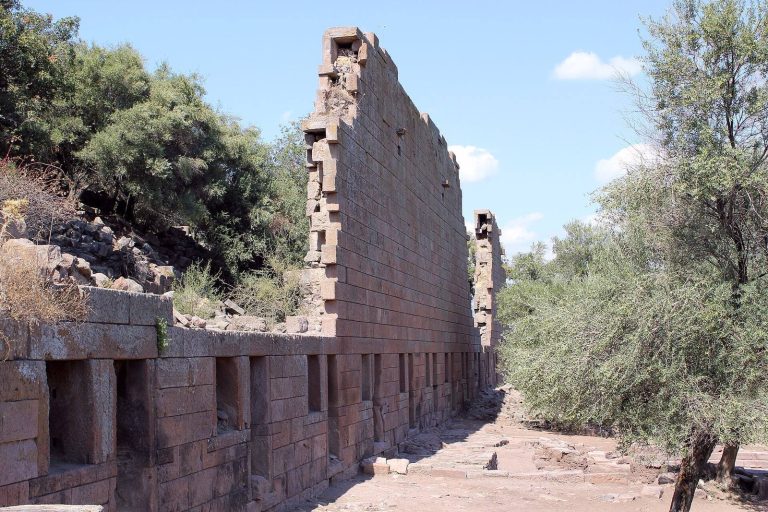
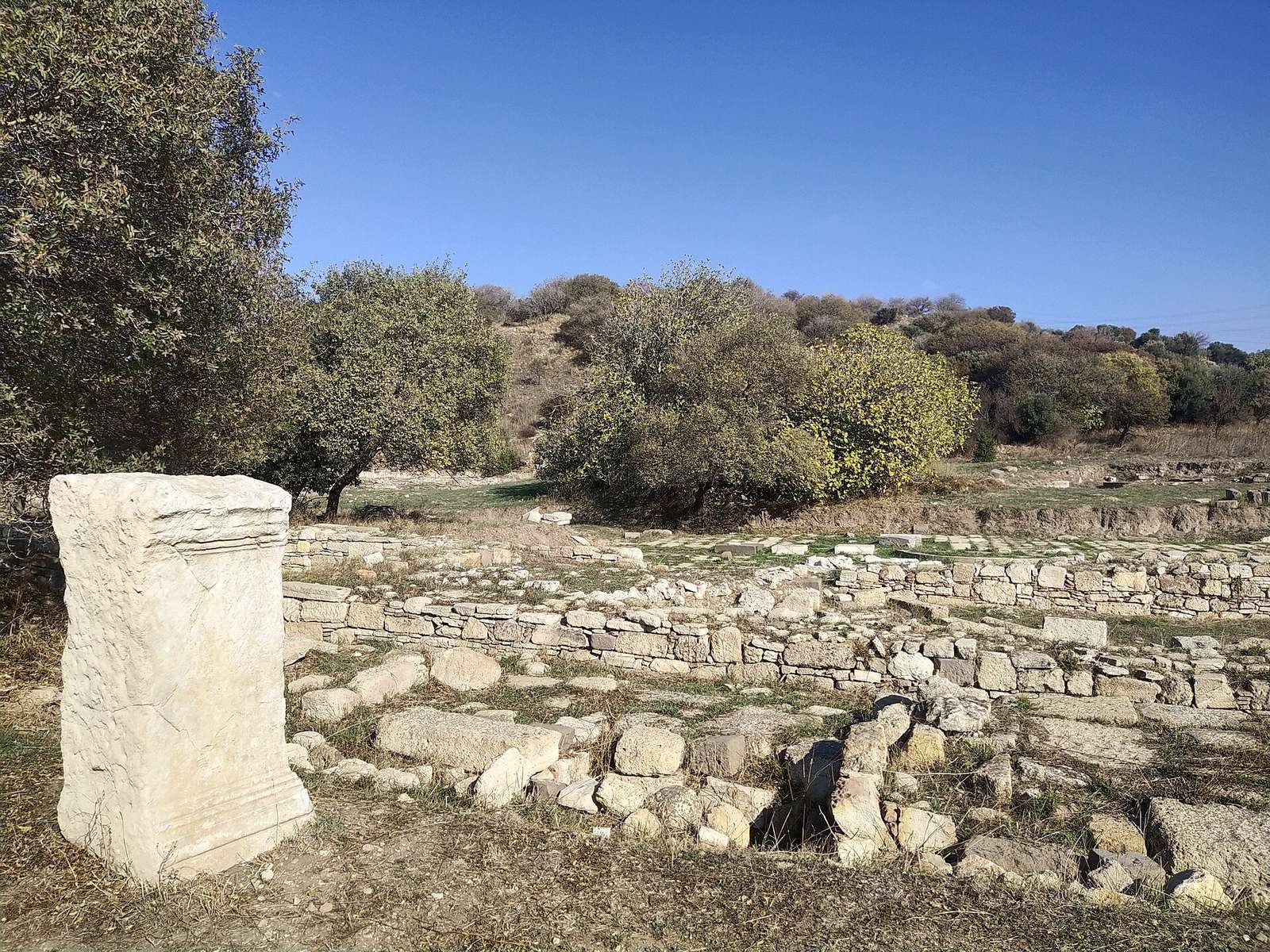
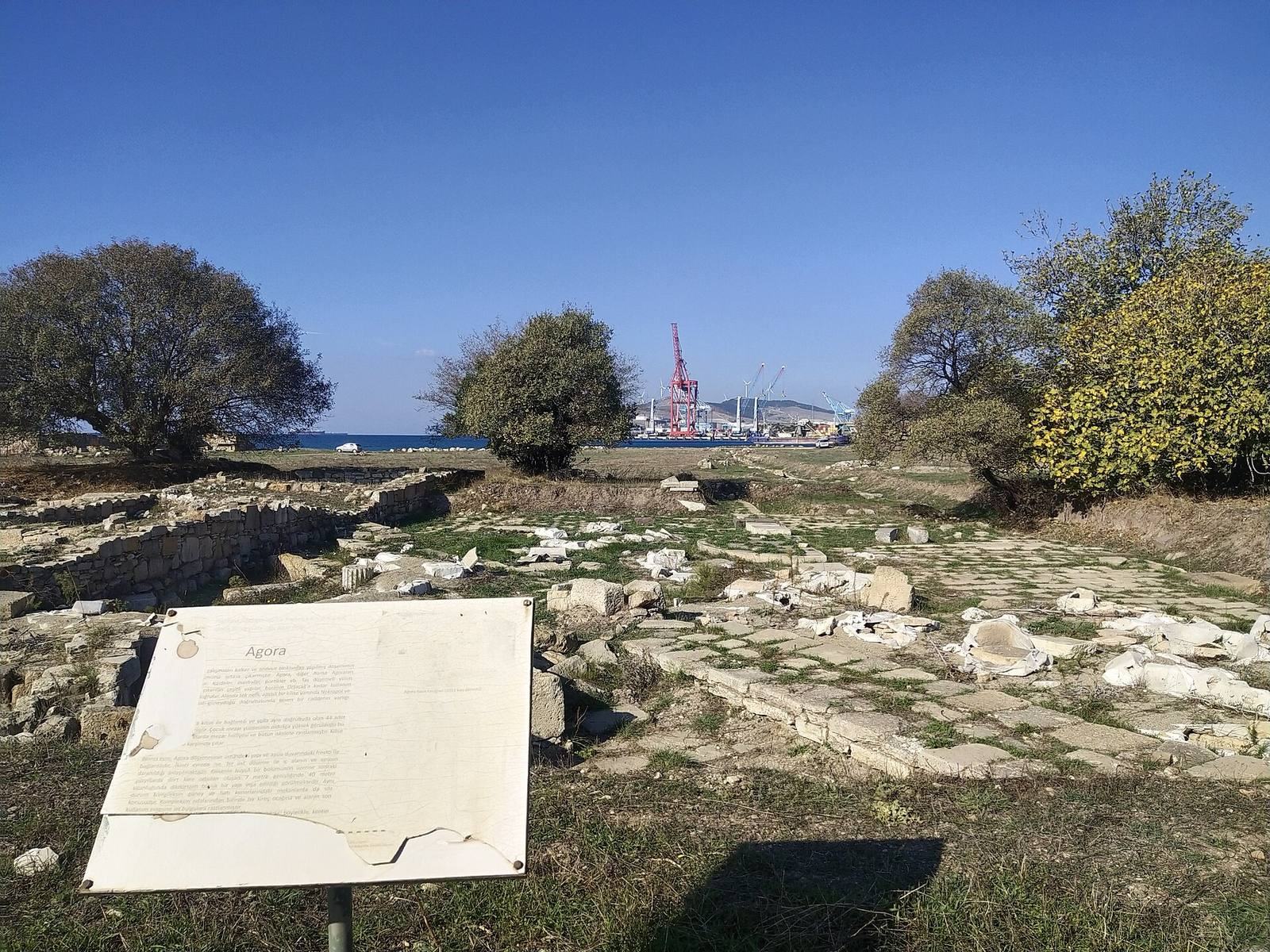
The remains include a coastal harbor area and a residential quarter on the northwest side of the southern hill. At least five successive building phases have been identified in the excavated part of that quarter, while other finds include civic, religious, and domestic structures from different periods.
Residential quarter on the southern hill
Early walls and fifth-century rooms
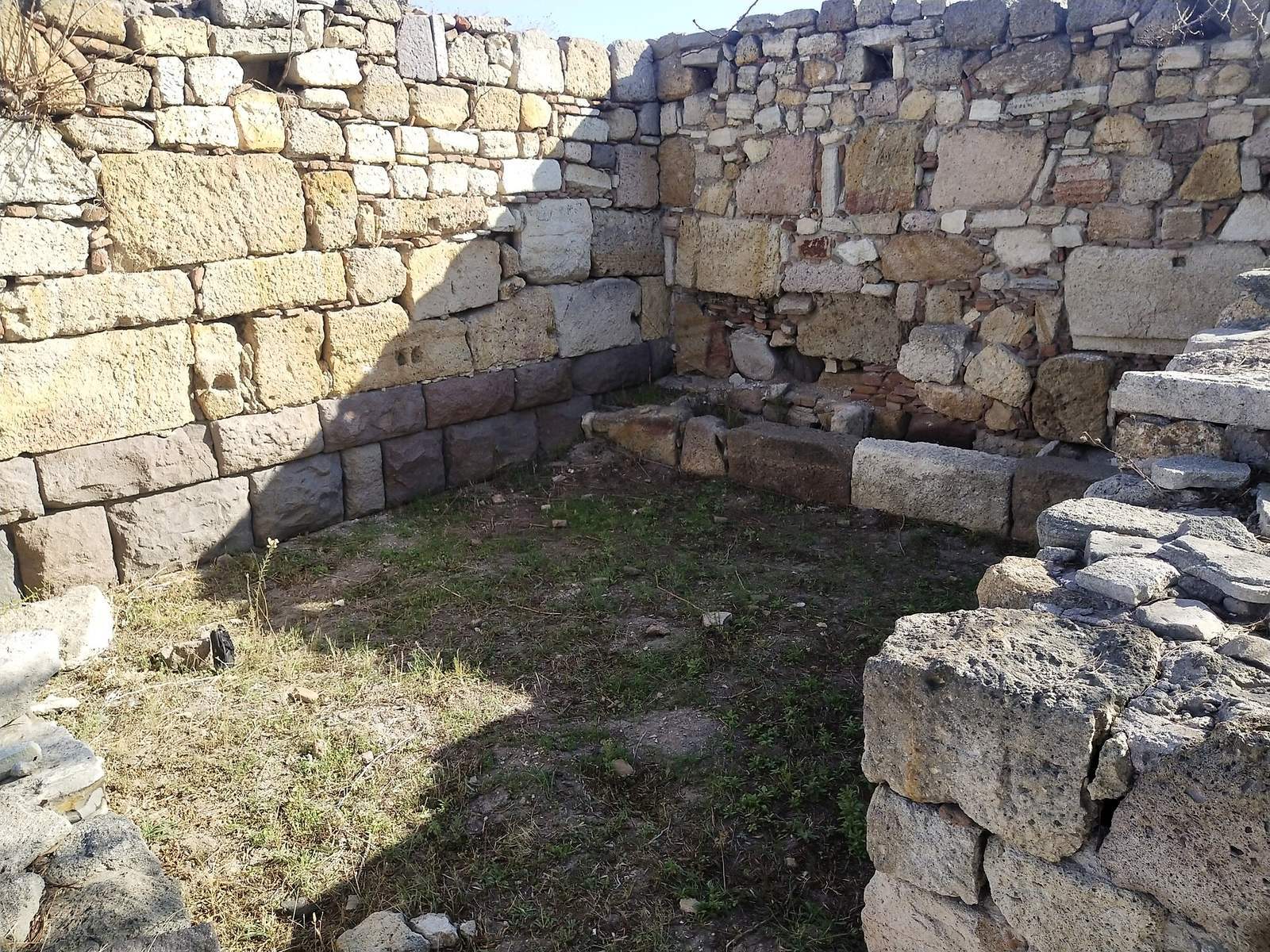
The earliest identified building phase includes a long, straight wall running from north to southeast, with traces of a threshold linking two rooms. Its date is uncertain, but it was built before the end of the fifth century BC. A later phase, dated to the end of that century, includes rooms A and B. The building appears to have been complete on its northern side, while its plan may have continued farther south. Room A’s entrance opened on the south side. Its western wall, made of squared limestone blocks, also held back the steep slope as a terrace wall.
A cistern cut into the rock at the foot of Room A collected water from the roof. Its fill contained debris and large quantities of black and plain pottery dating to the Late Hellenistic period.
Imperial Roman alterations
In the Imperial Roman phase, builders used white mortar and bricks for walls. A service room east of Room A had a floor formed from leveled rock. Another room was built over the area of the filled cistern and decorated with wall paintings.
Late Roman house
A large house occupied the area in the Late Roman period. Its rooms were built from reused materials without mortar and often had multicolored mosaics. A ramp at the southwestern edge of the excavated area provided access. The house was destroyed between the late sixth and early seventh centuries AD.
Later surface structures
The final identified phase consists of shallow structures in the northern part of the excavation. A long wall runs northwest to southeast, beside a ramp made from reused blocks and aligned with it. These features may point to use of the area during the Byzantine period.
Civic and harbor architecture
Hellenistic public buildings
During the Hellenistic period, the harbor was enlarged, and the city acquired a theater, colonnaded passageways, and monuments. Strabo placed Cyme 70 stadia from Larissa and 40 from Myrina; stadia were ancient units of distance whose length varied.
Temple of Isis
A small temple dedicated to Isis was uncovered in 1925. Isis was an Egyptian goddess worshipped across the ancient Mediterranean.
Roman passage and probable potter’s house
The Roman porticus, a covered colonnade or passage, and a building interpreted as a potter’s house were also found at Cyme.
Harbor fortress
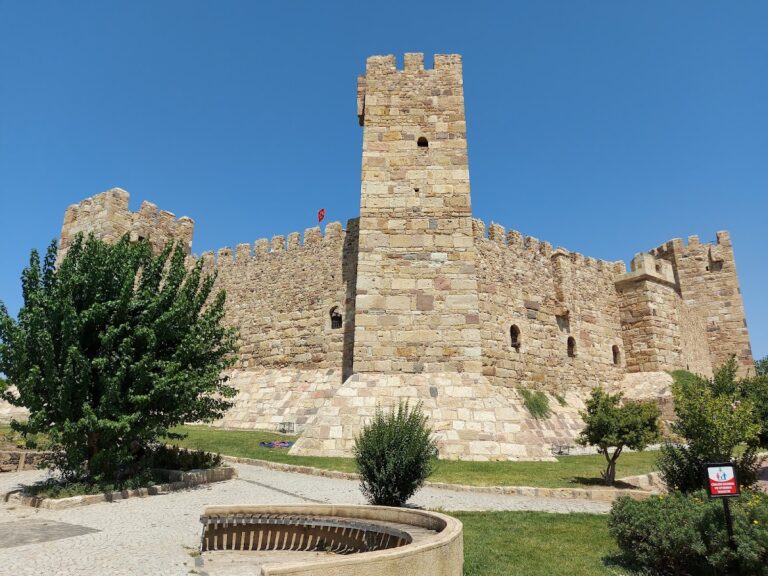
A fortress built beside the harbor in the twelfth century formed the focus of the settlement’s later, limited habitation.
Coins and further archaeological evidence
Cyme’s early silver fractions, dated to about 600–550 BC, bear a horse-head image. Other Cymean coins depict the Amazon Kyme and a prancing horse. Coins issued during the Roman imperial period, from Nero to Gallienus, show the river god Hermos, horses with raised forelegs, and victorious athletes. Coins and other archaeological evidence also refer to a river believed to have been the Hyllus. Excavations have uncovered inscriptions, while geophysical and geomagnetic surveys have located additional structures beneath the soil.