Hisar Mosque: An Ottoman Landmark in İzmir


Site at a Glance
- Rating
- 4.7
- Popularity
- Medium
- Country
- Turkey
- Primary era
- Early Modern
- External website
- Open
- Eras represented
- Early Modern
- Civilizations
- Ottoman
- Site type
- Religious
- Remains
- Mosque
On this page8 sections
History
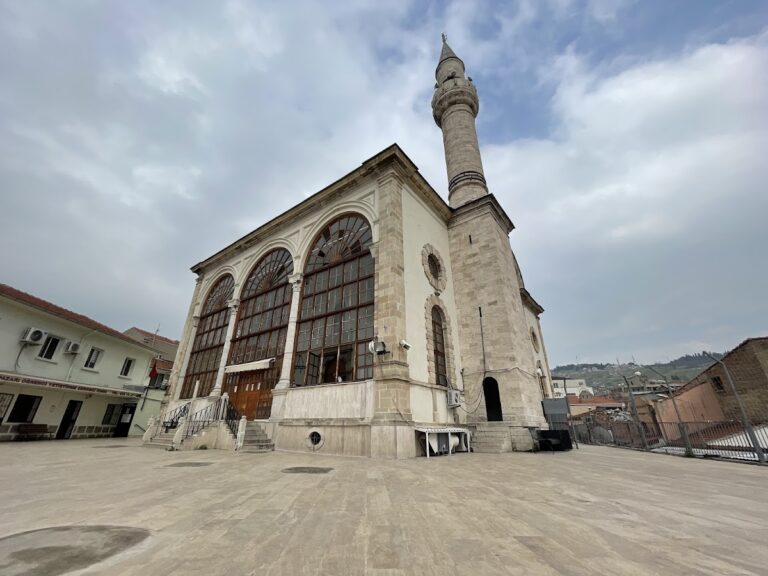
Hisar Mosque, also called Hisarönü Mosque, is a late-sixteenth-century Ottoman mosque in İzmir, Türkiye. Built in the classical Ottoman architectural tradition, it was begun in 1592 and completed or opened in 1598. The mosque is traditionally attributed to Aydınoğlu Yakup Bey, the Ottoman governor and bey of İzmir from 1592 to 1598. It is regarded as İzmir’s first monumental building and remains an active place of Islamic worship in the historic Kemeraltı commercial district.
The harbor fortress site
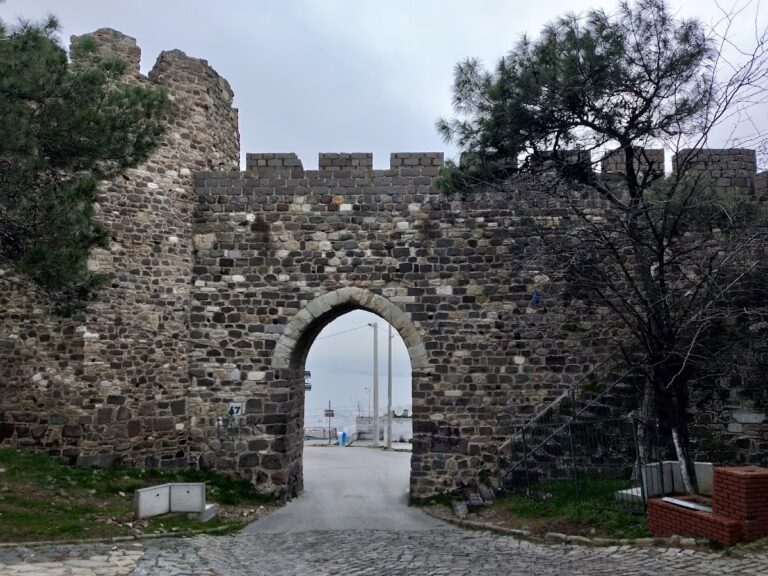
The name Hisar means “Fort” and refers to the mosque’s position near the lower gate of İzmir’s Inner Harbor Fortress. This stronghold, also called the Lower Fortress, Hisar Fortress, or Arrow Fortress, stood at the mouth of the inner harbor. It was constructed between 1231 and 1235, captured and destroyed by Timur in 1402, and later left ruins that were used as the mosque’s building site. The remaining fortress structure behind the mosque was demolished in 1872, although the mosque’s name continued to preserve the memory of the site.
Other traditions connect the location with an earlier Latin church. A separate interpretation places a mosque there as early as the fourteenth century and attributes it to another man named Molla Yakup. Ibn Battuta, a fourteenth-century Moroccan traveler, mentioned a Sheikh Yakup in İzmir at the beginning of that century, but his connection with the present mosque remains uncertain. Evliya Çelebi, the seventeenth-century Ottoman traveler and writer, recorded both Kadifekale and the harbor fortress during his visit to İzmir in 1671 and 1672.
Repairs and continued use
Earthquakes in 1813, 1868, and 1881 damaged the mosque. The 1813 repairs added the portico in front of the prayer area, and further interventions took place in 1870, 1881, 1890, 1927, 1938, and 1985. The minaret was repaired on 22 May 1890 under İzmir governor Halil Rıfat Pasha. After the 1927 earthquake destroyed it, Governor Kazım Dirik Pasha commissioned a replacement, whose inscription records reconstruction during his governorship that year. The latest major restoration, carried out from 2009 to 2011, reopened the mosque for worship on 11 March 2011.
Hisar Mosque also has an association with the musical life of İzmir. The twentieth-century composer Rakım Elkutlu served as its imam from the death of his father until his own death. He chaired the İzmir Music Society for many years and composed works particularly associated with the Hisarbuselik musical mode. The mosque stands near Kızlarağası Hanı and the Yorgancılar, Yağcılar, and Peynirciler markets within Kemeraltı.
Remains
Domed prayer hall
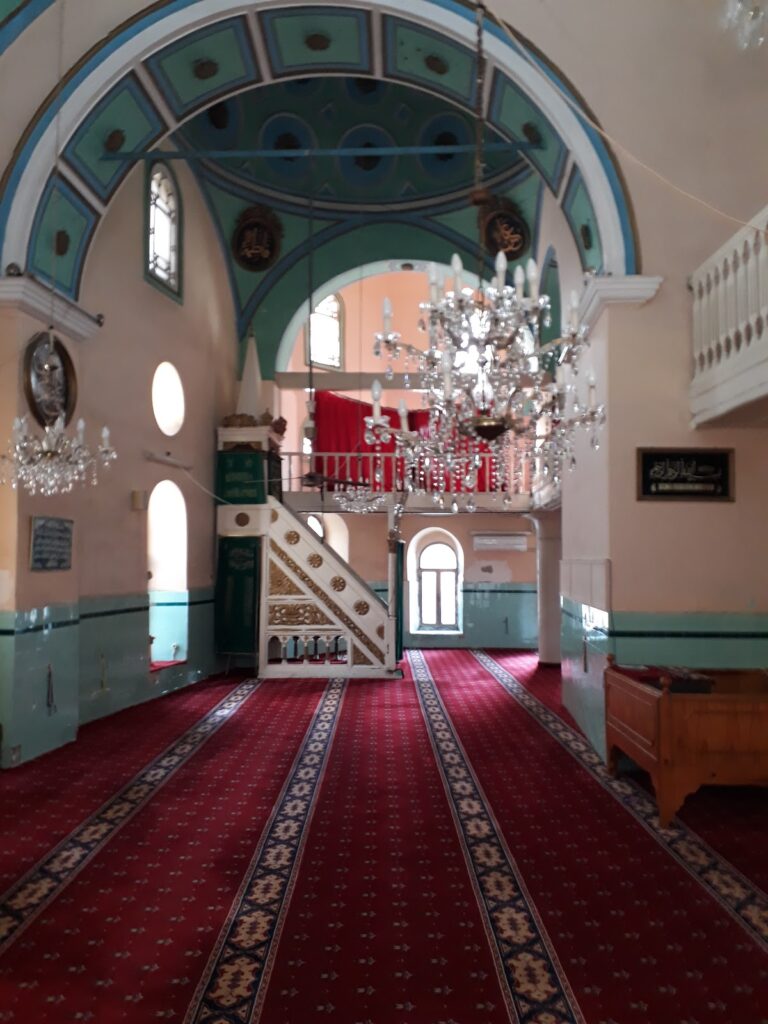
The mosque is built principally of cut stone and rubble stone. Its square main prayer hall is organized around a central dome supported by eight substantial piers, often described as elephant-foot supports. The domed space before the mihrab, the niche indicating the direction of Mecca, is surrounded on three sides by smaller domed areas. Six smaller domes support this central arrangement, creating a compact and strongly unified interior.
Entrance portico
The western entrance opens into the prayer hall through three doors. In front of it, the last-congregation area is a covered portico where worshippers may pray before or after the main congregation. It is carried by eight marble columns joined by round arches and is covered by seven domes. In recent times, glazing has enclosed its front. The capitals of the portico and arcade columns suggest Roman influence, while the columns themselves are thought to have been taken from ancient structures in İzmir. One capital, preserved without later plaster decoration, remains visible on the column to the right after entering the prayer hall, above the women’s gallery.
Courtyard and minaret
The rectangular courtyard contains a covered fountain for ritual washing before prayer, commonly called a shadirvan. Its surrounding walls carry a series of seven domes. The mosque has a single minaret standing on a cut-stone base. Its shaft is circular and has one balcony. The base of the replacement minaret is decorated with Kütahya tiles, and the entrance bears the inscription commemorating its reconstruction in 1927.
Mihrab, minbar, and interior decoration
The mihrab has a rounded, semicircular niche and is described as triple, an unusual arrangement associated with the mosque’s three patrons. Its decoration shows Italian influence and includes painted ornamental work from the eighteenth and nineteenth centuries. The wooden minbar, the elevated pulpit used for sermons, is decorated with mother-of-pearl inlay. Its entrance carries a calligraphic inscription using part of verse 97 of the Quranic chapter Al Imran, translated as, “Whoever enters it shall be safe.” The interior also contains notable Ottoman calligraphy and Islamic artistic decoration.