Temple of Mercury (Puy de Dôme): A Roman Sanctuary in France
Site at a Glance
- Popularity
- High
- Country
- France
- Primary era
- Classical
- Eras represented
- Classical
- Civilizations
- Roman
- Site type
- Religious
- Remains
- Temple
On this page11 sections
History
The Temple of Mercury (Puy de Dôme) is a Roman-period sanctuary near Orcines, France, whose first temple was built around AD 50. In the first century, Augustonemetum, the Roman-period capital of the Arverni, a Gallic people whose territory included the mountain, established a sanctuary to Mercury here.
Foundation and expansion
Objects from before the Roman conquest point to earlier activity on the mountain, possibly involving temporary visits. Around AD 150, the first temple was replaced by a larger sanctuary, with some material reused from the earlier building. The new complex may have been built to accommodate the many pilgrims who came to the site.
The sanctuary drew pilgrims approaching from Ceyssat Pass. Worship included offerings to Mercury, and the terraces could host ceremonies. Valuable gifts may have been stored in a treasury near the temple.
Mercury worship and uncertain identifications
Mercury, the Roman god commonly associated with the Greek Hermes, could also be linked with local deities in Gallo-Roman religion. The worship at Puy de Dôme therefore did not simply reproduce the cult of Rome’s Mercury. Inscriptions from other places name Mercury Arvernorix, meaning “king of the Arverni,” and Mercury Arvernus. These dedications are generally associated with Arverni serving in a Roman legion on the German frontier.
The Roman writer Pliny the Elder described a colossal bronze Mercury made by the Greek sculptor Zenodorus for a sanctuary of the Arverni, but did not identify its location. Since the statue and the first temple belong to roughly the same period, it has been suggested that the statue may have stood on the mountain. If so, construction of a microwave relay in 1956 may have disturbed remains of the first temple.
Gregory of Tours, a sixth-century bishop and historian, referred to an Arverni temple called Vasso Galate without stating where it stood. The identification most widely accepted is a temple on Rue Rameau in Clermont-Ferrand, also known as the Mur des Saracens or Temple of Jaude. The archaeologist Auguste Audollent instead proposed that Vasso Galate was the sanctuary on Puy de Dôme. Its description has been considered compatible with this site, although the name Gregory used could refer either to Auvergne or to Clermont. A connection between the name and a Mercury epithet in a German inscription has also been proposed. The two temples were contemporary; coins from Rue Rameau date to the reign of Augustus, but that sanctuary’s dedication remains unknown.
Later use
Coins indicate that the sanctuary remained in use during the fourth and fifth centuries, although its buildings may have fallen into ruin as early as the third century, perhaps alongside the nearby settlement at Ceyssat Pass. In the twelfth century, a Romanesque church stood on the summit, where a hermit lived.
Rediscovery and modern intervention
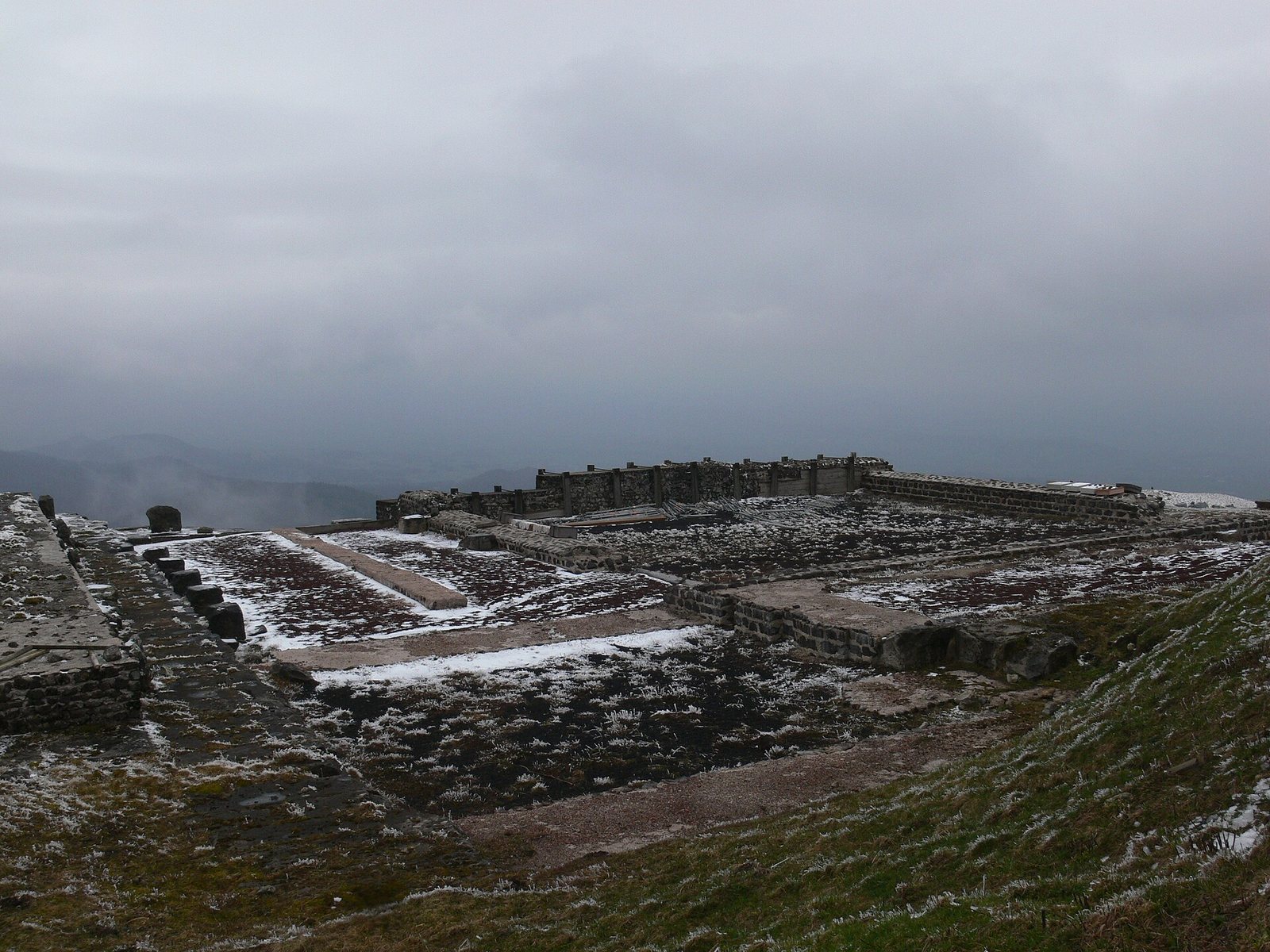
The sanctuary was discovered in 1872 during construction of a meteorological observatory. The Academy of Sciences of Clermont-Ferrand excavated it from 1873 to 1878, with Louis-Clémentin Bruyère directing the work from 1875. The investigations produced the first plans of the site, then stopped, leaving the ruins in the condition reached by the excavations. Protection measures began in 1886, and the sanctuary was classified as a historic monument in 1889.
Later work led by Auguste Audollent and Gabriel Ruprich-Robert examined the surroundings and identified an annex temple and a small Mercury statuette. In 1956, workers installing a microwave relay above the temple found coins during construction without prior archaeological excavation; the coins were dispersed. Weather damage prompted consolidation and repairs, including a major restoration in 1978. Intensive excavations resumed from 2000 to 2004 under Dominique Tardy and Jean-Louis Paillet, producing a precise architectural survey. An archaeological assessment followed in 2008 before further development and restoration.
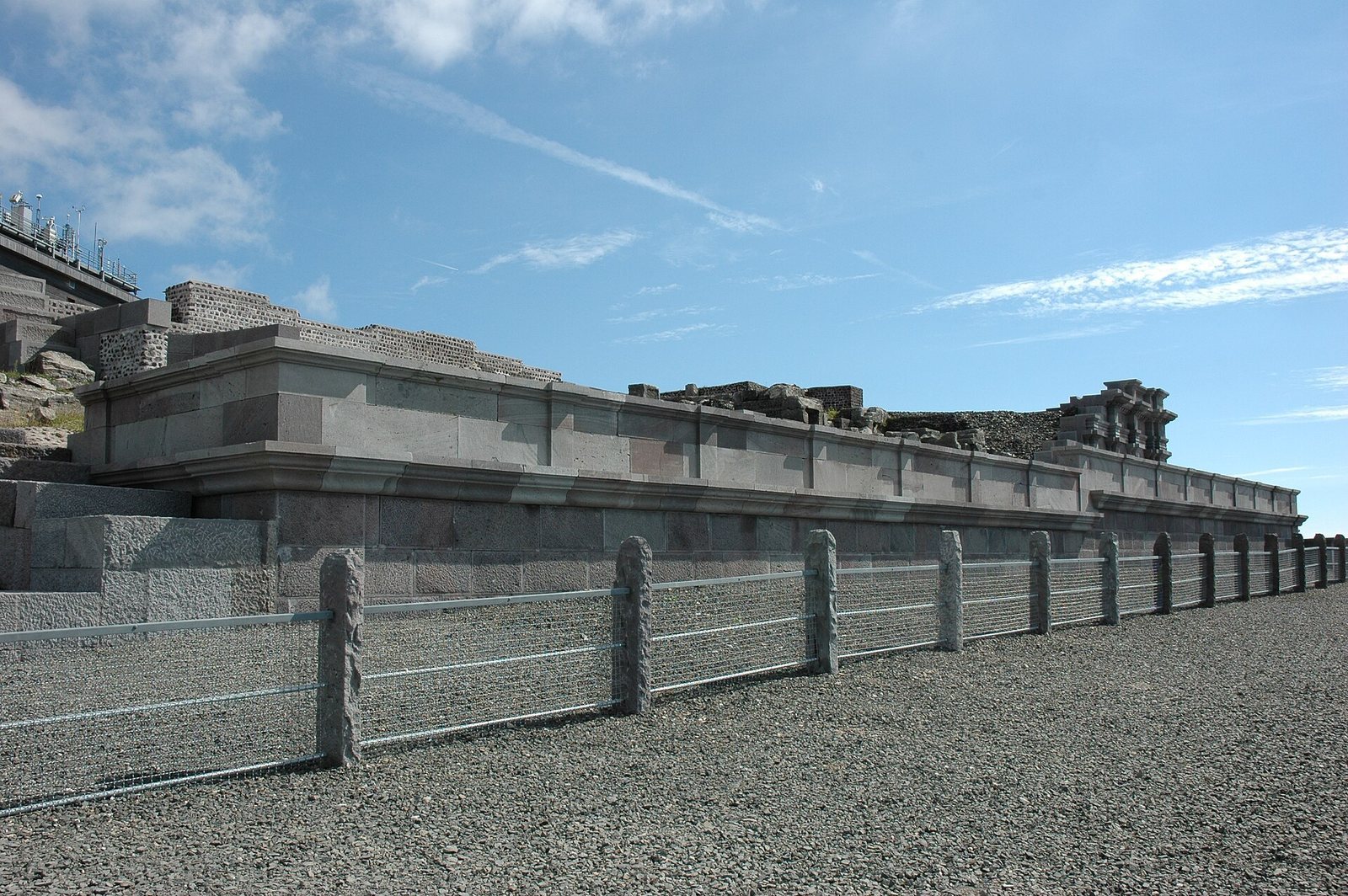
A partial reconstruction of the sanctuary’s lower sections was planned in 2008, with work beginning in 2012 and the first phase continuing through 2014. The project aimed to protect the ruins from severe weather and make the temple’s scale and original appearance easier to understand. Excavator Frédéric Trément objected that he had not been consulted and that the work would conceal ruins. Tardy also criticized the reduced visibility of original masonry and the processional layout, as well as the reconstruction’s impact on archaeological remains, particularly at the southeast corner.
Remains
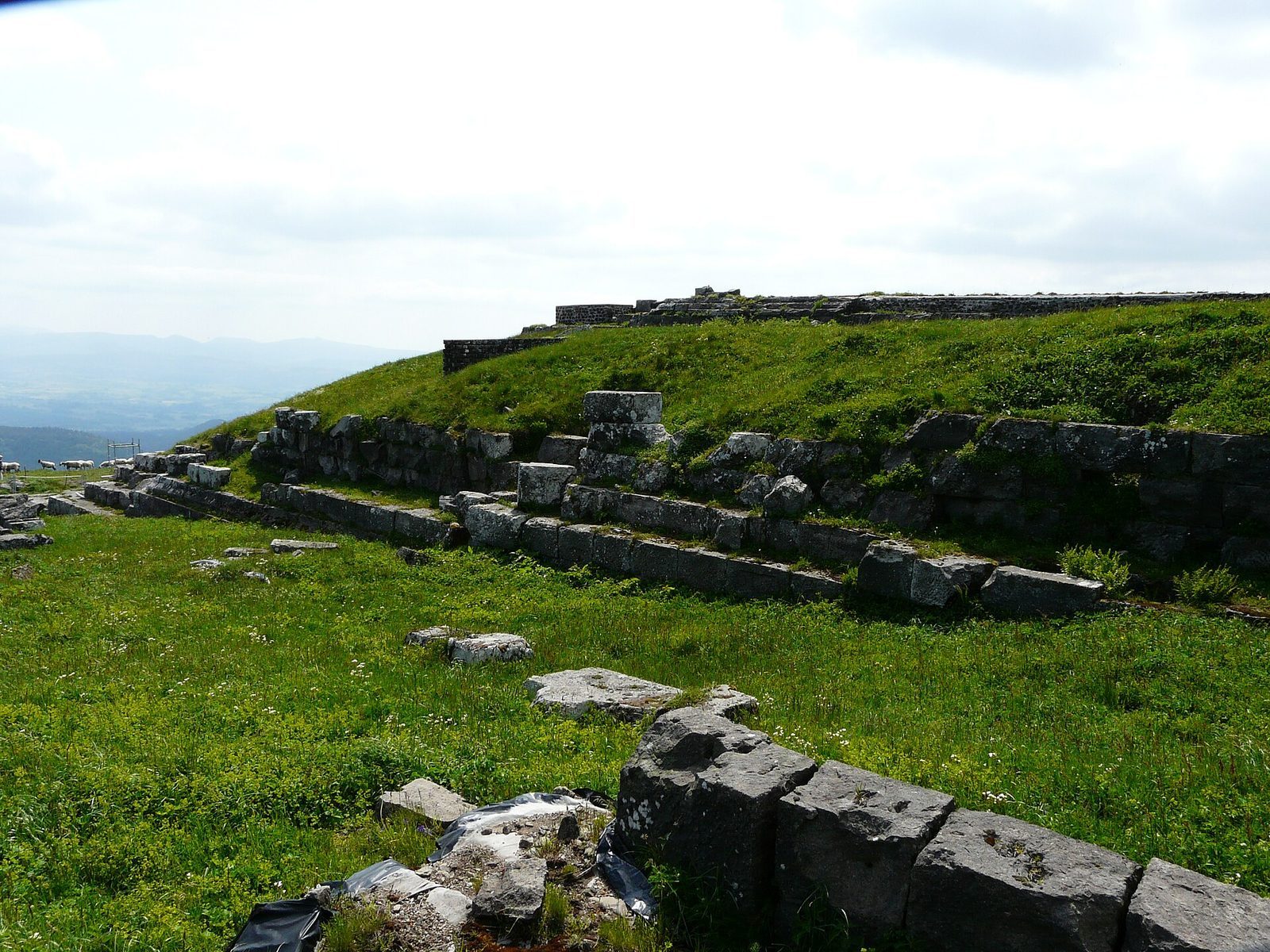
The surviving sanctuary is arranged as a sequence of terraces around a temple platform, built with local trachyte. It stands about 1,435 metres above sea level on the slope below the earlier summit temple and occupies approximately 3,600 square metres. The square platform measures 60 metres on each side and compensates for ground that falls from north to south.
Terraces and worshippers’ route
The temple stood at the upper end of a series of terraces. The first terrace had steps, altars and statues and could serve as a ceremonial area. A passage connected it to an eastern terrace overlooking Augustonemetum and the Limagne plain. From there, worshippers could reach the temple entrance and make devotions in front of and around its inner chamber. The treasury lay near the temple between the two terraces. Pilgrims approaching from Ceyssat Pass may also have stopped at chapels along the ascent.
Temple and materials
The temple combined an inner chamber (cella), of a type associated with Gallo-Roman sanctuaries, with a Mediterranean-style entrance porch (pronaos). Its façade faced east toward the Limagne plain and Augustonemetum, and could be seen from the city in suitable weather. Large blocks of trachyte quarried near Ceyssat Pass formed the visible masonry, while smaller blocks of the same stone served as fill. Other decorative materials included white and colored marble paving, Autun schist, arkose capitals and bronze. Fragments of the pavement are held at the Bargoin Museum in Clermont-Ferrand.
Approach and associated sites
A path led from Ceyssat Pass to the sanctuary, beginning at the Roman road between Lyon and Saintes. The settlement near the pass had at least one temple where travellers could worship Mercury without climbing to the summit. A building used for changing or relaying road transport is suspected there. Traces of an artisan quarter surround the trachyte quarry that supplied stone for the summit temple, and a funerary area lies nearby. The Mercury-dedicated temple at Tourette d’Enval, in Orcines, marked the beginning of the ascent and formed part of the same cult complex.
Dedications and small finds
A small bronze tablet found in the 1874 excavations has dovetail-shaped handles and bears a dedication to imperial power and Mercury Dumiatis, meaning “Mercury of the Dome.” It names Matutinius Victorinus as the donor. A small bronze statuette of Mercury was found later near the annex temple.
Reconstructed sections
The restoration rebuilt part of the southern enclosure wall, the southeast corner of the terrace’s retaining wall and several retaining structures belonging to the temple. The reconstructed southeast corner rises more than seven metres. Other rebuilt parts include recessed bays supporting the southern gallery and the supporting structure beneath the dedication room.