Gibeon: An Ancient City in the Levant
Site at a Glance
- Popularity
- Very High
- Country
- Israel
- Primary era
- Iron Age
- Eras represented
- Bronze Age, Iron Age, Classical
- Civilizations
- Israelite, Roman
- Site type
- City
On this page16 sections
History
Gibeon was an ancient city at Al Jib, north of Jerusalem, in Israel’s Levant region. Its earliest occupation dates to the Early Bronze Age, and a permanent settlement developed in Middle Bronze Age I–II. The city later flourished during the Iron Age.
Early settlement and Egyptian reference
Gibeon’s earliest known extra-biblical mention appears in a city list at Karnak commemorating a campaign by Shoshenq I, an Egyptian pharaoh who ruled from 945 to 924 BCE. Josephus later placed the city about 7.4 kilometres from Jerusalem.
Biblical traditions
The Hebrew Bible describes Gibeon as a large city in the territory of Benjamin and a Levitical city, a settlement assigned to the Levites, who had religious and sanctuary duties. In Joshua, the city’s inhabitants are called Hivites; Samuel identifies them as Amorites, names for ancient peoples associated with Canaan in biblical texts. Joshua, portrayed as Israel’s leader in the conquest narratives, makes a treaty with Gibeon’s people after they disguise themselves as envoys from a distant land. He honours the agreement but assigns them work as woodcutters and water carriers.
The same narrative tells of a siege by five neighboring kings: Adonizedek of Jerusalem, Hoham of Hebron, Piram of Jarmuth, Japhia of Lachish, and Debir of Eglon. Joshua leads the Israelites to Gibeon’s aid, and the account describes the coalition’s defeat amid a hailstorm and the miraculous stopping of the sun and moon. An interpretation published in 2017 proposed that this episode might refer to an annular solar eclipse on October 30, 1207 BCE. During an annular eclipse, the Moon passes in front of the Sun but leaves a bright ring visible; the proposed link remains uncertain.
After the Philistines captured the Ark of the Covenant, a sacred chest in Israelite religious tradition, the remaining Tabernacle, a portable sanctuary, was said to have moved from Shiloh to Gibeon. Chronicles describes worship at Gibeon continuing alongside worship in Jerusalem after David brought the Ark there, though an uninterrupted sacrificial tradition at Gibeon is uncertain. On becoming king, Solomon met Israel’s leaders at Gibeon and offered 1,000 burnt offerings, sacrifices consumed by fire on an altar, at its high place, a local place of worship often set on elevated ground. The biblical account says God appeared to Solomon in a dream there and granted him wisdom.
Samuel attributes a campaign against the Gibeonites to Saul, Israel’s first king. The narrative does not recount a massacre, but connects a three-year drought during David’s reign to Saul’s actions and also assigns blame to Saul’s family. David hands over seven of Saul’s male descendants, whom the Gibeonites hang. The biblical account names two as sons of Rizpah and five as sons of Merab; a Talmudic version names Michal as the mother of the five. David spares Jonathan’s son Mephibosheth because of his covenant with Jonathan. Jewish tradition also links Saul’s violence against the Gibeonites with the killing of priests at Nob.
Other biblical episodes place battles and deaths near Gibeon. After Saul’s death, the forces of Joab, David’s commander, and Abner, who had commanded Saul’s forces, fought beside the Pool of Gibeon. The area was also the setting for one of David’s victories over the Philistines, and the account places the killing of Amasa, an Israelite military commander, there.
Persian and Hellenistic periods
After the Babylonian exile, Gibeon formed part of Judea, the Jewish region centered on Jerusalem, and returning exiles resettled it. Nehemiah describes the Gibeonites as descendants of earlier inhabitants. During the reign of Artaxerxes I, a Persian king, men from Gibeon led by Melatiah repaired part of Jerusalem’s wall near the Old Gate. Nehemiah also places the Nethinim, a group associated with sanctuary service, at Ophel. By the time of Nehemiah and Ezra, they had joined the Judean community and signed Nehemiah’s covenant.
Rabbinic tradition identifies the Nethinim as descendants of the Gibeonites and assigns them a distinct legal status, including limits on marriage with Jews of established lineage. The Babylonian Talmud expands the story of Saul’s descendants, describing their selection through an ordeal involving the Ark and Rizpah’s efforts to protect their bodies from birds and animals. It associates their work as woodcutters and water carriers with Joshua and attributes lasting restrictions on the Nethinim to David. It also gives a traditional figure of 150,000 men joining Israel in connection with Solomon’s workforce.
Occupation appears sparse from the sixth century to the beginning of the first century BCE. Late Hellenistic pottery and coins include material from the reign of Antiochus III, a Seleucid king. Other finds are associated with the Hasmonean dynasty in Judea, including its ruler and high priest John Hyrcanus. Gibeon may then have depended on Jerusalem.
Roman period and modern identification
During the First Jewish–Roman War, a Judean revolt against Roman rule, Cestius Gallus, the Roman governor of Syria, camped at Gibeon while advancing on Jerusalem and again during his retreat. Roman-period building at Gibeon included baths and water conduits.
The identification of Al-Jib with ancient Gibeon was made by the 10th-century Jewish lexicographer David ben Abraham al-Fasi. Franz Ferdinand von Troilo made the identification in 1666, and Edward Robinson adopted it in 1838. Inscribed jar handles found at the site later strengthened the case. An excavation team from the University of Pennsylvania, led by archaeologist James B. Pritchard, carried out six campaigns from 1956 to 1962.
Remains
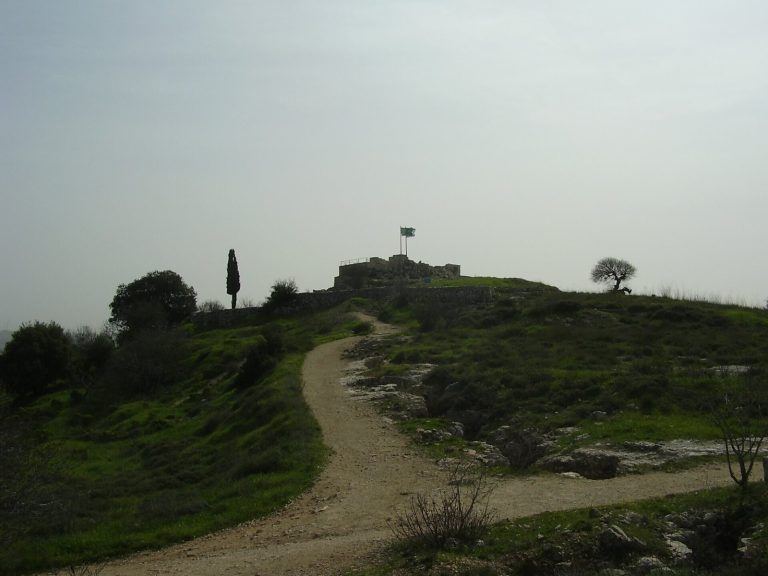
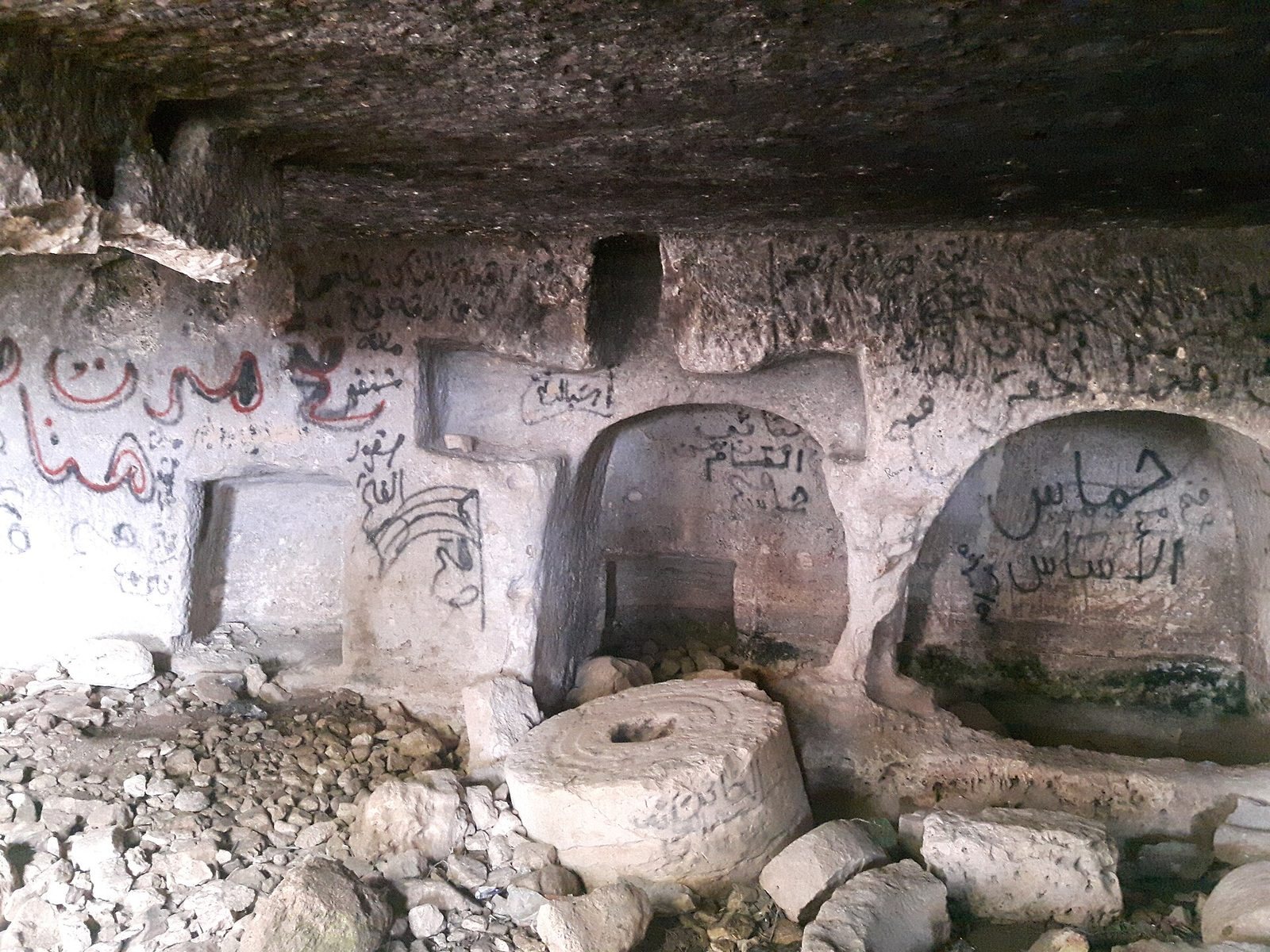
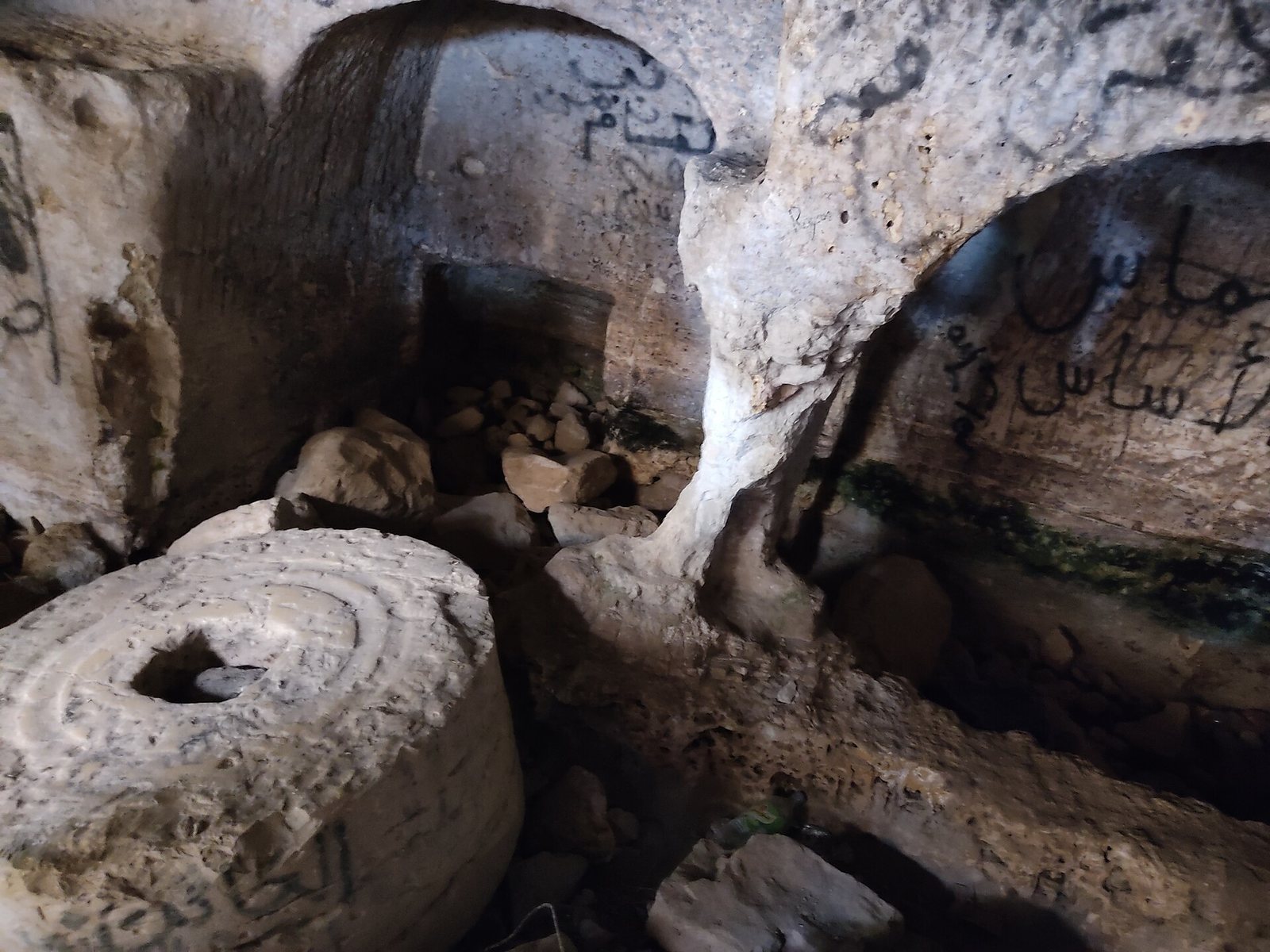
The remains lie in southern Al Jib, north of Jerusalem, in the West Bank. They occupy a tell, a mound formed by successive settlement layers, whose hilltop was enclosed by an Iron Age wall. Rock-cut tombs, water installations, wine cellars, and Roman-period buildings show how the settlement and its resources were arranged. British gunfire during the First World War disturbed the archaeological layers at the top of the mound.
Bronze Age settlement
Early Bronze Age remains
Rock-cut tombs on the eastern side of the hill contained Early Bronze Age jars and bowls. Craftspeople shaped the vessels by hand and finished them on a slow potter’s wheel. The early city was destroyed by fire, though the date of that destruction is undetermined.
Middle and Late Bronze Age remains
Many jar handles from Middle Bronze Age I–II carried an inscription identified as the name Gibeon. Seven tombs are known from the Late Bronze Age. Their contents included imported Cypriot pottery and local vessels made in forms resembling Mycenaean and Cypriot examples. At least some tombs had been cut in earlier periods and used again.
Iron Age defenses and waterworks
Hilltop wall
In Iron Age I, a massive wall enclosed the hilltop. Fourteen Early Bronze Age storage jars were found beneath its foundations, showing an earlier phase of activity beneath the later fortification.
Pool and tunnels
A large pool was cut into the bedrock just inside the wall. In its first phase it measured 11.8 metres across and 10.8 metres deep, with a spiral staircase of 79 steps cut into its sides. A later phase added a tunnel descending to a water chamber 24 metres below the city. The pool may be the one mentioned in Samuel, but this identification is unproven.
During Iron Age II, a second tunnel with 93 steps was built near the pool. It led beneath the city to a water source, which also had an access point at the foot of the hill that remains in use. Conduits formed further parts of the city’s water system.
Wine production and burial
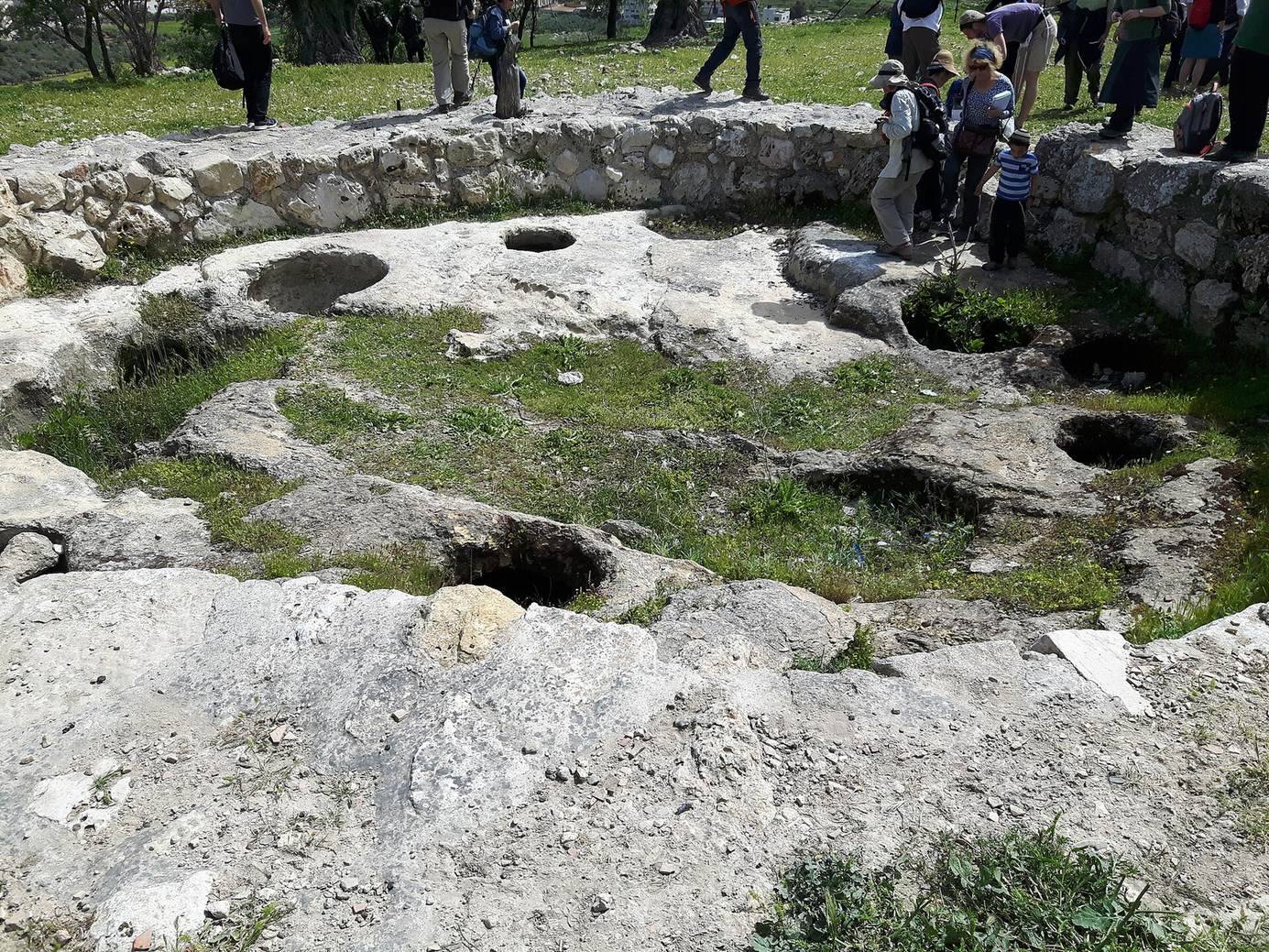
Wine cellars and storage
The surrounding flat, fertile land and numerous springs supported a substantial wine industry. Excavations uncovered 66 rock-cut wine cellars, about 2 metres deep. In the eighth and seventh centuries BCE, 63 cellars are associated with a combined capacity of 95,000 litres. Individual storage jars could hold 45 litres, and many jar handles carried the Hebrew place-name inscription GBʻN. Most of these handles were recovered from a large pool.
Eastern cemetery
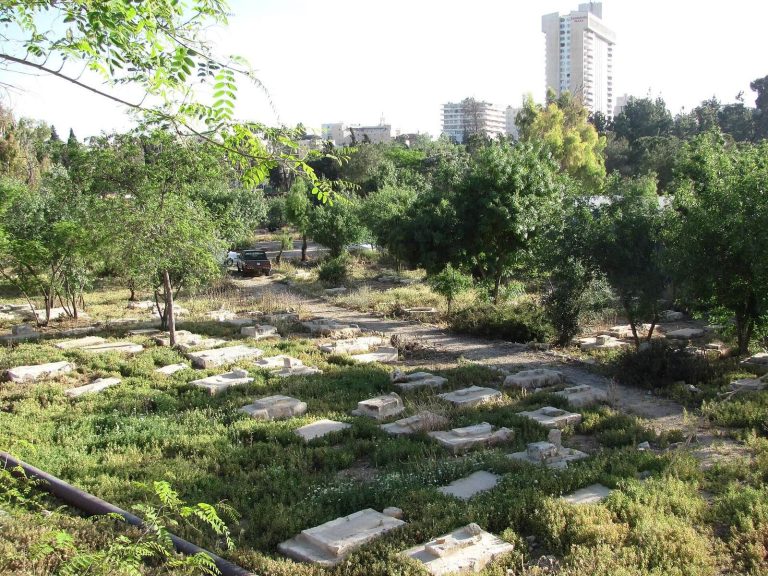
A lavish cemetery dating to the same period as the wine cellars lay east of the tell.
Roman buildings
Roman-period remains include stepped baths and water conduits, part of the substantial construction undertaken at Gibeon during that era.