Mamilla Cemetery: Jerusalem’s Historic Muslim Burial Ground
Site at a Glance
- Popularity
- Medium
- Country
- Israel
- Primary era
- Medieval
- Eras represented
- Iron Age, Classical, Medieval, Early Modern, Modern
- Civilizations
- Byzantine, Crusader, Kingdom of Jerusalem, Mamluk, Ottoman, Umayyad
- Site type
- Burial
- Remains
- Necropolis
On this page19 sections
History
Mamilla Cemetery is a historic Muslim burial ground west of the Old City in Jerusalem, Israel. Burials in the area are associated with the Byzantine period, while the cemetery was identified as Muslim by the 11th century and later became Jerusalem’s largest Muslim cemetery. Its name has several proposed origins, including links to a church dedicated to St. Mamilla and to Arabic expressions, but its derivation remains uncertain.
Early Christian burial traditions
Burial activity in the Mamilla area is linked to the Byzantine period, when a church dedicated to St. Mamilla stood nearby. After the Sassanian capture of Jerusalem in 614, thousands of Christians killed in the conflict were reportedly buried in caves around Mamilla Pool. The death toll remains uncertain: translations of the lost Greek text give figures of either 4,518 or 24,518.
Medieval traditions also connected a cave in the area with people killed during the Crusader capture of Jerusalem in 1099. Muslim accounts described these dead as martyrs and gave totals reaching 70,000. It is uncertain whether every tradition referred to the caves beside the cemetery, as some may have concerned other caves in the Mamilla district.
Muslim cemetery and medieval use
Arabic and Persian writings identified Mamilla as a Muslim cemetery by the 11th century. Traditions attributed to an eighth-century authority suggest that Muslim burials may have begun earlier. After Saladin, the 12th-century ruler of the Ayyubid dynasty, retook Jerusalem, he had warriors killed in battle buried at Mamilla. Mujir al-Din, a Jerusalem judge and historian, identified a burial there in 1189 as the earliest specific one in his account of the cemetery.
Mamilla grew into Jerusalem’s largest Muslim burial ground and received the dead of religious and civic dignitaries, officials serving rulers, scholars, and Sufi figures. Sufis follow Islamic mystical traditions. Muslim belief held that burial in Jerusalem carried special merit; a 14th-century scholar wrote that burial at Mamilla was equivalent to burial in heaven. The cemetery’s oldest surviving epitaph, an inscription honoring the dead, dates to 1285.
During Crusader rule, the cemetery also served Christians. In 1843, an agreement allowed Christian burials in a southeastern section. Disputes arose over Muslim and Christian funerals taking place at the same time. A separate Christian cemetery opened on Mount Zion in 1848, and Christians already buried at Mamilla were reinterred there.
Changing use and shrinking boundaries
Under Ottoman rule, a road was built across cemetery land and later became Agron Street. Development of the southern area was considered, while a wall was constructed to protect the remaining cemetery. By its greatest extent the burial ground covered several tens of hectares; by 1948 it had contracted to about 13.4 hectares.
The Supreme Muslim Council, the principal body overseeing Muslim communal affairs and religious endowments in Mandatory Palestine, largely ended cemetery use in 1927 and designated Mamilla a historic site. Some families continued to bury their dead there until 1948. British authorities designated the cemetery an antiquities site in 1944 and an archaeological site in 1947.
In 1929, the Palace Hotel was built on former cemetery land under the direction of Mohammed Amin al-Husayni, then Mufti of Jerusalem and head of the Supreme Muslim Council. Human remains came to light during foundation work. Al-Husayni directed that the bones be gathered and reburied discreetly, and the construction prompted disagreement about whether Islamic law permitted building on cemetery land. Plans for a commercial center announced in 1945 did not proceed. A proposal in 1946 instead combined commercial and residential construction with public open space and the protection of some important tombs.
Modern administration, development, and dispute
After the 1948 Arab–Israeli War, Israeli authorities took control of the cemetery. Its administration passed to the Custodian of Absentee Property and later to the municipality. The Waqf, an Islamic religious endowment, was refused permission to resume maintenance, and many Palestinian Muslims faced severe restrictions on access.
Construction and public works transformed cemetery land. Independence Park, a school, roads, commercial and public buildings, a parking lot, and public lavatories were built on parts of the area. Work for the park in the 1950s destroyed graves, and a larger section was converted to the park in 1967, with further graves lost. Other changes included drainage and street improvements, leveling ground near the pool, and cleaning the pool. The cemetery was expropriated in 1964, and a 1967 request by the Waqf to maintain it was rejected. By 2009, less than two hectares remained, about 8 percent of the original area, along with an estimated 5 percent of its graves.
Religious opinions on the treatment of the site differed. In 1964, qadi (Islamic judge) Taher Hammad issued a fatwa (religious legal opinion) allowing graves to be removed from land he considered abandoned, while permitting a public park rather than buildings. He had not inspected the cemetery, and the opinion’s legal authority was later disputed. In 1994, qadi Ahmad Natour issued a decree affirming the continuing sanctity of Muslim cemeteries and mosques, including abandoned ones. Israel’s Ministry of Religious Affairs rejected the decree in 1996.
Plans by the Simon Wiesenthal Center for a Museum of Tolerance on a former cemetery parking area renewed the controversy. Archaeological work in 2005–06 uncovered about 1,000 graves arranged in five layers; the oldest dated to the 11th or 12th century. Remains from about 400 people were removed. Their reburial place was initially withheld, then described as a fenced section of the construction site intended to remain cemetery land. After legal proceedings and work stoppages, Israel’s Supreme Court allowed construction to continue in 2008 subject to conditions for respectful treatment of human remains.
From November to December 2008, most of the remaining graves beneath the greater part of the building site were removed without excavation authorization. An authorized excavation in early 2009 exposed an Iron Age aqueduct, a structure for carrying water. Further excavations took place in 2012 and 2014. Architect Frank Gehry withdrew from the museum project in 2010, after which a less ambitious design was developed. Disputes continued over the project and work on graves and tombstones. A separate proposal for a Jerusalem court complex on cemetery land was abandoned after human remains were found.
Remains
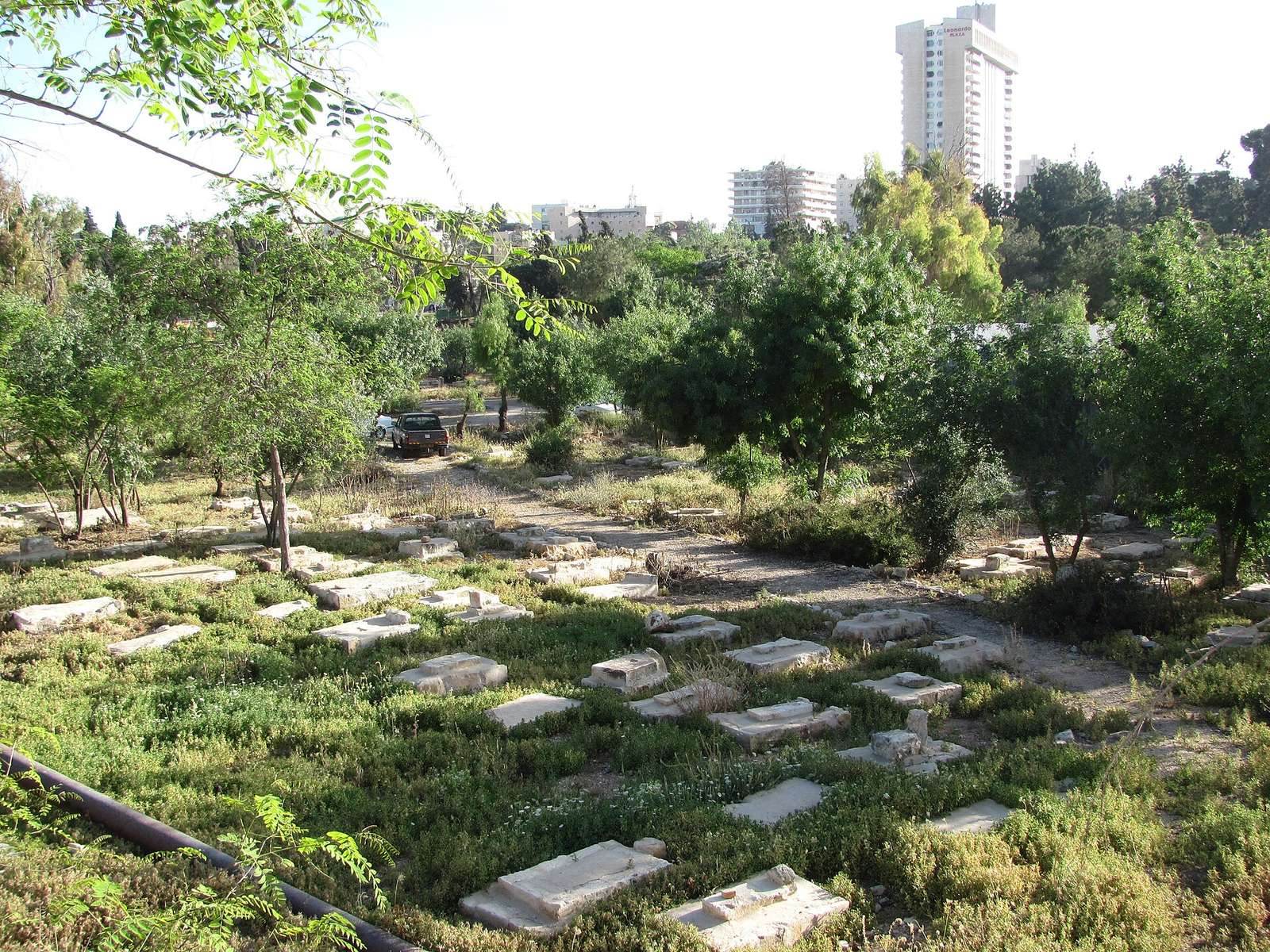
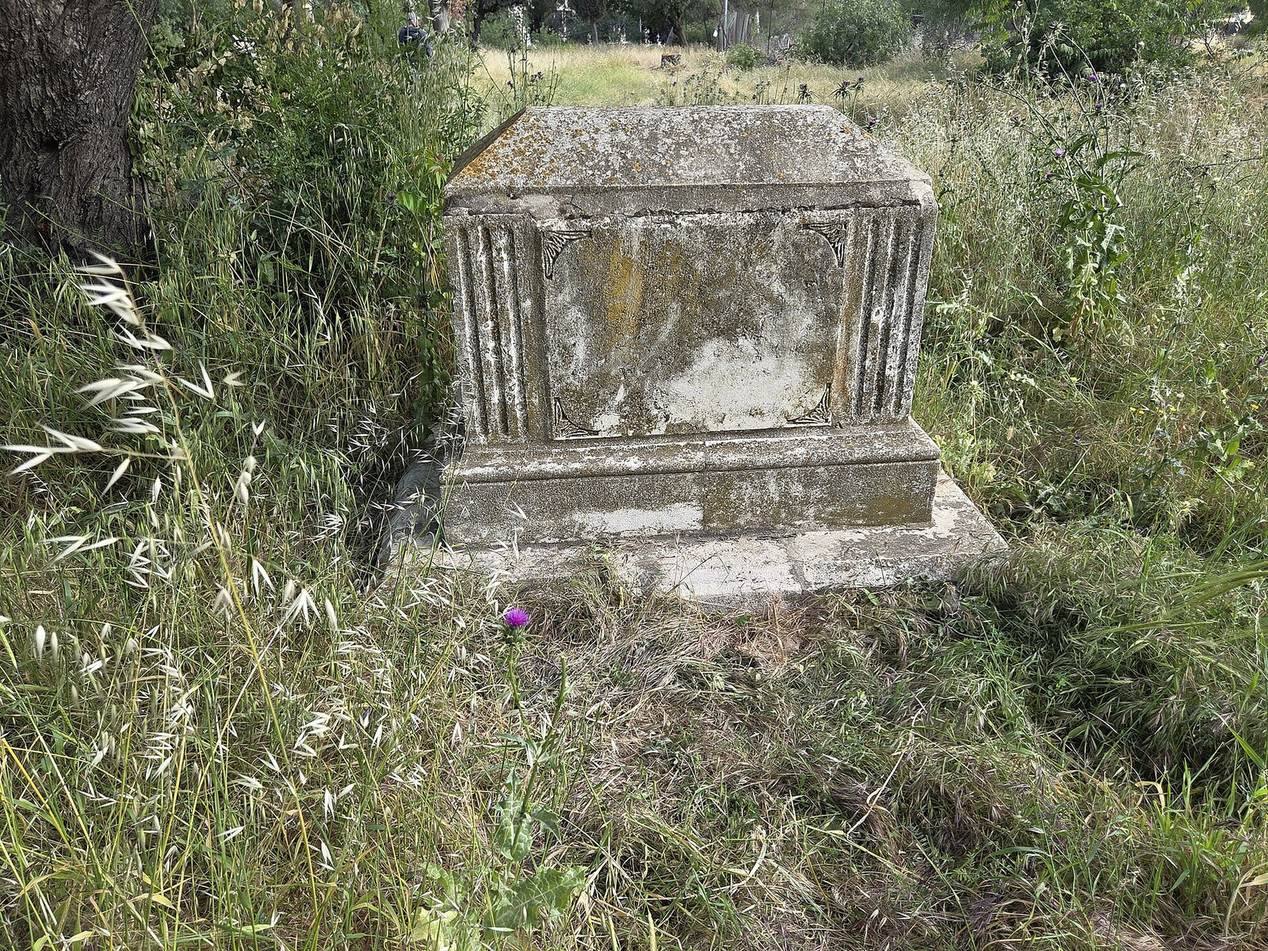
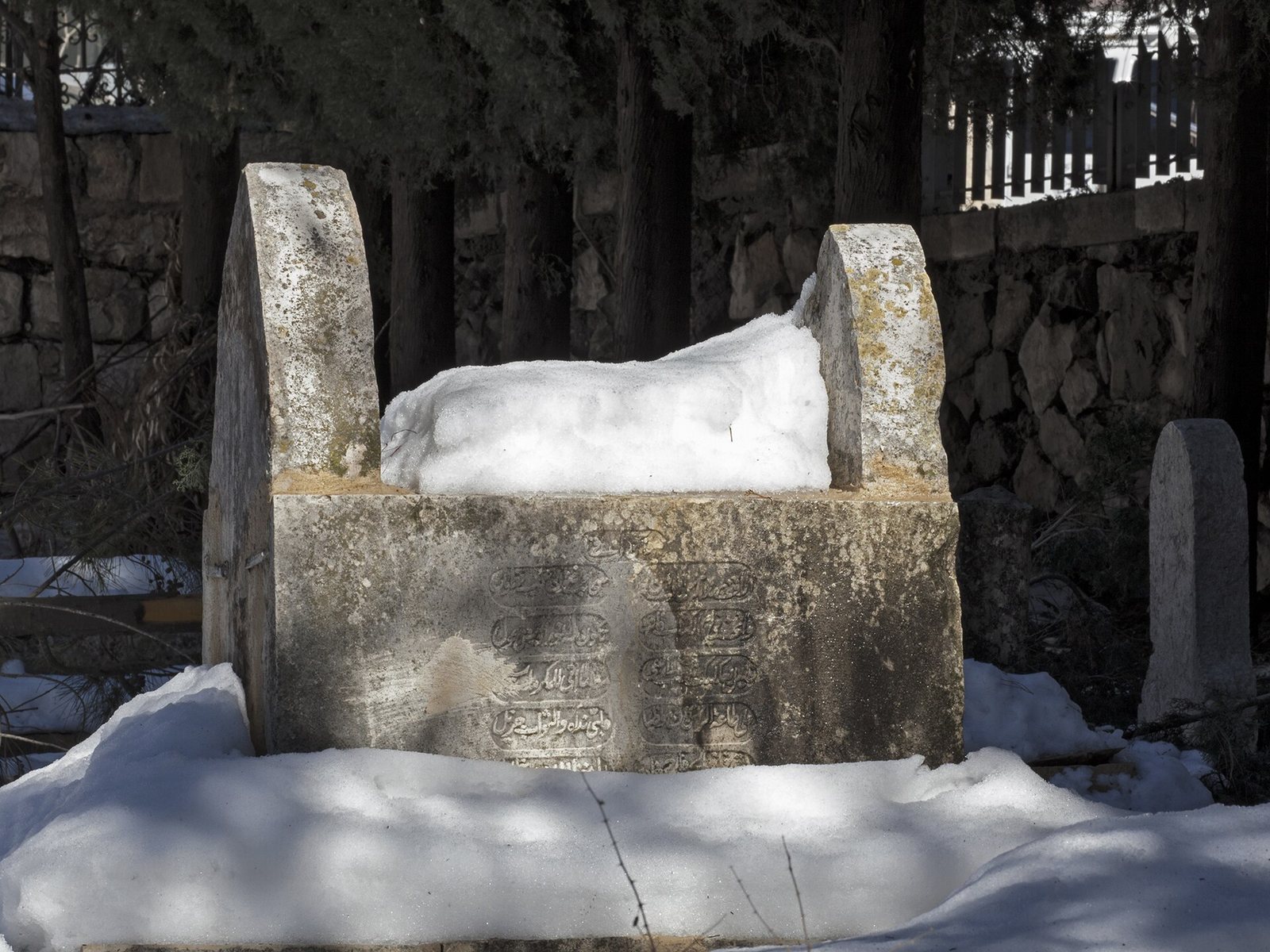
The surviving cemetery lies northwest of the Old City, about 700 metres northwest of Jaffa Gate, beside Independence Park. Its remaining area is lightly wooded and bounded by Agron, Hillel, and Menashe ben Israel streets, with Mamilla Pool occupying a large area near the center. Only a few dozen historic gravestones remain; many are broken or toppled, overgrown, or damaged, and inscriptions have been painted over, cemented, or broken. A 1945 register listed 841 graves and gave names where the deceased could still be identified. Oak, cypress, and pine grow among the graves, alongside a large Atlantic pistachio. Some trees are centuries old.
Water features and archaeological remains
Mamilla Pool
The ancient Mamilla Pool measures approximately 89–97 metres long, 59–65 metres wide, and 6 metres deep. Rainwater reached it from the surrounding hills. The pool probably served as a reservoir for Jerusalem’s water supply and was connected underground and by aqueducts to Hezekiah’s Pool and Sultan’s Pool.
Byzantine cistern
Excavations in 2012 revealed a cistern beside Menashe ben Israel Street in Independence Park. It began as a two-storey tomb with chambers cut into the rock, in use between the fourth and seventh centuries. Around 700, the chamber walls and floors were removed, openings were cut through the vaulted ceiling, and the space was converted into a cistern. It remained in use until the late 18th or 19th century, was later used as a shelter, and was connected by a tunnel to rooms to the east before it was forgotten.
Iron Age aqueduct
An excavation in 2009 exposed an aqueduct dating to the Iron Age. The remains came to light during archaeological work connected with the Museum of Tolerance construction site.
Burial caves
Three caves lie west of the surviving cemetery area, within Independence Park. Medieval traditions call one of them the Martyrs’ Cave and associate it either with Christians killed in 614 or Muslims killed in 1099. The association between these accounts and the caves beside the cemetery remains uncertain.
Roadside tomb
Roadworks on Ben Sira Street uncovered a square tomb containing skeletons in 2017. Authorities classified it as less than 300 years old and left the tomb and human remains in place beneath the paved road.
Religious buildings and tomb structures
Church of St. Mamilla and the Red Monastery
A church dedicated to St. Mamilla stood in the area during the Byzantine period and remained standing into the ninth century. St. Mamilla is a Christian figure venerated in local tradition, though her historical identity is uncertain. A Byzantine chapel known as the Red Monastery was reportedly converted into a zawiya, a Sufi lodge or religious center, called al-Qalandariyya. The building collapsed in 1487 or 1488. The Palace Hotel was later built at that location in the late 1920s.
Kubakiyya mausoleum
The freestanding Kubakiyya mausoleum stands at the cemetery’s eastern end. It was built for the emir Ala al-Din Aydughdi al-Kubaki, who died in Jerusalem in 1289. The structure has a square plan about 6 by 6 metres, with a cylindrical upper section, a projecting horizontal molding, and a dome. Three walls contain windows; the entrance is in the northwest-facing wall.
A relieving arch, which redirects weight around an opening, rests on two projecting supports above the entrance. The panel over the doorway is decorated with a three-lobed ornament and a rectangular inscription naming al-Kubaki and giving his death date as 22 September 1289. Inside, a stone sarcophagus, or coffin, stands beside a simple mihrab, a niche indicating the direction of Mecca. Pointed arches top the window niches, and an octagonal transition joins the square room to the cylindrical upper section.
The mausoleum combines Mamluk architectural features with elements derived from Crusader buildings and reused in a later structure. The entrance arch and inscription are identified as Mamluk features; the pointed window arches, ornament, supports, molding, and sarcophagus are described as Crusader-derived spolia. Their reuse has been interpreted as a statement of Islam’s victory over Crusader conquerors. The city sealed the door and windows in 1975, and two stone benches that once stood beside the entrance have been removed.
Al-Dajani mausoleum
A mausoleum attributed to Sheikh Ahmad al-Dajani stands at the southwestern edge of Independence Park and dates to the mid-16th century. An adjoining structure visible in 1933 no longer survives, and several family graves once recorded nearby can no longer be identified. In 1986, an unauthorized occupant altered the interior and removed the sarcophagus. The family regained control in 2012, renovated the building, and installed a new gravestone.
Al-Qureishi gravestone
A few metres from the al-Dajani mausoleum stands the gravestone of Sheikh Abdallah al-Qureishi, a Sufi mystic and teacher in Jerusalem. The stone was moved from his actual grave, formerly beside the Museum of Tolerance construction site. Dated 1557, it bears six Turkish verses honoring him and naming Mamilla as his resting place. His grave was reportedly renovated in 1332.
Crusader-period tombs and the Mankouros tomb
A small, ornate Crusader-period tombstone identified in a 19th-century survey is enclosed west of Mamilla Pool. Frankish stone coffins were also recorded at the cemetery; most were destroyed in 1955. Near the Crusader tombstone is a second tomb structure associated with Ruq ed-din Mankouros, who served as military governor of the Jerusalem Citadel and as a senior Mamluk official.
Vaulted structure on Hillel Street
A freestanding vaulted structure without walls stands on Hillel Street along the northern side of the cemetery. It appears in pilgrimage descriptions and older images of Mamilla, but its builder and the identity of anyone buried there are unknown.