Tempio Italiano in Jerusalem: An Italian-Rite Synagogue
Site at a Glance
- Popularity
- Medium
- Country
- Israel
- Primary era
- Early Modern
- Eras represented
- Medieval, Early Modern, Modern
- Civilizations
- British, Venetian
- Site type
- Religious
- Remains
- Synagogue
On this page15 sections
History
The Tempio Italiano in Jerusalem is an Italian-rite synagogue at 25 Hillel Street in Jerusalem, Israel. Established by Jerusalem’s Italian Jewish community, it opened in 1952 in a former chapel, fitted with furnishings from the Conegliano synagogue in northeastern Italy, whose construction began in 1701 and ended in 1719. After 34 synagogues in Jerusalem’s Old City were destroyed in 1948–49, the Tempio contained the city’s oldest synagogue interior, judged by the age of its furnishings.
Jewish life in Conegliano
Around 1398, the first Jewish family settled in Conegliano after receiving an invitation to live and work there as moneylenders. Some early arrivals were Ashkenazi Jews escaping persecution in southern Germany and the Rhineland. Italian Jews later became the majority, and the community’s religious customs shifted from Ashkenazi to Italian practice.
In 1490, a Jewish resident named Mandolin received permission to establish a small synagogue in his home and a cemetery. In 1637, the Venetian Republic confined Conegliano’s Jews to a ghetto, whose gates were locked at night. A synagogue was established there using an ark from the earlier place of worship. Work on the Conegliano synagogue that later supplied Jerusalem’s furnishings began in 1701 and was completed in 1719.
Emigration from smaller Italian towns after nineteenth-century emancipation reduced Conegliano’s Jewish population. The synagogue closed around 1900, and one of the few Jewish women still living in town kept its key. During the Piave battles of the First World War, fighting along the Piave River in northeastern Italy, Austro-Hungarian soldiers held Sabbath and Yom Kippur services there with their field rabbi, Harry Deutsch, in September and October 1918. The building subsequently fell into further disrepair.
Establishing a congregation in Jerusalem
In 1940, after Italy declared war on Britain and Italian citizens in British-ruled Mandatory Palestine were interned as enemy aliens, Jews of Italian custom in Jerusalem organized a congregation. They chose the name Community According to the Custom of the Children of Rome. This traditional designation referred to Jews following the Italian rite, not only to people from Rome. The congregation’s first service was for Rosh Hashanah, the Jewish New Year, in a kindergarten room at the Margaliot, also known as Spitzer, school on Prophets Street.
From 1942, the congregation paid its first rabbi, Elia Samuele Hartom, who also taught at the Ma’aleh school. On 20 August 1945, members formally established the Society of Italian Jews for Religious Activity. It had membership contributions, elected leaders, and the legal authority to hold property.
Transferring the Conegliano furnishings
Alfonso Pacifici had advocated bringing the interior of an abandoned Italian synagogue to Mandatory Palestine. In 1944, Federico Luzzatto recommended Conegliano as a suitable source. On 26 March 1946, the Society and the Bezalel art academy asked the national organization of Italian Jewish communities for permission to transfer the furnishings. Venice’s Jewish community, which administered the former Conegliano synagogue property, approved the move on 7 October 1948.
The furnishings were salvaged in 1949, and the Conegliano building was demolished in 1950. Disagreement between the religious Society and the secular Organization of Italian Immigrants about responsibility for the objects delayed their departure. After Venice’s community set a January 1951 deadline, communal leaders Umberto Nahon and Renzo Toaff helped reach an agreement, with Rabbi Emanuele Menachem Artom mediating. The packed furnishings arrived in Haifa in late April 1951.
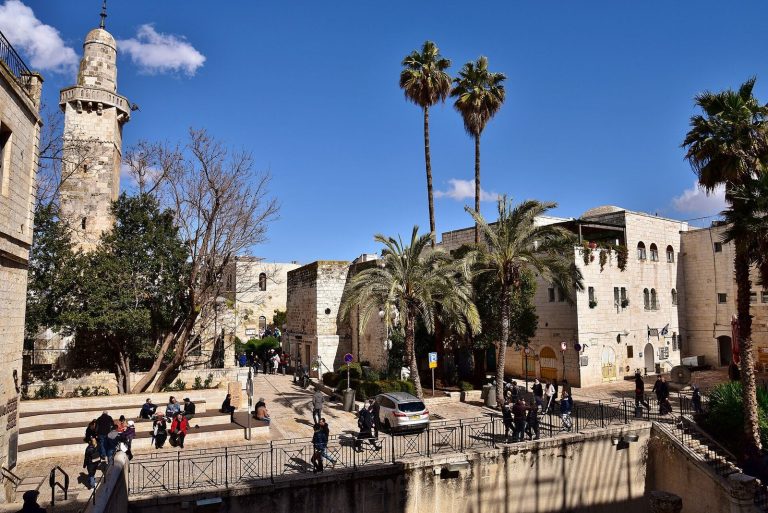
The Jerusalem premises were in the former Schmidt School, a Catholic girls’ school. British authorities had held the complex as enemy property, and Israeli authorities took it over in 1948. The complex was assigned to the Ma’aleh religious high school and belonged to the Jerusalem municipality. In late April 1951, Nahon and Toaff agreed with the school to install a synagogue in its former chapel. Ma’aleh used the room for weekday prayers, while the Society used it on Sabbaths and Jewish holidays. Fitting the ark, reading platform, seating, and wall panels took about a year.
Opening and later history
The synagogue was inaugurated after sunset on 4 April 1952, at the start of the Sabbath before Passover, the festival recalling the Exodus from Egypt. About 200 people attended, including members of the Italian Jewish community, long-established Jerusalem residents, Holocaust survivors, Israeli President Yitzhak Ben-Zvi, and Rabbi Emanuele Menachem Artom. The rabbi affixed a mezuzah, a small case containing sacred text, to the doorway. For several years, senior Israeli officials also attended a Sabbath gathering before Passover to mark the anniversary.
When Ma’aleh left the Schmidt complex in 1962, the municipality considered demolishing it. The Italian Jewish community insisted on remaining in the Old Hospice, and the plans were set aside. At first the Tempio was the complex’s only occupant. Other tenants later used its spare rooms, while the eastern building across the courtyard housed the Jerusalem command of the Israel Defense Forces.
Nahon continued collecting Jewish art from Italy in rooms beside the synagogue until his death in 1974. The collection became the Nahon Museum of Italian Jewish Art, formally opened in the early 1980s with the synagogue at its centre; the municipality later provided further rooms. In 1989, architect and Society president David Cassuto arranged for a women’s gallery and an interior restoration. When the community faced the possibility of a municipal sale of the Old Hospice in 2011, the Society acquired the property from the city in 2014.
The congregation continues to hold Italian-rite prayers on Sabbaths and holidays and to gather for communal events and celebrations. Its Italian custom draws on regional traditions from Florence, Livorno, Milan, and Piedmont as well as Rome; only one founding member was Roman. Prayer wording, order, and melodies have developed over time. Editions appeared in 1952, 1955, 1966, and 1991, with a prayer for Israel’s independence added in 1955. One practice adopted from Sephardic tradition is the recitation of El Nora Alilah before Ne’ilah, the concluding service of Yom Kippur, the Day of Atonement. Three cantors recite it while seated, then the congregation stands for Ne’ilah.
The community has about 400 members, while the wider Children of Rome community in Israel numbers around 9,000, including about 3,000 people born in Italy. The Italian rite is maintained at four Israeli synagogues, three in Jerusalem and one in Netanya. Each year on Yom HaShoah, Israel’s Holocaust Remembrance Day, the congregation reads the names of Italian Holocaust victims from a memorial book.
Remains
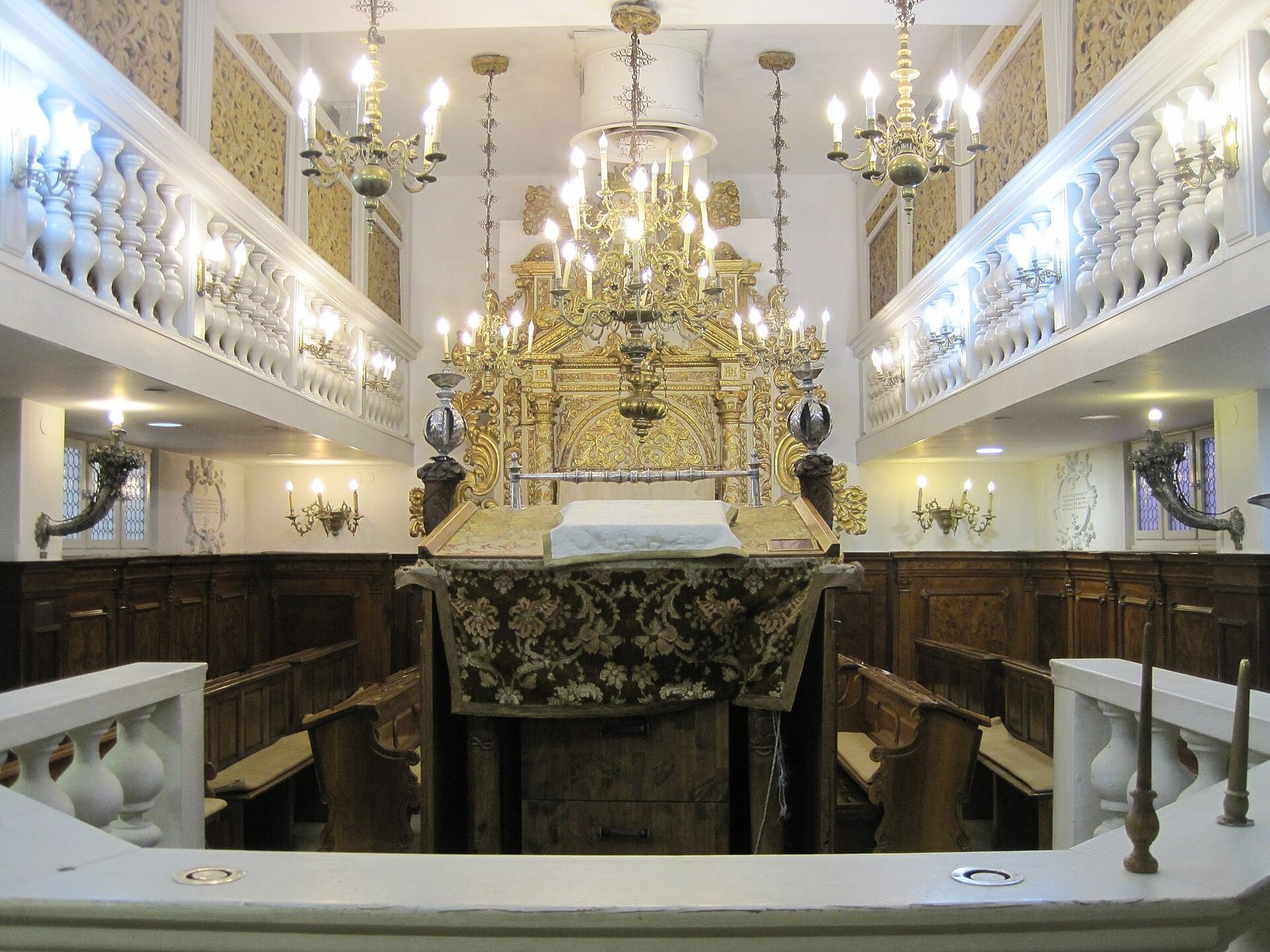
The synagogue occupies the upper-floor chapel of the Old Hospice, the western building of the Schmidt complex, and seats about 250 people. Its room lies east of the building’s central corridor and projects from the eastern facade. The entrance is on the west, facing the Torah ark at the centre of the opposite wall. Below the projection, the ground floor contains a panelled, vaulted vestibule and a covered gallery open on three sides.
Synagogue room and furnishings
Room and transferred fittings
The furnishings came principally from the seventeenth- and eighteenth-century Conegliano synagogue and were fitted into a smaller chapel. They extend beyond the chapel’s dimensions, and its existing side windows led to permanent cuts in the cherry-wood wall panelling. In Conegliano, tall windows occupied the space above the panelling and below the women’s gallery. A second storey over the western and central parts of the room was added between 1927 and 1931 to plans by Heinrich Renard. A flat roof above the room’s eastern third can be reached as a balcony from that storey.
Torah ark and curtains
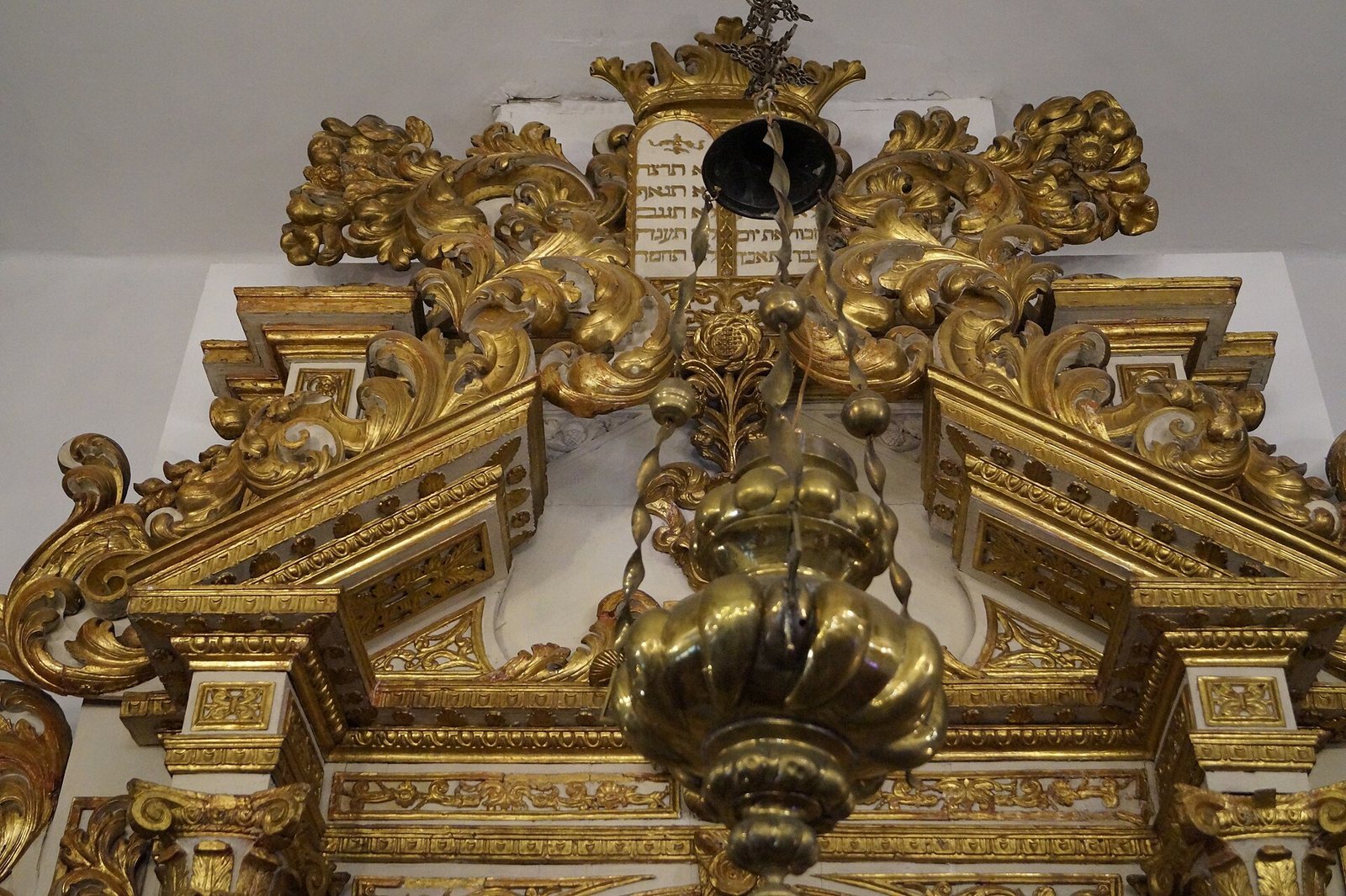
The Torah ark, the cabinet that holds Torah scrolls, has a core made in 1490 for Conegliano’s earlier synagogue. Its wooden body is gilded, and its central section was later decorated in Baroque style in memory of Rabbi Natan Ottolengo, who died around 1652. An inscription beneath the doors names him and identifies his position as head of Conegliano’s yeshiva, a school devoted to religious study. Two later columns entwined with grapevine foliage flank the ark, recalling Jachin and Boaz, the pillars described at the entrance to Solomon’s Temple in the Hebrew Bible.
Above the ark doors, a semicircular panel carries a gilded wooden floral relief. An interrupted, gilded pediment crowns the structure, which underwent extensive renovation in 2006. A red curtain from Alessandria bears the initials CA in honour of Carlo Alberto, the ruler whose kingdom emancipated Jews in 1849. The white curtain over the ark doors is woven with twelve gemstones representing the tribes of Israel, like the stones of the high priest’s breastplate. The ark also holds several old Italian Torah scrolls, including one from around 1600.
Reading platform and seating
The bimah, the platform from which the Torah is read, stands in the western part of the room, farther from the ark, following Italian synagogue custom. At Conegliano, windows in a roof lantern above the platform provided light. Walnut seating brought from Conegliano remains in the Jerusalem synagogue.
Women’s gallery
Installed in 1989, the women’s gallery follows the north, west, and south sides of the room. It hangs relatively low and affects the proportions of the interior. Its gilded wooden panels form decorative grilles that can be opened to improve the view into the men’s section.
Inscriptions and artworks
By November 1952, restorer Miriam Bollaffio Morpurgo had restored the Hebrew inscriptions from sacred writings to match their arrangement in Conegliano. Panels also commemorate Umberto Cassuto and Renato Jarach, who was killed in an accident in 1945, and honour 18 people of Italian origin killed in Israel’s War of Independence. The synagogue contains individual artworks from Padua, Mantua, and Ferrara.
Vestibule and courtyard
Marble basin
The vestibule holds an original red-marble basin brought from Italy, which worshippers continue to use. Marble figures above its taps have damage to their ears, noses, and mouths. The original Italian rabbi made those marks to prevent the figures from being treated as idols.
Courtyard pergola
A pergola stands on a platform raised by three steps on the north side of the Schmidt courtyard, northeast of the Old Hospice entrance. During Sukkot, the Jewish Festival of Booths, the congregation uses it as the frame for a sukkah, the temporary booth associated with the festival.