Temple of Jupiter Optimus Maximus: Rome’s State Sanctuary on the Capitoline
Site at a Glance
- Popularity
- Very High
- Country
- Italy
- Primary era
- Iron Age
- Eras represented
- Iron Age, Classical
- Civilizations
- Roman
- Site type
- Religious
- Remains
- Temple
On this page16 sections
History
The Temple of Jupiter Optimus Maximus was Rome’s principal state sanctuary, built on Capitoline Hill in Rome, Italy. Its first building, in Etruscan-Italic style, was traditionally dedicated in 509 BCE. For centuries, it was regarded as the largest temple in Rome and Italy, and it remained a major center of Roman public religion.
Foundation and dedication
Roman tradition traced the project to King Lucius Tarquinius Priscus, who vowed a temple during a war against the Sabines and began preparing the hilltop. Lucius Tarquinius Superbus, remembered as Rome’s last king, was said to have completed the foundations and most of the building. The undertaking reflected the influence of Rome’s Etruscan rulers. It may also have been intended to attract the political center of the Latin League, an alliance of communities in Latium, away from its sanctuary to Jupiter at Nemi.
Shrines to other gods already occupied the hill. According to the foundation story, Roman religious officials called augurs sought divine approval to move them. The shrines of Terminus, the god of boundaries, and Juventas, the goddess of youth, were believed to have remained within the new temple. Terminus’s refusal to move was interpreted as a favorable sign for Rome’s future. Another story held that a human head unearthed by workers foretold Roman supremacy.
The traditional dedication date is 13 September 509 BCE, the year the Republic replaced the monarchy. The ancient historians Dionysius of Halicarnassus and Tacitus instead placed the consecration in 507 BCE. The earlier date may have been shaped to link the sanctuary with the Republic’s foundation. Marcus Horatius Pulvillus, one of that year’s consuls, performed the dedication.
Republican worship and ceremony
The temple honored Jupiter, Juno, and Minerva, the three deities of Rome’s central state cult. Jupiter’s assigned priest, the Flamen Dialis, conducted his worship there. In 495 BCE, the Latins presented a gold crown in gratitude for Rome’s release of 6,000 Latin prisoners.
The sanctuary was also a destination for Roman triumphs, formal processions celebrating major military victories. Generals and their troops, carrying captured spoils, crossed the city’s ritually defined boundary and the Forum before ascending the Capitoline. The ceremony ended at the temple with a sacrifice to Jupiter. A nearby sanctuary of Jupiter Feretrius was associated with the dedication of armor taken from an enemy commander killed in single combat. Tradition connected its sacred oak and Romulus’s spoils from Acron, king of Caenina, with this practice. Later dedications were attributed to Aulus Cornelius Cossus, who killed Lars Tolumnius of Veii in 437 BCE, and Marcus Claudius Marcellus, who killed Viridomarus of the Insubres in 222 BCE. The story involving Cossus is historically uncertain, although his captured armor was said to remain on display in Augustus’s time. Priests responsible for formal relations with foreign peoples also placed ritual objects, including a sceptre and sacrificial knife, in the neighboring sanctuary.
Work on the temple continued over time. In 179 BCE, workers recoated its columns and walls with stucco, copied an inscription about another temple onto a door, and removed some statues attached to the columns. The chamber interiors later received a mosaic floor, and the ceiling was gilded in 142 BCE.
The precinct around the temple
The enclosed area around the sanctuary was expanded in 388 BCE to about 3,000 square metres. It held numerous shrines, altars, statues, and victory trophies, and some assemblies of plebeians and tribes met there. Roman tradition credited Juno’s sacred geese in the precinct with raising the alarm during the Gallic siege of Rome. In the imperial period, dogs guarded the area under the supervision of a temple attendant. During the fighting of 69 CE, Domitian hid in the attendant’s living quarters when forces supporting Vitellius seized the Capitoline. The precinct later became a luxury market, which continued into the medieval period.
Destruction and imperial rebuilding
The first temple burned in 83 BCE during the civil wars under the Roman general Sulla. The fire destroyed Jupiter’s statue and the Sibylline Books, consulted by Roman officials during state emergencies. Marius the Younger arranged for the temple treasury to be taken to safety at Praeneste. Sulla began rebuilding and placed the statesman Quintus Lutatius Catulus in charge. Catulus dedicated the replacement in 69 BCE, although construction continued into the later 60s BCE and its new cult statues were completed around 65 BCE. Around 63–62 BCE, Julius Caesar tried to prosecute Catulus over the work and remove his name from the dedication. After Caesar’s death, the Senate authorized substituting Caesar’s name, but it was never inscribed.
Augustus restored the second temple, probably around 26 BCE, without adding an inscription bearing his name. Lightning strikes damaged the building in 9 BCE and 56 CE. After Julius Caesar’s murder, Brutus and the other assassins reportedly shut themselves inside the sanctuary.
In 69 CE, the civil war known as the Year of the Four Emperors brought fighting to the Capitoline. Supporters of Vitellius attacked the hill, where Titus Flavius Sabinus, prefect of the city and Vespasian’s elder brother, had taken refuge. The temple burned on 19 December. Vespasian rebuilt it, and it was dedicated in 75 CE, but it burned again in 80 CE during Titus’s reign. Domitian began a further reconstruction, completed in 82 CE. Part of the money for its restoration and upkeep came from a tax imposed on Jews in the Roman Empire, introduced during Domitian’s reign.
Late antiquity and later remains
After Christianity became the Empire’s official religion under Theodosius I in 380, pagan temples were closed in 392. In the early fifth century, the commander Stilicho ordered gold stripped from the temple doors. During the Vandals’ sack of Rome in 455, they removed half of its gilded roof tiles; in 571, the Byzantine general Narses took many statues and ornaments.
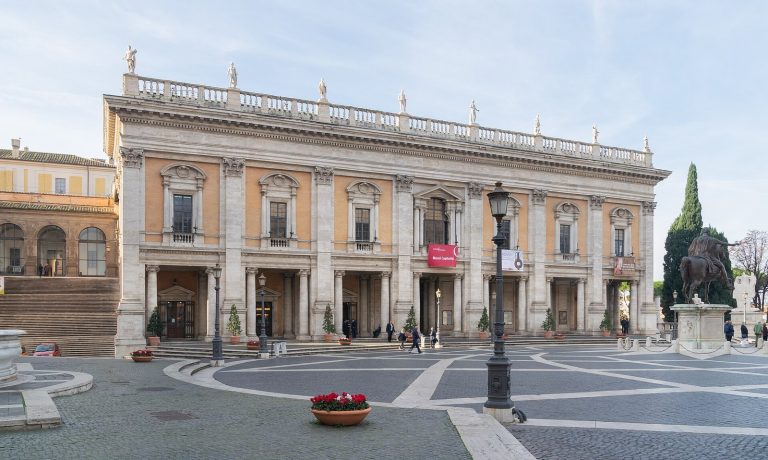
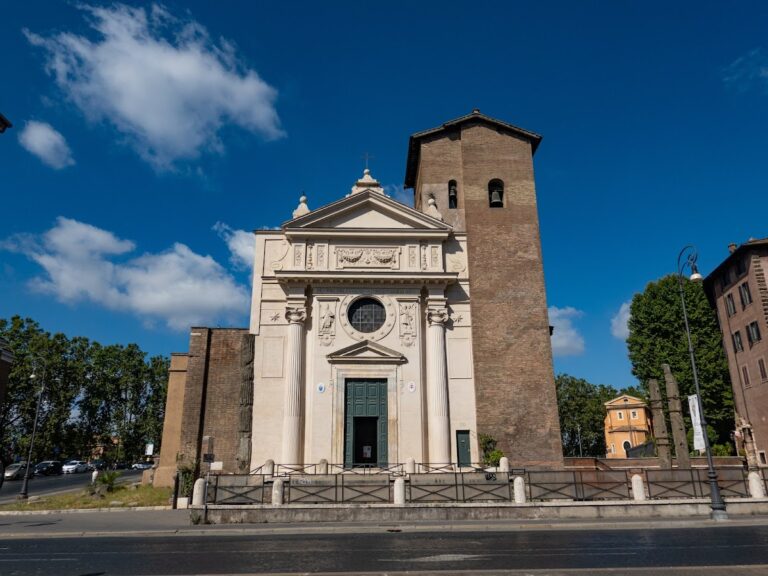
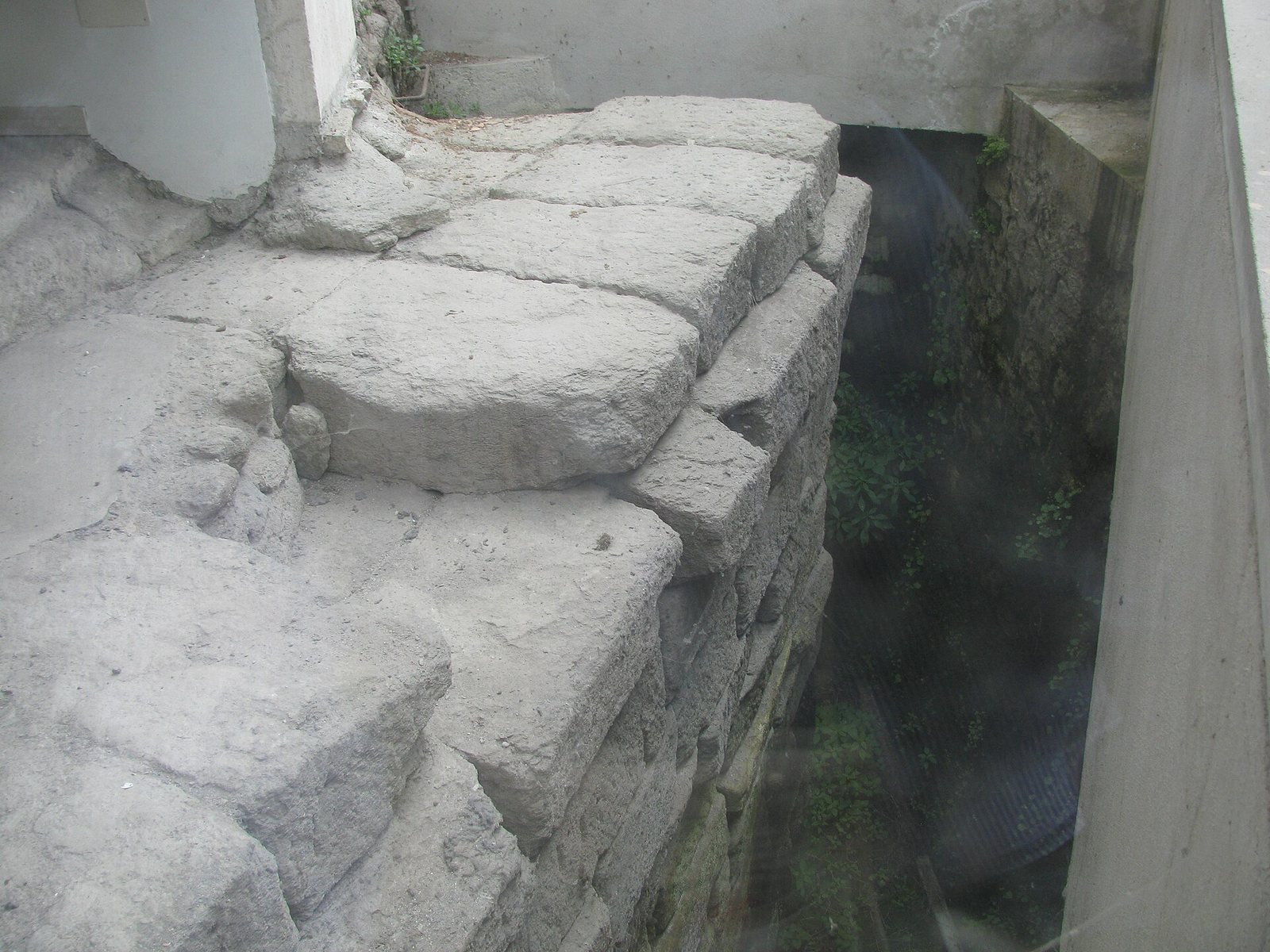
The ruins were still well preserved when the humanist Poggio Bracciolini saw them in 1447. In the sixteenth century, Giovanni Pietro Caffarelli’s palace was built on the site, and the remaining ruins were destroyed or incorporated into its construction. Archaeological investigations on the Capitoline have confirmed the extensive leveling needed to create the temple site. Excavations in 2014 recovered early decorative pieces that helped clarify the first building’s appearance, while later work brought substantial foundations to light, some now incorporated into Palazzo Caffarelli.
Remains
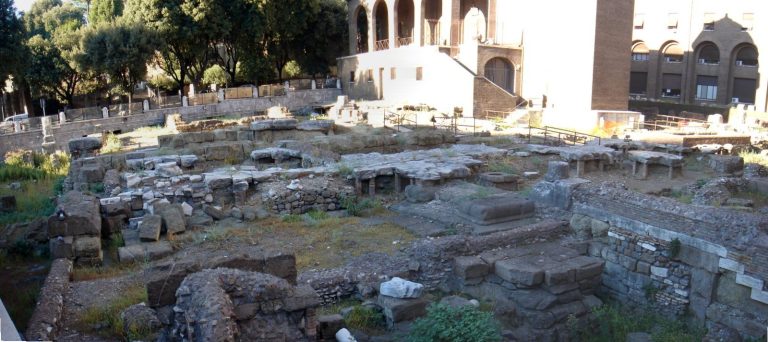
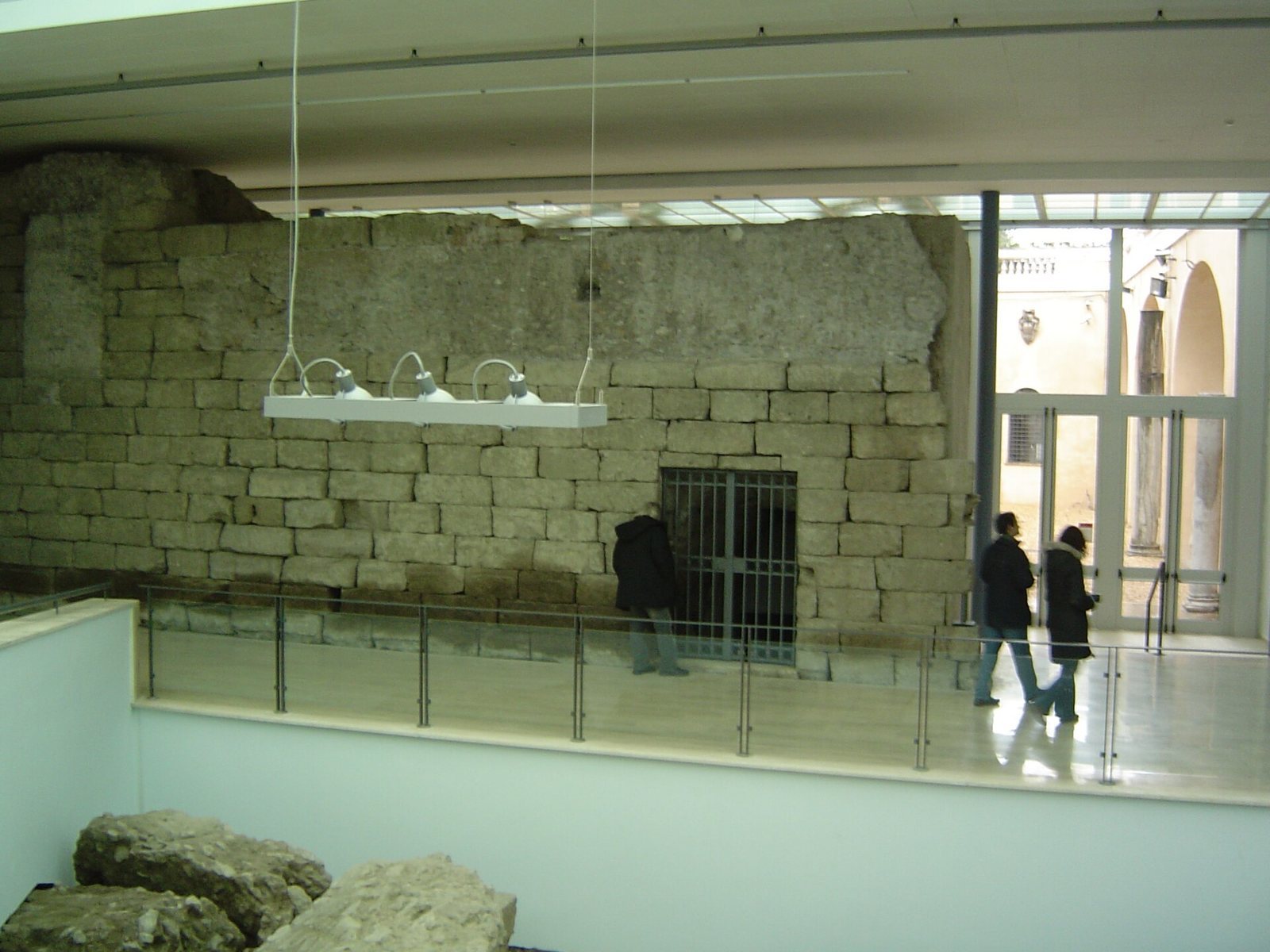
The temple occupied the summit of Capitoline Hill within an enclosed precinct. Its surviving foundations and raised platform preserve evidence of a building whose earliest form followed Etruscan-Italic design. Visible remains are located behind the Palazzo dei Conservatori, in the Capitoline Museums, and near the site’s eastern corner on Via del Tempio di Giove.
The temple buildings
Foundations and first temple
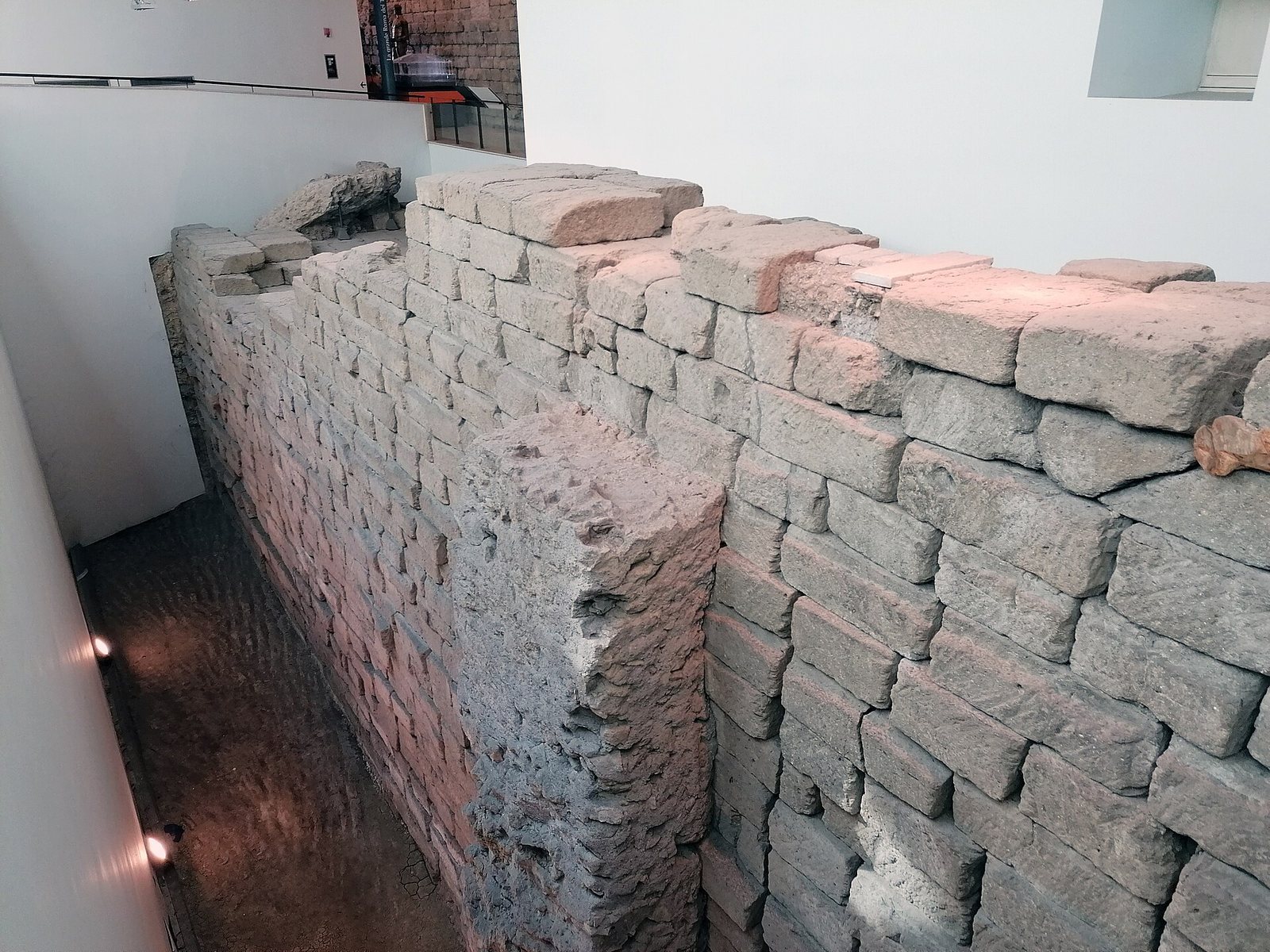
The first temple’s dimensions remain uncertain. Estimates for its platform reach about 60 by 60 metres, while estimates for the building itself include about 53 by 63 metres. Larger estimates are disputed, in part because ancient measurements may refer either to the building or to its platform. The structure had a high raised base, a frontal staircase, widely spaced columns, and three enclosed chambers arranged along a north–south axis. Its plan was Etruscan-Italic. Foundations and walls were made from local volcanic stone, probably quarried from the hill as workers leveled the site; timber and richly decorated fired-clay panels formed part of the upper structure and roof.
Cult images and early roof sculpture
Jupiter’s chamber stood in the middle, with Juno’s to the left and Minerva’s to the right. The first statue of Jupiter was attributed to the Etruscan sculptor Vulca of Veii. It was described as a standing figure holding a thunderbolt, with a red-painted face and costly clothing. Images of Juno and Minerva occupied the side chambers. Roof and gable decorations included fired-clay figures of Jupiter in a four-horse chariot and of Summanus, a deity associated with thunder. Descriptions also refer to a bronze four-horse chariot at the roof’s center, with figures of Minerva and Mars at its sides.
Large fired-clay panels and painted reliefs decorated the roof and other timber elements, including designs in several colors. Damaged pieces were replaced in the early fourth century BCE and again in the late third to early second century BCE. Material removed during later work was laid down in deposits that formed the square in front of the temple in the mid-second century BCE.
Second temple
The replacement built under Catulus retained the arrangement of the three chambers. Its new statue of Jupiter, completed around 65 BCE, was made from gold and ivory by Apollonius of Athens. The god sat holding a thunderbolt and sceptre; the statue may also have included an image of Roma, the personification of the city and Roman state. Replicas made for temples in Roman colonies provide evidence for its appearance. Sulla may have brought large columns or column pieces from Athens, but their use in the temple is uncertain. Coins dated to 43 BCE show a column style different from the Corinthian style sometimes proposed for this building.
Imperial reconstructions
The version rebuilt under Vespasian was taller than its predecessors and had an elaborate upper structure. Its roof sculpture included a four-horse chariot on the gable and two-horse chariots driven by figures of Victory at the roof’s base.
The temple completed under Domitian had six white marble columns from Mount Pentelicus near Athens. Their Corinthian capitals were decorated with acanthus leaves. Gilded bronze tiles covered the roof, and gold sheathing covered the doors. Its triangular gable displayed Jupiter between Juno and Minerva, with an eagle below and chariots associated with the Sun and Moon. A Renaissance drawing of damaged relief shows a four-horse chariot beside a two-horse chariot near the center, with Mars and Venus at the corners. The chariots served as central roof ornaments, while the figures of Mars and Venus adorned the corners.
Surviving architectural fragments
Fragments of the platform supporting the columns, along with column pieces, are preserved in the Palazzo dei Conservatori. The second Medici lion, sculpted by Flaminio Vacca in the late sixteenth century, was made from a capital from the temple.
The surrounding precinct
Walls and entrances
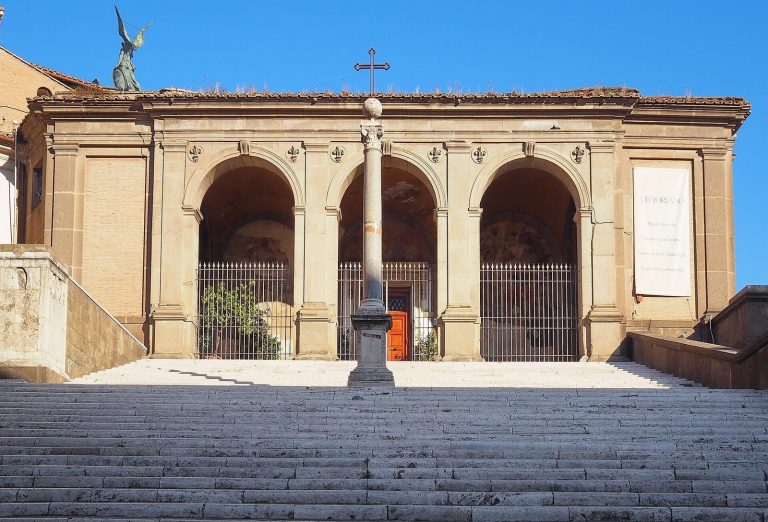
Irregular retaining walls enclosed the precinct and followed the contours of the Capitoline’s southern slope. The Clivus Capitolinus, the road ascending the hill, ended at the main entrance in the middle of the precinct’s southeast side. The Porta Pandana appears to have served as a secondary entrance. The gates were closed at night.
Underground storage chambers
Underground chambers stored damaged building materials, old offerings, and dedications not suitable for display. Religious rules prohibited disturbing them.