Ratiaria: A Roman City and Danube Provincial Capital in Bulgaria
Site at a Glance
- Popularity
- Medium
- Country
- Bulgaria
- Primary era
- Classical
- Eras represented
- Classical, Medieval
- Civilizations
- Byzantine, Roman
- Site type
- City
On this page20 sections
History
Before and during the early Roman period
Ratiaria was a Roman city near Archar, Bulgaria, on the Danube’s southern bank. It probably grew from a Roman garrison established in the 30s AD and later became a colony, a provincial capital, and a major military and trading centre.
Activity in the area predates Roman rule. Gold mining took place there during the Thracian period, and finds from the La Tène era, a late Iron Age European period, point to earlier human activity. An attack around 60 BC by Burebista, a Dacian ruler, suggests that a settlement may already have existed, perhaps in connection with mining. By 29 BC, Ratiaria was fortified; that year Marcus Licinius Crassus, a Roman commander, fought the Triballi, a people of the central Balkans, there.
The city likely began as a Roman garrison in the 30s AD. Evidence points to the presence of Legio VII Claudia, a Roman military formation, while Legio IV Flavia Felix and Legio IV Scythica have also been proposed. An enduring legionary headquarters has not been established. The Roman route guide known as the Antonine Itinerary associates Ratiaria with Legio XIV Gemina. In AD 33–34, Emperor Tiberius built a road connecting forts along the Danube, including Ratiaria. Under Vespasian, the city became an important base for the Roman Danube fleet as the emperor strengthened the frontier.
Colony and crossroads
Ratiaria became part of the Roman province of Moesia Superior in AD 86. It later served as a starting point for Emperor Trajan’s campaigns against the Dacians. After Rome conquered Dacia in AD 106, Ratiaria no longer lay on the empire’s frontier. Around AD 106–107, Trajan granted it colonia status, a high level of Roman civic standing, and the name Colonia Ulpia Traiana Ratiaria. An inscription from AD 125 provides the earliest precisely dated written mention of the city’s name.
The colony expanded alongside a Danube road that continued toward the Black Sea. Its population included people of Italian origin, local residents, and people from the eastern Mediterranean. Inscriptions refer to municipal councillors and priests who took part in the imperial cult, public rites honoring the emperor and his family.
Agriculture supported the city’s economy. Inscriptions refer to estates owned by members of the urban elite, including veterans, and indicate that enslaved people worked some of these properties. A dedication to Pales, a Roman deity associated with agriculture and herding, also reflects farming activity. Ratiaria developed craft industries that included bronze casting, pottery, and the working of lead, glass, and bone.
The city’s position linked Danube routes with Dacia, Italy, the Adriatic, the Black Sea, and Byzantion. A road to Serdica ran through Almus. Salt from Transylvania passed through the area, and Ratiaria also functioned as a customs port. Its connections helped sustain its role as a centre for trade as well as military and provincial administration.
Late Roman provincial capital
When Rome withdrew from Dacia north of the Danube around AD 270, the river again formed the frontier near Ratiaria. By about AD 285, the city was the capital of Dacia Ripensis, a Danube province created when Dacia Aureliana was divided. The reorganization is linked either to Emperor Aurelian or to Diocletian, and its timing and responsibility remain uncertain. Dacia Mediterranea, with its capital at Serdica, lay farther south.
As provincial capital, Ratiaria became the seat of the military governor, or dux, and an important strategic and economic centre. It also housed a state arms factory. From the late third century until about AD 600, Legio XIII Gemina was based in the city after its transfer from Apulum. Along with Legio V Macedonica at Oescus, its troops controlled routes into the Balkan provinces and maintained outposts north of the Danube.
Ratiaria became a bishop’s seat as Christianity spread through the empire. Paulinos is identified as bishop in 340, and Sylvester represented Ratiaria at the Council of Serdica, a Christian council held in 343. Palladius, associated with Arianism, a Christian theological movement disputed by other groups, held the office from 346 to 381. During the Great Persecution, an empire-wide campaign against Christians begun under Diocletian, Jan, Aggaeus, and Gaius were executed in the city in 304 or 305.
Hunnic attacks and Eastern Roman rebuilding
Hunnic campaigns devastated the Danube frontier in 441 and 447, and Ratiaria was probably destroyed in 447. The surviving passages of the history written by Priscus describe the city’s destruction without clearly assigning all the details to a particular attack.
Later rebuilding along the frontier, including at Ratiaria, is associated with Eastern Roman emperors Anastasius I and Justinian I. The historian Procopius says that Justinian restored ruined buildings in the city, but the date and extent of the work remain uncertain. Ratiaria again appears as the capital of Dacia Ripensis under Justinian.
Avar capture and later settlement
During Emperor Maurice’s Balkan campaigns, the Avars captured Ratiaria, probably in 586. The capture is often treated as the end of the city, although the evidence does not establish whether it immediately ended urban occupation. The ancient city had probably ceased to exist by the early seventh century. A smaller settlement later occupied the Roman ruins during the First Bulgarian Empire, between the seventh and eleventh centuries.
The ancient bishopric is no longer mentioned after antiquity. In 1925, the Latin Catholic Church re-established Ratiaria as a titular archbishopric, an ecclesiastical title associated with a former see rather than a functioning territorial archdiocese.
Investigation, excavation, and damage
Felix Philipp Kanitz investigated the ruins in 1862. Václav Dobruský examined them in 1892 and recorded details of the city’s layout and architectural fragments; further observations clarified his descriptions in 1900. The first book devoted entirely to Ratiaria’s history appeared in 1911. Excavations in the 1950s and 1960s uncovered two cemeteries, and regular archaeological work began in 1957. After interruptions, work resumed in 1976, then stopped in 1991.
Illegal digging intensified after the interruption of state-funded excavation and the theft of a marble statue from the Vidin museum in early 1992. Between 2001 and 2005, looting peaked, at times involving as many as 2,000 people using metal detectors and heavy machinery. The site was found to extend at least five times farther than previously estimated. After international protests, Bulgaria’s Ministry of Culture ordered stronger enforcement of monument protection and the resumption of excavation in 2010. Annual archaeological work restarted in 2013, and research was continuing in 2023.
Remains
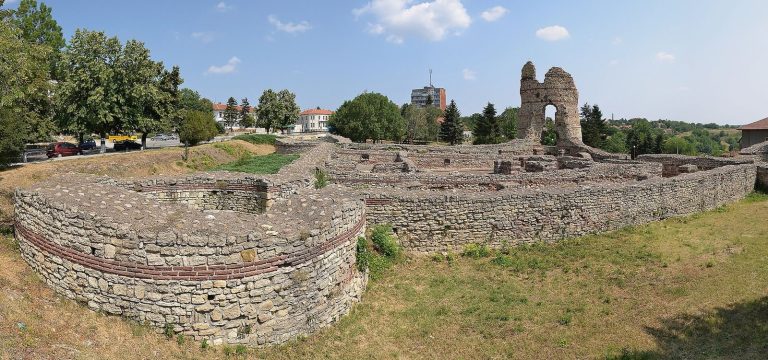
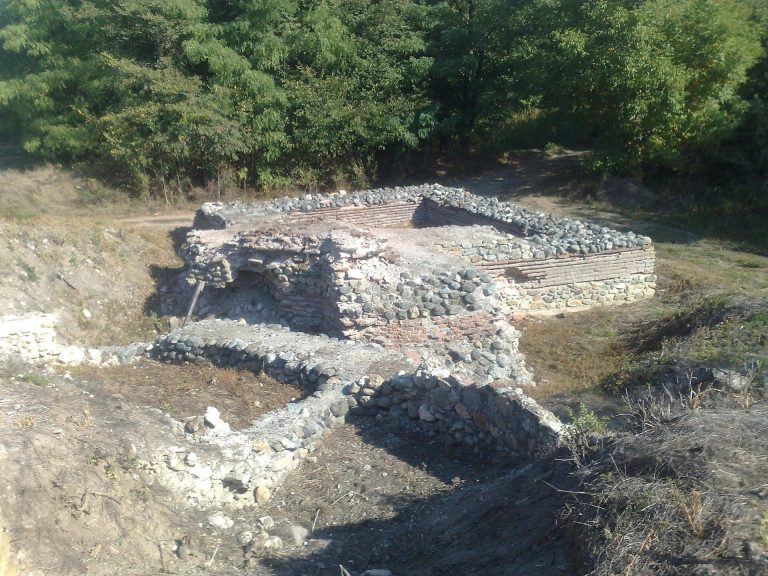
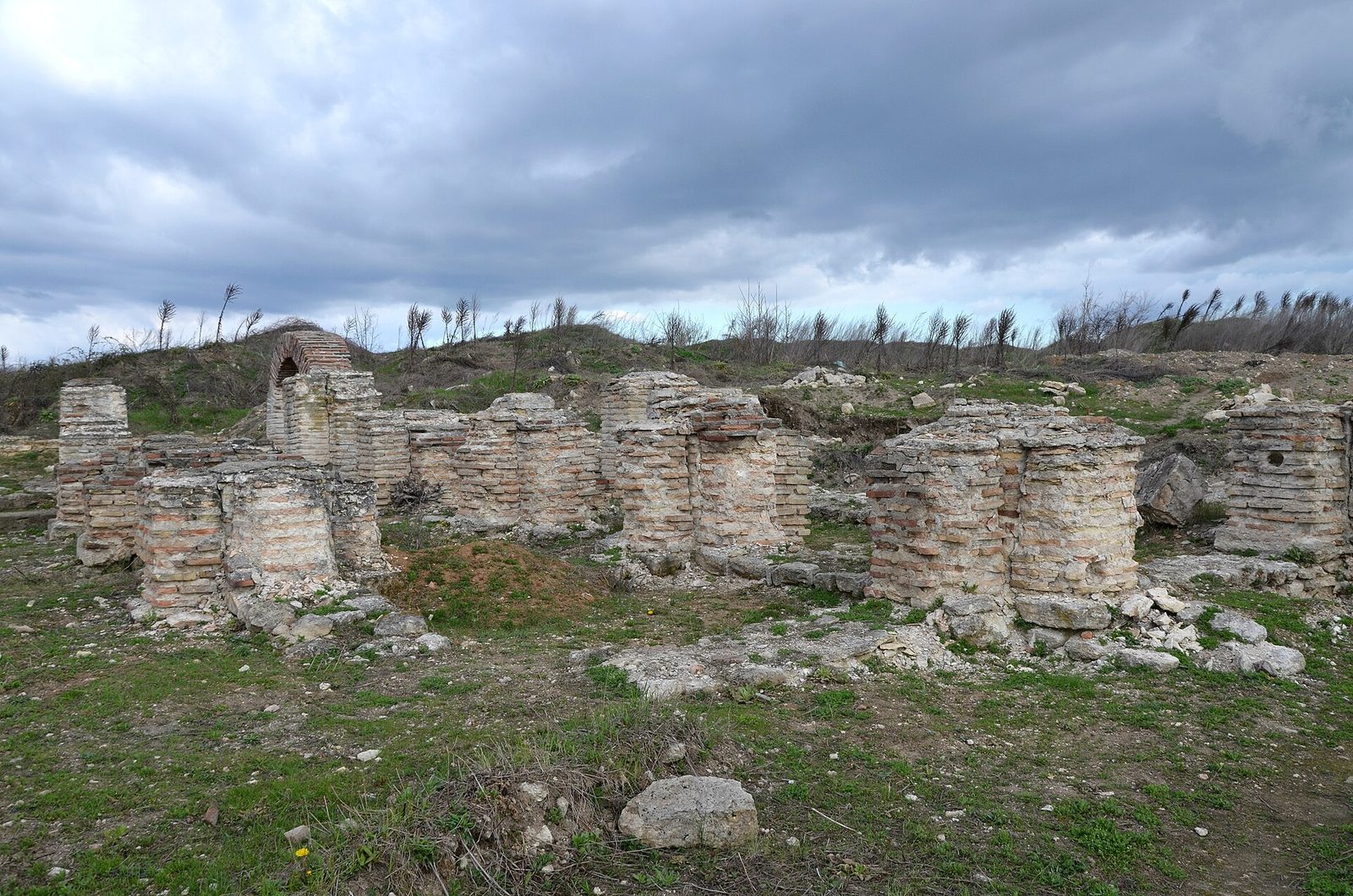
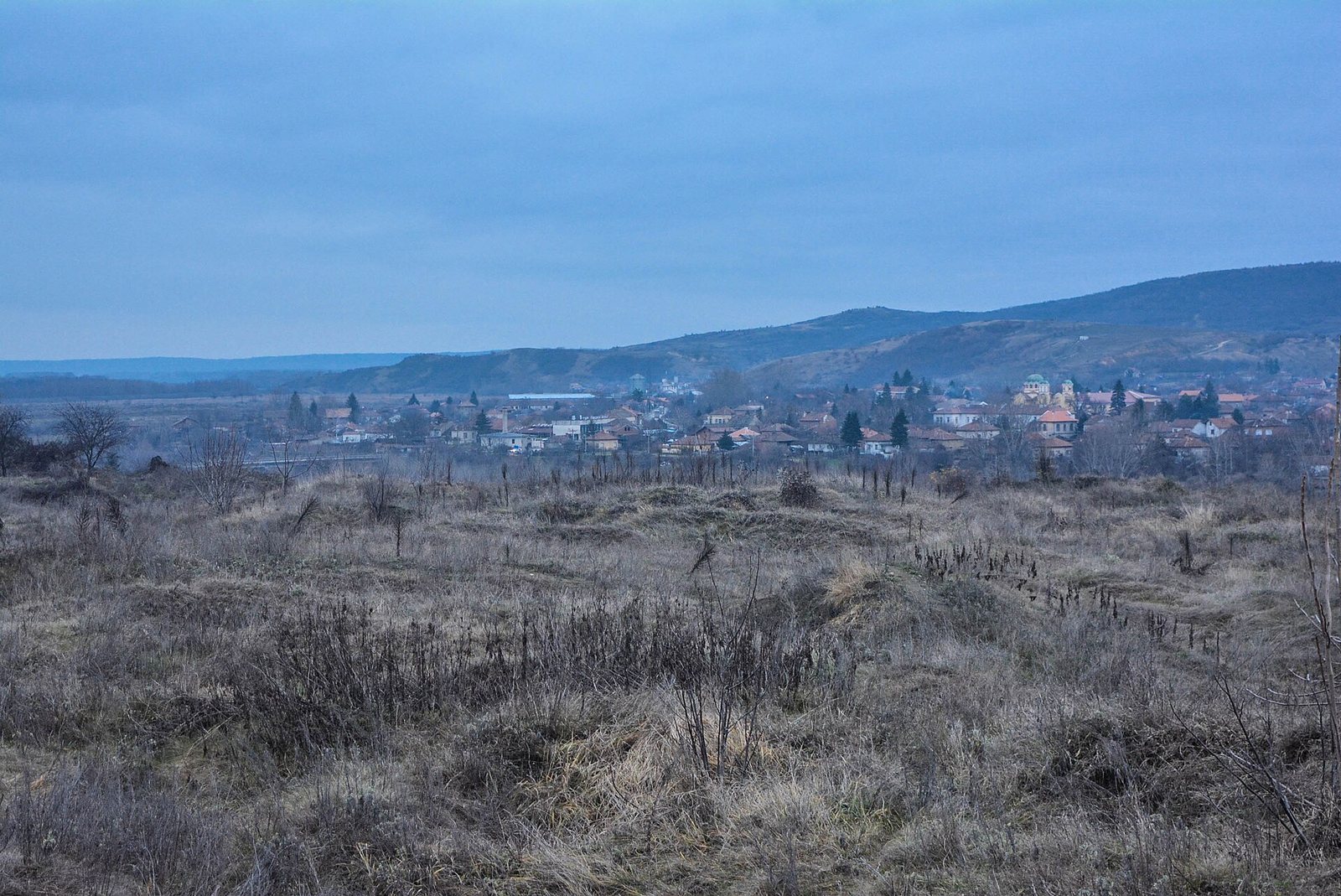
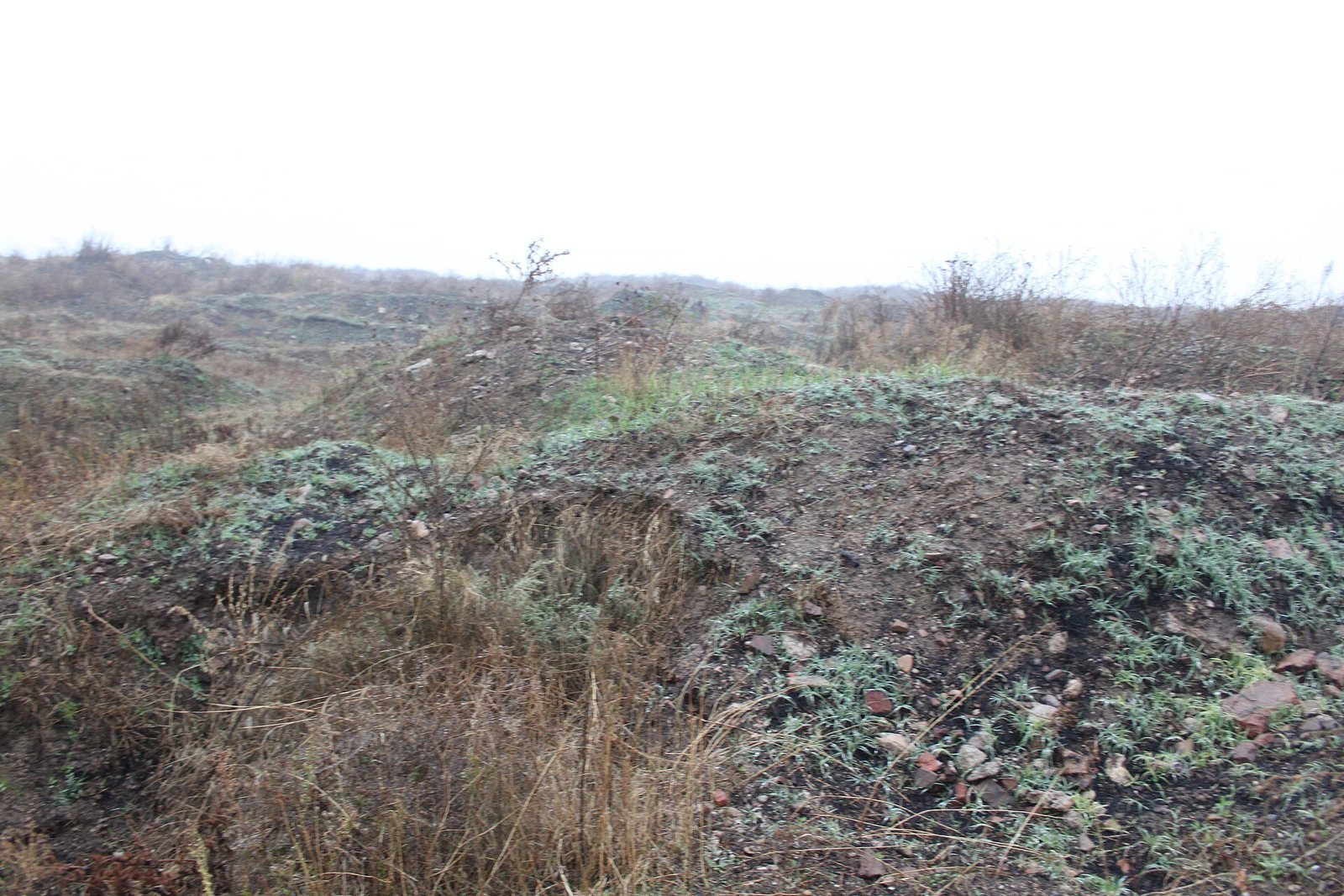
Ratiaria occupies a high, flood-free plateau measuring about 1,500 by 400 metres, or roughly 60 hectares, and rising 30–40 metres above the Danube. The river forms its northern edge, while the Artschariza River borders it to the east and south. The surviving remains include fortifications, public and cult buildings, a harbor, water conduits, villas, and cemeteries. Extensive digging has disturbed large areas, leaving deep pits and mounds of displaced earth.
Setting, defenses, and infrastructure
Plateau and fortifications
The ruins lie about two kilometres west of modern Archar. Archaeological work has identified the western fortification wall and western city gate. Two defensive walls and the principal gate were among the structures damaged by illegal digging. Remains of villas also occur in the surrounding area.
Harbor and water supply
The city’s harbor has been located archaeologically, and its position has been marked, though the harbor itself has not been excavated. Two Roman or late Roman water conduits have been identified. Their supply came from a large spring six to seven kilometres southwest of the city; traces of an aqueduct follow the route between the spring and the village.
Buildings and decoration
Governor’s residence
A partly excavated complex identified as the residence of the governor of Dacia Ripensis dates from the fourth through sixth centuries. It underwent substantial alteration during the fifth century.
Audience hall and monumental buildings
A late antique audience hall has a multicoloured mosaic depicting Orpheus, the figure from Greek mythology traditionally shown as a musician whose art moved animals and nature. A separate, partly excavated monumental building has a mosaic floor and may have served as a Christian church.
Late antique building
Another late antique building contained agricultural implements, clay lamps, household objects, and coins dating to the mid-sixth century.
Cemeteries, inscriptions, and finds
Cemeteries and funerary monuments
Roman and late Roman cemeteries have been identified at Ratiaria. Their burials include numerous sarcophagi, forming Bulgaria’s largest known collection. One sarcophagus from the site is held by the National Archaeological Museum in Sofia. A funerary monument found in 1944 commemorates a son of Gaius Mamius Proculus and Cornelia Inventa, identified as Gaius the Younger. Carefully carved funerary slabs and other inscriptions also come from the site.
Hercules statue
A 41-centimetre marble statue of resting Hercules, excavated in 1955, is a second-century AD Roman copy of a work by the Greek sculptor Lysippos. Stolen from the museum in Vidin in 1992, it was later recovered in Germany and returned.
Inscribed stone
A stone block, probably once part of a city gate, bears the words "Anastasiana Ratiaria semper floreat," meaning "May Anastasiana Ratiaria flourish forever." The name Anastasiana has been interpreted either as a reference to rebuilding under Anastasius or as a description of a city that had risen again.
Other archaeological evidence
Excavations have yielded 50 gold ornaments. A hoard found in 1986 contained 13 pieces of women’s jewelry and silver spoons. Stamped ceramic building materials bear the names of emperors, military units, makers, or workshops, and were grouped according to their identifying marks. Animal bones represent 18 wild and domestic species, including cattle, sheep, goats, chickens, and pigs. They also include the Colchic pheasant, extinct in Bulgaria, and the now very rare griffon vulture.