Leubingen Tumulus: An Early Bronze Age Elite Burial Mound
Site at a Glance
- Popularity
- High
- Country
- Germany
- Primary era
- Bronze Age
- Eras represented
- Bronze Age
- Civilizations
- Unclassified
- Site type
- Burial
- Remains
- Burial Mound
On this page16 sections
History
Early Bronze Age burial and society
The Leubingen tumulus is an Early Bronze Age elite burial mound near Leubingen, in Thuringia, Germany, created by people of the Únětice culture. Tree-ring analysis, which dates wood by comparing annual ring patterns, places its oak timbers at 1942 ± 10 BC; missing outermost rings account for the uncertainty. The burial belongs to Reinecke A1, a phase in the chronological system used for prehistoric Central Europe. The Únětice culture, named after a place in Bohemia, was first called the Leubingen culture, before discoveries at Únětice gave the wider group its familiar name.
The mound is regarded as one of the largest surviving Early Bronze Age elite burial mounds of the Únětice culture, and its grave was exceptionally richly furnished. Most Únětice burials were simpler: the dead were usually placed in pits with their limbs flexed, and graves commonly contained a single pottery vessel. A bronze object accompanied about one in ten. Leubingen’s monumental construction and unusually rich provision set it apart. Such burials also helped establish Leubingen group as an early name for this cultural grouping.
Later burials and excavation
In roughly AD 700–1000, Slavic people buried about 70 additional dead in the upper part of the Bronze Age mound. These later graves, placed within the older burial mound, were oriented east–west and included personal items such as jewelry, knives, and rings.
The grave had not been robbed before Friedrich Klopfleisch excavated it in 1877. A professor at the University of Jena, he worked for the Historical Commission of the Province of Saxony and kept a diary as well as submitting a final report. The two records differ over the chamber’s position and the arrangement and inventory of its contents; the diary is considered the more reliable account. After the excavation, workers rebuilt the mound with earth. In 1912, a royal district administrator prohibited its use for agriculture.
Excavations in the surrounding area added evidence of Early Bronze Age activity. A cemetery at Großbrembach was investigated between 1953 and 1955, and later excavations associated with development uncovered further remains. Pottery from a nearby longhouse resembles that from the Leubingen burial, suggesting that the two may be contemporary. Excavation leader Mario Küssner connected the building with the tumulus.
Interpretations of the deceased
Researchers broadly regard the deceased as a member of the elite, but his precise position in society remains uncertain. Klopfleisch interpreted him as a territorial ruler. Martin Jahn proposed that he was a priest, and suggested that a child, if buried with him, might have been intended to serve him in the afterlife. Jahn also saw the vessels as containers for provisions. Ilona Knapp identified the man as a chief with economic, religious, and military authority. Marija Gimbutas likewise considered him a respected chief, while allowing that a wealthy, patriarch-led family might instead have arranged the elaborate funeral.
Other interpretations focus on the community and the changes taking place in Early Bronze Age society. Vere Gordon Childe argued that trade in copper and tin from the south, and bronze to the north, enriched intermediary merchants. He associated the Leubingen area with routes connecting it to bronze-producing Bohemia and Moravia. Tobias Kienlin instead emphasized how collective burial ritual might have strengthened group cohesion and cultural identity as metal use and social hierarchy grew. Svend Hansen cautioned that the exceptional nature of such mounds makes the deceased’s exact role difficult to determine.
The lavish grave goods, the burial on the back, and the stone tools have also been interpreted as deliberate references to older Corded Ware funerary customs, perhaps to assert a long tradition of descent. The Corded Ware culture was a prehistoric European grouping known in part for its pottery and burial practices. Some interpretations also connect the exceptional treatment of the deceased with religious ritual. Researchers broadly associate the elite buried in such mounds with religious authority, including control of cults, and economic power linked to trade in metals and salt.
Remains
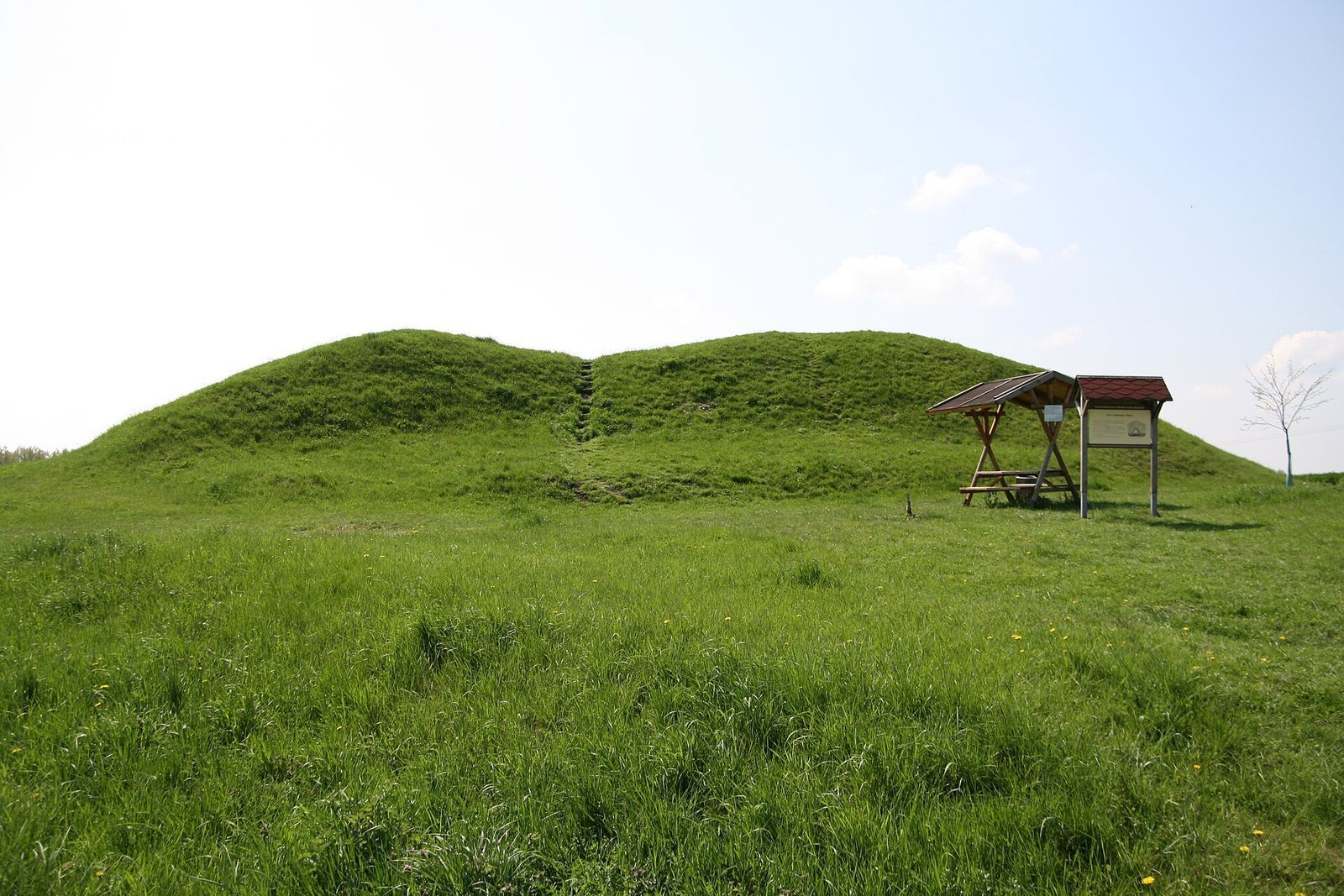
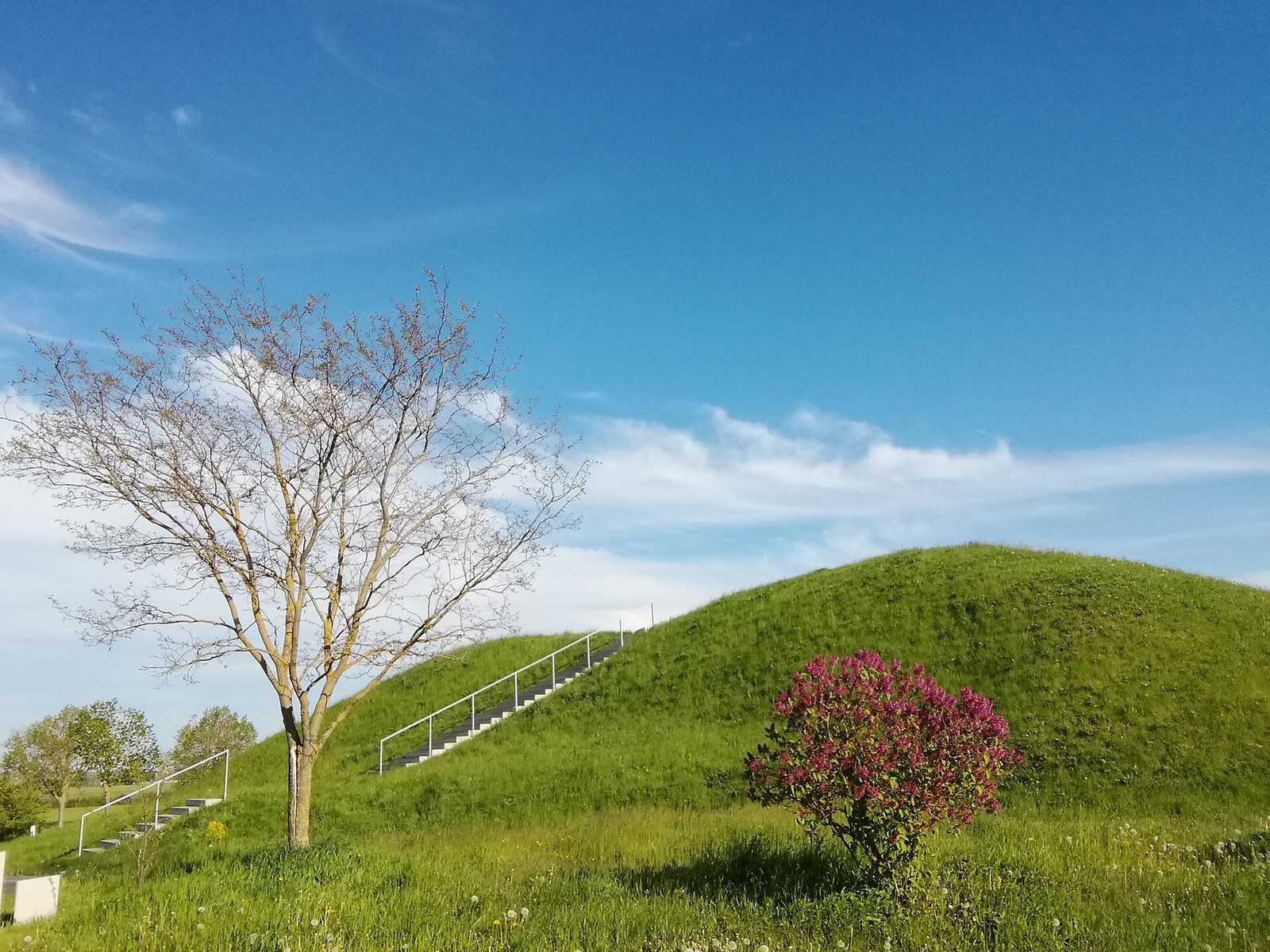
The mound stands on a prominent point in the valley plain of the Thuringian Basin, at the foot of the Kyffhäuser hills and beside a route used in the Bronze Age. Its earthen covering enclosed a central stone cairn and a wooden burial chamber, forming the principal elements of the burial’s construction.
Mound and chamber
Earth mound and stone cairn
Before excavation, the mound stood about 8.5 m high and measured approximately 34 m across. Investigations at its foot in 2017–2018 indicated that its original diameter was at least 50 m. The mound was reshaped with earth after excavation. Beneath it, a stone cairn about 20 m in diameter rose to roughly 5 m at its highest point and enclosed the chamber. A ring of stones marked its outer edge. Flat slabs of red and white sandstone sloped away from the chamber to direct water outward; the stones came from the surrounding area, from distances of up to 30 km.
The cairn contained about 210 cubic metres of stone, while approximately 3,600 cubic metres of earth covered it. Stone above the chamber reached a thickness of up to 2.5 m. A compacted earth layer about 70 cm thick lay above the stone, with loose soil forming the outer surface.
Oak burial chamber
The chamber was an intact, tent-shaped structure of oak, oriented north–south. Its floor measured 3.90 by 2.10 m. The smoothed floor was laid with stones and covered by wooden planks. Sloping oak-plank walls were fixed into the ground and braced at their tops by rafters. A pitched roof used a ridge beam and rafters; wooden nails held its boards in place, and gypsum mortar sealed the gaps. Reeds about 15 cm thick covered the outside, where they were coated with lime mortar. The chamber’s wooden components were moderately well preserved.
Burial and grave goods
Human remains and pottery
The principal burial was an older adult man, estimated to have been about 50. He had gout and worn teeth, and lay on his back with extended legs and his head to the north. Two arm bones were assigned to a possible second individual, estimated to have been about ten. Klopfleisch’s drawing of a complete second skeleton was his reconstruction, rather than a record of all the remains recovered.
A large ceramic vessel, about 35 cm high, stood below the man’s left foot amid surrounding stones. Brown and black decoration covered the vessel, which had small lugs at the shoulder. Sherds from several other vessels lay on the chamber floor.
Stone tools and bronze weapons
Near the man’s right foot were a stone object identified as an anvil or assay stone, a stone used to test metal, a slate whetstone for sharpening blades, and a roughly 30 cm serpentine implement. Its form has been described as shoe-last-shaped or hoe-like, and its purpose remains uncertain; proposals include a hoe or ploughshare. Strap remains show that it was attached to a handle. A perforated stone battle-hammer was also among the grave goods.
A dagger-axe, a blade mounted on a shaft, and three bronze dagger blades were arranged crosswise above the objects near the feet, along north–south and east–west axes. Microscopic examination showed that the daggers had hawthorn and ash handles wrapped in broad bronze wire, with sheaths of leather and oak bark. Two crossed bronze flanged axes, whose raised edges helped secure their wooden hafts, lay near the right foot. Three bronze chisels were placed within reach of the man’s right hand, near the upper pair of daggers. A small anvil was also listed among the finds.
Gold ornaments
Several gold ornaments were placed to the man’s right at head height: two loop-headed pins, two rings with raised knobs, a small spiral necklace ornament, and an arm ring. Their recorded total weight was 256.113 g.
Nearby Bronze Age features
Longhouse
Postholes traced the plan of a nearby longhouse measuring about 44 by 10.5 m, with a floor area of 462 m². It is among the largest known buildings of Early Bronze Age central Germany. Its pottery resembles material from the Leubingen grave, and Mario Küssner connected the house with the tumulus.
Bronze-axe hoard and cemetery
A pit beside the longhouse contained a covered ceramic vessel holding about 100 bronze axe blades. A nearby cemetery comprised 44 simple pit graves.
Finds and chamber reconstructions
Finds from the burial are displayed in the permanent exhibition of the State Museum of Prehistory in Halle. Reconstructions of the chamber are held at the Museum of Prehistory and Early History of Thuringia in Weimar, the museum in Halle, and the Leubingen local museum.