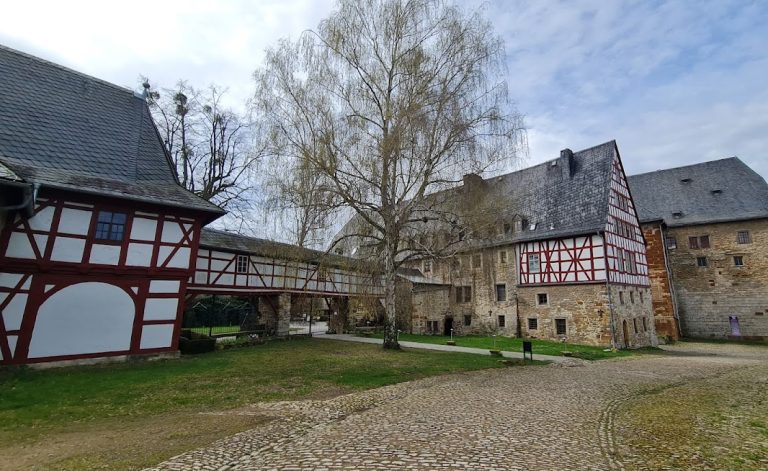
Runneburg: A Medieval Romanesque Castle in Germany


Site at a Glance
- Rating
- 4.4
- Popularity
- Low
- Country
- Germany
- Primary era
- Medieval
- External website
- Open
- Eras represented
- Medieval, Early Modern, Modern
- Civilizations
- Electorate of Saxony, Holy Roman Empire, Kingdom of Prussia, Landgraviate of Thuringia
- Site type
- Military
- Remains
- Castle
On this page12 sections
History
Runneburg is a medieval castle in Weißensee, Germany, founded in 1168 as a Romanesque residence of the Thuringian landgraves. Known in the Middle Ages as Burg Weißensee, it was first recorded as “Wyssense” in 1174. Its original development created a political and residential center whose unusually extensive high-medieval fabric later placed it among the most important castle complexes in Thuringia, alongside Wartburg.
Foundation and Thuringian rule
Landgravine Jutta Claricia of Thuringia, a half-sister of Emperor Frederick Barbarossa, had the castle developed from 1168. A landgrave was a high-ranking territorial ruler in the medieval German Empire, broadly comparable to a prince. The Thuringian landgraves used castles as residences and administrative centers, and Runneburg occupied a position roughly halfway between Wartburg and Neuenburg. Its location probably also helped contain the territorial ambitions of the Welf dynasty in central Germany.
Landgrave Ludwig III named the castle “Wyssense” in a charter of 1174. In 1180, Heinrich the Lion, the powerful Welf duke of Saxony and Bavaria, defeated Ludwig III and his knights in the Battle of Weißensee. The castle later resisted two unsuccessful sieges. King Philip of Swabia attacked it in 1204, while Emperor Otto IV besieged it in 1212 and employed a trebuchet, a siege engine for hurling stones and other projectiles against fortified positions.
Ludowinger and Wettin possession
Landgrave Ludwig IV of Thuringia, later venerated as “the Saint,” held a court assembly at Runneburg in 1225. He was the husband of Elisabeth, who became one of the best-known saints associated with medieval Thuringia. After the death of King Heinrich Raspe in 1247 ended the Ludowinger dynasty of Thuringian landgraves, Weißensee and its castle passed to Margrave Heinrich III of Meissen following the Hessian-Thuringian War of Succession.
The Wettin margraves, a ruling dynasty that succeeded the Ludowingers, visited Runneburg frequently and regularly. The castle returned to Thuringian possession in 1382. The last Landgrave of Thuringia, Friedrich IV, known as “the Simple,” died there in May 1440. Runneburg then passed to the dukes of Saxony.
From Saxon residence to Prussian administration
During the German Peasants’ War of 1525, insurgent peasants were refused entry to both Weißensee and the castle. From 1554, Runneburg served as a widow’s residence for the electors of Saxony. New residential buildings were erected in 1580 and 1581, followed by a gatehouse around 1600. Between 1656 and 1746, Weißensee and Runneburg belonged to the Duchy of Saxe-Weissenfels.
After the Congress of Vienna, the town and castle became part of the Kingdom of Prussia in 1815, and the Prussian king became the castle’s lord. The complex was subsequently adapted for administrative purposes. In 1890, a new district administration building for the former Weißensee district replaced an older military magazine barn.
School use, conservation, and interpretation
After the Second World War, the Palas, the principal residential and representative building of a medieval German castle, was used as a school in the German Democratic Republic from 1952 to 1995. Severe structural deficiencies then led the building authorities to close it. Archaeological building research began at Runneburg in 1988, and the Association for the Rescue and Preservation of Runneburg in Weißensee was founded in 1990. Extensive stabilization and conservation followed, including the installation of a steel framework to prevent the residential tower from collapsing.
A museum opened on the ground floor of the Palas in 1993, and the Historical Archive of Weißensee was established at the castle in 1995. Runneburg was transferred to the Foundation of Thuringian Castles and Gardens in 1996, the state foundation responsible for preserving and managing major historic monuments in Thuringia. The association ended its work at the castle in 2010. The museum and restaurant subsequently closed, while the reconstructed trebuchet had already been sold in 2009.
In 1998, historian Michael Kirchschlager discovered the Weißensee Beer Purity Ordinance of 1434 in the castle’s historical archive. It specified hops, malt, and water for brewing. A large stone-throwing machine was reconstructed between 1996 and 1997 in memory of Otto IV’s siege of 1212. It was tested with a stone on 1 June 1997 and used to throw a fireball on 11 August 1999, the date of a total solar eclipse.
Since 2013, the former Prussian district administration building has housed the 3B-Weißensee educational and meeting center, operated by the Workers’ Samaritan Federation. On 25 March 2026, the exterior building identified as the Old Kitchen and former stable burned. Investigators attributed the fire to a defect in an electrical line that probably caused a prolonged smoldering fire, while the full extent of the damage was still being determined.
Remains
The castle occupies a built-up site within the town of Weißensee. Its surviving core preserves a Romanesque gate complex, the lower stories of the former keep, the Palas with later additions, a residential tower, and the enclosing castle wall. The original residential complex consisted of a two-story Palas, a five-story residential tower, a castle gate, and the surrounding wall. Around 1220, the Palas was enlarged by the addition of a banqueting hall, creating the principal group of Romanesque remains.
Medieval residential and defensive buildings
Palas
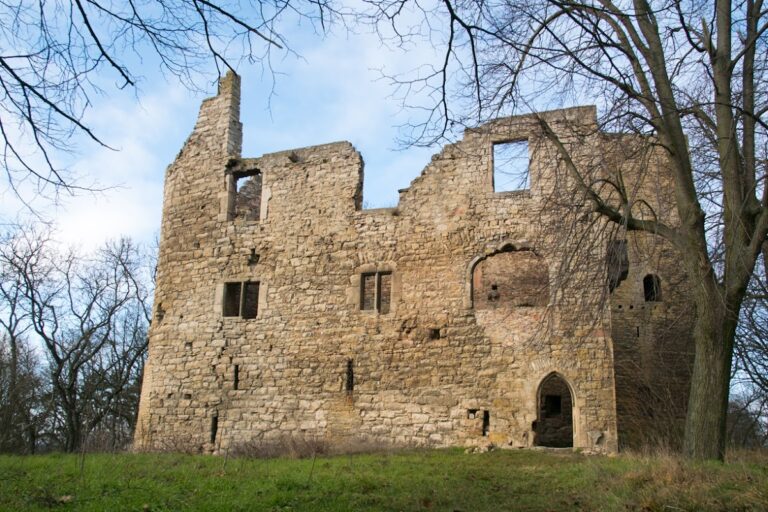
The Palas formed the main residential and representative building of the medieval castle. Its ground floor contains a vaulted treasury space that later housed the castle museum from 1993 until its closure in 2010. The museum presented archaeological material associated with the period of Thuringian landgrave ownership, including high-quality wood and leather objects dating to about 1230 and a substantial coin collection connected with historically important rulers of the region. Other rooms were incorporated into the museum route when their restoration allowed. Finds from Runneburg are exhibited in Weißensee Town Hall.
Residential tower
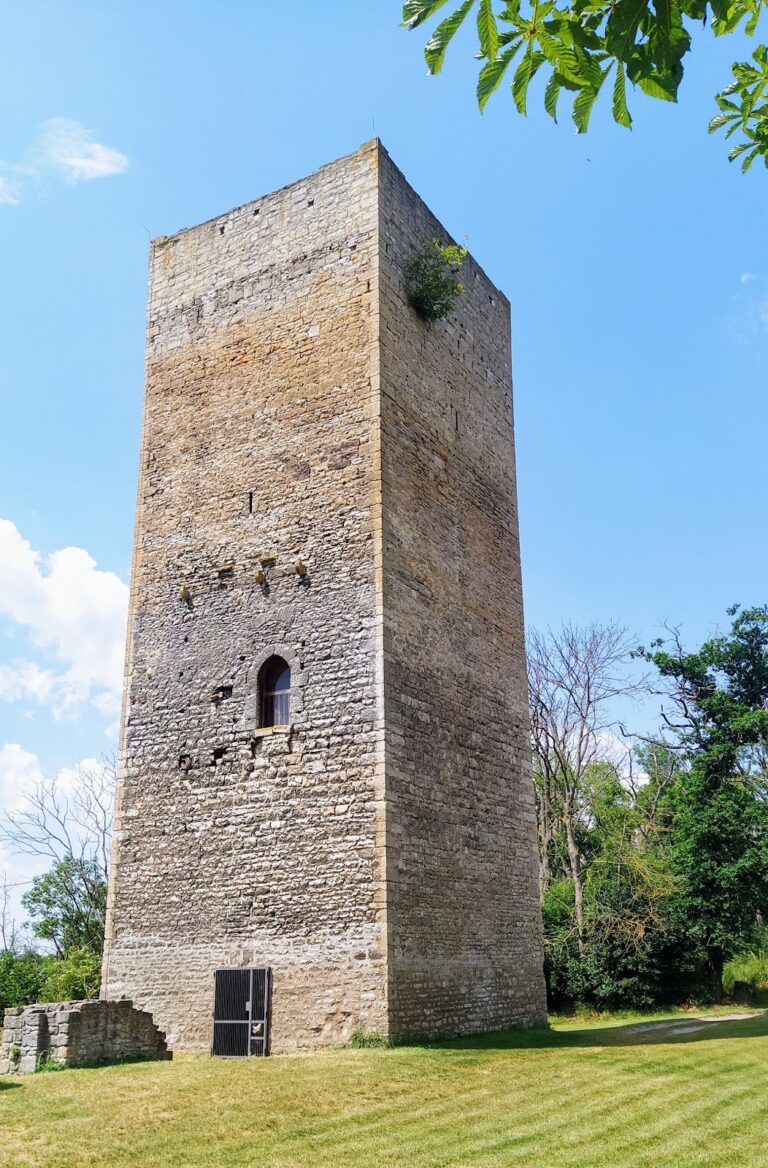
The original residential tower rose five stories and remains one of the principal elements of the medieval complex. Its structural condition became critical during modern conservation, requiring a steel framework to prevent collapse. The intervention forms part of the wider stabilization work that preserved the castle’s high-medieval fabric.
Gate complex and castle wall
The Romanesque gate complex and the surrounding castle wall belonged to the original residential foundation. Together with the Palas and residential tower, they define the surviving medieval enclosure. The later gatehouse, built around 1600, added a distinct early modern element to the entrance arrangements.
Former keep
The former Romanesque keep, also known as the Fighting Tower, was a fortified tower used primarily for defense and as a sign of authority rather than as a permanent residence. It was dismantled around 1750 after becoming structurally unsafe. Its lower stories survived and remain part of the preserved medieval fabric.
Early modern and later structures
The residential buildings erected in 1580 and 1581 represent the castle’s early modern adaptation as a Saxon widow’s residence. The gatehouse followed around 1600, and a carriage house was built in 1738. The former stable, also called the Old Kitchen, stood as an exterior building associated with the castle. The separate former district administration building, erected in 1890, now contains the 3B-Weißensee educational and meeting center.
Nearby sites