Qanawat: An Ancient City and Druze Religious Center

Site at a Glance
- Popularity
- Very Low
- Country
- Syria
- Primary era
- Classical
- Eras represented
- Iron Age, Classical
- Civilizations
- Byzantine, Nabataean, Roman
- Site type
- City
On this page15 sections
History
Qanawat is an ancient city in Syria that developed into the Hellenistic-Roman city of Canatha, one of the earliest urban centers of the Bashan and Hauran regions. Its settlement history may extend back to the Late Bronze Age, while its best-known ancient phases belong to the Hellenistic and Roman periods. In the nineteenth century, the town also became an important religious and political center for the Druze community of the Jabal al-Druze.
Early Canatha and Roman Rule
Qanawat may be identified with Kenath, a place mentioned in the Hebrew Bible. Possible earlier references occur in Egyptian execration texts, ritual writings intended to curse enemies, from the twentieth and nineteenth centuries BC, and in the Amarna letters, fourteenth-century BC diplomatic correspondence, where the name may appear as Qanu. These identifications remain possible rather than certain.
The Hellenistic-Roman city of Canatha first enters the historical record during the reign of Herod the Great in the first century BC. Herod, the Roman-supported king of Judea, was involved in a period when Nabatean Arab forces defeated a Jewish army, leaving Canatha contested between Nabatean and Jewish forces. From the time of the Roman general Pompey until the reign of the emperor Trajan, the city belonged to the Decapolis, a loose federation of Hellenistic and Roman cities that retained some local autonomy under Roman rule.
Canatha was annexed to the Roman province of Syria during the first century AD. In the second century, the emperor Septimius Severus renamed it Septimia Canatha, made it a Roman colony, and transferred it to the province of Arabia. Near the city, at S’ia, Herod also supported a temple dedicated to Baal Shamim, a Semitic sky deity worshipped in the ancient Levant. The temple may have continued to be patronized as late as 9 BC.
Christian Canatha and Medieval Decline
Canatha became an episcopal center of regional Christianity. Its bishop Theodosius represented the city at the Second Council of Ephesus in 449, the Council of Chalcedon in 451, and a synod held in Constantinople in 459 against simony, the buying or selling of ecclesiastical offices or spiritual privileges. The former residential bishopric is now retained by the Catholic Church as a titular see, an honorary episcopal title for a former or non-residential bishopric.
Muslim Arab forces captured the city in 637. Qanawat remained a regional Christian center for a time, and Christians made pilgrimages there during the seventh century. Its importance later declined, and by the ninth century it had become a poor village.
Ottoman Village and Druze Resettlement
Ottoman tax registers from 1596 place Qanawat in the Bani Nasiyya subdistrict of the Hauran Sanjak. The village contained twelve Muslim households and five Christian households, together with settled Bedouin inhabitants. Its tax assessment, fixed at 20 percent on wheat, barley, summer crops, goats, and beehives, amounted to 4,750 akçe.
Qanawat was abandoned sometime between the seventeenth and eighteenth centuries. Druze migrants from Mount Lebanon repopulated it during the 1820s, making it one of the first villages in the Hauran to be resettled by Druze communities. Five or six families initially established themselves there, and the population grew gradually between 1830 and 1850. Further immigration after the 1860 civil war in Mount Lebanon transformed Qanawat into a large village.
During the nineteenth century, Qanawat became a residence of Druze religious shaykhs. In the 1850s it became the seat of the leading shaykh al-aql, the principal religious authority of the Druze community, and a center of local Druze politics. Ibrahim al-Hajari, Qanawat’s first shaykh al-aql, helped organize Druze resistance to conscription orders imposed by the Egyptian governor Ibrahim Pasha in the late 1830s. After Ibrahim died in 1840, his son Husayn succeeded him.
Qanawat was then controlled by Al Hamdan, the leading Druze family of the Hauran. Under Husayn, the Hajari family established the mashaykhat al-aql, the institution through which this religious leadership was exercised in the Hauran. Al Hamdan used it to extend its influence, but lost Qanawat to the Bani al-Atrash in the 1860s. The Bani al-Atrash retained only nominal control, while the al-Hajari family administered the village through the religious institution.
Modern Setting and Archaeological Recognition
Qanawat lies 7 km northeast of Suwayda in the Jabal al-Druze, the mountainous region of southern Syria historically associated with the Druze community. The modern settlement stands at approximately 1,200 m above sea level near a river and among wooded mountains. It is predominantly Druze and had 8,324 inhabitants in the 2004 census.
The German explorer Hermann Burchardt visited Qanawat in 1895 and photographed its antiquities. His photographs are now held by the Ethnological Museum in Berlin, preserving an early visual record of the ancient remains.
Remains
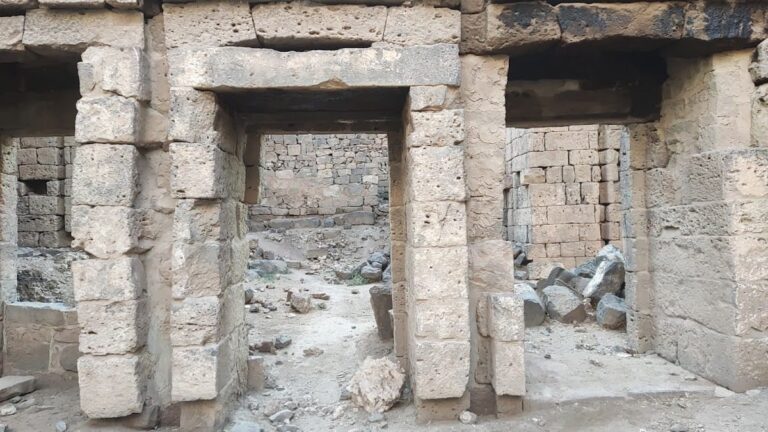
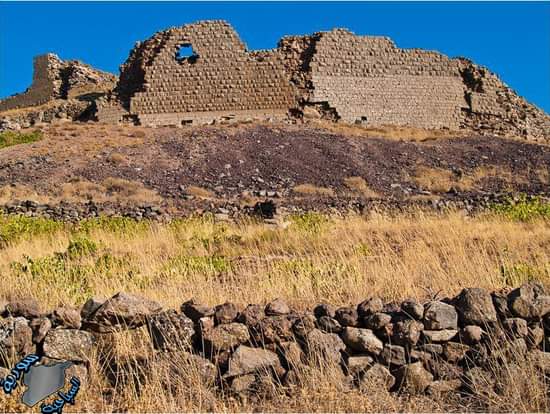
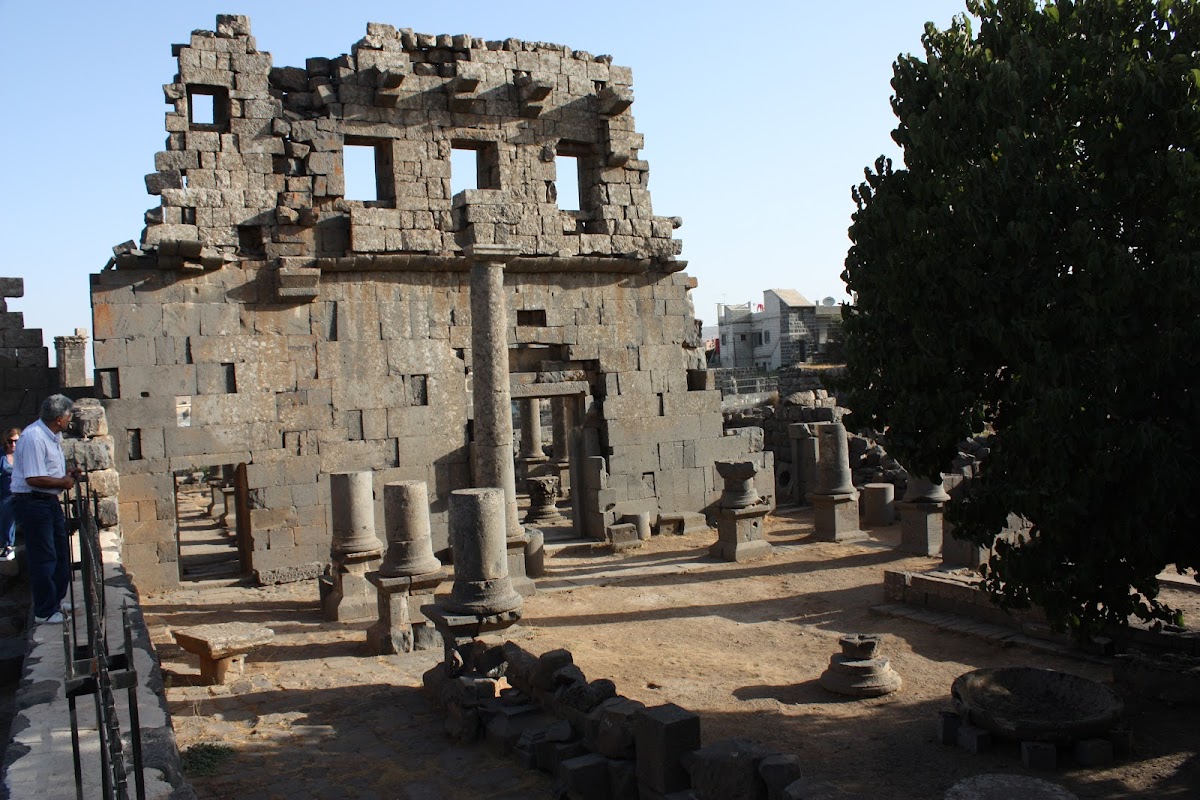
The ancient ruins extend approximately 1,500 m from end to end and 750 m across. They occupy an upper area of terraces and high walls and a lower section in the valley. Temples, civic buildings, water installations, a theatre, baths, monastic buildings, and later religious structures form the surviving archaeological landscape.
Upper City
The upper part of the city, identified with historical Canatha, was used from before the beginning of Iron Age I. High walls, level stone blocks, and stone terraces define this area, which contains several temples, including a temple of Zeus and temples built on terraces.
Western Serai and Civic Buildings
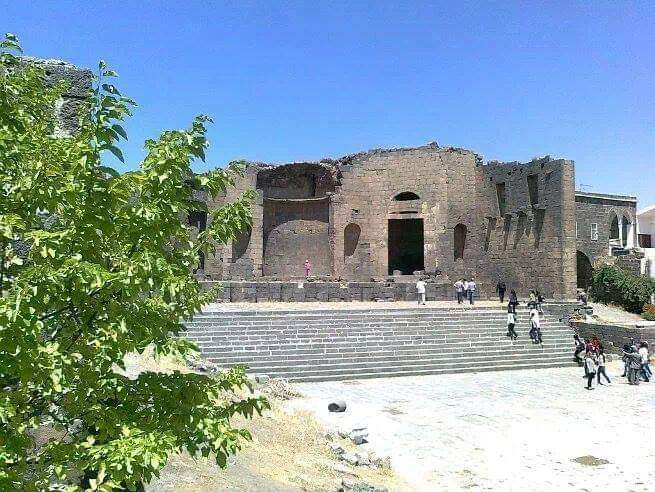
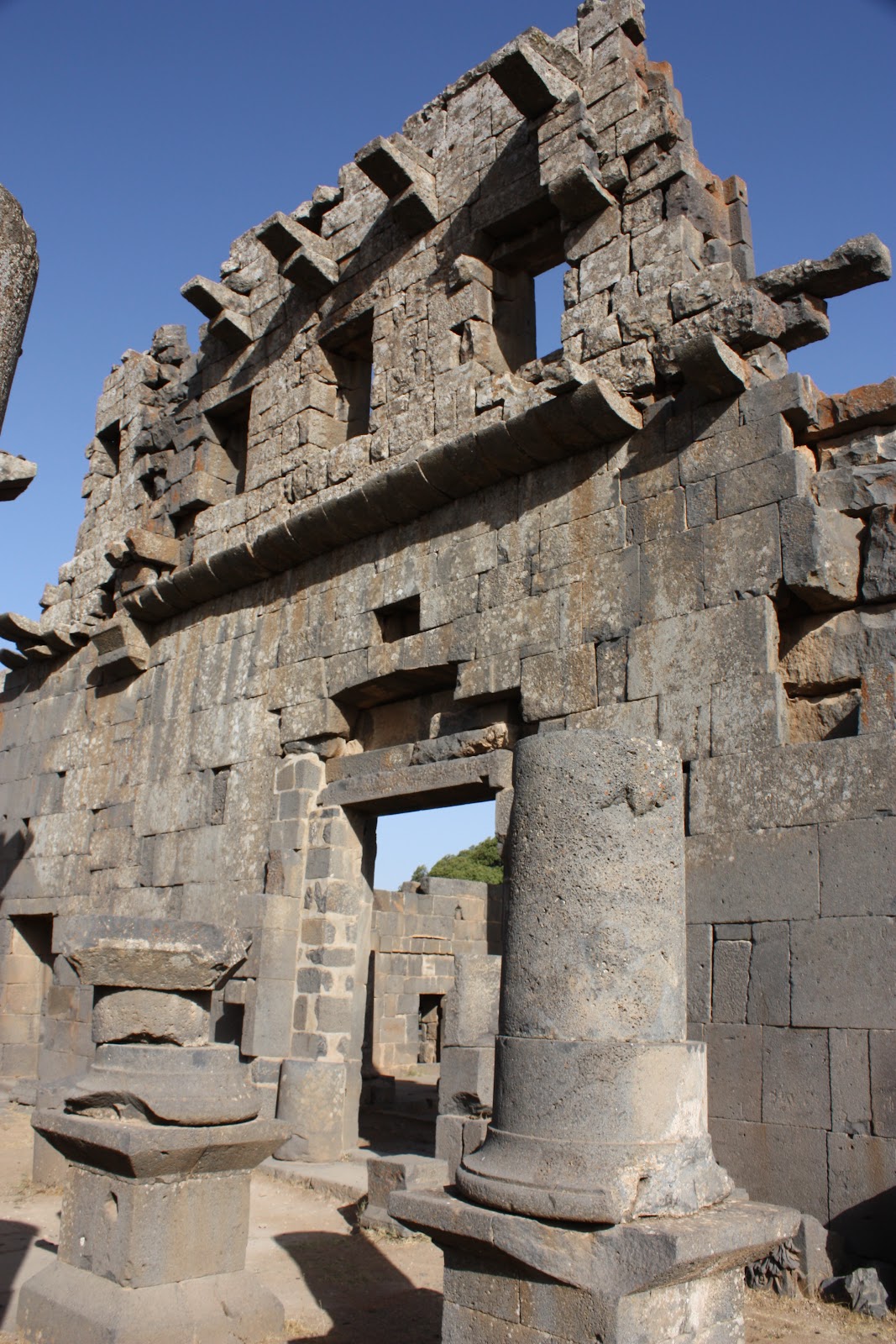
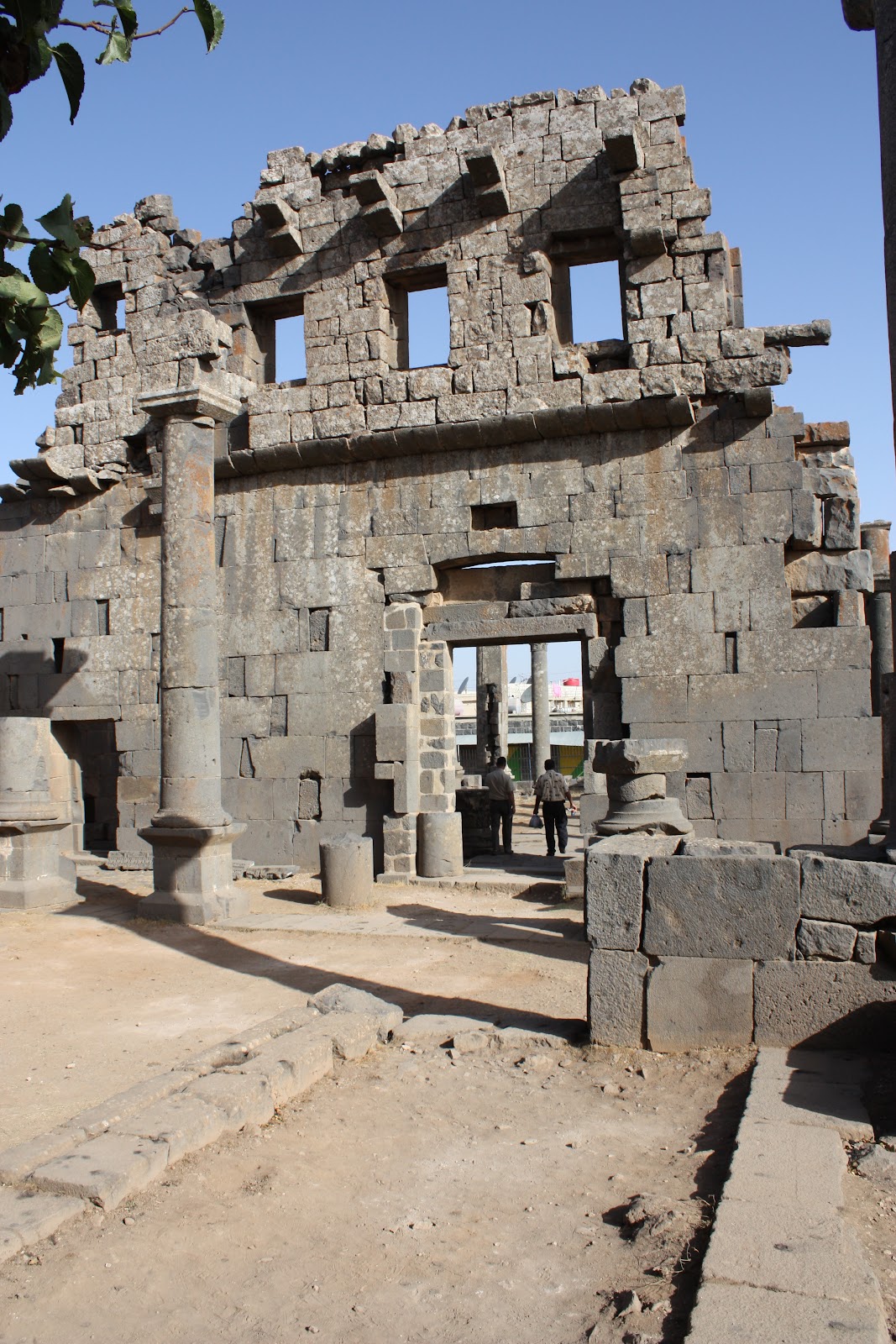
The western Serai was the largest temple in the upper section. It contained a sanctuary, an altar, and three domes. Nearby remains include a basilica used for commerce, administrative buildings, walls, and cisterns, showing the concentration of religious, civic, and practical structures in the upper city.
Lower City and Waterworks
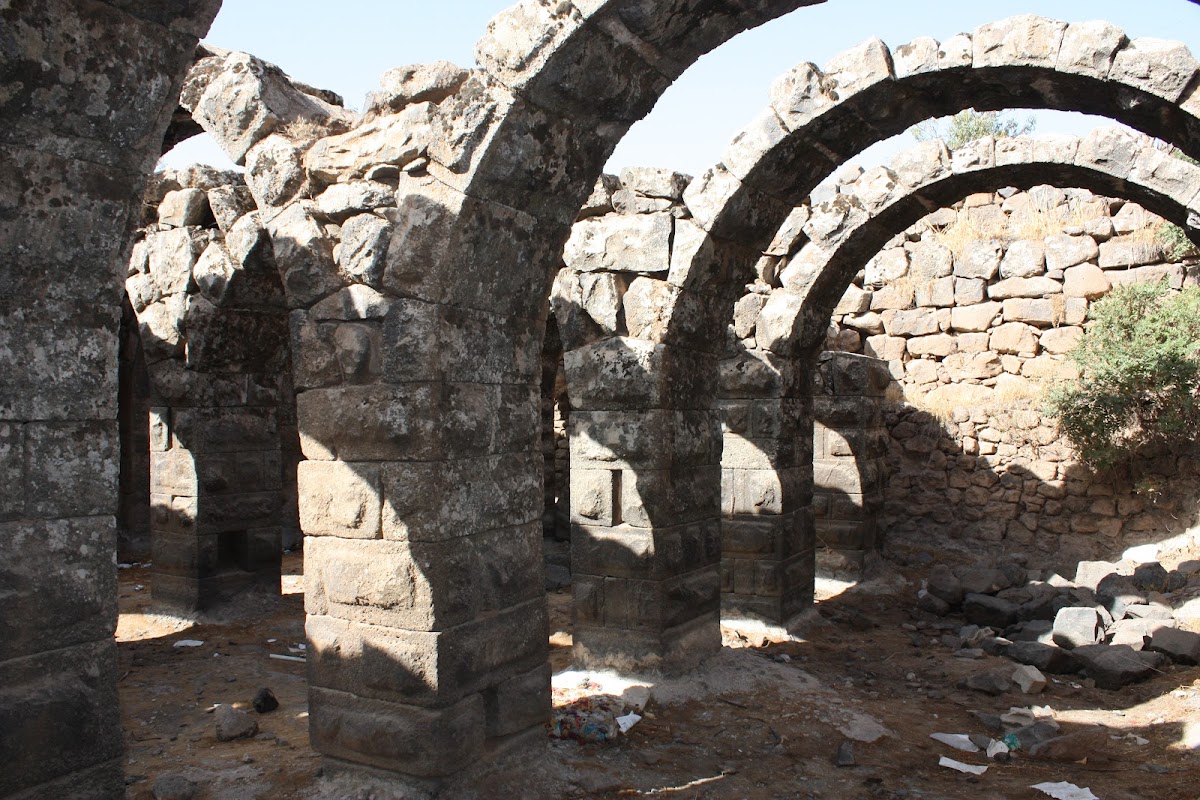
The lower section occupies the valley. Its remains include the theatre, a temple dedicated to a water goddess, underground water channels, Roman baths, reservoirs, and numerous other ancient buildings. Monastic buildings in this part of the site date from the first century BC, and a Roman bridge also survives among the ruins.
Roman Theatre
The Roman theatre was cut directly from rock. It has nine tiers of seats, while its orchestra, the central performance area, measures 19 m in diameter.
Fountains, Aqueduct, and Temple
A nymphaeum, a monumental fountain or water shrine, forms part of the water-related remains. The ruins also include an aqueduct and a large prostyle temple, whose portico has a colonnade across the front.
Temples and Later Religious Buildings
Temple of Rabbos
Northwest of the town stands a peripteral temple, a building surrounded by columns, dated to the late second or early third century AD. It was raised on a high platform encircled by a colonnade. Long considered a temple of Helios, the Greek and Roman sun god, it was identified as a sanctuary of the local deity Rabbos after an inscription discovered in 2002.
Es-Serai Basilica
The monument called Es-Serai, or Seraya, a name meaning “palace,” dates from approximately the second century AD. It began as a temple and was converted into a Christian basilica, a longitudinal church building, during the fourth or fifth century. The structure is 22 m long and was preceded by an exterior portico and an atrium, an open or semi-open forecourt, with eighteen columns.
Druze Shrine and Khalwa
The modern religious landscape includes the Maqam Sheikh Abu Hussein Ibrahim al-Hijri, a Druze shrine, and the Khalwa Sheikh Abu Hussein Ibrahim al-Hijri.