Serapeum of Alexandria: A Ptolemaic Sanctuary of Sarapis



Site at a Glance
- Rating
- 4.3
- Popularity
- Medium
- Country
- Egypt
- Primary era
- Classical
- Eras represented
- Classical
- Civilizations
- Roman
- Site type
- Civic
- Remains
- Monument
On this page13 sections
History
The Serapeum of Alexandria is an ancient sanctuary in Egypt, in the city of Alexandria, dedicated to Sarapis, the Hellenistic deity who combined Greek and Egyptian religious traditions. Built under Ptolemy III Euergetes, who ruled from 246 to 222 BC, it belonged to the Ptolemaic period and served as a major religious center for Alexandria. The sanctuary stood in the Egyptian quarter of Rakotis, southwest of the city, on elevated ground that gave the precinct the informal name “Acropolis of Alexandria.”
Ptolemaic foundation
The cult of Sarapis was established under Ptolemy I, probably first at Memphis, but the Alexandrian sanctuary was constructed during the reign of Ptolemy III. Sarapis was deliberately associated with both Greek and Egyptian religious traditions, helping connect the Greek-speaking and Egyptian populations of Ptolemaic Egypt. Alexandria treated him as a protective god, and the temple became a prominent expression of the city’s shared religious culture.
Bilingual foundation plaques identified Ptolemy III Euergetes as the builder of the Serapeion. Archaeological evidence identifies Parmeniskos, also called Parmenion, as the probable architect. The sanctuary also became associated with scholarship. A subsidiary collection of the Library of Alexandria, known as its “daughter library,” operated within the precinct for scholars who did not work in the Museum of Alexandria. It held duplicate texts, including editions produced by the library, and contained 42,800 volumes in the time of Callimachus, the Greek poet and scholar associated with the institution.
Ancient descriptions also preserve larger figures for the libraries of Alexandria. Ammianus Marcellinus wrote of two libraries and stated that the Ptolemies’ patronage had assembled 700,000 volumes. The fire connected with Julius Caesar’s Alexandrian war and other conflicts may have destroyed approximately 40,000 to 70,000 scrolls in a warehouse beside the harbor rather than in the library itself.
Roman rebuilding and expansion
Archaeological evidence points to an early Ptolemaic phase followed by substantial Roman work. Signs of an initial destruction during the Kitos War, a Jewish revolt against Roman rule in several eastern provinces in AD 115 to 117, have led to the proposal that the sanctuary was repaired or rebuilt under Hadrian. Granite columns indicate further rebuilding and enlargement between AD 181 and 217.
The complex remained an important landmark in the Roman city. The enormous triumphal column now known as Pompey’s Pillar was erected between AD 298 and 302 in honor of the emperor Diocletian, who ruled from AD 284 to 305. Aphthonius, a Greek rhetorician from Antioch who visited Alexandria around AD 315, identified the column as marking the upper part of the Serapeum precinct.
Destruction and later religious use
The Serapeum became a temporary fortified refuge during the religious violence of 391. Rufinus and Sozomen stated that pagan occupants seized the sanctuary, killed or wounded Christians, held captives there, and compelled them to sacrifice. The pagan historian Eunapius presented a different interpretation, describing the attack as an unprovoked Christian assault followed by looting.
The sanctuary was closed and destroyed during the religious conflicts of the late fourth century. The destruction is generally dated to 391, while the closure is also dated to July 392. Measures issued under Theodosius I, Roman emperor from AD 379 to 395, restricted public pagan worship and encouraged the closure or destruction of pagan sanctuaries. The destruction was associated with Theophilus, bishop of Alexandria, and with Roman authorities including Romanus, commander of the legions in Egypt, and Evagrius, prefect of Alexandria.
Rufinus and Sozomen described the pagan defenders abandoning the sanctuary after the imperial decree, while Eunapius stated that only the massive stone floor or foundations escaped removal because the blocks were too heavy. Rufinus, Socrates, and Sozomen also connected the demolition with cross-shaped hieroglyphic signs that they interpreted as meaning “the life to come,” and with the conversion of some pagans. Sozomen further stated that the site was converted into a Christian church.
A monastery and a church dedicated to John the Baptist were established after the sanctuary’s destruction. Sozomen stated that the converted church received the name of the emperor Arcadius. It fell into ruins around AD 600, was restored by Pope Isaac of Alexandria between AD 681 and 684, and was finally destroyed in the tenth century. A Muslim cemetery known as Bab Sidra occupied the site in the twentieth century. Archaeological investigation has continued, including excavations around Diocletian’s Column in 1944.
Remains
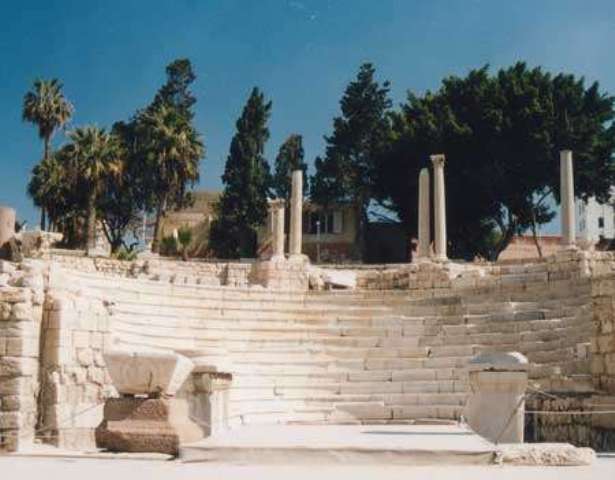
The Serapeum occupied a rocky plateau overlooking the surrounding land, with the sea to the north and Lake Mareotis to the south. Ancient descriptions place the temple on a human-made elevation about 100 feet high or more, within a vast rectangular precinct. Almost nothing of the complex survives above ground. Diocletian’s Column is the most conspicuous surviving monument, accompanied by large sphinxes and limited archaeological remains.
Precinct and temple structures
Upper precinct
The upper level contained courtyards, small chapels with images of deities, and buildings where priests and people undergoing ritual purification lived. The complex was arranged around arcades with very large windows above the arches. An independent colonnaded portico ran around the inner perimeter, while the central temple had a grand exterior faced with marble and valuable columns.
Subterranean galleries
Galleries beneath the temple probably served as places for the mysteries of Sarapis. The sanctuary also contained hidden chambers associated with ritual activity. These underground spaces formed part of the temple’s restricted religious environment, alongside the inner areas connected with the cult image.
Cult images and sacred objects
Statue of Sarapis
The central image of Sarapis was described as colossal, with its right hand reaching one wall and its left hand reaching the opposite wall. Rufinus said that the statue was made from many kinds of metal and wood. The famous image associated with the sanctuary was attributed to Bryaxis, a Greek sculptor. It had originally represented Pluto, the Greek god associated with the underworld, stood at Sinope, and was brought to Egypt by Ptolemy I before being reinterpreted as Sarapis.
Apis and other divine figures
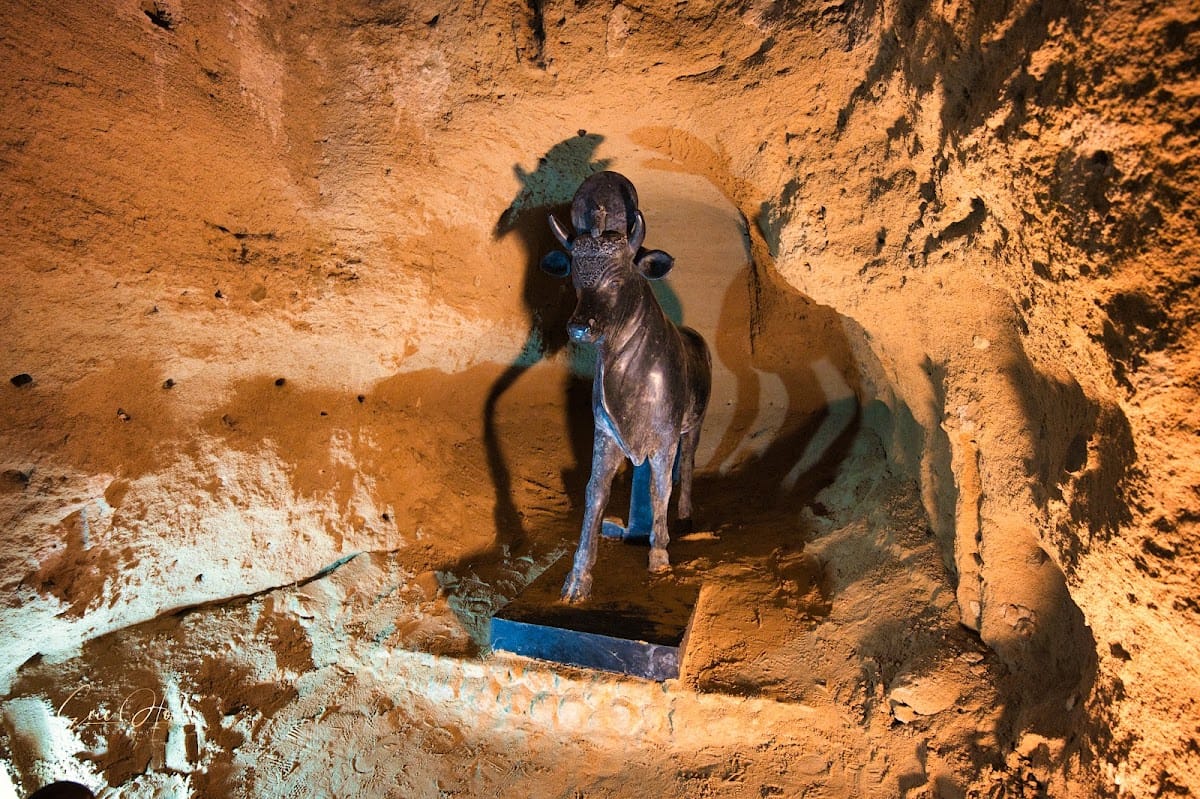
The precinct contained a black granite statue of the Apis bull, now in the Greco-Roman Museum of Alexandria, as well as two red-granite obelisks. Several sphinxes were associated with the site, and two large examples stand on plinths in front of and beside Diocletian’s Column. A black diorite statue found in 1895 represented Sarapis in his Apis-bull form, with a solar disk between the horns. Its inscription dates it to the reign of Hadrian.
Fragments indicate that the complex contained statues of twelve gods. A nineteenth-century description mentioned nine standing figures holding scrolls, possibly corresponding to the nine Muses traditionally associated with the Library of Alexandria. The related sculptures were probably made in the third century from limestone and stucco, with some figures standing and others seated. A marble torso of Mithras, a deity associated with the Roman mystery cult of Mithraism, was found in 1905 and 1906.
Harpocrates temple
Foundation deposits for a separate temple dedicated to Harpocrates were found within the enclosure walls. Harpocrates was the Greek form of the Egyptian child-god Horus and represented the child aspect of that deity in Hellenistic religious practice. The deposits date the building to the reign of Ptolemy IV Philopator.
Decorative and ritual installations
The sanctuary’s decoration included statues, valuable marbles, gold and silver surface treatments, and bronze plating. Rufinus described chapel walls with gold sheets on their lower sections, silver above them, and bronze at the highest level. Excavations also recovered 58 bronze coins and three silver coins, with dates extending to AD 211.
A narrow opening on the eastern side was calculated so that the rising sun could illuminate the mouth and lips of the statue of Sarapis at dawn. The arrangement created the appearance of a solar greeting. Another reported installation used an iron image of the sun and a magnet concealed in the ceiling. The magnet was said to draw the image upward, leading worshippers to believe that it was suspended in the air. The account presents this as a mechanical deception attributed to the temple’s priests.