Schloss Sababurg: A Medieval Hill Castle in Germany


Site at a Glance
- Rating
- 3.9
- Popularity
- Medium
- Country
- Germany
- Primary era
- Early Modern
- External website
- Open
- Eras represented
- Medieval, Early Modern, Modern
- Civilizations
- Holy Roman Empire
- Site type
- Military
- Remains
- Castle
On this page14 sections
History
Schloss Sababurg is a medieval hill castle in Sababurg near Hofgeismar, Germany, founded by the Mainz Bishopric in the fourteenth century. Its original construction began on 19 April 1334 and ended in 1336, creating a fortified site connected with pilgrimage, territorial rivalry, and the protection of travellers.
Foundation and Territorial Rivalry
The Mainz Bishopric, a powerful ecclesiastical principality, established the castle to protect pilgrims travelling to nearby Gottsbüren. In 1330, an allegedly incorrupt body believed to be that of Jesus was said to have been found there, turning the settlement into a pilgrimage destination. Revenue from the pilgrims probably helped finance the building works.
The foundation of Zappenburg, as the castle was first known, reflected competition among the Mainz Bishopric, the Landgraviate of Hesse, the Bishopric of Paderborn, and the Duchy of Brunswick. A landgraviate was a territorial principality ruled by a landgrave. After construction ended, Arnold of Portenhagen became the first Burgmann, or castle officer. Following a conflict in 1346 in which Mainz was defeated, the castle was divided between Hesse and Paderborn. It was described as abandoned in 1455 and passed entirely to Hesse in 1462, after the end of the Mainz Diocesan Feud.
Hessian Hunting Lodge
From 1490, Landgrave William I of Hesse commissioned a hunting lodge on the foundation walls of the medieval castle. The resulting Zapfenburg remained in use for about three centuries as a setting for festivals and social gatherings. The demand for drinking water for people and animals led to the construction of a water pipeline, while a stud farm was established at the site.
Construction of the principal residential and representative building, the palas, began in 1508 and was completed in 1519 under William I’s nephew, Landgrave Philip I. In 1582, a chancellery building was added when the castle became the seat of the Gieselwerder administrative office. The name Sababurg appears for the first time during this period.
War, Decay, and the Sleeping Beauty Association
Catholic troops commanded by Field Marshal Tilly occupied the castle in 1628 during the Thirty Years’ War, a prolonged European conflict, and severely damaged the complex. Repairs were completed in 1651. The castle later acquired an overgrown and romantic appearance that became associated with the Sleeping Beauty story.
The Brothers Grimm, nineteenth-century German scholars and folklorists, helped establish the castle’s international connection with the fairy tale. Their collections began circulating and were published from 1812 onward, after which Sababurg became widely known as “Sleeping Beauty Castle.” A local tradition also holds that a thorn hedge about 5 kilometres long and 3 metres high surrounded the castle between 1571 and 1591, protecting livestock from wild animals.
Later Use and Restoration
Landgrave Charles made minor extensions to the complex, but the stud farm moved to Beberbeck in 1724. French soldiers occupied the castle in 1760 during the Seven Years’ War. It then largely fell into decay and was later used as a forester’s house. The west, east, and south wings were demolished between 1824 and 1826.
The State of Hesse began gradually restoring the complex in 1957 and opened it to the public. From 1959, the ruins were adapted for an upscale hotel with a restaurant and café, which opened in 1960. The site also housed the SabaBurgTheater. A civil wedding room established there in 1987 was the first such venue in Germany outside a town hall, and a larger second room followed in 2002.
Hotel and catering operations ended in 2018, and civil weddings were discontinued. The old hotel was demolished in 2020 during a proposed redevelopment, but work stopped in 2024 because of economic difficulties and ground conditions beneath the castle hill.
Legend and Regional Setting
Sababurg is also linked with the legend of Krukenburg. In this tradition, Saba, described as the founder of Sababurg, leaves Krukenburg to establish her own castle before being killed by her sister Trendula. This legendary origin story is separate from the documented medieval foundation of the castle.
The castle, the surrounding village, and the wildlife park form a Hofgeismar exclave within the unincorporated Reinhardswald district. Sababurg is traditionally counted among the three best-known castles of the Reinhardswald region, alongside Trendelburg and Krukenburg.
Remains
The surviving ruins occupy a relatively open basalt summit about 315 metres above sea level. Schloss Sababurg is arranged as a hill-castle complex whose defensive remains include sections of the main enclosing wall, a gate protected from the side, and associated ditches and banks. The site stands within the Reinhardswald landscape, with Beberbeck about 4.5 kilometres to the west-southwest and Gottsbüren about 4.5 kilometres to the north-northwest.
Defensive Works and Towers
Enclosing Wall and Gate
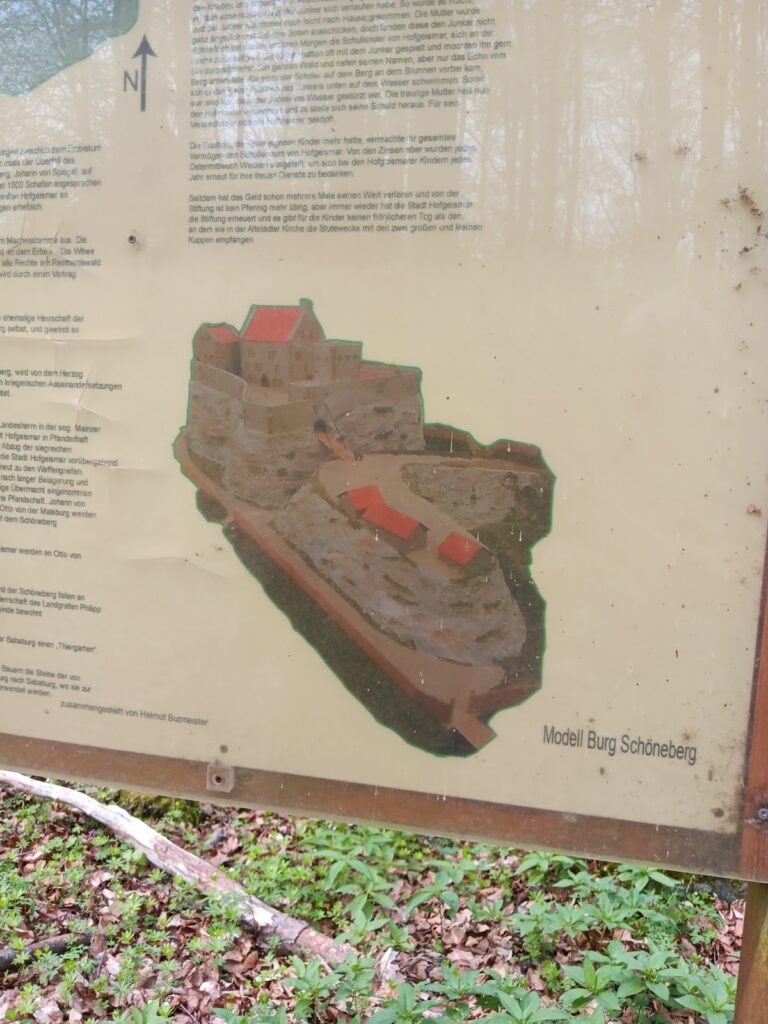
Parts of the castle’s enceinte, the main enclosing defensive wall, survive with a flanking gate and earthworks formed by ditches and banks. These remains follow the defensive organization of a medieval hill castle built on the basalt elevation.
Corner Towers and Staircase Tower
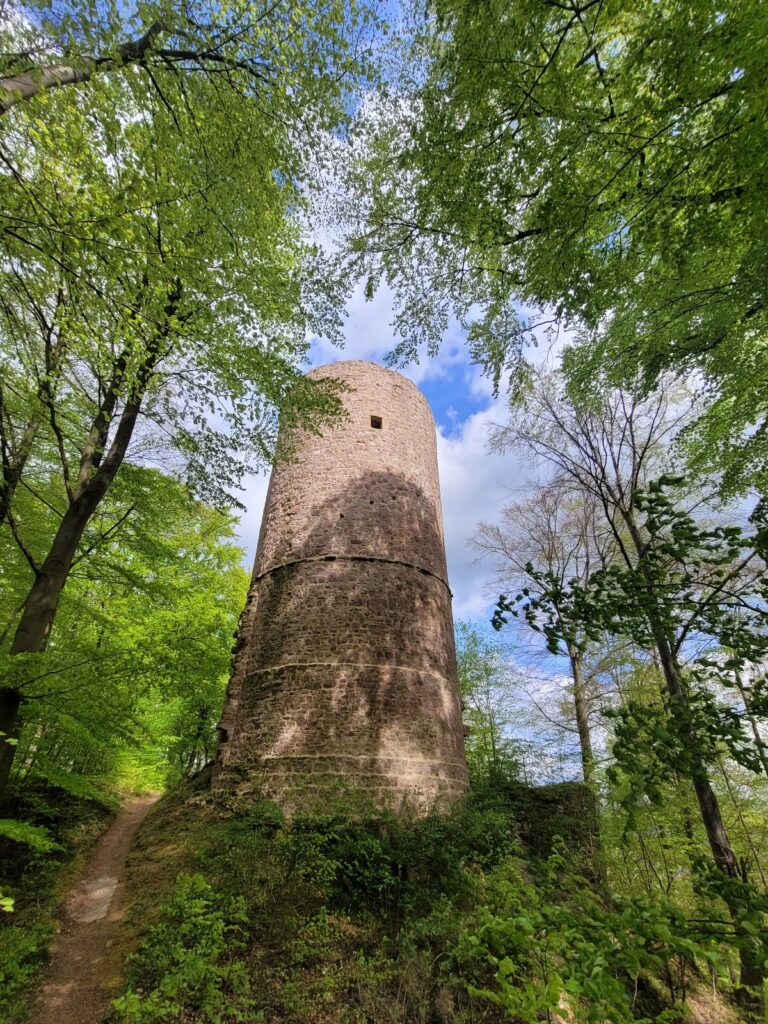
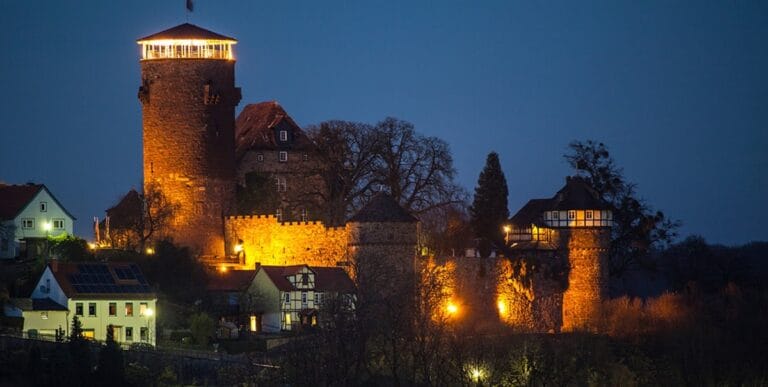
Two massive corner towers remain, each carrying a distinctive curved, often bulbous roof known as a welsche Haube. A smaller staircase tower also survives. The corner towers were incorporated into the former hotel, linking the later reuse of the ruins with the visible medieval structures.
Residential and Administrative Buildings
Palas
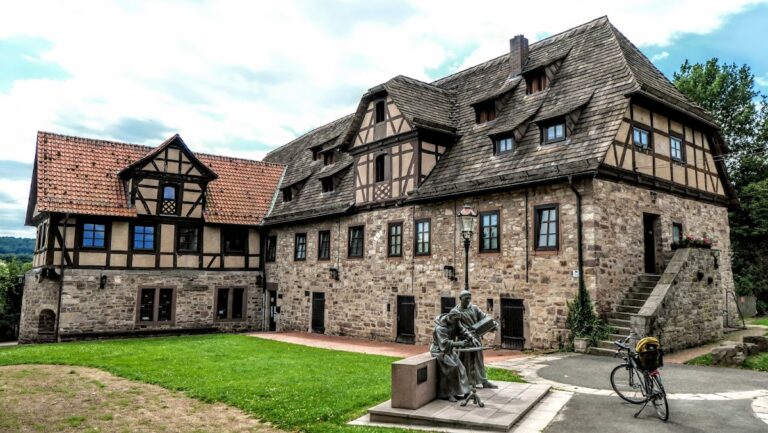
The surviving palas is represented by its outer walls. Construction began in 1508 and ended in 1519, during the transformation of the medieval castle into the Hessian hunting lodge known as Zapfenburg. Its remains belong to the residential and representative core of that later complex.
Chancellery
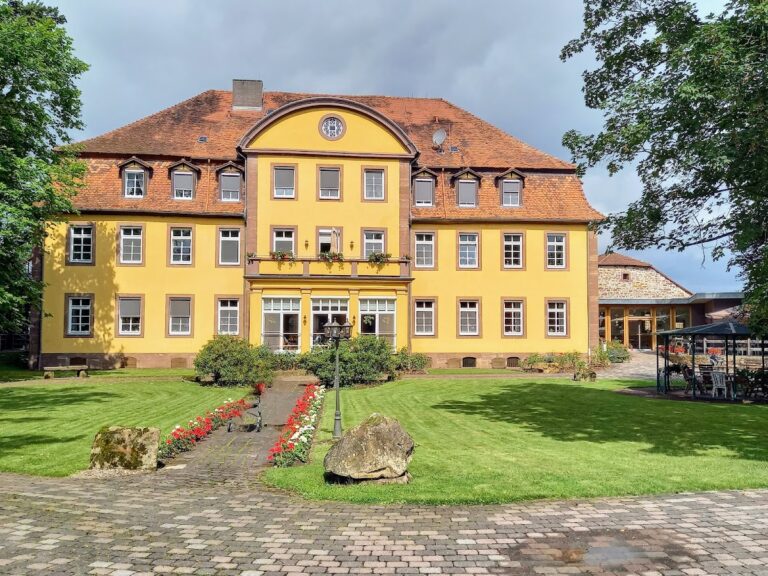
The chancellery building, erected in 1582, also survives. It reflects the period when Sababurg served as the seat of the Gieselwerder administrative office, and it received a modern extension in 1976.
Surrounding Landscape
The Sababurg Wildlife Park lies southwest and below the castle. The small Donnebach stream runs northwest through the park as an eastern, right-bank tributary of the Holzape. West of the wildlife park is the adjacent former wood pasture known as Urwald Sababurg, placing the castle’s physical remains within a landscape shaped by woodland and historic land use.
Nearby sites