Bursfelde Abbey: A Benedictine Monastic Foundation in Germany


Site at a Glance
- Rating
- 4.5
- Popularity
- Low
- Country
- Germany
- Primary era
- Medieval
- External website
- Open
- Eras represented
- Medieval, Modern
- Civilizations
- German, Holy Roman Empire
- Site type
- Religious
- Remains
- Church
On this page16 sections
History
Bursfelde Abbey is a former Benedictine abbey in Germany, founded in 1093 in the Romanesque period by Count Heinrich the Fat of Northeim with the participation of Archbishop Ruthard of Mainz. It stands at the confluence of the Nieme and Weser in Bursfelde, now part of Hann. Münden in Lower Saxony. The abbey began as a Northeim family monastery, serving as a burial place and center of memoria, or commemorative prayer for the dead, especially for the counts and their dynasty.
Foundation and Northeim patronage
The monastery was established on the Miminde estate, which Heinrich had acquired from Albert of Gieselwerder. Monks came from nearby Corvey Abbey, which remained Bursfelde’s mother house and an important associated institution. The nearby Bramburg fortress, built by Heinrich’s father Otto of Northeim, offered protection. The foundation combined the religious aims of Benedictine monasticism with Heinrich’s dynastic interests and the wider Cluniac and Hirsau reform movements, which sought stricter communal discipline, renewed prayer, and improved liturgical practice.
Ruthard of Mainz supported Bursfelde’s right to elect its abbots freely. The Northeim counts, however, retained hereditary control of the bailiff’s office. A bailiff, also called an advocate, was a lay official who represented and protected a monastery in legal and military affairs. Bursfelde therefore depended on its bailiff for protection and jurisdiction and did not possess political autonomy. Its market and minting rights appear to have supported the territorial ambitions of the Northeim family.
Heinrich was killed in Frisia in 1101 and buried on 10 April in the original foundation building, later called the West Church. His wife, Gertrud the Younger of Brunswick, founded St. Aegidien Abbey in Brunswick in 1115 and placed it under the authority of the abbot of Bursfelde. After 1135, Heinrich’s daughter Richenza and her husband, the later Emperor Lothar III, promoted the construction of the great East Choir. This enlargement strengthened the representational role of Bursfelde as the Northeim family monastery.
Transfer to the Welfs and medieval development
In 1144, after Siegfried IV, a grandson of Otto of Northeim, died without male heirs, Bursfelde and the County of Northeim passed to the Welfs. Henry the Lion, Duke of Saxony and later Duke of Bavaria, confirmed the abbey’s rights with a falsified foundation document. His authority was limited to protection and jurisdiction, preserving the distinction between the monastery’s religious administration and the secular power exercised around it.
By around 1200, the abbey held fourteen widely scattered farming estates. They extended from southern Hanover through Brunswick, West Thuringia, the Erfurt region, northern Hesse, Westphalia, and the area near Osnabrück. Most were managed through manorial associations, while the Bursfelde estate itself was administered directly. The monastery placed greater emphasis on scholarship and teaching than on craft production or agriculture.
From the late twelfth century until about 1430, relatively little is known about the abbey’s development. A late-twelfth-century vacancy of the abbacy and a proposal to relocate the monastery remain unproven. As an aristocratic monastery, Bursfelde mainly admitted members of local noble families, although two members of a prosperous Göttingen burgher family entered the community in the early fourteenth century.
Decline and the Bursfelde reform
Bursfelde entered a severe decline during the late medieval period. Only four monks were recorded in 1398, and documentary evidence disappears from 1402 until the beginning of the reform. By 1424, the church, school, and monastic buildings had nearly fallen into ruin. The elderly abbot Albert of Bodenstein resigned in 1430 because he could not undertake their restoration.
Johannes Dederoth became abbot in 1433 and began the reform of Bursfelde. After encountering the movement associated with Ludovico Barbo in Rome, he reorganized the abbey and promoted stricter discipline, renewed prayer, and liturgical reform. He also served as abbot of Clus and Reinhausen and became one of the principal initiators of Benedictine reform in northern Germany.
Dederoth died of the plague in 1439. His successor, Johannes von Hagen, formed a union that initially linked Bursfelde, Clus, Reinhausen, and Huysburg. In 1445 he sought a common liturgical order from the Council of Basel. Approval in 1446 established the Bursfelde Congregation, a fifteenth-century association of Benedictine monasteries that followed shared standards of worship, discipline, visitation, and administration. Its chapters and visitators operated under the lifelong presidency of the abbot of Bursfelde.
Between 1458 and 1530, the congregation held sixty-eight general chapters, eleven of them at Bursfelde. It eventually included at least 136 abbeys and became a major Benedictine reforming force before the Reformation curtailed its influence. The association continued in restricted form until the secularization of surviving religious houses in the late eighteenth and early nineteenth centuries. Bursfelde also supported scholarship by creating, copying, and collecting books for its monastic library.
Reformation and the end of monastic life
Reformist criticism initially encountered strong resistance at Bursfelde. In 1518, a demand was made for disciplinary action against supporters of the Reformation, the sixteenth-century movement that challenged established Catholic teaching and church authority. The general chapter could not meet in 1525 because of the Peasants’ War, and the abbey formally rejected the new teachings in 1529.
In 1542 and 1543, Duchess Elisabeth of Calenberg-Göttingen and her evangelical superintendent Antonius Corvinus conducted a visitation that converted Bursfelde to the evangelical order. Abbot Johannes Rappe retained the presidency of the congregation only conditionally, and the admission of novices was prohibited. After Erich II came to power and returned to Catholicism, Rappe reversed the Reformation at Bursfelde.
Following Erich’s death, Duke Julius of Brunswick-Wolfenbüttel introduced another evangelical visitation and required Abbot Johannes Pumme to renounce Catholicism. The monastery became definitively evangelical under the Peace of Westphalia in 1648, the settlement that ended the Thirty Years’ War and regulated the religious and political order of the German territories. Monastic life and the institutional functioning of the abbey ended during the seventeenth century. Its estates were leased, and the abbatial title became honorary.
Evangelical prelature and modern functions
Under Abbot David Denicke, who held office from 1640 to 1679, Bursfelde entered a period of evangelical prelature under Protestant territorial rule and became part of the Hanoverian Monastery Fund. A prelature is an ecclesiastical office or institution governed by a prelate. Denicke was the last conventual abbot, meaning the last abbot belonging to a resident monastic community, and he did not live at the monastery. After his death, the title was granted to distinguished officials.
Since 1828, the title of Abbot of Bursfelde has been an honorary office awarded to a theology professor at the University of Göttingen. It carries preaching rights at Bursfelde and the general rights and duties of an ordained minister, but no specifically prescribed duties. Since the 1955 Loccum Treaty, its ecclesiastical and legal arrangements have been regulated by the Lower Saxony Church Treaty.
Abbot Carl Stange, who held the title from 1932 to 1959, gave it a more active institutional role and initiated the Bursfelde Ascension meetings of the University. The traditional university service on Ascension Day continues the abbey’s Benedictine association with prayer and study. Since 1978, the Spiritual Center at Bursfelde has provided year-round programs for paid and voluntary church workers. It belongs to the House of Church Services of the Church of Hanover and includes a conference house and facilities for retreat and silence.
The former abbey library was divided into several collections between the Reformation and the Thirty Years’ War and was later dispersed or destroyed. The largest surviving portion is held by the University Library of Marburg, having reached it through the library of Corvey Abbey after Corvey was dissolved in 1812. Other holdings passed through Corvey to the Archbishop’s Academic Library in Paderborn and the diocesan archive in Trier. Additional books and manuscripts are held in libraries in Göttingen, Hanover, Hildesheim, Kassel, Bonn, Brussels, Strasbourg, Harvard, and Berlin. An inventory shows that the library remained intact until 1585, although the exact date and circumstances of some transfers to Corvey remain uncertain.
The surviving church and the former monastic estate, covering approximately 300 hectares, belong to the General Hanoverian Monastery Fund, administered by the Hanover Monastery Chamber. The Evangelical-Lutheran Church of Hanover is the legal body responsible for the Spiritual Center. The historic cultural landscape of Niemetal with Bursfelde Abbey covers approximately five square kilometers and was classified in 2018 as a cultural landscape of state-wide importance in Lower Saxony. This classification does not create a special legally binding protection status.
Remains
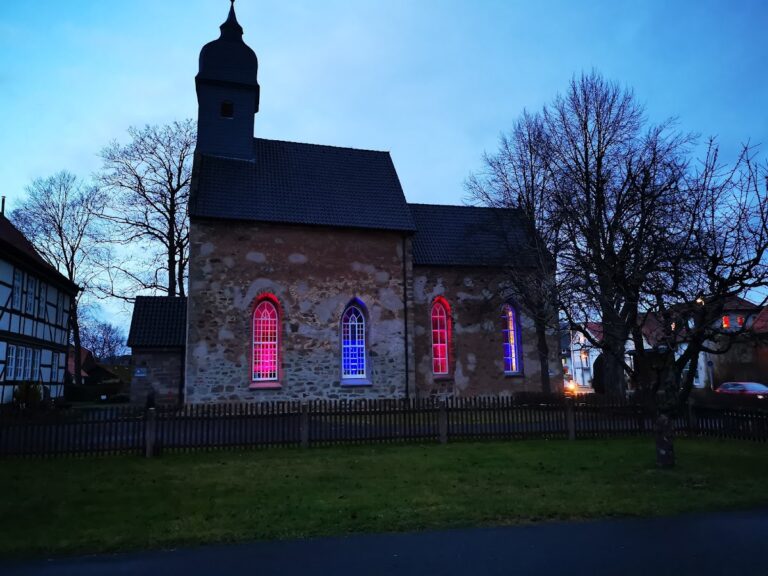
The surviving remains consist primarily of the Romanesque Abbey Church of St. Thomas and St. Nicholas. The church is divided into an East Church and a West Church, preserving the principal phases of the abbey’s medieval construction as well as later alterations. The other former monastic buildings have largely disappeared or have been converted to different uses. Together, the church and associated structures show how the original late-eleventh-century basilica was enlarged in the twelfth century and repeatedly adapted thereafter.
The Romanesque church
West Church
The original church was a three-aisled columned basilica with seven arcades, a transept, a square choir, and a rectangular apse. The West Church formed part of the first foundation building and is associated with Heinrich the Fat’s burial. Its northern wall preserves herringbone masonry. From the late eleventh century, the arcade zone followed the Hirsau choir scheme, an arrangement associated with the Hirsau reform tradition that gave the eastern liturgical spaces a structured form. Four alternating sequences of columns and piers stood on high bases, and the eastern part of the church later received a similar arrangement.
East Church and East Choir
The East Church was enlarged after 1135 with the great East Choir, promoted by Richenza and Lothar III. The church’s impost blocks, the horizontal stones transferring an arch’s load to its support, bear a checkerboard pattern. Later painted decoration survives on the shields of the cushion capitals, which are medieval capitals shaped in simplified cushion-like forms. The choir received tracery windows during the later medieval period. Its apses were remodeled in the nineteenth century, while the exterior ashlar pattern still indicates the earlier rectangular choir form.
Medieval decoration and later alterations
Frescoes and windows
Large fifteenth-century frescoes survive above the arcades on both sides of the church. They show figures of saints separated by ornamental fields. The nave was repainted around 1450, and the choir’s windows were altered during the later Middle Ages. The original Romanesque windows had red-and-white stripes and were later changed into pointed-arch windows.
Division and westwork
In 1846, a wall was inserted between the East and West Churches. The East Church became a parish church, while the West Church was used as a barn. The south and east wings of the monastery were demolished, and their materials were used to construct the dividing wall. The apses were also remodeled during the nineteenth century, changing the appearance of the eastern ends.
The unstable westwork, the western entrance and tower block of a medieval church, was dismantled and rebuilt between 1901 and 1904. Two tower spires were added during this work. The church towers facing the Weser were constructed or reshaped in historicist nineteenth-century forms. The East Church is used for regular worship, while a room of silence immediately to its south provides a place for quiet prayer. The West Church is used for choral and chamber-music performances during the Bursfelde Summer Concerts.
Bell collection
A historic hour bell in the church tower weighs 100 kilograms. It was found in 1952 at the Hamburg bell cemetery and brought to Bursfelde. The bell still in use bears an inscription stating that it was cast in Danzig in 1470. Another bell is identified as having come from Königsberg Cathedral.
Former monastic buildings
Baroque manor house
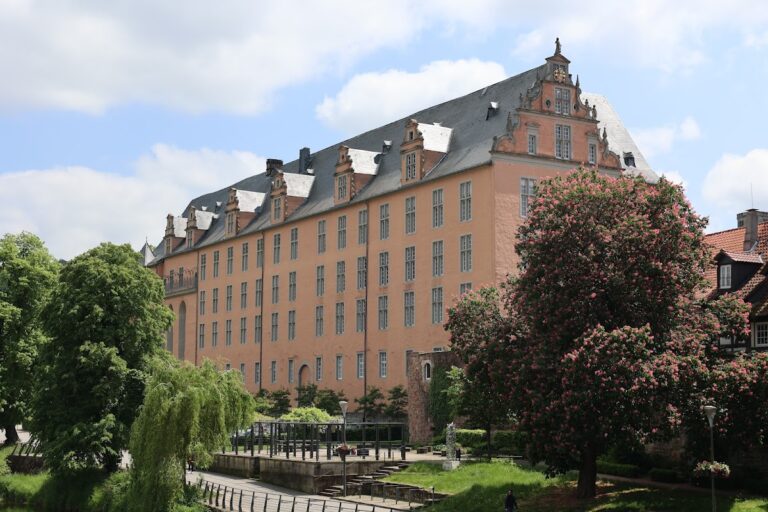
The abbey’s baroque manor house was created in 1722 by converting a monastic wing into a manor. It was renovated and modernized in 1990 and is now used as the Bursfelde Conference Center. The building contains thirty-six beds and forms part of the surviving complex associated with the former abbey.
Nearby sites