Burgruine Schöneberg: Medieval Hilltop Castle Ruins in Germany


Site at a Glance
- Rating
- 3.2
- Popularity
- Very Low
- Country
- Germany
- Primary era
- Medieval
- Eras represented
- Medieval
- Civilizations
- Holy Roman Empire
- Site type
- Military
- Remains
- Castle
On this page6 sections
History
Burgruine Schöneberg, also called Schöneburg, is a medieval hilltop castle ruin in Germany, near Hofgeismar. Established around 1122, the castle is attributed to Count Hermann II of Winzenburg, who built it to protect his possessions.
From Winzenburg to Mainz
After Hermann was murdered in January 1152, Schöneberg passed to the archbishops of Mainz. As senior ecclesiastical authorities and territorial rulers in the Holy Roman Empire, they granted the castle as a fief, or property held in return for service and allegiance, to the Lords of Eberschütz. From 1170, this family was known as the Lords of Schonenberg.
Conflict and Hessian control
Schöneberg became involved in the prolonged struggle between Mainz and Hesse in the Hofgeismar region. In a document of 1303, the Lords of Schonenberg promised that Schöneberg Castle, like nearby Trendelburg Castle, would always remain open to the Archbishop of Mainz.
After the landgraves of Hesse achieved a definitive victory over Archbishop Konrad III of Dhaun in the Mainz–Hessian War of 1427, most former Mainz possessions in northern Hesse came under Hessian supremacy. Landgrave Ludwig I probably purchased Schöneberg Castle in 1429. The remaining Mainz possessions between the Diemel and Weser were later pledged to Landgrave Ludwig II of Hesse because of debts arising from the Mainz Diocesan Feud of 1461–1463, a conflict over the political and territorial interests of the Archbishopric of Mainz and its opponents. Hofgeismar consequently also came under Hessian control.
Demolition and later record
The castle was demolished in 1582–1583. Landgrave Wilhelm IV ordered its stones to be reused in the walls of the game park at Sababurg. In 1655, Matthäus Merian the Younger included the ruins and their presumed appearance in Topographia Hassiae, an illustrated topographical work on Hesse. A modern information panel presents the history and presumed appearance of the castle, while the castle well has been restored.
Remains
Hilltop castle site
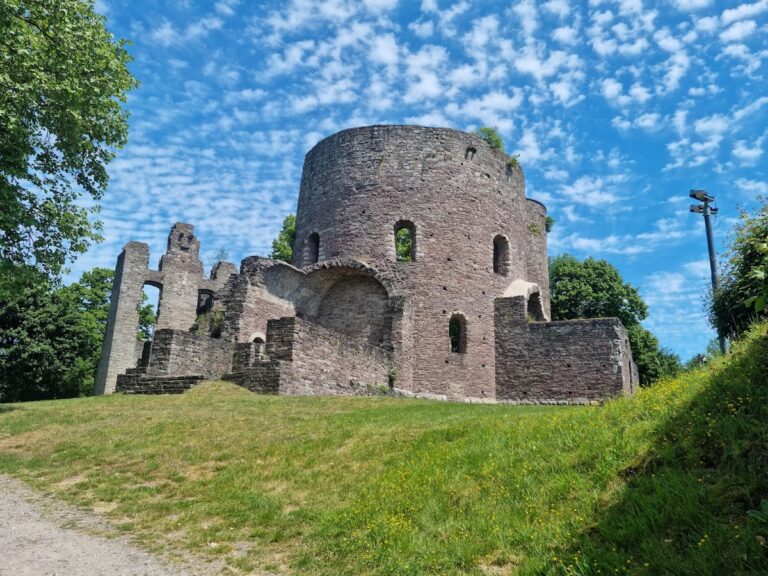
The surviving remains occupy the steep basalt cone of Schöneberg, a 323.2-metre hill north of Hofgeismar, northwest of the Schöneberg district, and south of Hümme. The Esse, a tributary of the Diemel, runs west of the hill, near the Schießbach farm or hamlet, approximately 190 metres below the castle site. The former extensive complex now survives as a largely vanished castle site, with only a few fragments representing its archaeological remains.
A restored castle well is among the surviving features. Together with the remaining fragments, it belongs to the physical evidence of the hilltop stronghold and helps identify the former castle location on the basalt cone.
Nearby sites