Rudelsburg: A Medieval Hill Castle in Germany
Site at a Glance
- Rating
- 4.7
- Popularity
- Medium
- Country
- Germany
- Primary era
- Medieval
- External website
- Open
- Eras represented
- Bronze Age, Medieval, Modern
- Civilizations
- German, Holy Roman Empire
- Site type
- Military
- Remains
- Castle
On this page20 sections
History
Rudelsburg is a medieval hill castle in Germany, above Saaleck near Naumburg in Saxony-Anhalt. It was probably established by the bishops of Naumburg in the mid-twelfth century, during the Romanesque period, to help secure trade routes including the Via Regia, a major east-west route across central Europe, and the Saale crossing at Bad Kösen. The often repeated foundation dates of about 1030 or 1050 are unsupported. The castle first appears reliably in 1171.
Origins and Medieval Rule
In 1171, a Naumburg ministerial named Hugo de Ruthelebesburch was associated with the castle. Ministerials were officials and military retainers who served powerful lords and could rise into the lower nobility. The family connected with Rudelsburg and Schönburg belonged to this service nobility and cannot be shown to have been related to the high-noble Schönburg family.
Rudelsburg was expanded into its principal medieval form during the second half of the twelfth century and was largely complete by the century’s end. In 1238, the bishop of Naumburg enfeoffed Heinrich the Illustrious, Margrave of Meissen, with the castle and settlement, while local administration remained with ministerials. A document of 1271 lists twelve castellans at Rudelsburg, and a priest was recorded there in 1293. By then, an oppidum, or settlement, lay east of the castle within or beside the large outer ward.
The castle stood within the political struggle between the bishops of Naumburg and the Wettin margraves of Meissen. The Wettins were a powerful ruling dynasty whose territories included much of central Germany. In 1348, citizens of Naumburg led by their captain Johann von Trautzschen besieged Rudelsburg during a feud with the nobleman Curtefrund. The attack apparently captured and destroyed the castle, killing and wounding people on both sides and taking at least one castellan prisoner. The outer ward suffered especially heavily, probably because Naumburg regarded it as an economic rival.
The siege also involved an unusual weapon whose nature remains uncertain. It may have been a stone-throwing engine or an early firearm. In a burned stone cellar in the outer ward, excavators found extensive fire debris together with tableware fragments, toys, and metal objects. The Schenks of Saaleck, a branch of the House of Vargula, were recorded as lords of Rudelsburg in 1383. A Wettin feudal document of 1441 names Rudolf, Günther, and Heinrich von Bünau as holders, apparently without lands outside the castle grounds.
Destruction and Decline
During the Saxon civil war between Friedrich and Wilhelm of Saxony, Rudelsburg was besieged and destroyed again in 1450. The inner castle was burned. The 1485 division of the Wettin lands assigned Rudelsburg to the Albertine line, the branch of the dynasty that ruled the Albertine territories including Saxony. In 1538, Bishop Philipp of Naumburg enfeoffed the von Bünau family and the knights of Rudelsburg with their ecclesiastical fiefs, including the Kreipitzsch estate and nine hides in the Camburg district.
Rudolph von Bünau of Teuchern and Günther von Bünau of Gröbitz sold the castle, the estates of Kreipitzsch and Krölp, and the town of Naumburg to Hans George von Osterhausen in 1581 to settle debts. Maintenance then became increasingly inadequate. Gregor Groitzsch nevertheless called Rudelsburg the “most beautiful castle” in 1584. By 1612, emergency work was needed to support collapsing beams, rafters, and other structural members. A court session still took place there on 4 June 1616, although only a caretaker lived at the castle.
Swedish troops burned Rudelsburg in 1640, near the end of the Thirty Years’ War, the European conflict that devastated much of central Europe between 1618 and 1648. Following this third destruction, the castle was abandoned on 14 April 1641, and its occupants moved to the Kreipitzsch estate.
The von Creutz(en) family probably owned Rudelsburg from 1671 to 1774. In 1690, its members attempted to establish the uninhabited castle as a possession directly subject to the emperor of the Holy Roman Empire, a status known as Reichsunmittelbarkeit. The associated settlements and estates, however, had separate feudal relationships. In 1770, the owner ordered the outer-ward walls demolished for building material. The work stopped after a worker was permanently disabled in an accident regarded as a bad omen. Friedrich Adolph von Creutz died in 1774, ending the relevant family line in male succession.
Ownership and Romantic Revival
The counts von Zech and von Brühl were briefly recorded as later owners. The von Schönberg family purchased Rudelsburg in 1797 and established a family entail, an inheritance arrangement designed to keep the estate undivided. The family retained the castle as part of the Kreipitzsch estate into the twentieth century. Colonel Kurt von Schönberg owned it until 1938, followed by his widow, Alice von Schönberg.
During the nineteenth century, Rudelsburg became a destination for Romantic travelers and students from Jena, Leipzig, and Halle. Gottlieb Wagner, known as “Samiel,” began serving visitors from the Kreipitzsch estate in 1824 and opened the first castle tavern at Easter 1827. Growing visitation led to the construction of a road to the castle. Improved transport also broadened its appeal, particularly after the Thuringian Railway was completed in 1849.
Franz Kugler composed An der Saale hellem Strande at Rudelsburg in 1826 while resting during a walk along the Saale. Hermann Allmers later composed the student song Dort Saaleck, hier die Rudelsburg in 1863. In June 1848, about 500 corps students met at the castle to begin creating an umbrella organization. The decision was implemented at the University of Jena a month later, leading to the establishment of the Kösener Senioren-Convents-Verband, an organization of German-speaking university corps, traditional student associations with formal membership and ceremonial customs.
A drinking hall was built in the inner courtyard in 1853, probably in connection with a breakfast offered to King Frederick William IV during a Prussian military exercise nearby. After a storm brought down sections of the perimeter walls in December 1868, repairs began in 1870. Partial reconstruction followed from 1871 under plans by the royal Saxon building officer Oskar Mothes, with the work carried out by the mason Werner of Bad Kösen. It was completed by Easter 1872.
From 1855, Rudelsburg served as the annual meeting place of the Kösener organization in connection with gatherings at Bad Kösen. The reconstruction and the erection of student monuments changed the castle from a Romantic excursion site into a representative and commemorative center for the corps. The first major monument, the Pillar to the Fallen, was dedicated in 1872 to corps students killed in the Franco-Prussian War. The Emperor William I Obelisk followed in 1890, the Young Bismarck Monument in 1895–96, and the Lion Monument in 1926 for members killed in the First World War.
Twentieth-Century Changes
The last pre-war Kösener meeting at Rudelsburg took place in 1934. The organization was dissolved by the National Socialists after its 1935 congress. A clandestine attempt to revive it culminated in a meeting and ceremonial gathering at Rudelsburg in 1944, but no lasting institution resulted.
After the Second World War, Rudelsburg fell within the Soviet occupation zone and later the German Democratic Republic. The noble owner was expropriated, and the castle was transferred to the town of Bad Kösen. Student organizations moved to West Germany, while Rudelsburg and its monuments deteriorated. Some larger metal components were melted down.
Student traditions began to revive among East German students during the 1960s and early 1980s. On 20 June 1987, the association Salana Jenensis organized the first ceremonial gathering of East German student associations at Rudelsburg. Nineteen people attended, with some arriving on the Saale by raft or zinc bathtub. The associations formed the Rudelsburg Alliance in 1990, and the castle has remained their annual meeting place.
After 1990, corps associations gradually returned to their former universities. The first post-war Kösener Congress in Bad Kösen took place in 1995 and again incorporated Rudelsburg. Preparations were supported by building-archaeological documentation undertaken in 1990 and 1991. Since German reunification, the corps monuments have been progressively restored through contributions from the Kösener organization, individual corps, and private donors. The song Dort Saaleck, hier die Rudelsburg remains associated with both the Kösener corps and the Rudelsburg Alliance.
Archaeological work has also extended the history of the hilltop beyond the medieval castle. Finds from the late nineteenth century onward indicate intensive occupation and probable fortification during the Late Bronze Age and Iron Age. Later discoveries point to an earlier Early Bronze Age settlement associated with the Unetice culture, an archaeological culture of central Europe known for settlements and metalwork. Excavations in 2005–06 revealed prehistoric features beneath medieval deposits and showed that the early settlement had not been entirely destroyed, although its layers had been substantially disturbed. Prehistoric finds and excavated materials are held mainly by the State Museum of Prehistory in Halle and the prehistoric and early historical collection of the University of Jena.
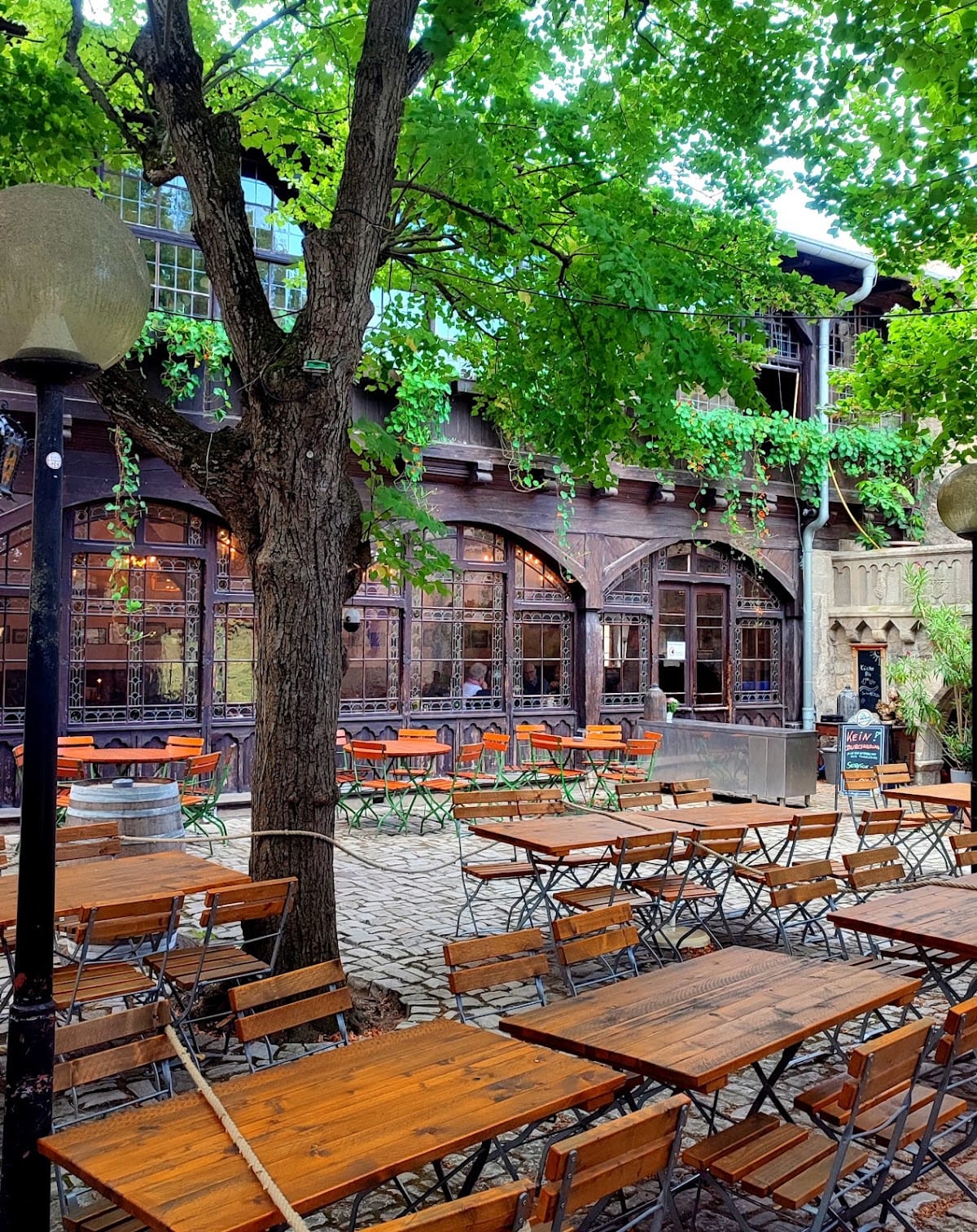
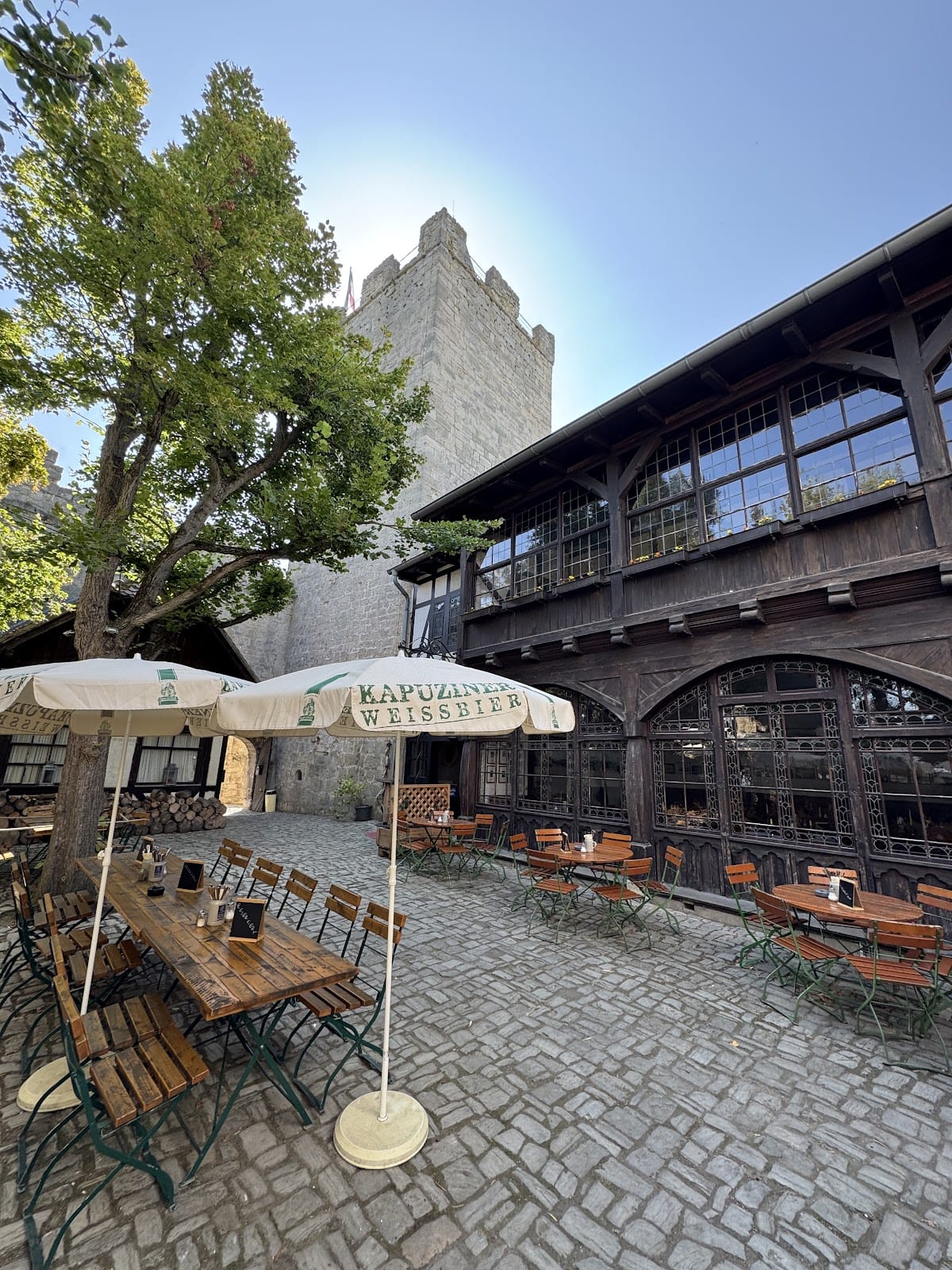
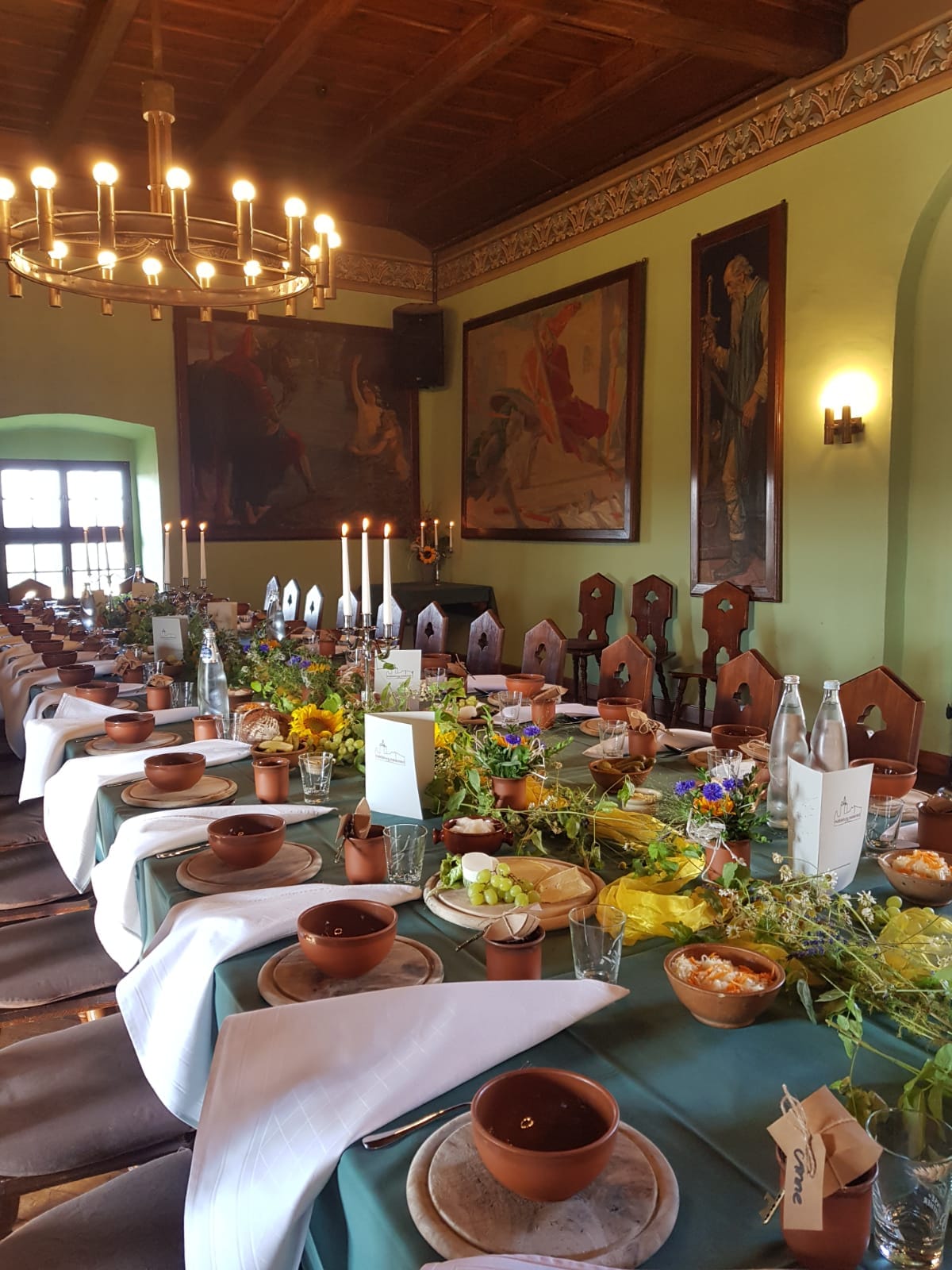
Rudelsburg is administered within the municipality of Naumburg, although its historical associations include Bad Kösen and Saaleck. It forms part of the Romanesque Road cultural route and is used as a restaurant and an external civil-registry office for weddings. In 2018, Thiemo von Creytz became tenant and operator of the castle restaurant, bringing a descendant of the von Creutz(en) family back to Rudelsburg after 244 years.
Remains
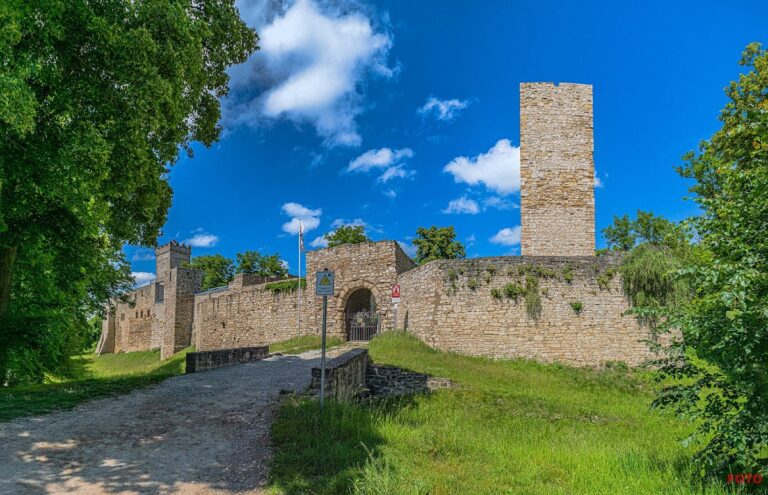
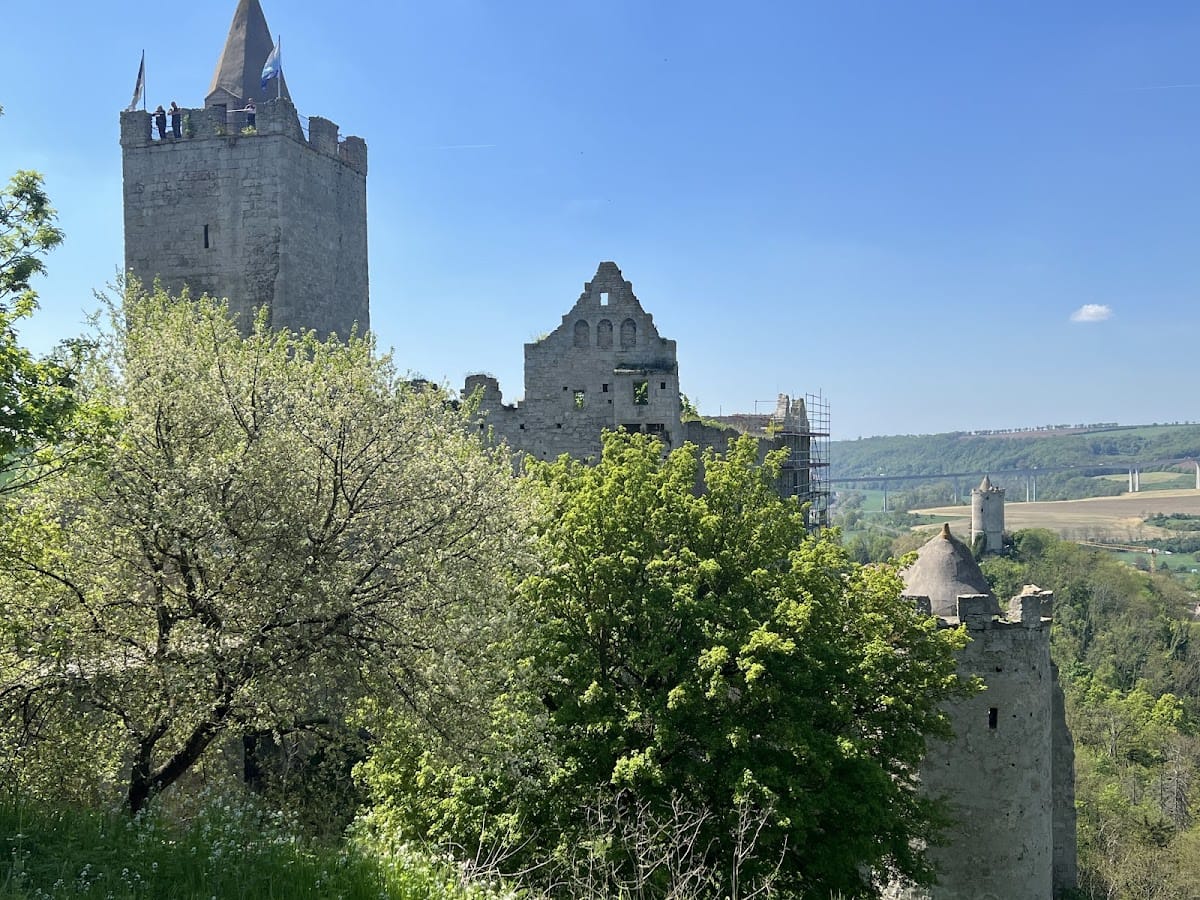
Rudelsburg occupies a rocky shell-limestone ridge about 85 metres above the southern bank of the Saale. The ridge runs from west-southwest to east-northeast, drops steeply toward the river, and slopes more gently on its other sides. The castle is divided into a small inner castle at the western end and a much larger outer ward spread across most of the higher plateau. The outer ward covered approximately 22,000 square metres and contained the residences of castle retainers and production facilities.
Outer Ward
Walls, Gates, and Settlement
The outer ward was defended on its west, south, and east sides by walls, a ditch, and an earthwork, with two gates. Excavations have revealed both stone and timber-framed buildings extending close to the perimeter wall. The ward was heavily quarried for building stone during the eighteenth century and is now difficult to identify as a complete enclosure, although wall remains survive or were encountered during later construction in the southern and eastern areas. The burned stone cellar associated with the 1348 siege contained fire debris, tableware fragments, toys, and metal objects, providing evidence of domestic activity and violent destruction.
Later Tower and Windmill
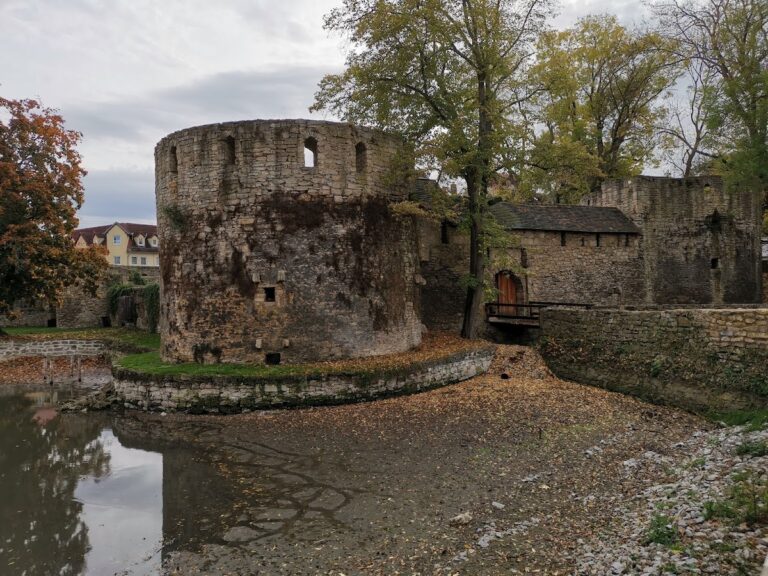
Larger surrounding walls with rounded corner towers, which functioned as projecting defensive platforms, were probably added in the middle of the fifteenth century. A further defensive enclosure on the southern side had two corner towers, with the strongest at the southeast. The eastern side was protected by the ditch, an additional defensive passage, and the main tower of the inner castle. A windmill was later erected on one of the round towers. It appears in many representations of Rudelsburg until the mid-nineteenth century and was destroyed by fire in 1864.
Inner Castle
Fortifications and Courtyard
A deep neck ditch separates the inner castle from the outer ward. The inner enclosure forms an irregular quadrilateral about 40 by 24 metres around a small courtyard. Its perimeter wall contains the main tower, the palas, living quarters, and other medieval rooms. The western side stood above the steepest rock face and was the least accessible approach. There, the palas and perimeter wall formed the principal defenses.
The northern wall was set back from the cliff edge by about 1.5 metres rather than built directly on it. This arrangement probably reduced the danger of collapse if the brittle limestone broke away. A later projecting corner tower at the northeast helped prevent attackers from reaching the ledge between the wall and the cliff. An eastern defensive enclosure, a passage between the main fortification and an outer wall, was probably built during the Romanesque period and appears to have been planned from the castle’s beginning.
Bergfried
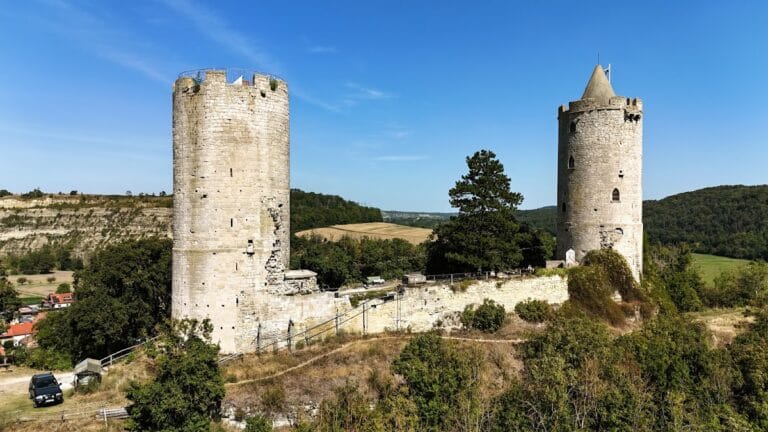
The Romanesque bergfried, the principal tower of a medieval German castle and a place of defense and refuge, stands in the southeast corner of the inner castle. It rises approximately 20 metres and has an almost square plan measuring about 7.60 by 8.20 metres. Its stone pyramidal roof creates the characteristic outline of Rudelsburg. The tower is older than the adjoining southern perimeter wall. A dungeon was installed in its basement only in relatively recent times, while the lower rooms now contain display cases concerning the student associations.
Palas and Medieval Rooms
The palas, the castle’s principal residential or ceremonial hall, occupies the western part of the inner castle. It is a transverse rectangular building integrated structurally with the southern perimeter wall. Its architectural decoration, especially the capitals, indicates a date around 1200. The upper storey and the raising of the northern perimeter wall were completed during the Romanesque period.
By the early nineteenth century, the inner courtyard was heavily ruined. A description from 1818 mentions rubble from collapsed ceremonial halls, chambers, weapon and storage rooms, kitchens, vaults, cellars, and passageways. The destruction made the original internal arrangement difficult to reconstruct. The first tavern, built in 1827, was a wooden structure with a thatched roof. In 1853, it was replaced or supplemented by a drinking hall formed by a roofed seating area open toward the courtyard.
Reconstructed Entrance Area
The reconstruction of 1871–72 added or restored the entrance, bridge, knight’s hall, staircase, and an adjoining room. A large breach at the northeast corner was filled, and windows were cut into the old northern wall. A cannon captured during the Franco-Prussian War was placed beside the bridge.
Student Monuments
Pillar to the Fallen
The Pillar to the Fallen, the first major corps monument, was dedicated in 1872. It consisted of a stepped base, a platform and balustrade, a four-metre pedestal, and a pillar topped by an imperial eagle. The monument was destroyed in 1953, and its surviving remains have not been completely reconstructed.
Emperor William I Obelisk
The Emperor William I Obelisk was unveiled on 25 May 1890. It was destroyed during the period of the German Democratic Republic and rebuilt after German reunification.
Young Bismarck Monument
Norbert Pfretzschner created the Young Bismarck Monument in 1895–96. It portrayed Otto von Bismarck as a seated young corps member wearing a student sash and carrying a dueling sword. The original was destroyed, but its inscribed foundation stone and Bismarck’s student cap survived. A replacement memorial was erected in 1998, and a reproduction of the original was unveiled in 2006. The reproduction has itself been damaged by souvenir hunters or vandals.
Lion Monument
Created by Hermann Hosaeus and unveiled in 1926, the Lion Monument depicts an oversized lion pierced by lances and dying in relief. It commemorated 2,360 Kösener members killed in the First World War. After reunification, the overgrown monument was restored, and plaques commemorating those killed in both world wars were added.
Rudelsburg Alliance Memorials
The Rudelsburg Alliance erected a memorial stone in 1997 for the tenth anniversary of the 1987 East German student gathering. The earlier concrete Old Alliance Stone, installed in 1987, remains in its original position. Together with the restored and reconstructed corps monuments, these memorials form part of the twentieth- and twenty-first-century commemorative fabric of the grounds.