Mylau Castle: A Medieval Hill Fortress and Museum in Germany


Site at a Glance
- Rating
- 4.5
- Popularity
- Low
- Country
- Germany
- Primary era
- Medieval
- External website
- Open
- Eras represented
- Medieval, Early Modern, Modern
- Civilizations
- Electorate of Saxony, German, Holy Roman Empire
- Site type
- Military
- Remains
- Castle
On this page12 sections
History
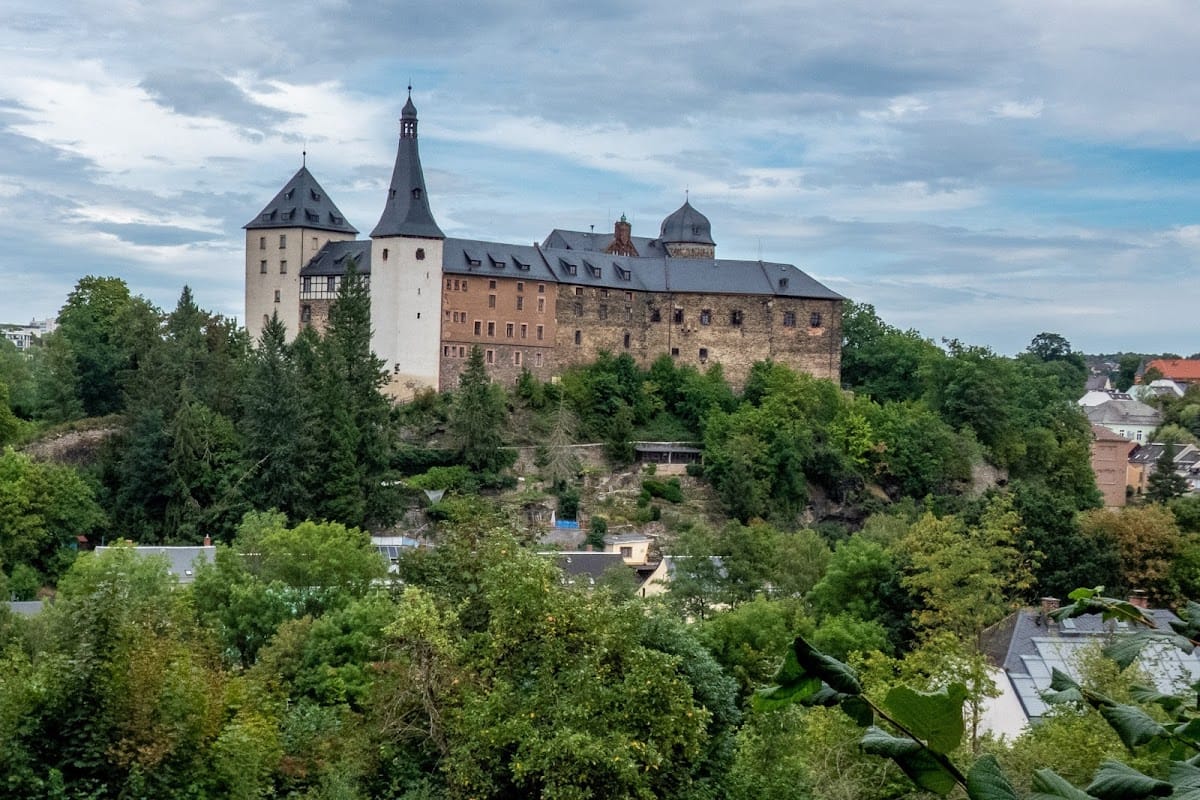
Mylau Castle is a medieval hill castle in Germany, located in the town of Mylau above the confluence of the Göltzsch and Seifenbach. Probably erected around 1180 during the German eastward expansion associated with Frederick I, known as Barbarossa, it served as a lordly seat and protected predominantly Frankish settlers in an area then sparsely inhabited by Slavs. The settlement that became Reichenbach im Vogtland developed under the castle’s protection.
The Lords of Milin and the Bohemian Crown
The Lords of Milin, who occupied the castle, were first recorded in 1214. Their control ended after the Vogtland War, when Emperor Charles IV, the fourteenth-century Holy Roman Emperor and King of Bohemia, compelled them to sell Mylau Castle to the Bohemian Crown in 1367. Charles visited Mylau in the same year, granted town privileges to the settlement below the castle, established a royal Bohemian office there, and began enlarging the complex. His sons Wenceslaus IV and Sigismund continued this work.
A section of the castle was destroyed in 1400 during a feud between Wenceslaus IV and the Vogtland bailiffs, medieval territorial officials whose name is associated with the historical region of the Vogtland. The rebuilding that followed included two large outer baileys, expanding the fortified site beyond its earlier arrangement.
In 1422, Sigismund pledged Mylau Castle to the Electors of Saxony in recognition of their services during the Hussite Wars, fifteenth-century religious and political conflicts centered in Bohemia and linked to the followers of the reformer Jan Hus. Apart from the years 1547 to 1569, when a burgrave administered the Vogtland, the castle remained under Saxon control.
Aristocratic residence and industrial reuse
From the middle of the fifteenth century, Mylau Castle passed successively to the families von Metzsch, von Schönberg, von Bose, and von der Planitz. Joseph Levin von Metzsch, a theologian and friend of Martin Luther, was among its lords. Under the von Schönberg family in the late sixteenth century, the complex was transformed from a defensive stronghold into a residence. Its use as an aristocratic seat ended in 1772, after which the castle passed into private ownership.
The complex later acquired an industrial role. Between 1808 and 1828, the spinning-mill owner Christian Gotthelf Brückner operated the first factory in northern Vogtland there. From 1868 to 1894, the Baust calico and wool-printing works used the castle, making several alterations for industrial production. These successive uses added to the building’s earlier defensive and residential phases.
Municipal ownership and the museum
Mylau Castle came into municipal ownership in 1892. A castle-building association then remodeled it in the Historicist style, a nineteenth-century approach that revived and combined forms from earlier periods. The renovated complex served as a town hall, tavern, and museum, while the town hall in the upper courtyard was built between 1894 and 1896.
The Mylau Natural History Society began displaying its collections in the former Imperial Hall in 1893. After the society was dissolved in 1945, the town of Mylau administered the museum from 1948. In 1956 it became the Museum of the Reichenbach District, combining the Mylau collections with much of the holdings of the Reichenbach museum and developing a regional-historical focus. In 1990, responsibility for the museum was assigned to the town of Mylau, and further castle rooms were converted into exhibition spaces.
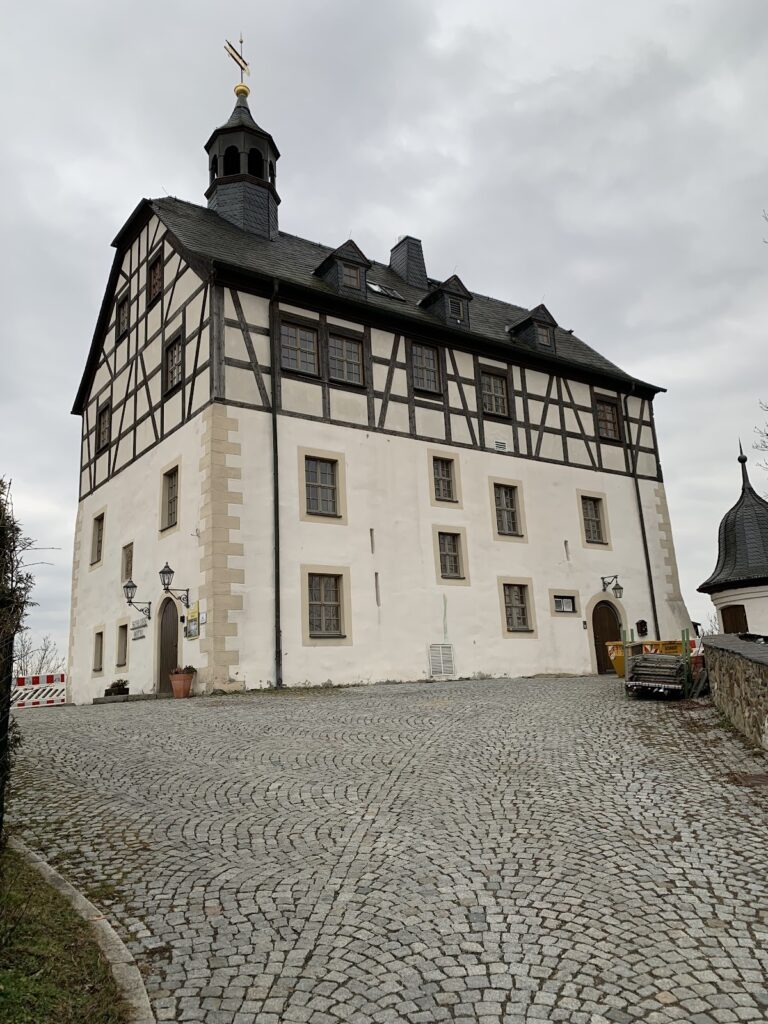
Operation of the castle and museum passed to the Evangelical School Association of Vogtland in 2010. A new permanent exhibition was created in the upper-courtyard rooms in 2014 and 2015, and since 1 August 2014 the museum has been directed by restorer Sina Klausnitz. Finds made in the castle grounds before 1983 range from the thirteenth century to the modern era. The castle area was registered as an archaeological monument on 7 July 1956, and the castle has been protected as a monument since 1980. It is now used primarily as a museum and also contains offices.
Remains
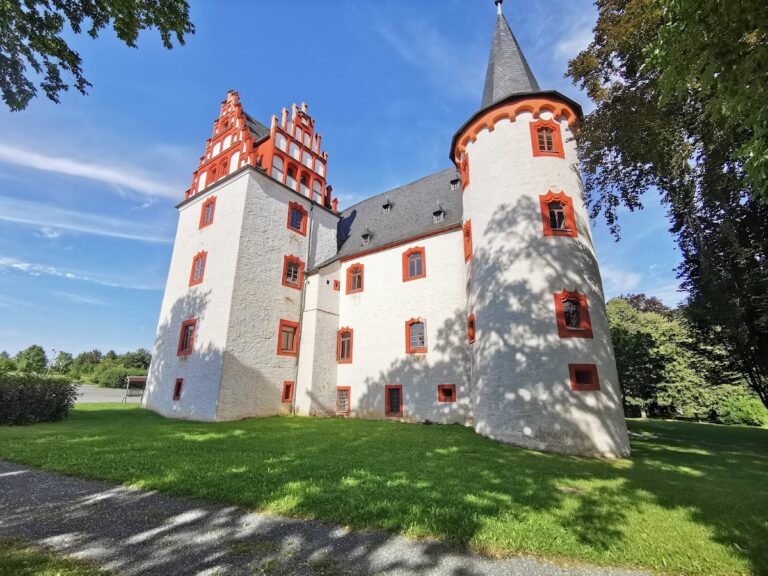
Mylau Castle occupies a rocky spur rising above the confluence of the Göltzsch River to the west and the Seifenbach to the north. The spur projects toward the northwest. The castle was arranged as a single-courtyard stronghold on a rocky ridge about 80 metres long and 35 metres wide. Its original defenses included four towers and a dry moat approximately 10 metres deep. The complex now brings together Romanesque fabric, later defensive additions, industrial alterations, municipal buildings, and Historicist elements.
Medieval fortifications
Keep and original stronghold
The 27-metre-high keep dates from the Romanesque period. In a medieval German castle, the keep, or Bergfried, was the principal defensive tower and functioned mainly as a stronghold rather than as a permanent residence. It forms the dominant surviving element of the original castle on the rocky ridge, whose defensive arrangement also included the four towers and the surrounding dry moat.
Outer baileys and entrance route
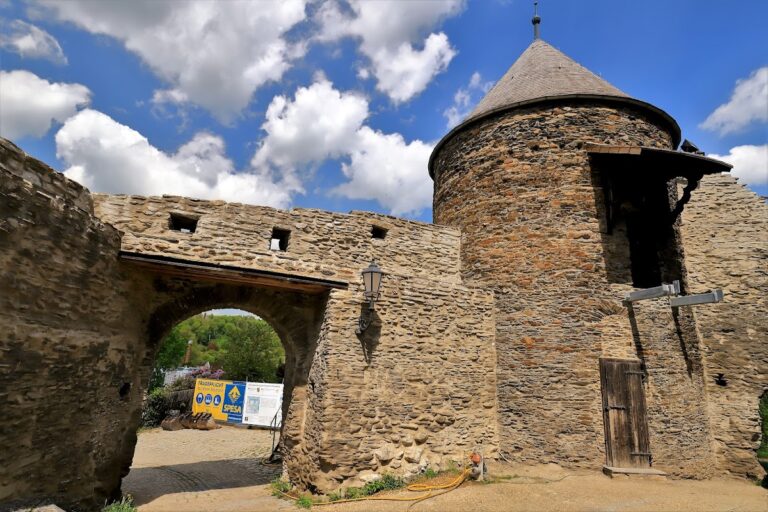
The reconstruction after the destruction of 1400 produced two powerful outer baileys. Together with the earlier single-courtyard core, they reflect the castle’s expansion under the Bohemian kings. A porphyry relief of Charles IV stands above the main entrance gate. The Market Gate leads along the Imperial Path to the Imperial Court, and thirteen panels on the route explain architectural features and the castle’s history under Charles IV, Wenceslaus IV, and Sigismund.
Historicist municipal buildings
Upper-courtyard town hall
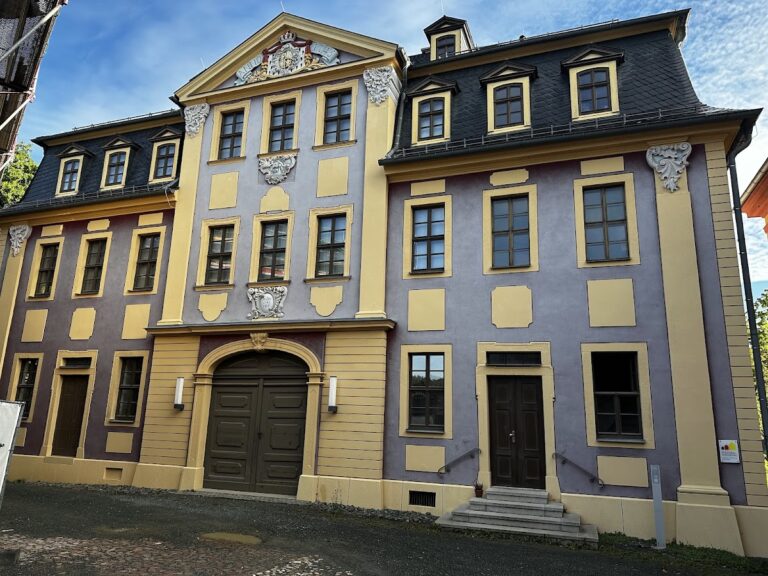
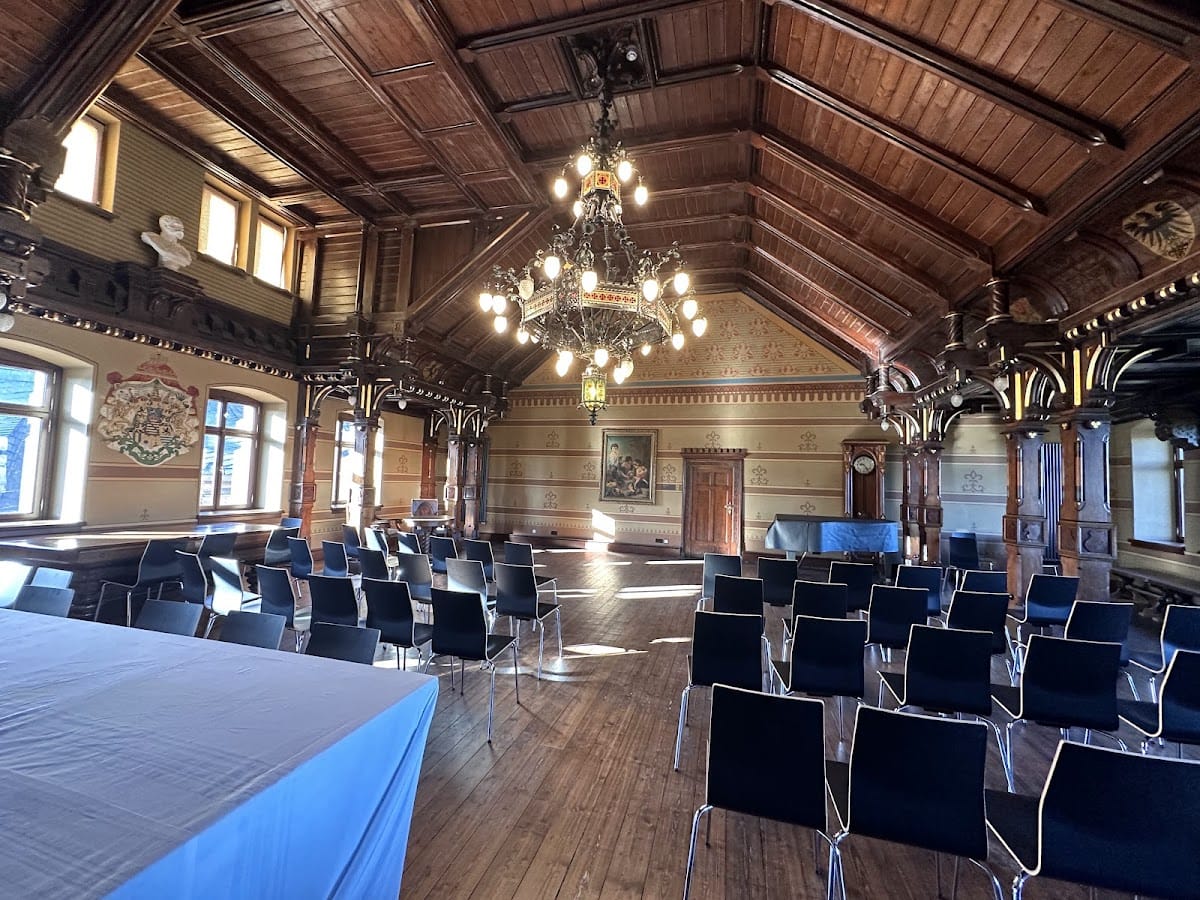
The town hall built in the upper courtyard between 1894 and 1896 is constructed of quarry stone, with architectural details in Rochlitz porphyry. A German imperial crown is displayed on its gable. The council chamber has a wood-paneled ceiling and ornamental wall paintings in the Neo-Renaissance style. Its design was modeled on the Wartburg, and a marble bust of King Albert stands in the gable field. Painted-glass windows made in 1890 by the Cologne workshop Schneiders and Schmolz complete the room’s decorative scheme.
Imperial Hall and Metzsch Room
The former Imperial Hall became an exhibition space for the Mylau Natural History Society in 1893. The castle also contains a former Metzsch Room, established in 1899 and 1900 to present the history of the family that held Mylau Castle for an extended period. Additional rooms were later adapted for museum use, preserving the building’s continued conversion from residence and industrial complex into a public cultural institution.
Museum collections
The museum’s collections cover natural history, regional geology and mining, the construction of the Göltzsch Viaduct, and the history of the Metzsch family. The natural-history collection is described as the largest in the Vogtland. The grounds and buildings preserve evidence of repeated rebuilding and conversion for defensive, residential, industrial, municipal, and museum purposes.