Edinburgh Castle: Royal Fortress and Military Stronghold


Site at a Glance
- Rating
- 4.6
- Popularity
- Very High
- Country
- United Kingdom
- Primary era
- Early Modern
- External website
- Open
- Eras represented
- Medieval, Early Modern, Modern
- Civilizations
- British, English, Kingdom of Scotland
- Site type
- Military
- Remains
- Castle
On this page16 sections
History
Edinburgh Castle is a historic fortress in Edinburgh, United Kingdom, occupying Castle Rock at the western end of the Old Town. The site has been used since at least the Iron Age, while its royal and military buildings developed chiefly from the medieval period onward. It became one of Scotland’s principal royal centres, a repository for state papers, an arsenal, and a major stronghold during conflicts between Scotland and England.
Early occupation and Din Eidyn
People occupied Castle Rock during the late Bronze Age or early Iron Age, although the scale and character of this settlement remain uncertain. Excavation in the 1990s produced Roman pottery, bronze objects, and brooches from occupation during the first and second centuries AD. These finds point to a possible trading relationship between the Votadini, an Iron Age Brittonic people whose territory included southeastern Scotland and northeastern England, and the Romans during and after Agricola’s northern campaign, from about AD 82 until approximately AD 140, when the Antonine Wall was established across central Scotland. The settlement may have included a broch, a circular fortified structure, although its function is uncertain.
Ptolemy’s second-century name Alauna may refer to Castle Rock, giving it a possible early recorded name, although the same name could have described another hillfort in Votadini territory. The later name Maidens’ Castle appears frequently until the sixteenth century and occurs in charters issued by David I and his successors. Medieval and early-modern explanations linked the name with Pictish royal maidens, nuns, or legends of nine maidens, but these traditions came to be regarded as uncertain.
Around AD 600, the Welsh poem Y Gododdin referred to Din Eidyn, generally identified with Castle Rock. The poem describes the Gododdin king Mynyddog Mwynfawr and his warriors leaving the fortress after a year of feasting to fight the Angles at Catreath, probably Catterick. Irish annals state that Etin was besieged in 638 and that the Gododdin were defeated by Angles under Oswald of Northumbria.
The surrounding area later became part of the Kingdom of Northumbria, which was absorbed into England during the tenth century. Lothian became part of Scotland during the reign of Indulf, around 954 to 962. Evidence for this transition consists of midden deposits and continues the archaeological sequence from the Roman period.
Royal centre in the twelfth century
The first documentary reference to a castle at Edinburgh appears in John of Fordun’s account of Malcolm III’s death in 1093. Fordun wrote in the later fourteenth century, and his near-contemporary account by Bishop Turgot does not mention a castle, so the story requires chronological caution. Fordun states that Malcolm’s widow, the future Saint Margaret, was staying at Maidens’ Castle when she heard of his death, after which Malcolm’s brother Donald Bane besieged it.
During the reigns of Malcolm III and his sons, Edinburgh Castle became one of Scotland’s principal royal centres. Malcolm’s son Edgar died there in 1107. David I, king of Scots from 1124 to 1153, strengthened royal administration and developed Edinburgh as a centre of government. Between 1139 and 1150 he held assemblies of nobles and churchmen at the castle, gatherings that formed a precursor to the Scottish Parliament.
By the end of the twelfth century, the castle probably served as a principal repository for Scotland’s official state papers. In 1174, William the Lion surrendered it to Henry II of England under the Treaty of Falaise after his capture at the Battle of Alnwick. An English garrison occupied the castle for twelve years. It returned to William in 1186 as part of the dowry of his bride, Ermengarde de Beaumont.
Wars of Scottish Independence
Edward I of England briefly stayed at Edinburgh Castle during negotiations over the Scottish succession after Alexander III’s death in 1286, and may have received homage from Scottish nobles there. In March 1296, during the First War of Scottish Independence, the castle surrendered after a three-day English bombardment. Edward transferred Scottish legal records and royal treasures from the castle to England and had installed a garrison of 325 men by 1300.
After Edward I died in 1307, Scottish forces recaptured the castle on 14 March 1314 in a surprise night assault led by Thomas Randolph, 1st Earl of Moray. According to John Barbour’s The Brus, thirty selected men climbed the northern face of Castle Rock with the help of William Francis, a member of the garrison. Robert the Bruce then ordered the castle to be slighted, meaning that its defences were deliberately damaged so the English could not easily reoccupy it.
English forces reoccupied and refortified Edinburgh Castle in 1335 during the Second War of Scottish Independence. William Douglas, Lord of Liddesdale, recovered it in 1341 through a deception involving men disguised as merchants from Leith. A cart was brought to the entrance and prevented the gates from closing, allowing a hidden assault force to enter and kill the garrison’s 100 English soldiers.
After the Treaty of Berwick ended the Wars of Independence in 1357, David II rebuilt the castle as his principal seat of government. David’s Tower began around 1367 and was completed by Robert II during the 1370s. In the early fifteenth century, an English army under Henry IV began another siege but withdrew because its supplies ran short.
Royal politics and the growth of the arsenal
Sir William Crichton was keeper or governor of the castle by 1436 or 1437 and later became Chancellor of Scotland. In 1440, William Douglas, the sixteen-year-old sixth Earl of Douglas, and his younger brother David were summoned to the castle. After the event known as the Black Dinner in David’s Tower, both boys were summarily executed before the ten-year-old James II on fabricated charges. Supporters of the Douglas family later besieged the castle and damaged it.
Alexander Stewart, Duke of Albany, was imprisoned in David’s Tower in 1479 for plotting against his brother, James III. He escaped after getting his guards drunk and lowering himself from a window on a rope. In 1482, he returned to Scotland with Richard, Duke of Gloucester, later Richard III, and an English army. James III was confined in the castle from 22 July to 29 September before a settlement was negotiated.
During the fifteenth century, Edinburgh Castle increasingly functioned as an arsenal and arms factory. The first known gun was purchased in 1384, and Mons Meg, a large medieval cannon, arrived in 1457. Robert Borthwick was casting bronze guns at the castle by 1498, and Edinburgh had become Scotland’s principal foundry by 1511. Its production included guns for the flagship Great Michael and the Seven Sisters cannons captured by the English at Flodden in 1513. Dutch craftsmen made hand culverins there from 1510, while French smiths later produced hagbuts.
The royal family increasingly lived at Holyrood Abbey and Holyroodhouse, reducing the castle’s residential role. James IV nevertheless commissioned the Great Hall, completed in the early sixteenth century, and the castle hosted his Wild Knight and Black Lady tournaments. His daughter Margaret Stewart also stayed there.
The sixteenth-century fortress
After James IV died at Flodden on 9 September 1513, the Scots strengthened Edinburgh’s town wall and the castle’s defences. James V was brought to the castle for safety when he was five years old. After his death, the crown passed to his infant daughter, Mary, Queen of Scots. During the English burning of Edinburgh in 1544, the castle gunner Andrew Mansioun destroyed an English cannon positioned to bombard the castle’s forework.
Refortification in 1548 added the earthen angle bastion called the Spur, an early British example of the trace italienne, a system of low, angled artillery fortifications developed for gunpowder warfare. Brunstane Castle, the home of Alexander Crichton, was demolished to provide building material. The Spur may have been designed by the Italian engineer Migliorino Ubaldini and reportedly carried the arms of France. Mary of Guise, Mary, Queen of Scots’ mother, served as regent from 1554 until her death at the castle in 1560.
Mary, Queen of Scots, returned from France in 1561 and gave birth to her son James in a small palace room on 19 June 1566. Following her forced abdication in 1567, the castle passed through the control of James Balfour and Regent Moray. After the Battle of Langside in May 1568, Moray appointed Sir William Kirkcaldy of Grange as keeper.
When Regent Moray was murdered in January 1570, Grange changed allegiance and held Edinburgh Castle for Mary. The resulting conflict, known as the Lang Siege, lasted from 1571 to 1573 and involved blockades, bombardments, sorties, and continued strengthening of the fortress. A truce in 1572 temporarily ended the blockade, but fighting resumed on 1 January 1573.
In the final bombardment, government forces under Regent Morton received support from about 1,000 English troops led by Sir William Drury and twenty-seven cannons from Berwick-upon-Tweed. Around 3,000 shots were fired over twelve days. David’s Tower collapsed on 22 May 1573, Constable’s Tower fell the following day, and the Spur was captured on 26 May. Grange arranged for Drury’s troops to enter the castle on 28 May rather than surrender to Morton. Grange, his brother James, and the jewellers James Mossman and James Cokke, who had minted coins for Mary inside the castle, were executed on 3 August.
Rebuilding and the end of the royal residence
Regent Morton rebuilt much of the damaged fortress, including the Spur, the Half Moon Battery, and the Portcullis Gate. The ruined palace block saw little use after James VI became king of England in 1603. James ordered repairs in 1584 and extensive work in 1615 and 1616 for his return visit. He held court in the refurbished palace in 1617, but continued to prefer sleeping at Holyrood.
In 1624, James VI and I created the Baronetage of Nova Scotia to promote settlement in territory granted to Sir William Alexander. Because the territory was distant, the king permitted the legal ceremony of taking possession, or sasine, to be performed symbolically at Edinburgh Castle, which was described as Scotland’s most eminent and principal place.
Charles I visited the castle once, holding a feast in the Great Hall and spending the night there before his Scottish coronation in 1633. This was the last residence at the castle by a reigning monarch. In 1639 and again in the following year, Presbyterian Covenanters captured the fortress after sieges during the civil conflict over Charles’s attempts to impose episcopal government on the Scottish Church. The Spur was badly damaged and demolished during the 1640s.
Civil conflict and permanent military occupation
After his capture in 1650, the Royalist commander James Graham, 1st Marquess of Montrose, was imprisoned at the castle. Later that year, Edinburgh Castle fell to Oliver Cromwell after a three-month siege that caused further damage. Its governor, Colonel Walter Dundas, surrendered despite reportedly having sufficient supplies.
After the Restoration of the monarchy in 1660, Charles II maintained a full-time standing army, and a permanent garrison remained at Edinburgh Castle until 1923. The fortress served as a military and political centre as well as a prison. Its prisoners included the Marquis of Argyll in 1661 and his son, the ninth Earl of Argyll, during the reign of James VII.
During the Glorious Revolution of 1688, the Catholic governor, the Duke of Gordon, refused to surrender the castle to supporters of William of Orange. In March 1689, 7,000 troops blockaded the 160-man garrison. Viscount Dundee urged Gordon to resist, but after a three-month siege, dwindling supplies, and the loss of seventy men, Gordon surrendered on 14 June.
The castle nearly fell during the first Jacobite rising in 1715, an attempt by supporters of the Stuart claim to restore the dynasty to the British throne. About 100 Highlanders led by Lord Drummond tried to scale the walls with help from members of the garrison. Their rope ladder was too short, the alarm was raised, and the Jacobites fled. Deserters inside the castle were hanged or flogged.
General Wade reported in 1728 that the defences were decayed and inadequate. Major strengthening followed during the 1720s and 1730s, when Captain John Romer designed new artillery defences and bastions, projecting fortification platforms used to provide fire along adjoining walls. William Adam built these works.
The castle’s final military action occurred during the second Jacobite rising in 1745. Charles Edward Stuart’s army captured Edinburgh without a fight, but General George Preston, the castle’s deputy governor, refused to surrender. After the Battle of Prestonpans, the Jacobites tried to blockade the fortress. Preston bombarded their positions in the town, destroying several buildings and killing four people before the blockade was abandoned.
The vaults held prisoners of war during the Seven Years’ War, the American War of Independence, and the Napoleonic Wars. A major prison break in 1811 saw forty-nine prisoners escape through a hole in the south wall. This led to the abandonment of the castle’s prison use in 1814.
Rediscovery, conservation, and continuing military associations
In 1818, Sir Walter Scott received permission to search the castle for the Scottish crown, believed to have been lost after the 1707 Union. He opened a sealed room and found the Honours of Scotland in a chest. The crown, sceptre, and sword of state were subsequently displayed to the public. The palace began opening more widely during the 1830s, and Mons Meg returned from the Tower of London in 1829.
St Margaret’s Chapel, which had been used as a store, was rediscovered in 1845 by the antiquary Daniel Wilson and restored in 1851 and 1852. Works funded by the publisher William Nelson and carried out by Hippolyte Blanc during the 1880s included the construction of the Argyle Tower over the Portcullis Gate and restoration of the Great Hall. A new Gatehouse followed in 1888. Nineteenth-century proposals to rebuild the entire castle as a Scottish baronial chateau were not realised. Work begun in 1858 was soon abandoned, although the hospital building was remodelled in 1897. David Bryce’s proposed 50-metre memorial keep for Prince Albert, who died in 1861, was rejected by Queen Victoria.
Responsibility passed from the War Office to the Office of Works in 1905. The garrison moved to Redford Barracks in 1923, although the castle was used again as a prison during the First World War and for captured German Luftwaffe pilots during the Second World War. The honorary office of Governor of Edinburgh Castle, vacant since 1876, was revived in 1935 for the General Officer Commanding in Scotland.
Historic Scotland assumed care of the castle in 1991, and it became a Scheduled Ancient Monument in 1993. Its buildings and structures are protected by twenty-four separate listings, including thirteen at category A, Scotland’s highest level of protection for historic buildings. The Scottish Ministers own the castle, which is managed chiefly by Historic Environment Scotland. The British Army remains responsible for the New Barracks and military museums, and the fortress retains a ceremonial and administrative military role, including the regimental headquarters of the Royal Regiment of Scotland and the Royal Scots Dragoon Guards. It forms the backdrop to the Royal Edinburgh Military Tattoo and is associated with the annual One O’Clock Gun, a time signal established in 1861 for ships in Leith harbour and the Firth of Forth. The current L118 Light Gun entered service on 30 November 2001.
Remains
Edinburgh Castle occupies the summit and eastern approach of Castle Rock, the hard dolerite plug of an extinct volcano formed approximately 350 million years ago during the lower Carboniferous period. The rock rises to 130 metres above sea level and about 80 metres above the surrounding land, with steep cliffs to the north, south, and west. Its gentler eastern ridge provides the readily accessible approach. The fortress follows this natural terrain, concentrating its defensive works along the route to the summit through a succession of gates, batteries, walls, and courtyards.
Eastern approach and artillery defences
The Esplanade is a long, gently sloping forecourt. The sixteenth-century Spur originally occupied this area, while the present parade ground was laid out in 1753 and extended in 1845. A dry ditch in front of the entrance reached its present form in 1742. James III’s approach road, built in 1464 to move cannon, curves northwards around the Half Moon Battery and Forewall Battery before reaching the Portcullis Gate. A separate tunnel excavated in 1990 connects the north of the Esplanade with the northwestern part of the castle for visitor and service traffic.
The Gatehouse was added in 1888 as a largely decorative architectural frontage. Statues of Robert the Bruce and William Wallace, made by Thomas Clapperton and Alexander Carrick, were added in 1929. The motto Nemo me impune lacessit, meaning “No one attacks me with impunity,” is inscribed above the gate. Offices occupy the Gatehouse, and a ticket office designed by Gareth Hoskins Architects was completed to its north in 2008.
The Portcullis Gate was begun by Regent Morton after the Lang Siege to replace the destroyed Constable’s Tower. William Schaw completed its upper parts in 1584, and those sections were altered in 1750. In 1886 and 1887, Hippolyte Blanc replaced the upper structure with the Scots baronial Argyle Tower, while the original gate survived below. The Argyle Tower takes its name from the imprisonment there of the ninth Earl of Argyll before his execution in 1685. The rebuilding was described as an extreme form of restoration and was the first of works funded by William Nelson.
Western batteries and water supply
The Argyle Battery overlooks Princes Street. To the west are Mills Mount Battery, the Low Defences, and the ruined Wellhouse Tower at the base of the rock. The Wellhouse Tower was built in 1362 to protect St Margaret’s Well. The eighteenth-century military area also includes former cart sheds, now used as tea rooms, and the Argyle, Mills Mount, Low, Western, Butts, and Dury’s batteries. Butts Battery takes its name from the archery targets formerly placed there, while the West Sally Port provides access to the western slope.
Castle Rock’s impermeable basalt made water storage difficult. A 34-metre-deep well served the Upper Ward, but its supply frequently ran out during droughts and sieges. St Margaret’s Well provided an important secondary spring, and water was raised from it by a crane on the platform called the Crane Bastion. The Fore Well, cleared and surveyed in 1912 and 1913, is 110 feet, or 34 metres, deep and is largely cut through the rock.
Upper Ward and medieval fortifications
The Upper Ward, or Citadel, occupies the highest part of Castle Rock and is entered through the late seventeenth-century Foog’s Gate. The name’s origin is unknown, while the former name Foggy Gate may refer to Edinburgh’s sea fogs, known as haars. Large cisterns beside the gate reduced dependence on the well. The ward contains St Margaret’s Chapel, Mons Meg, the nineteenth-century Dogs’ Cemetery for regimental mascots, the Lang Stair, a surviving section of medieval bastion, the Forewall Battery, and the Half Moon Battery.
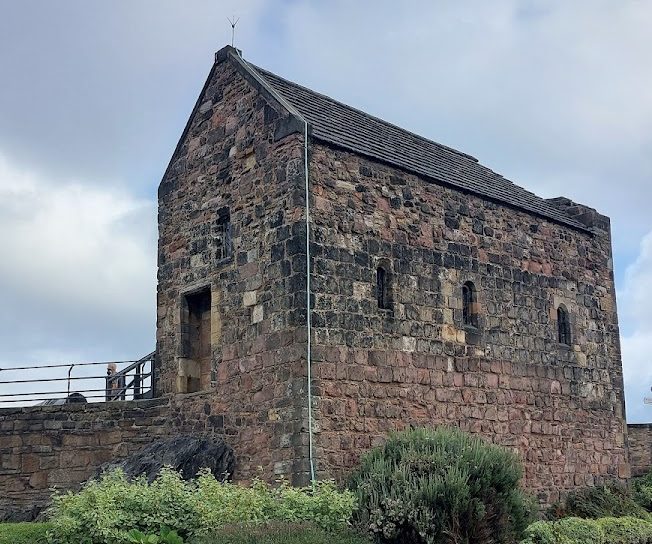
St Margaret’s Chapel is the oldest surviving building in Edinburgh and one of the few surviving twelfth-century structures in a Scottish castle. David I built it as a private royal chapel and dedicated it to his mother, Saint Margaret, who died at the castle in 1093. The small stone building survived the slighting of 1314, served as a gunpowder store from the sixteenth century, was rediscovered in 1845, and was restored in 1851 and 1852. It remains available for religious ceremonies, including weddings.
Mons Meg is a fifteenth-century bombard displayed on the terrace before St Margaret’s Chapel. Made in Flanders in 1449 on the orders of Philip III, Duke of Burgundy, it was presented to James II in 1457. The 13,000-pound gun rests on a reconstructed carriage based on an old stone relief inside the Gatehouse tunnel. Several associated gun stones, each weighing about 330 pounds, are displayed nearby. Mons Meg fired a salute for the marriage of Mary, Queen of Scots, to the French dauphin François II on 3 July 1558. Its barrel burst while firing a salute for the arrival of the future James VII and II on 30 October 1681, and the cannon returned from the Tower of London in 1829.
The Half Moon Battery was built between 1573 and 1588 over and around the ruins of David’s Tower. The Forewall was constructed between 1689 and 1695 to connect the Half Moon Battery with the Portcullis Tower, incorporating part of a wall built in 1540. Two levels of David’s Tower survive beneath the battery, with windows facing its inner wall. David’s Tower was L-shaped, with a main block measuring 51 by 38 feet and a western wing measuring 21 by 18 feet. Excavation beneath the battery in 1912 revealed surviving rooms, an adjoining curtain wall, and a gun loop overlooking the High Street. The tower had stood as high as 59 feet before the Lang Siege, while surviving portions rise as much as 49 feet above the rock.
Military buildings
The Governor’s House was built in 1742 to accommodate the Governor, Storekeeper, and Master Gunner. It later housed nurses from the castle hospital and now serves as an officers’ mess and the Governor’s office. The New Barracks, completed in 1799 for 600 soldiers, replaced accommodation in the Great Hall and contains regimental headquarters and military museums. A military prison built in 1842 was extended during the 1880s and last used in 1923.
A munitions store built in 1747 and 1748 was later enlarged into a courtyard containing the main gunpowder magazine. The area was remodelled as a military hospital in 1897. The former hospital now houses the National War Museum of Scotland, whose collections include uniforms, medals, weapons, and other military artefacts.
Crown Square and the royal buildings
Crown Square, also called Palace Yard, became the principal courtyard during the reign of James III. Its foundations consist of large stone vaults built over the uneven rock in the 1430s. The vaults served as a state prison until the nineteenth century. The square is bounded by the Royal Palace to the east, the Great Hall to the south, the Queen Anne Building to the west, and the National War Memorial to the north.
The Royal Palace contains the former apartments of the later Stewart monarchs. Begun in the mid-fifteenth century under James IV, it originally communicated with David’s Tower and was extensively remodelled for James VI’s visit in 1617. Its lower floor includes the Laich Hall, now the King’s Dining Room, and the Birth Chamber, or Mary Room, where James VI was born on 19 June 1566. Painted commemorative ceilings and other decoration date from 1617. The vaulted Crown Room was built in 1615 to house the Honours of Scotland. The Stone of Scone has been kept there since its return to Scotland in 1996. The Register House south of the palace was built in the 1540s for state archives.
The Great Hall measures 29 by 12.5 metres and served as the castle’s chief place of state assembly. It is usually attributed to the reign of James IV and is thought to have been completed in the early sixteenth century. Its carved Renaissance corbels support one of only two medieval Scottish halls with an original hammerbeam roof, a timber structure whose projecting horizontal beams support the roof while leaving a broad open interior.
After Cromwell seized the castle in 1650, the Great Hall became a barracks. In 1737 it was divided into three storeys to house 312 soldiers. It became a military hospital after the New Barracks were built and remained in that use until 1897, after which Hippolyte Blanc restored it. A section of fourteenth-century curtain wall, the defensive wall linking fortified points, survives south of the hall.
Queen Anne Building and national memorial
The Queen Anne Building occupies the site of sixteenth-century kitchens and the later Royal Gunhouse. Built during the attempted Jacobite invasion of 1708, it was designed by Captain Theodore Dury to accommodate staff officers. It was remodelled as a naval and military museum during the 1920s and now contains a function suite and education centre.
The Scottish National War Memorial occupies a converted barrack block on the north side of Crown Square, on the site of the medieval St Mary’s Church. The church was rebuilt in 1366, converted into an armoury in 1540, demolished in 1755, and replaced by a North Barrack Block that reused some of its masonry.
Proposed in 1917, the memorial was designed by Sir Robert Lorimer, begun in 1923, and opened on 14 July 1927 by the Prince of Wales. Gargoyles and sculpture decorate its exterior, while the interior contains memorials to individual regiments and stained-glass windows by Douglas Strachan. It commemorates Scottish soldiers and members of Scottish regiments killed in the two world wars and later conflicts. A sealed casket beneath the shrine altar contains Rolls of Honour recording more than 147,000 First World War dead, with a further 50,000 names added after the Second World War and additional names continuing to be recorded.