Edinburgh’s Mercat Cross: A Civic Monument for Public Proclamations
Site at a Glance
- Popularity
- High
- Country
- United Kingdom
- Primary era
- Medieval
- Eras represented
- Medieval, Modern
- Civilizations
- British, Kingdom of Scotland
- Site type
- Civic
- Remains
- Monument
On this page12 sections
History
Medieval origins and sixteenth-century events
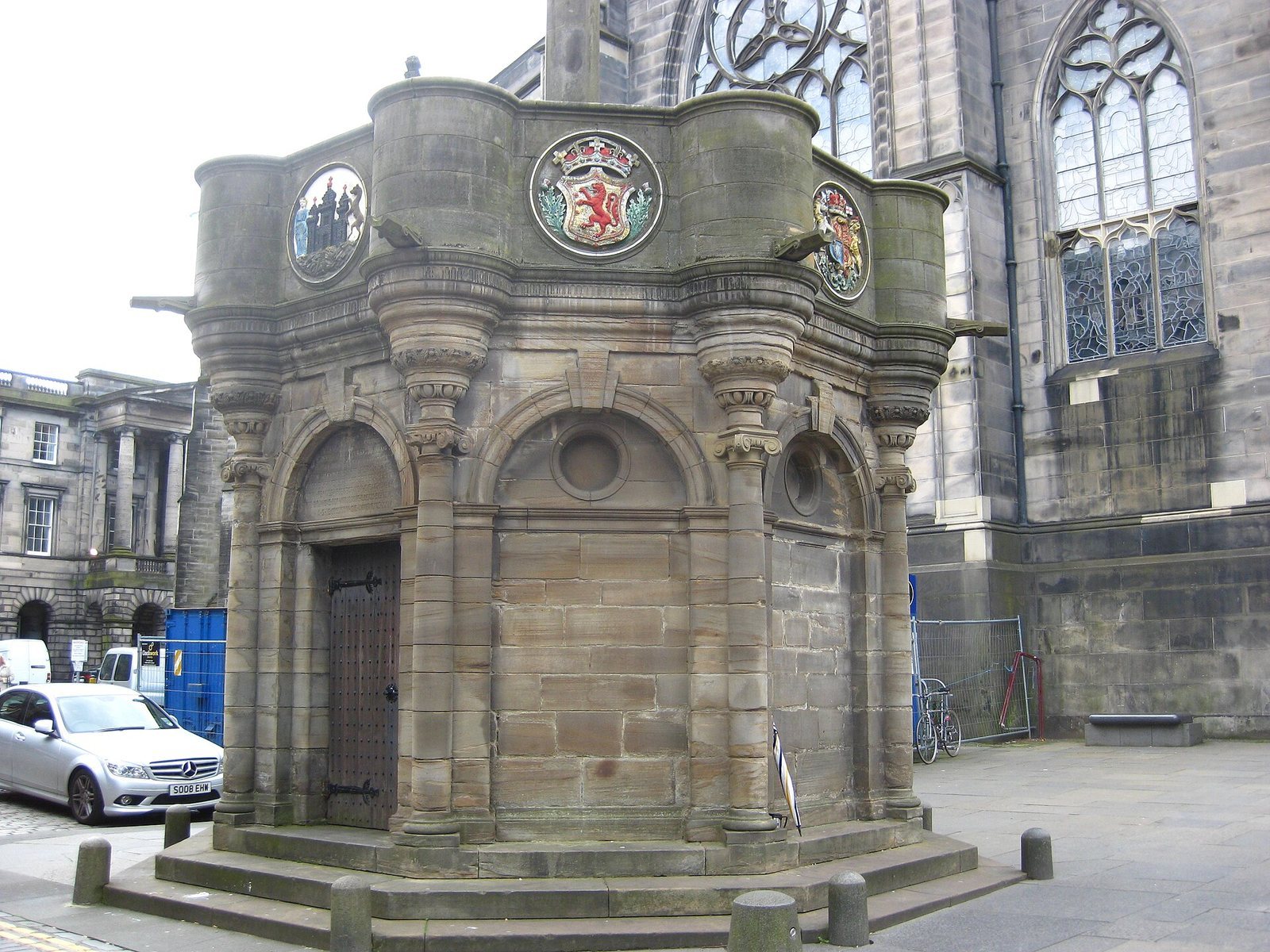
The Mercat Cross is a civic monument in Parliament Square beside St Giles’ Cathedral in Edinburgh, Scotland, United Kingdom. In Scotland, a mercat cross was associated with civic life and public announcements. The cross is first mentioned in a charter of 1365, although that reference does not establish when it was built. Royal and parliamentary proclamations concerning Scotland were read there, making it a public setting for important announcements.
A legend associated the cross with the Battle of Flodden in 1513, a Scottish defeat by English forces. It tells of a demon called Plotcock announcing the names of men destined to die as artillery was prepared in Edinburgh. The chronicler Pitscottie related that Richard Lawson threw a coin at the cross to defy the summons and survived.
The cross was painted for Queen Mary of Guise’s royal entry into Edinburgh on 20 July 1538. In January 1556, tapestry was hung on it to mark the resolution of a dispute between merchants and craft organisations. In 1565, Sir James Tarbet was bound to the cross and pelted with eggs on two occasions, for one hour and then four hours, after saying the Tridentine Mass, the Roman Catholic form standardized after the Council of Trent. Scotland’s Reformation Parliament, which enacted religious changes during the Reformation, had banned the Mass five years earlier.
On 22 August 1567, Regent Moray, James Stewart, took an oath before the Justice Clerk, a senior judicial officer, at the Tolbooth, a civic building used for courts and jails. Heralds and trumpets then announced him at the cross. After Edinburgh Castle’s siege ended with the surrender of supporters of Mary, Queen of Scots, William Kirkcaldy of Grange, his brother James, and jewellers James Mosman and James Cockie were hanged at the cross on 3 August 1573. They had made coins for the queen inside the castle.
Executions and political conflict, 1584 to 1700
Executions and punishments at the cross continued into the late sixteenth century. On 2 December 1584, Robert Henderson, a baker’s apprentice, was burned alive after setting fire to a stack of heather belonging to his father and to a nearby house, creating a risk that the flames would spread through the town. In 1591, John Dickson, convicted of killing a parent, was tortured and executed by breaking on the rack. This was one of only two recorded uses of that punishment in Scotland, and the other also occurred at the cross.
In 1600, after the failure of the Gowrie conspiracy, John, Earl of Gowrie, and his brother Alexander Ruthven were hanged and quartered there. Their heads were put on spikes at Edinburgh’s Old Tolbooth, while their limbs were displayed at places around Perth. On 27 April 1601, James Wood was beheaded in the morning and Archibald Cornwall was hanged in the afternoon. In January 1604, Alastair MacGregor of Glen Strae, chief of the outlawed Clan Gregor, was executed alongside eleven of his kinsmen. He was hanged above them at a height equal to his own. That year, Robert Weir was also condemned to be broken on a cart wheel with a plough coulter for murdering John Kincaid. Kincaid’s wife, Jean Livingstoun, had hired Weir, with her nurse’s help.
After Charles I was executed in 1649, Scotland’s parliamentary assembly, the Scottish Estates, proclaimed his son Charles II king at the cross on 5 February, six days later. This defied the English Parliament’s acceptance of the Commonwealth, the republican government formed after Charles I’s death. Royalists, who supported the monarchy, were also executed at the cross: George Gordon, 2nd Marquis of Huntly, in 1649, and James Graham, 1st Marquis of Montrose, in 1650. Five of Montrose’s close supporters were beheaded there soon afterwards.
Following the English Parliamentary Army’s occupation of Scotland, a proposal to incorporate Scotland into the Commonwealth was proclaimed at the cross on 4 February 1652. Three days later, the King’s Arms were taken down in a ceremony and hanged on the public gallows. In May 1654, English general George Monck attended the reading of proclamations declaring Oliver Cromwell Protector of England, Ireland, and Scotland, and confirming Scotland’s union with the Commonwealth of England. That union ended when the monarchy was restored in 1660.
After the Restoration, Archibald Campbell, 1st Marquis of Argyll, was beheaded at the cross on 27 May 1661. James Guthrie and Captain William Govan were hanged there on 1 June, and Archibald Johnston, Lord Warriston, on 22 July 1663. In 1660, the public hangman had burned Guthrie’s The Causes of the Lord’s Wrath and Samuel Rutherford’s Lex, Rex at the cross. The monarchy considered the books dangerously seditious.
In June 1679, Presbyterian ministers John King and John Kidd were executed for taking part in the Battle of Bothwell Brig. David Hackston, remembered for his role in the murder of Archbishop James Sharp, was hanged, drawn, and quartered at the cross on 30 July 1680. The Solemn League and Covenant was burned there in 1682. On 30 June 1685, Archibald Campbell, 9th Earl of Argyll, was executed for attempting to lead a Scottish rising in conjunction with the Monmouth Rebellion. On 10 December 1688, woodwork torn from King James VII’s private chapel at Holyrood Abbey was brought to the cross and burned with an effigy of the Pope. Sir Godfrey McCulloch of Myreton and Cardoness was beheaded there on 26 March 1697 for murdering William Gordon.
Public ceremony and reconstruction
After the Acts of Union joined Scotland and England as Great Britain in 1707, parliamentary dissolutions and monarchs’ deaths were also proclaimed at the cross. During the Malt Tax Riots, protests against a tax on malt used in brewing, a petition for brewers in and around Edinburgh was brought there and read aloud in July 1725.
On 18 September 1745, Charles Edward Stuart, a Jacobite supporter of the Stuart claim to the throne, had his father proclaimed King James VIII of Scotland and himself Regent. The public response was mixed: some women waved white handkerchiefs from upper windows, few gentlemen appeared, and some townspeople remained silent. After the Jacobite army’s defeat at Culloden the next year, captured colours were ceremonially burned at the cross. In 1752, the public hangman burned copies of Alasdair Mac Mhaighstir Alasdair’s 1751 collection there. It was the first secular book published in Scottish Gaelic, a Celtic language. The poet and Jacobite army captain had used his verse to attack Whig political ideas and the House of Hanover, the dynasty that succeeded the Stuarts on the British throne in 1714.
The cross was moved in 1617 and demolished in 1756. After its pillar broke during the demolition, parts were taken to the grounds of Drum House in Gilmerton. In 1866, these remains were reassembled on a stepped pedestal beside St Giles’ Cathedral. That pedestal now supports the Canongate Cross. Sydney Mitchell designed a new reconstruction in 1885, paid for by William Gladstone, then MP for Midlothian. The cross underwent extensive renovation in 1970.
The cross has continued to serve for public proclamations. Heralds of the Lord Lyon King of Arms, Scotland’s senior heraldic officer, announce royal successions and general elections there. Lord Lyon Joseph Morrow announced parliamentary dissolutions in 2015 and 2017. After Elizabeth II’s death, he proclaimed Charles III’s accession in September 2022.
Remains
Form, location, and surviving elements
Position and earlier settings
The present cross stands in Parliament Square, facing the High Street, near the site of its predecessor. Before its 1617 move, the older cross stood on the south side of the High Street, about 45 feet (14 metres) from the east end of St Giles’ Cathedral. Its later position, a few yards farther down the street, is marked by an octagonal pattern of paving blocks shown on Gordon of Rothiemay’s 1647 map. The current cross is 24 feet (7.3 metres) south of the original pre-1617 position.
Column and supports
The cross that was reassembled in 1866 stood on a stepped pedestal east of the north door of St Giles’. Following the pillar’s break in 1756, it was rebuilt at a reduced height of 13.9 feet (4.25 metres), compared with its earlier 19.7 feet (6 metres), and with a thinner girth. The 1885 reconstruction placed the cross on an octagonal drum, a polygonal support beneath it. Its upright shaft was replaced during the 1970 renovation.
Sculpture and heraldry
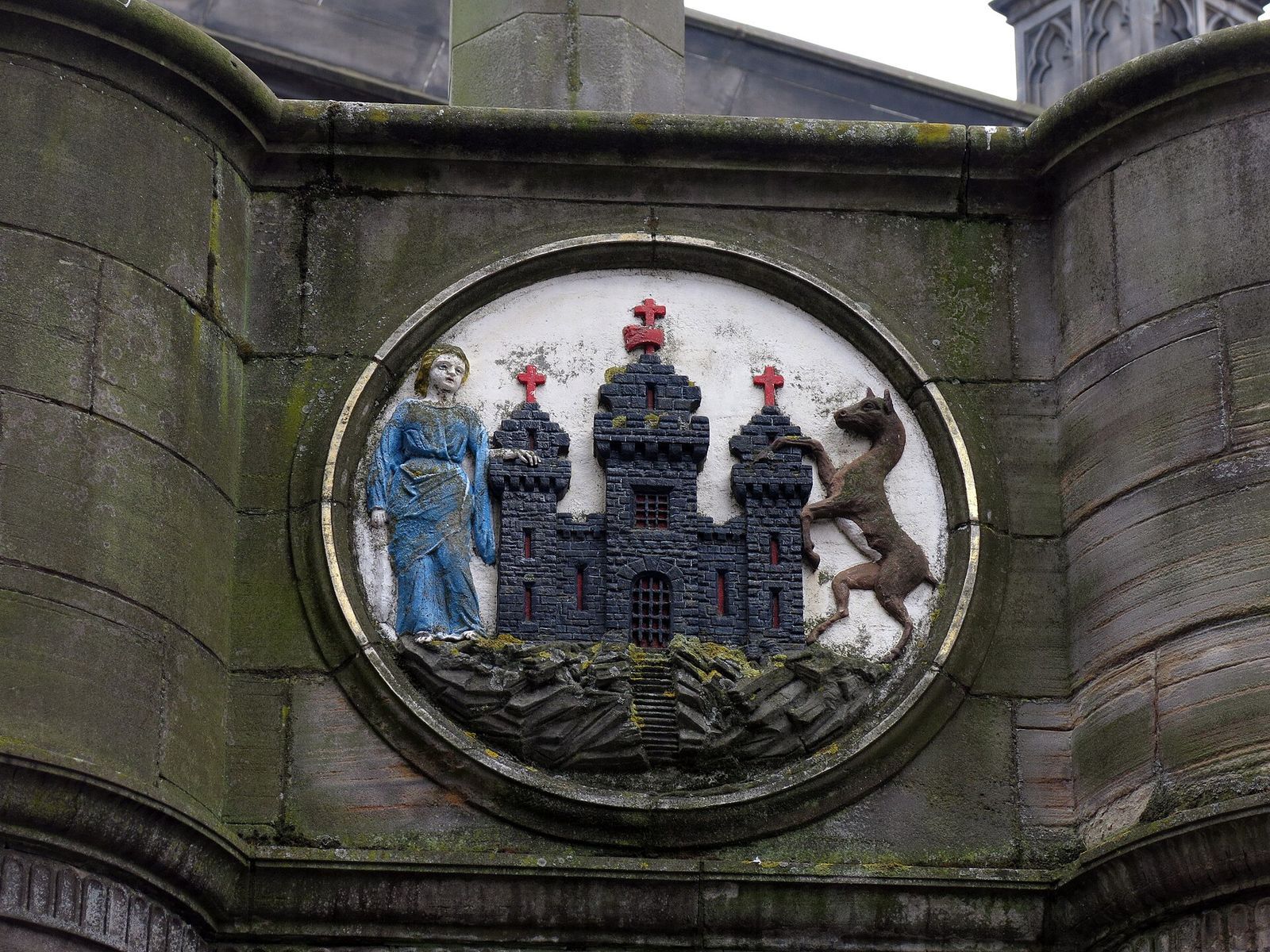
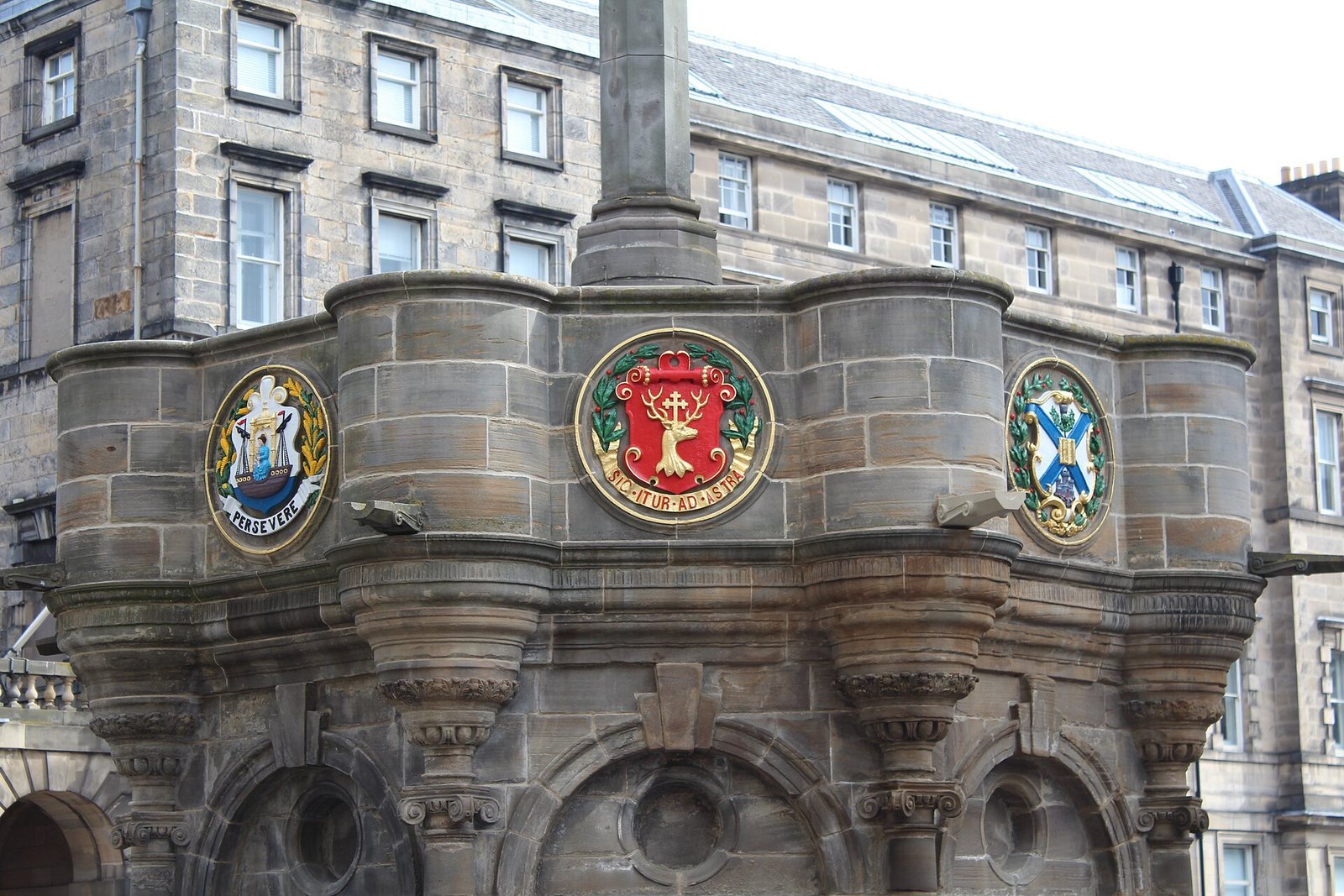
The original cross had eight circular medallions bearing sculpted heads. Sir Walter Scott incorporated five of them into the garden wall of his house at Abbotsford in the Scottish Borders; the heads have not been identified. Sculpted heads on the cross were replaced by panels bearing royal arms for Britain, Scotland, England, and Ireland, alongside the arms of Edinburgh, Leith, and Canongate and those of the University of Edinburgh.
Doorway inscription
On the east side, a wooden door fitted with studs sits beneath a tympanum, the panel above a doorway. Its Latin inscription, cut in Gothic lettering and composed by Gladstone, gives thanks to God and describes the cross as an old monument used for public ceremonies. It recalls the demolition in 1756 and Walter Scott’s verse about the cross, and states that Gladstone restored it with the city magistrates’ permission. The inscription also records his claim of Scottish descent through both parents and is dated 24 November 1885.
Memorial at Drum House
A monument at Drum House, Gilmerton, commemorates the old cross’s presence there between 1756 and 1866. Its plaque gives November 1882 as the date it was erected.
Older stonework and the unicorn
A study of the stonework in 1971 found two pieces of an older shaft embedded in the present structure. It dated the capital, the top section of the pillar, to the first half of the fifteenth century. The study also identified the unicorn as an 1869 reproduction of the earlier figure on the 1617 cross, based on descriptions from that time.