Preah Khan of Kompong Svay: An Angkorian Religious and Military Complex
Site at a Glance
- Rating
- 4.5
- Popularity
- Low
- Country
- Cambodia
- Primary era
- Medieval
- Eras represented
- Medieval
- Civilizations
- Unclassified
- Site type
- Religious
- Remains
- Sanctuary
On this page10 sections
History
Preah Khan of Kompong Svay is a Khmer religious complex in Preah Vihear Province, Cambodia, about 100 kilometers east of Angkor. Built during the Angkorian era, the period of the Khmer Empire centered on Angkor from roughly the ninth to the fifteenth century, it occupies an outer enclosure exceeding 22 square kilometers and is described as the largest single religious complex built during that era.
Origins and royal roles
Little historical information survives about the complex’s foundation. Some French scholars have proposed that it began in the eleventh century, probably under Suryavarman I, a Khmer king of the Angkorian period, but this attribution remains interpretive. During the reign of Suryavarman II, the complex served as a royal residence. It later became a military outpost for Jayavarman VII, whose reign was associated with major building activity and conflicts with the Cham, the people and political communities of Champa to the east and southeast of the Khmer Empire.
Its original character remains open to interpretation. Preah Khan of Kompong Svay has been understood as a Khmer kingdom, an independent political entity, a trading outpost, or a defensive center. These possibilities reflect the scale and complexity of the site, which combined religious buildings, water infrastructure, and controlled enclosures.
Iron production and abandonment
Iron production became important at Preah Khan of Kompong Svay, probably beginning in the mid-thirteenth century, after the complex had been completed. The site’s proximity to iron sources, especially Phnom Dek, or “Iron Mountain,” helped support this activity. Iron smelting, the process of extracting iron from ore by heating it in a furnace, took place near the temples and inside the walled enclosures. This arrangement is unusual among Angkorian sites.
Techniques associated with the indigenous Kuay people may connect their iron production with that of Preah Khan. Local furnaces used until the mid-twentieth century and furnaces from the period of Preah Khan employed similar mixtures for smelting and used bamboo in shaping and constructing the furnaces, although the two groups obtained ore from different sources. Slag, the stony waste left by smelting metal ores, indicates that iron production began around the mid-thirteenth century. Widespread burning appears around the mid-fourteenth century, possibly in connection with industrial activity, while little evidence points to regular burning before that time. The change may reflect the departure of Khmer groups and the reorganization of the complex by local communities.
Sediment analysis indicates that maintenance of the temples and infrastructure ceased around the middle of the fourteenth century. The site was completely abandoned between the late fourteenth and fifteenth centuries, although archaeological mapping identifies material indicating occupation from the eleventh to the seventeenth centuries.
Exploration and protection
Louis Delaporte visited the complex in 1873 and studied its ruins. With the agreement of the Cambodian king, he sent reliefs and stone sculptures to France. They were exhibited at the Indochinese Museum of the Trocadéro and transferred to the collections of the Musée Guimet, a Paris museum specializing in Asian art and archaeology, in 1927. Several French missions followed around the turn of the twentieth century. In 1937, Victor Goloubew’s aerial surveys revealed the full extent of the complex.
The temples were extensively looted in the past, and thieves damaged many structures while removing sculptures and carvings during the second half of the 1990s. The central tower later collapsed during a looting attempt in 2003. Preah Khan of Kompong Svay was added to UNESCO’s World Heritage Tentative List in the cultural category on 27 March 2020. The nomination had originally been proclaimed on 1 September 1992.
Remains
The complex covers about 22.5 square kilometers and is organized into four concentric enclosures. Unlike the usual eastward orientation of Khmer sites, it is aligned toward the northeast. Its layout combines large-scale waterworks, laterite walls, sandstone temples, causeways, gateways, and central religious buildings.
Reservoir and island temple
A large baray, a Khmer reservoir or artificial water basin, crosses the eastern side of the complex. It measures approximately 2.8 kilometers by 750 meters and is almost completely dry today. Preah Thkol stands on an artificial island, or mebon, within the reservoir. The temple is built of sandstone and has a cruciform plan with a standing central tower.
Southeastern temple
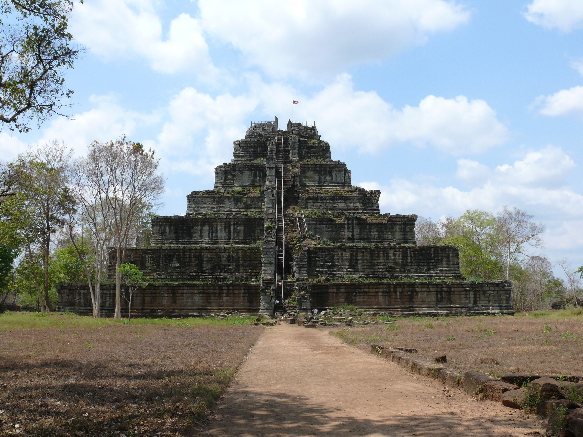
Preah Damrei occupies the southeastern corner of the complex. Its pyramid was about 15 meters high and had a laterite enclosure. Two stone elephants stood at its upper corners, while two additional elephants are held by the National Museum of Cambodia and the Musée Guimet in Paris.
Western temple and central approach
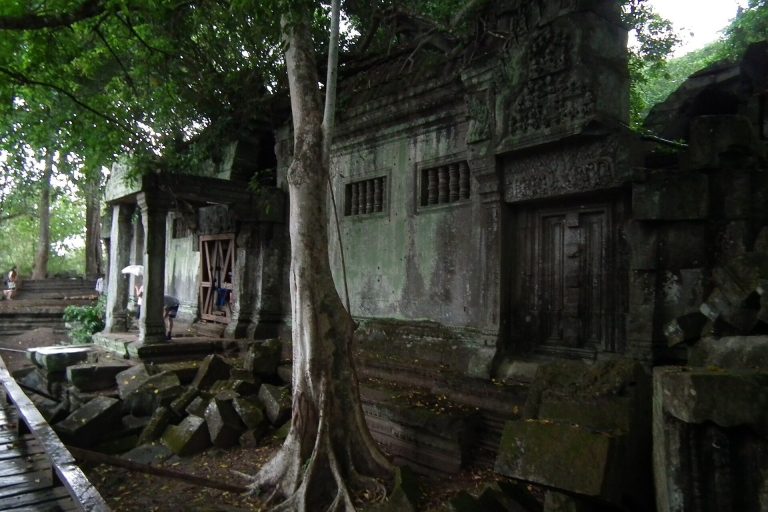
Prasat Preah Stung stands near the middle of the western side of the baray, inside the outer enclosure. Its central tower has four carved faces in the distinctive Bayon style associated with the Bayon temple at Angkor. A landing stage with naga balustrades precedes the temple. Naga balustrades are railings decorated as serpents, with the naga representing a serpent figure in South and Southeast Asian religious and artistic traditions.
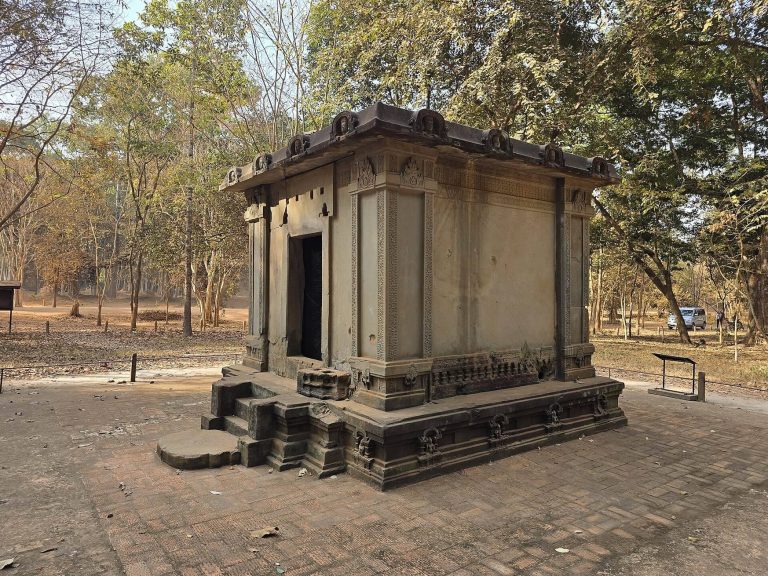
A laterite causeway leads from Prasat Preah Stung to a central enclosure measuring approximately 701 by 1,097 meters. The enclosure is surrounded by a moat and entered through four gopuras, monumental entrance pavilions or gateways, comparable to those of Angkor Thom, the major fortified royal city at Angkor. A dharmasala, a religious or rest house associated with a temple complex, stands near the eastern gopura.
Central sanctuary
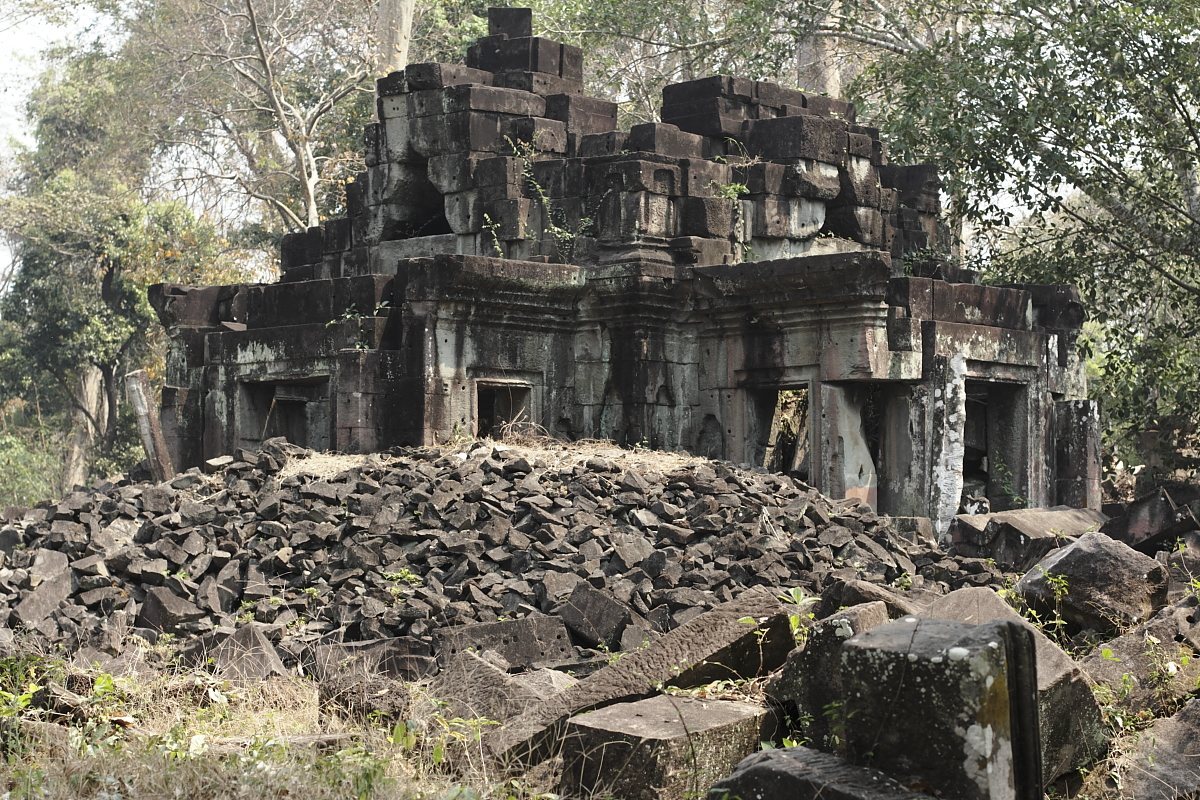
The inner laterite enclosure contains the central sanctuary, which stands on a two-tier platform. Entrances open on all four cardinal sides, and a gallery with windows surrounds the sanctuary. Its central tower collapsed during a looting attempt in 2003, leaving the principal shrine in a damaged condition.
Hydraulic, industrial, and artistic evidence
Revised mapping using ASTER and OrbView imagery, FINNMAP photography, and other methods has identified extensive hydraulic works and masonry religious structures across the complex. Concentrations of stoneware, earthenware, imported porcelain, and other ceramics add evidence of activity within the site. Stoneware and earthenware are fired ceramic materials, while imported porcelain is a finer, high-fired ceramic made outside the region.
Iron-smelting installations occur near the temples and within the enclosures, linking the industrial remains with the religious and architectural core. Reliefs and stone sculptures from Preah Khan are regarded as major examples of Khmer art. A putative head of Jayavarman VII from the complex is displayed at the National Museum of Cambodia, while other sculptures removed from the site are held at the Musée Guimet.