Iximche: Capital of the Kaqchikel Maya Kingdom
Site at a Glance
- Rating
- 4.6
- Popularity
- Medium
- Country
- Guatemala
- Primary era
- Medieval
- External website
- Open
- Eras represented
- Medieval, Early Modern
- Civilizations
- Unclassified
- Site type
- City
On this page22 sections
History
Iximche was the capital of the Kaqchikel Maya kingdom near Tecpán Guatemala, Guatemala, founded during the Late Postclassic period between about AD 1470 and 1485. The Kaqchikel built the city on a defensible ridge and maintained it as their political center until its abandonment in 1524, although resistance to Spanish rule continued until 1530.
Foundation of the Kaqchikel Kingdom
The Kaqchikel and K’iche’ were related Maya peoples whose politically distinct kingdoms occupied the Guatemalan Highlands. The Kaqchikel had once been close allies of the K’iche’, but growing Kaqchikel power created tensions within the alliance. The Kaqchikel eventually left the K’iche’ capital, Q’umarkaj, and established their own kingdom. They also abandoned an earlier capital called Chi Awär, possibly located near modern Chichicastenango.
The foundation of Iximche was led by four lords, Wuqu-Batz’, Hun-Toh, Chuluk, and Xitamel-Keh. At the time, their titles were Ahpo Sotz’il, Ahpo Xahil, K’alel Achi, and Ahuchan. Ahpo was a Kaqchikel ruling title, and the Ahpo Sotz’il and Ahpo Xahil were the two principal rulers. Each of the four leading nobles represented one of the major Kaqchikel clans and possessed a separate part of the city with its own palace, court, and temples.
The titles Ahpo Sotz’il and Ahpo Xahil had originally been granted to Kaqchikel clan leaders by the K’iche’ kingdom for military service. They became hereditary offices. The heirs of the two principal rulers also served as battlefield commanders, linking the administration of the new kingdom with its military power.
Expansion and Political Organization
Iximche grew rapidly and reached its greatest extent within roughly fifty years. Its government rested on the four principal nobles, although the Ahpo Sotz’il and Ahpo Xahil held the real authority. Wuqu-Batz’ and Hun-Toh had previously served the K’iche’ ruler K’iq’ab, who protected them after a revolt by his sons weakened K’iche’ control.
A dispute involving a Kaqchikel bread seller and a K’iche’ soldier later brought the two Kaqchikel leaders into danger. The K’iche’ nobility condemned them to death, but K’iq’ab warned them in time. Wuqu-Batz’ and Hun-Toh then led their people away from Q’umarkaj on the day 13 Iq’ of the Kaqchikel calendar, establishing the independent kingdom centered on Iximche.
Hun-Toh’s son Lahuh-Ah succeeded him and died in 1488. He was followed by Kablahuh-Tihax. Wuqu-Batz’ was succeeded by his son Oxlahuh-Tz’i’, whose long reign brought military success. Around 1491, Oxlahuh-Tz’i’ and Kablahuh-Tihax defeated the K’iche’, captured their rulers Tepepul and Itzayul, and seized the image of the K’iche’ deity Tohil. The captives, together with K’iche’ nobles and soldiers, were sacrificed. In 1493, the two rulers also suppressed a revolt by the Akajal and Tukuche’ clans.
Oxlahuh-Tz’i’ died on 23 July 1508 and was succeeded by his son Hun-Iq’. Kablahuh-Tihax died on 4 February 1509 and was followed by his son Lahuh-Noh. The Kaqchikel continued their conflict with the K’iche’ during the following decade. In 1510 and 1512, messengers sent by the Aztec ruler Moctezuma II warned the Kaqchikel of foreign arrivals in the Caribbean, Yucatan, and Veracruz.
Crisis before the Spanish Conquest
Iximche suffered several disasters before the arrival of Pedro de Alvarado. A locust plague affected the Kaqchikel in 1513, and a serious fire damaged the city in 1514. A major epidemic began in 1519 and lasted for two years, causing many deaths. It was probably smallpox, introduced into the Americas by the Spanish.
After the fall of Tenochtitlan in 1521, the Kaqchikel sent messengers to Hernán Cortés and offered an alliance. On 11 August 1521, Belehe Qat and Cahi Imox became the rulers of Iximche. Cahi Imox held the title Ahpo Sotz’il, while Belehe Qat was Ahpo Xahil. At the beginning of the Spanish conquest, their kingdom was expanding into former K’iche’ territory and had become the most powerful new kingdom in the Guatemalan Highlands, though Q’umarkaj remained more important.
Spanish Alliance and Abandonment
Pedro de Alvarado reached Iximche on 14 April 1524 and was welcomed by Belehe Qat and Cahi Imox. The Kaqchikel supplied Indigenous warriors for Spanish campaigns against K’iche’ resistance and the neighboring Tz’utujil kingdom. On 27 July 1524, Alvarado declared part of the city to be Santiago de los Caballeros de Guatemala, the first Spanish capital and settlement of the Kingdom of Guatemala.
The alliance broke down when the Spanish demanded tribute, including 1,000 gold sheets weighing 15 pesos each. On 28 August 1524, the Kaqchikel left Iximche for the forests and hills. The Spanish declared war ten days later. The city remained habitable in 1526, when Bernal Díaz del Castillo described its houses as being in excellent condition, but the conflict continued.
On 9 February 1526, sixteen Spanish deserters burned the Ahpo Xahil’s palace, looted temples, and kidnapped a priest. The Kaqchikel attributed these acts to Pedro de Alvarado. The Spanish settlement of Tecpán Guatemala, established nearby, was abandoned in 1527 because of continuing Kaqchikel attacks. The colonial capital moved to the Almolonga Valley, at the site later known as San Miguel Escobar in Ciudad Vieja. Kaqchikel resistance ended with the surrender of the two principal kings on 9 May 1530, followed by the submission of many nobles, families, and other inhabitants.
Name, Investigation, and Modern Cultural Importance
The name Iximche comes from the Kaqchikel words ixim, meaning maize, and che’, meaning tree. The name refers to the ramon tree, Brosimum alicastrum. The Spanish used a Nahuatl rendering of the name, Guatemala, for their first city and later for the kingdom, giving the modern country its name. Nineteenth-century investigators also called the ruins Pa Tinamit, meaning “the city.”
Francisco Antonio de Fuentes y Guzmán first described the ruins in 1695. Miguel Rivera Maestre published plans and drawings in 1834, and John Lloyd Stephens described the site after visiting it with Frederick Catherwood in 1840. César Daly mapped the ruins in 1857, followed by Alfred P. Maudslay’s survey and plans in 1887. Stones were removed from the site during the nineteenth century for construction in Tecpán.
A syncretic colonial cult developed around a relic taken from the ruins and transferred to the church at Tecpán. Processions traveled from Tecpán to Iximche on Good Friday until the nineteenth century. The cult had disappeared by the period of the Guatemalan Civil War.
Serious archaeological work began in the 1940s with Robert Wauchope’s ceramic study. Janos de Szecsy began excavations in January 1956, and Jorge Guillemin excavated the city from 1959 to 1972. Guillemin died before completing his final report, but his field notes were published in 2003. Iximche became a Guatemalan National Monument under governmental decree 1360 in 1960, with the decree published in May 1963.
The ruins also regained an important place in modern Maya political and religious life. In 1980, during the Guatemalan Civil War, Maya leaders and guerrilla representatives met at Iximche. Their Declaration of Iximche included a commitment by the guerrillas to defend Indigenous rights. Maya ceremonies held in 1987 and 1989 helped reestablish the ruins as a sacred place. Kaqchikel ritual specialists and pilgrims continue to use the site, especially on important days of the Maya calendar such as Waqxaqi’ Batz’. From 26 to 30 March 2007, Iximche hosted the III Continental Summit of Indigenous Peoples and Nationalities of Abya Yala, whose closing statement committed delegates to social justice and opposition to neoliberalism and other forms of oppression.
Remains
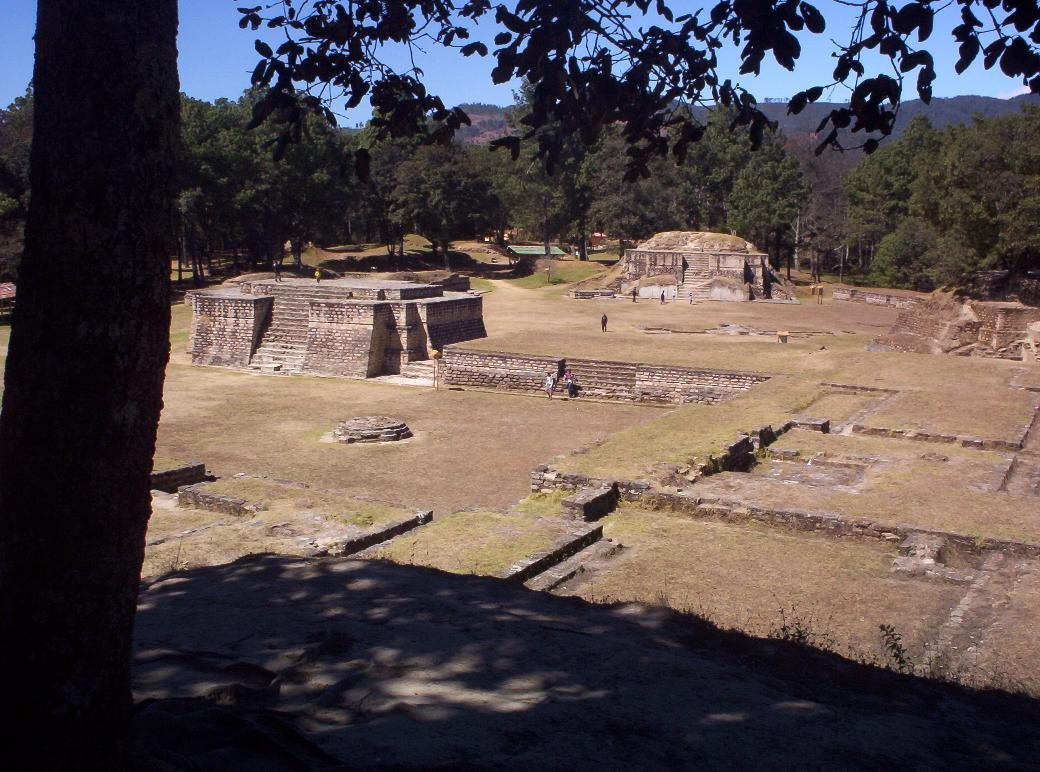
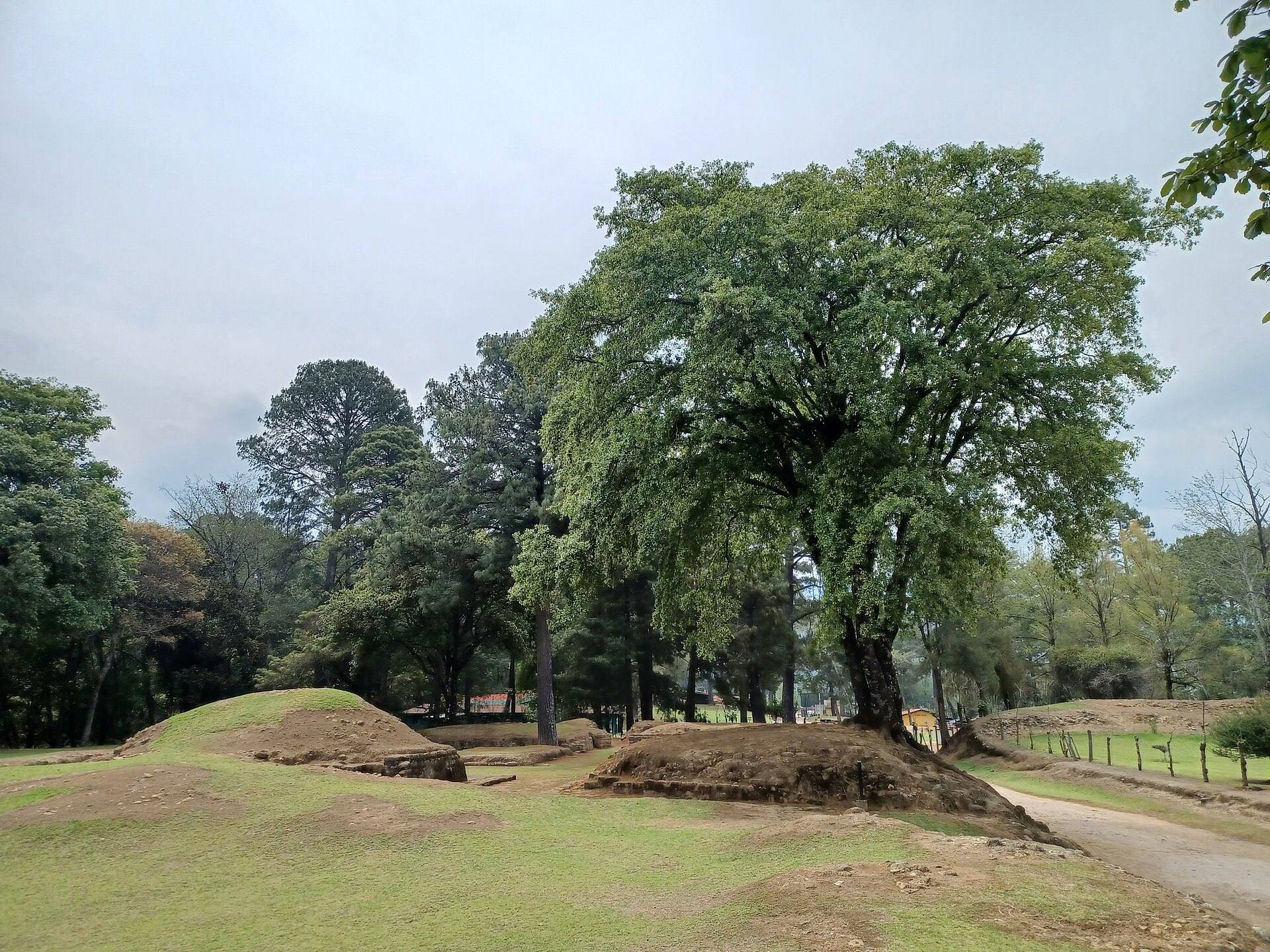
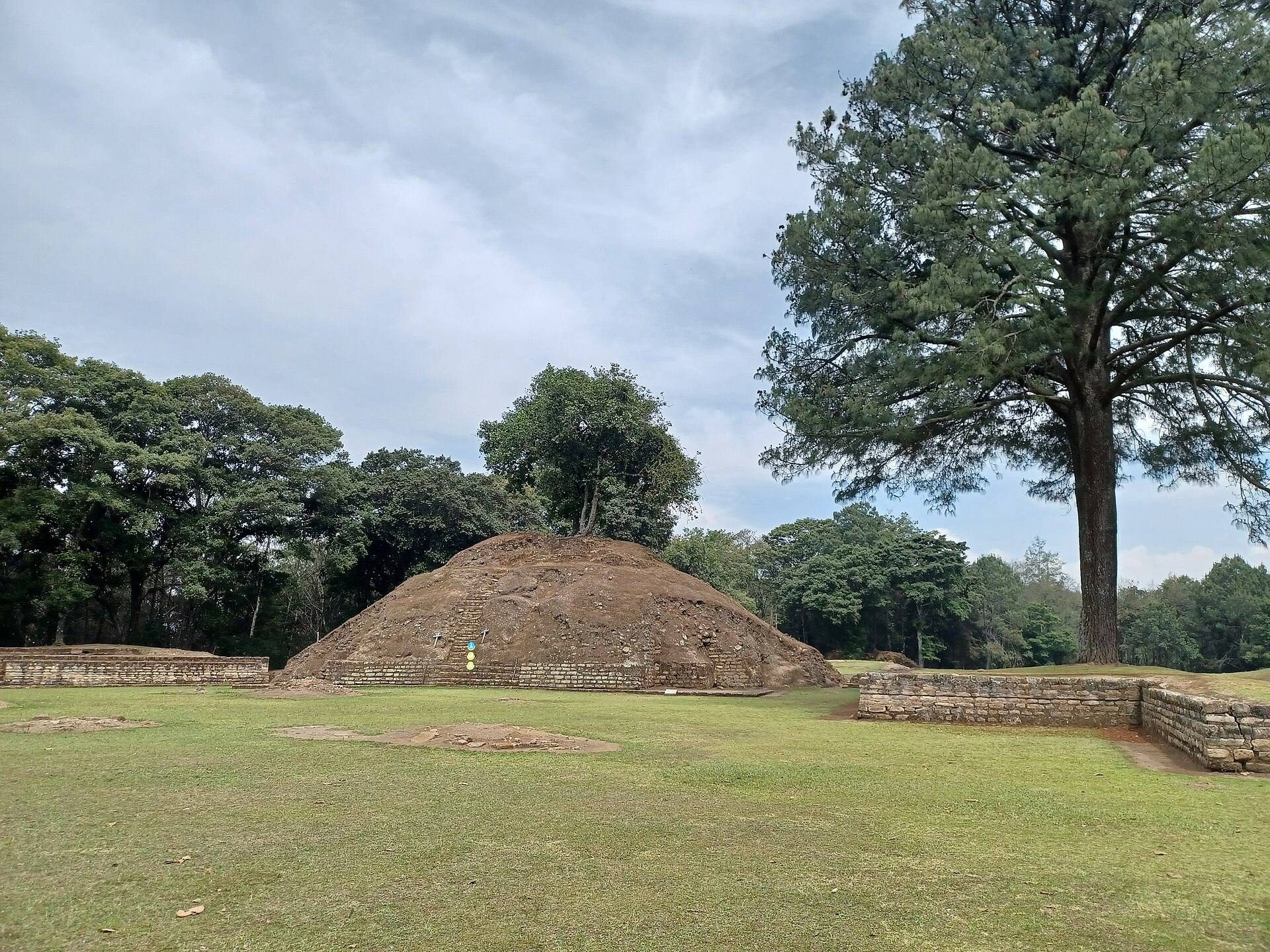
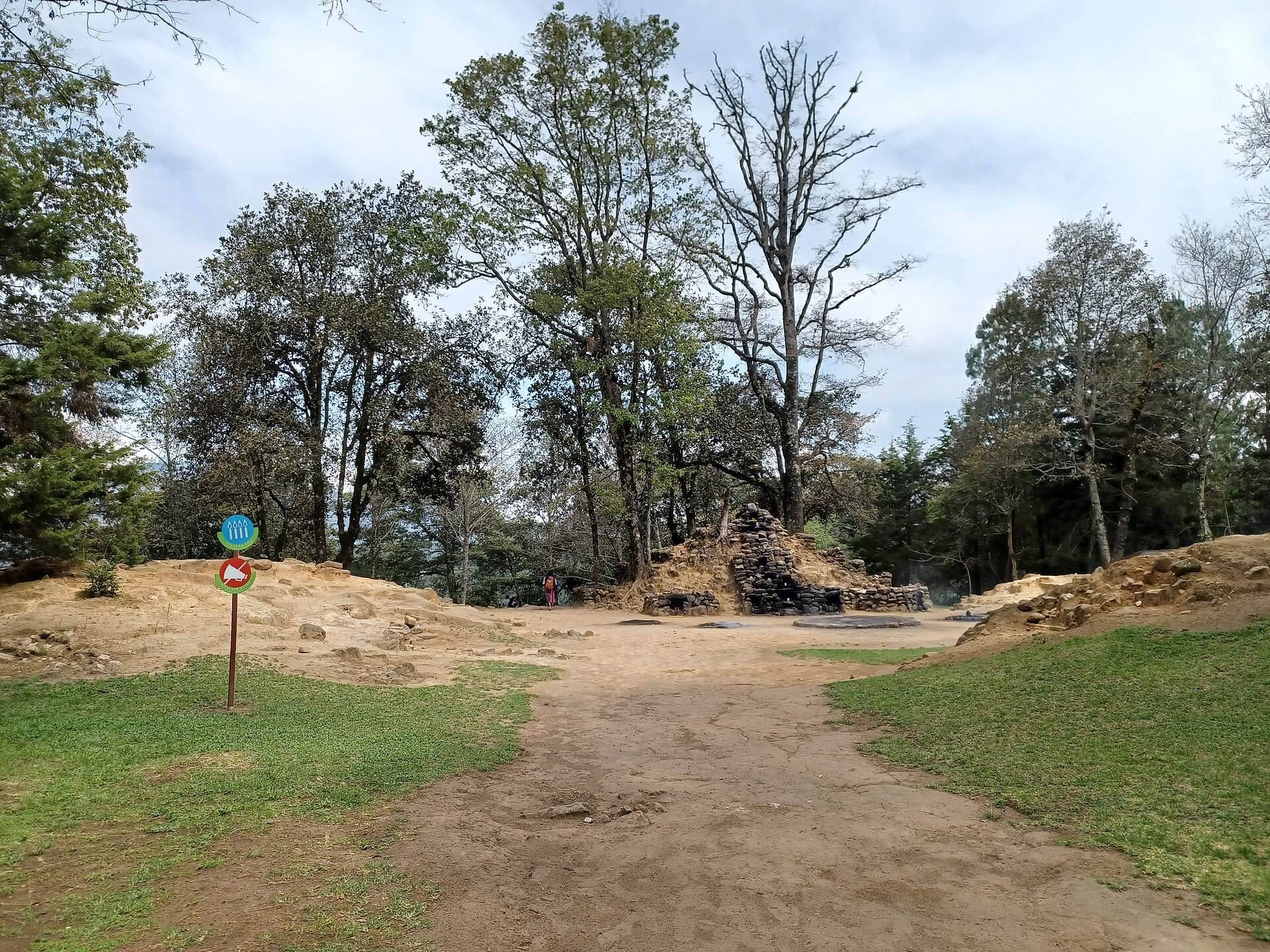
Iximche occupies approximately 2,260 metres above sea level at the southeastern end of the Ratzamut ridge on Tecpán Hill. Deep ravines containing the El Molino and Los Chocoyos rivers border the ridge, and those rivers join the Madre Vieja River before it reaches the Pacific Ocean. Pine and oak forests surround the site. The ridge’s natural defenses were strengthened by a ditch, masonry walls, narrow passages, and controlled approaches. More than 160 structures were mapped, with the central ceremonial area separated from the main residential zone by a wall and ditch.
Plazas and Palace Complexes
The central area contained four smaller plazas and two larger plazas, designated A through F and arranged from northwest to southeast. Each major plaza had at least two temples, while elite palaces stood beside two ballcourts. Plazas A and B probably formed a single Sotz’il clan complex, Plaza C contained the Ahpo Xahil’s palace complex, and Plazas E and F formed another complex probably associated with the K’alel Achi. Plaza D was a large cleared and mapped space surrounded by high mounds.
Great Palace I
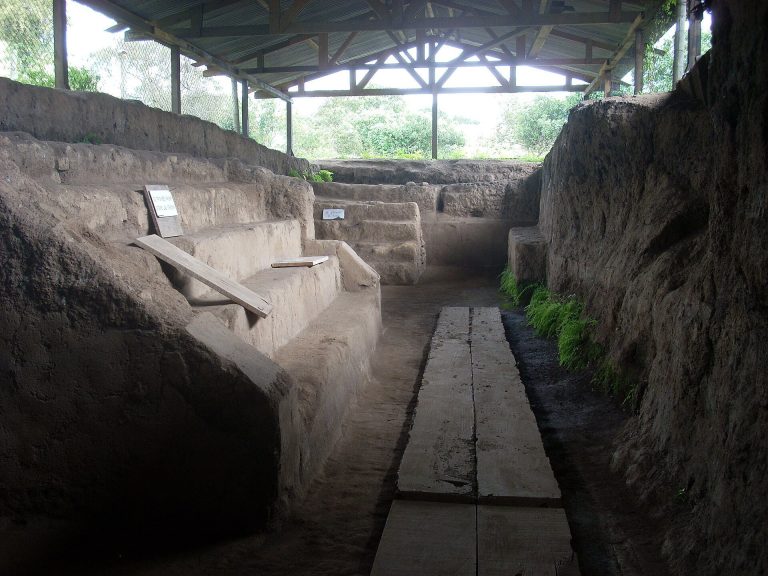
Great Palace I stood northeast of Plaza B. Its surviving remains include a sunken court and low house platforms. The earliest of its three construction phases belonged to the foundation period under Wuqu-Batz’ and Hun-Toh. It covered about 500 square metres and consisted of four long, single-room residential buildings around a court with a central altar. Wall benches, central hearths, and adobe walls decorated with murals formed part of this early complex.
Objects from the first phase included obsidian knives, comales, three-legged grinding stones, domestic pottery, and fragments of incense burners near the palace altars. The complex expanded through successive additions of buildings and courts, and the original court was eventually divided into smaller spaces. During the reigns of Hun-Iq’ and Lahuh-Noh, the final phase covered more than 3,000 square metres. Low platforms southwest of the palace may have been used for ritual dancing. A building southeast of the court had benches along three walls and hearths at both ends, and may have served as a hall where the Ahpo Sotz’il held court and received visitors and tribute.
Great Palace II
Great Palace II stood southeast of Plaza C. Its many small rooms were arranged around seven interior courts. Large quantities of pottery were recovered there. Rooms around the northeast and north courts may have been royal apartments because they were close to, but separate from, the central court. The pottery from the northeast area was exotic and associated with elite use.
Xahil Palace
The Xahil Palace occupied the southeast side of Plaza C and was aligned from east to west. Its entrance court was on the west and contained a central altar, while the main palace entrance opened on the east side of the court. Rooms and courts held numerous domestic artifacts. Fire destroyed the palace, causing its adobe walls to collapse and preserving much of the interior contents. It may have housed Pedro de Alvarado and his soldiers and may have been the building burned by Spanish deserters in 1526.
Other Palace Platforms
The southern palace of Plaza D had three interior courts, including a western court with a cross-shaped altar. It was probably the palace of the Ahuchan. Unlike the complexes in the other principal plazas, it lacked large eastern and western pyramids. Structure 22, a broad building on the north side of Plaza A, retained the bases of pillars that divided five entrances. Benches lined the inner sides of three walls, and hearths were set into the floor. Structure 38 was a 61-metre-long platform enclosing the north side of Plaza C and supporting three residential buildings, each with its own staircase.
Temples and Ritual Features
Temple 2
Temple 2, or Structure 2, stood on the west side of Plaza A. Its eastern staircase rose from the plaza, and the temple was aligned toward the sunrise at the summer solstice. It is the best-preserved excavated temple at Iximche and was built in three phases associated with the reigns of Wuqu-Batz’, Oxlahuh-Tz’i’, and Hun-Iq’.
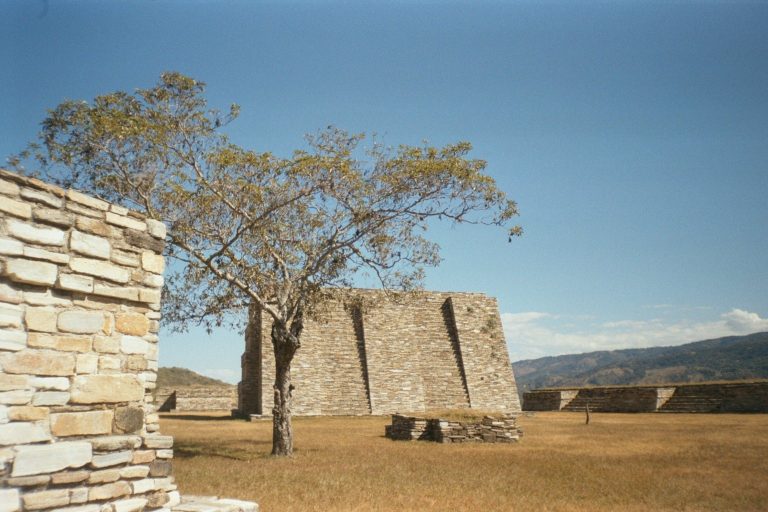
The intermediate phase consisted of four stepped levels with tall sloping-and-panelled walls, recessed corners, and a steep staircase. This form, known as talud-tablero, combines a sloping lower wall with a vertical panel above it. The temple floor stood 9 metres above the plaza, while the walls and roof raised the structure about 5 metres higher at the time of the Spanish conquest.
The summit altar measured 40 centimetres high, 45 centimetres wide, and 18 centimetres deep. Made of stone and stucco, it had a slightly concave upper surface and belonged to a type associated with heart sacrifice. The sanctuary contained benches along three walls, a central hearth, and a small rear chamber with benches that may have held Sotz’il deity images. Part of the floor had been opened, possibly for a burial, but the unused tomb was covered. Turtle remains found directly in front of the temple may have represented a bacab, a Maya mythological being associated with supporting the structure of the world.
The visible sanctuary dates to the reign of Oxlahuh-Tz’i’. It had three entrances separated by columns and was built of adobe covered with plaster. The columns and nearby walls were painted red, yellow, and blue over a thin clay layer marked with a pointed instrument. Ten painted figures appeared on the front, with further murals at the rear. The figures may depict a Kaqchikel ritual that included tongue piercing. Moisture and tree roots have badly damaged the murals, whose style resembles Mixteca-Puebla art, a Late Postclassic Mesoamerican style known for polychrome painting and shared decorative forms.
A low platform southwest of the temple bore murals of a skull with two crossed long bones and may have been an itzompan, or skull place. Two decapitated skulls and obsidian blades were found in a cache southeast of the temple. Stone was removed from both the earlier and final phases for later construction, including construction in nearby Tecpán.
Temple 3
Temple 3, or Structure 3, stood on the east side of Plaza A opposite Temple 2. It had a similar pyramidal form, with a west-facing staircase and a small rectangular platform in front. More than twelve large cylindrical incense burners were used there. Some showed an aged deity emerging from a serpent’s jaws, while others depicted the same deity standing or accompanied by suspended modeled sun disks. The figures may represent the Kaqchikel patron deities B’elehe-Toh or Hun-Tihax.
The incense burners remained where the Kaqchikel left them when they abandoned Iximche. Fragments of an Early Postclassic lead-glazed ceramic vessel, probably a relic, were found around three sides of the temple. Since there is no evidence of an occupation at Iximche from that earlier period, the vessel may have been looted from Zaculeu. A flint sacrificial knife was also recovered, and two low platforms in front of the temple probably served as altars or dancing platforms.
Other Temples
Structure 1, or Temple 1, faced Plaza B and is the only temple at Iximche described as completely restored. Structure 4 was a pyramidal temple platform on the west side of Plaza C. A low platform at its southeast corner contained 48 decapitated heads, most associated with obsidian blades. Most were placed in individual pits in the plaza floor, while some were grouped in small lots. They have been tentatively connected with the K’iche’ rulers Tepepul and Itzayul and other members of their court.
Structure 5 was a pyramidal temple with at least two construction phases. Its single staircase divided into two stairways near the summit sanctuary. Structure 6 was an unrestored pyramidal temple platform southwest of Plaza C. Structure 14 was a circular altar in Plaza B measuring 3.5 metres across. Its form resembles Aztec altars associated with gladiatorial sacrifice and may have served a similar purpose. A noble and three companions were buried nearby.
Ballcourts and Architectural Construction
Xahil Ballcourt
Structure 7, on the southwest side of Plaza C, was the ballcourt of the Xahil clan and may have been the older of Iximche’s two courts. Projecting stairs stood at both ends, with another stairway toward the southeast. A carved zoomorphic head found in Plaza C may originally have been a marker from this court.
Structure 8 Ballcourt
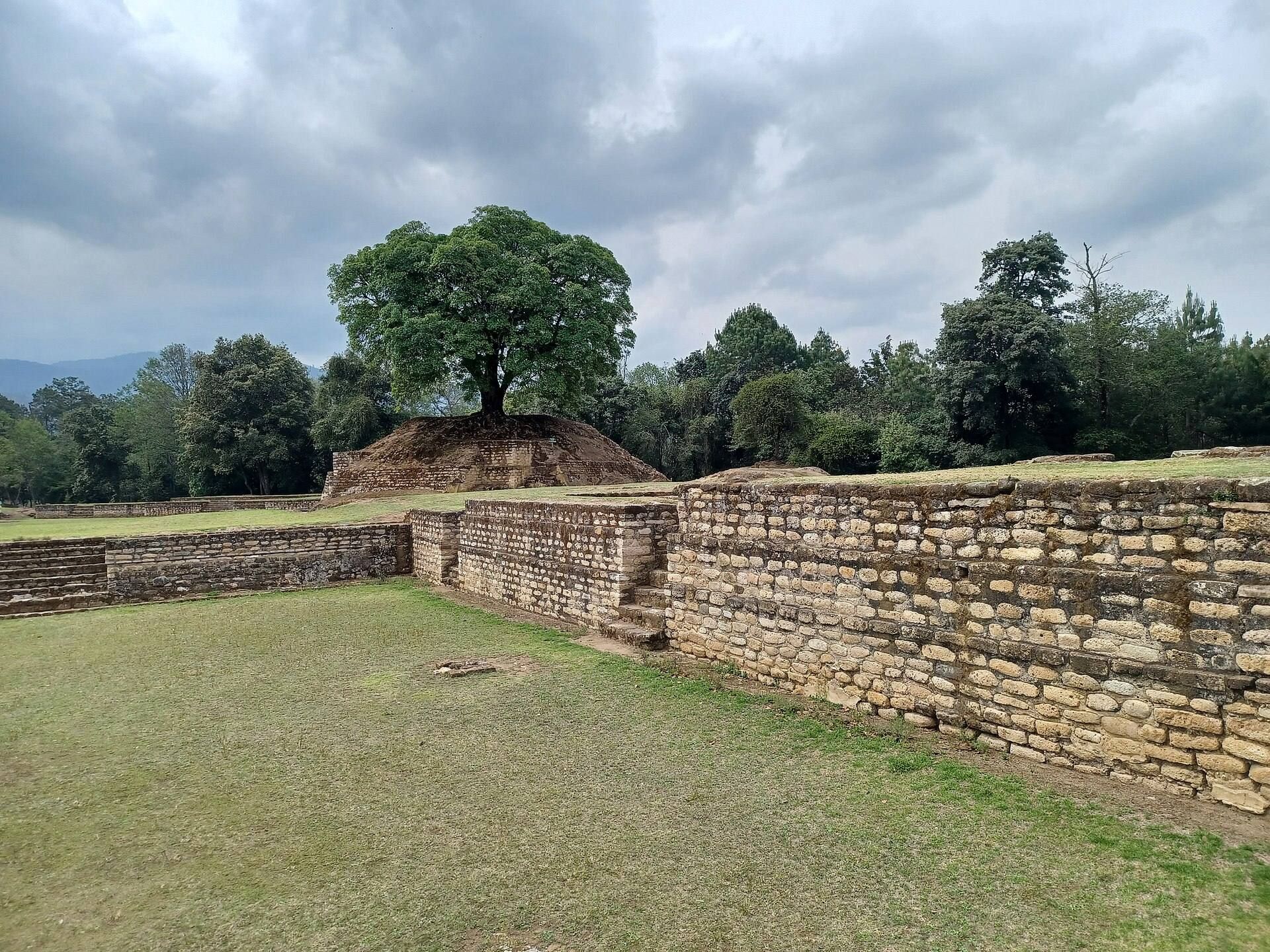
Structure 8 stood southwest of Plaza A. It was 40 metres long, with a playing area measuring 30 by 7 metres. Enclosed end zones were reached by stairways, while the side platforms extended outward. The court was excavated and restored, and two plaster floor levels indicate construction during the second of Iximche’s three principal building phases, around AD 1500. In Kaqchikel belief, ballcourts, called hom, were portals to Xibalba, the Maya underworld.
Buildings and Construction Materials
Structure 9-sub had two pillars dividing three entrances. Structure 10 enclosed an interior court on three sides, and Structure 13, between Plazas A and B, also had a three-sided interior court. Two rough zoomorphic sculptures, possibly jaguar heads, were found near Structure 24. They probably came from one of the ballcourts and may have served as cores covered with modeled stucco.
Most building platforms had cores of rough stone set in clay. Their outer faces consisted of stone blocks covered with lime mortar, sometimes painted with polychrome murals in the Mixteca-Puebla style. Adobe superstructures supported beams and mortar roofs, although the roofs did not survive. Residential buildings around the ceremonial plazas generally contained benches and hearths. The central defensive ditch was originally about 8 metres deep. It was largely filled soon after the conquest to make the city less defensible, measured about 2.7 metres in the mid-nineteenth century, and remained visible though almost filled by the 1960s.
Burials and Excavated Objects
More than 100 human skeletons were excavated at Iximche. Their original locations became unclear after the bones were mixed during storage near the site. Of 36 analyzed skulls, 25 showed decapitation. Thirteen of those individuals were male, seven female, and five of indeterminate sex. Most were young adults, including ten aged between 15 and 21 and eleven slightly older than 21. The sacrificed individuals were probably captives from enemy states rather than Kaqchikel inhabitants.
Fewer than 3 percent of the analyzed skulls showed iron-deficiency anemia, suggesting limited dietary stress and probable elite status. Evidence of infection appeared in 31 percent, almost half of it active at death. Dental-enamel hypoplasia, which indicates poor health during early childhood, affected 89 percent of 19 individuals.
Burials were placed beneath residential platforms. The bodies were generally crouched and had no consistent orientation. Many were accompanied by broken obsidian knives. Other offerings included soot-blackened household utensils, jade beads in two child burials, and burned pine and oak pieces in the burial of an older man.
Tomb E-27-A in Structure 27 contained three sacrificed adults placed face down over a seated individual. The seated person wore a gold diadem with a jade and turquoise mosaic, a necklace with ten jaguar-head pendants, forty small gold beads, and bracelets made from human occipital bone. The bracelets were engraved with birds and stars hanging from a Mexican-style celestial band. A finely worked jade piece near the lower jaw may originally have been placed in the mouth. The burial also contained a crescent-shaped copper nose ornament and jade beads, including one depicting a deity similar to the figures on the Temple 3 incense burners.
The individual in E-27-A belonged to Iximche’s first occupation phase and had died in battle from a blow to the head. The burial has been tentatively identified as that of one of Wuqu-Batz”s two Xahil sons, either Chopena-Tz’ikin Uka or Chopena-Tohin.
Ceramic finds include handled and molded incense burners, mica-tempered domestic pottery, comales, imported polychrome and white-on-red Chinautla pottery, brown vessels also known from Zaculeu and Mixco Viejo, three-legged metates, black obsidian blades, and simple jade ornaments. The small number of European artifacts reflects the short Spanish occupation. The principal European finds were forged-iron crossbow bolts. Other evidence for human sacrifice includes the heart-sacrifice altar from Structure 2, a cylindrical deposit of decapitated skulls with obsidian knives, and a pentatonic flute made from a child’s femur.
Living Sacred Landscape
A modern ceremonial area lies in woodland south of the archaeological core. A path connects it with the ruins, and six concrete altars are arranged around the remains of an unexcavated building. Flowers, food, and drink are placed on the altars as offerings. A small museum at the site displays excavated objects, including sculptures and ceramics.